

Curtains Exporters in Bangladesh: Verified Supplier Checklist
A printable, numbered checklist for vetting curtains exporters in Bangladesh: documents to request, factory and capacity checks, sample and label tests, packing checks and contract points, with fixes for common failures.
Short answer
Use this numbered checklist to vet a curtains exporter in Bangladesh before ordering: request and match the legal, tax and export documents, check the factory and any subcontracted steps, approve a full pre-production sample and the label draft, agree packing and the delivery term, and settle tolerances, acceptance and payment in the contract. Record every item as pass, fail or not applicable.
On this page
Key takeaways
Match names, addresses and expiry dates across every supplier document before any payment or sample approval, and treat a mismatch as an open fail item.
Name every subcontracted step and check that unit too, because undisclosed subcontracting is where heading, dyeing and finishing quality is lost.
Keep the approved sample and shade reference as the bulk reference, and check bulk against them at the first production check.
Write the delivery term with its named place, the tolerances and the acceptance rule into the contract, so disputes have a method to settle them.
Use this checklist before placing a curtains order in Bangladesh, not after problems arrive. It vets the supplier, not just the product: documents, factory checks, sample and label tests, and contract points. Record each item as pass, fail or not applicable, and do not order while a fail item is open. It is not a product inspection of finished curtains; see the curtains quality control checklist.
Why this checklist matters
Most curtains disputes start before production, when supplier paperwork, capacity or subcontracting was never checked. A curtain order combines fabric, heading, lining, hardware and packing, so any weakness shows in the finished panel. A trader who cannot name the dyeing unit, an uncovered certificate, or a contract with no acceptance rule all end the same way: the buyer finds the gap too late.
A written checklist removes guesswork: each point is checked against a document, sample or visit record, and the result written down. Use the same list for every supplier compared, so the comparison rests on evidence, not price or presentation. The curtains manufacturers list helps find candidates; this checklist tests them.
Before you start
Do not begin until the specification is complete: curtain type, heading style, fabric, lining, finished sizes, colours, hardware, packing, destination market. Name who completes each section, and choose in-person visit, live video walkthrough, or independent inspector for the factory check. Agree in advance how inspection samples are drawn from the lot, not pieces the factory selects. ISO 2859-1 specifies an acceptance sampling system for inspection by attributes, indexed in terms of the acceptance quality limit (AQL), for lot-by-lot inspection.1
Keep one file per supplier: documents, sample record, visit notes, contract draft. A missing document or mismatched name is a fail item; ask for a corrected copy before moving on.
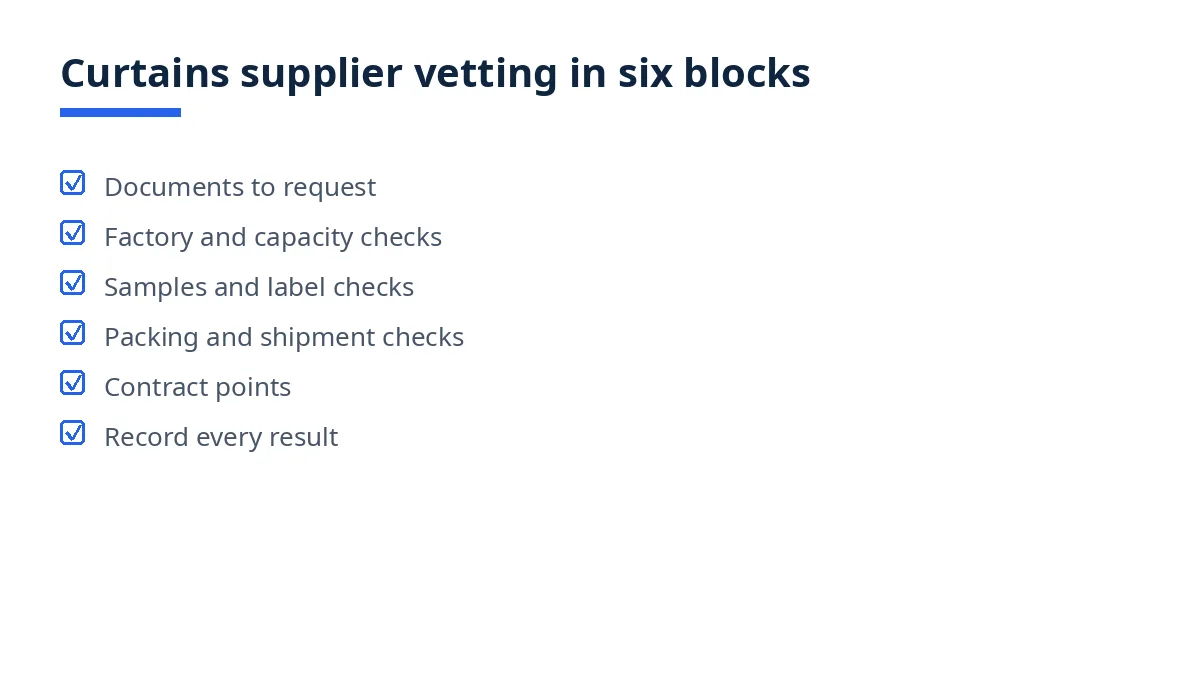
The full checklist (numbered, printable)
Documents to request
Request the trade licence and tax identification certificate; check legal name, address and owner names match across both and the bank details.
Request the export registration certificate; confirm exporter coverage and record number and expiry date.
Ask whether the supplier is a manufacturer, a manufacturer with subcontracted steps, or a trading company; record the answer in writing. Undisclosed trading is a fail.
Request any association membership certificate claimed, with copy, number and expiry date; check the name matches the legal name.
Request copies of every product or system certificate relied on in the offer; check scope, coverage and expiry date. Other-product or expired certificates do not support the order.
If a harmful-substances claim will appear on the product, check certificate scope before printing. Under OEKO-TEX STANDARD 100, curtains are Product Class IV (furnishing materials for decorative purposes), and the label requires all components to meet the criteria.2
Request two trade references you may contact; record what each confirms: product type, order size, delivery and quality as agreed.
Confirm bank details through a bank document or confirmed company letter, not an email signature, before arranging payment.
Factory and capacity checks
Visit the factory or complete a live video walkthrough of cutting, sewing, heading, finishing and packing areas; record date, areas seen, guide.
Check machinery and lines shown match the types offered: heading construction, lining attachment, pleating or grommet work.
Ask which steps are in-house and which are subcontracted; record name and location of each subcontracted dyeing, printing, embroidery or finishing unit.
Ask how the supplier will staff and schedule your order alongside existing work; check the window leaves time for sampling, correction and inspection.
Check fabric sourcing: supplier, whether fabric is in stock or must be woven or dyed, and action if the first lot is rejected.
Check storage: fabric off the floor, protected from damp and sunlight; finished curtains protected in packing; approved and rejected goods kept apart.
Ask who carries out in-line and final checks, what records are kept, and whether you or your inspector may see them.
Ask for one example of a past quality problem and its fix; note whether it names a cause and a change, or only blames a subcontractor.
Sample and product tests
Agree a pre-production sample to the full specification — heading, lining, hardware, finished size — approved in writing before bulk fabric is cut.
Compare the sample point by point: heading style and fullness, lining type, hem finish, hardware fit, finished width and drop.
Request a lab dip or shade approval for each colour; keep the approved shade reference for judging bulk shade.
Ask which test methods and laboratories will be used for wash, colour or performance evidence; record method and laboratory with each report. Reject any report naming neither fabric lot nor colour tested.
Check the label draft before bulk printing. For the EU, a textile product shall be labelled or marked with the name and percentage by weight of all constituent fibres in descending order.3
Check care labelling against the destination market's care system. ISO 3758 establishes graphic symbols for care labelling, covering washing, bleaching, drying, ironing and professional textile care.4
If the destination market requires a flame-retardant or other performance property, agree requirement, test method and evidence in writing before sampling; verbal assurance is not a test report.
Keep the approved sample as the bulk reference; any change to fabric, lining or construction needs new written approval.
Packing, labelling and shipment checks
Agree the packing specification: folding, protection, polybag type where used, carton contents, carton marks, and buyer barcode or label position.
Confirm carton marks, size labels and set contents match the purchase order; check a sample carton before the full packing run.
Agree which shipment documents the supplier will provide and who prepares each, so none is found missing at the port.
Name the Incoterms rule and named place or port in the contract; confirm both sides understand delivery and risk transfer. Under the Incoterms 2020 C rules, delivery and risk transfer occur at the place or port of shipment, not the named destination, while the seller arranges transport there.5
Confirm inspection point and timing: before packing, after packing, or both, and who pays for re-inspection after failure.
Contract points
Attach specification, approved sample record, shade reference and packing specification to the contract as annexes, so the order refers to documents, not memory.
Agree tolerances for finished width, drop, heading and hem in writing, and how measurements are taken, so measurement disputes have a settlement method.
Agree the acceptance rule before production: defect classes, sorting or rework outcomes, and when rejection applies, using the sampling plan agreed at the start.1
Tie payment stages to documents and events — sample approval, inspection pass, shipment documents — not dates alone.
Agree the delivery schedule with a latest shipment date, notice due if production slips, and remedy if the date is missed.
Agree a claim window after arrival, the evidence required, and the supplier's response time, so a claim is not lost to an unwritten deadline.
Agree change control: no change to fabric, lining, construction, subcontractor or packing without written approval; approved changes are priced and dated in writing.
Common failures and how to fix them
The most common failure is a document set that disagrees with itself: a trade licence in one name, a bank account in another, a certificate in a third. Stop, ask for corrected copies, and re-check names before any payment or sample approval. A second is undisclosed subcontracting, found when the factory shown cannot do the heading or dyeing work needed; ask for the subcontractor at the start, and check that unit too. A third is an approved sample never used as the bulk reference, so bulk fabric or lining drifts from agreement; keep it accessible, compare bulk at the first production check, and stop the line on any difference. A fourth is label wording agreed after printing: fibre percentages or care symbols not matching market rules. Check the label draft against the fibre labelling rule3 and care symbol system4 before bulk printing. A fifth is a contract naming a delivery term without a named place, leaving delivery and risk unclear; write the Incoterms rule and named place into the contract.5 When any failure is found, record it, agree fix and date, and re-check it rather than carrying it open into shipment.
Downloadable template / summary table
Copy the checklist into your supplier file with supplier name, specification and check dates, and record a result per item.
Section | Checks | Evidence |
|---|---|---|
Documents | Legal name, licences, certificates, references | Copies, expiry dates, name matches |
Factory and capacity | Visit, lines, subcontractors, schedule | Visit notes, production plan |
Samples and labels | Sample approval, shade, label draft | Approved sample, label proof |
Packing and shipment | Packing spec, documents, delivery term | Packing sample, document list |
Contract | Specification annex, tolerances, acceptance | Signed contract with annexes |
How Exportain helps
Exportain is a B2B marketplace connecting buyers with Bangladeshi suppliers of curtains and home textiles, so the specification behind this checklist can be agreed at enquiry stage. Browse suppliers, compare offers, and use inspection services when planning the factory or shipment check. Supplier profiles show recorded document and photo checks, not factory inspections. Exportain is not a party to the goods contract and does not inspect goods, book freight or clear customs. Also read the how to import curtains guide and the HS code guide for curtains.
FAQs
When should this checklist be used?
Use it before ordering, while supplier, specification or contract terms can still change. Repeat the document and sample sections for every new supplier, and the factory section for a new production unit.
Who should complete it?
The buyer, a local agent or an independent inspector can complete it, using specification, supplier documents and approved sample. The factory and sample sections need someone who has seen the production areas or sample in person, not only a brochure.
What are the most common failures?
Mismatched document names, undisclosed subcontracting, an unused bulk reference sample, late label wording, and an unnamed delivery place are the failures buyers find most often.
Can a third party do it?
Yes, if you share the specification, documents to request and acceptance rule first, and the third party reports item by item with evidence, not one overall opinion.
Next steps on Exportain
Shortlist candidates from the curtains manufacturers list, work through this checklist for each, and read the curtains quality control checklist before shipping. You can also post a free RFQ via RFQs.
Sources
- ISO 2859-1:1999 - Sampling procedures for inspection by attributes — Part 1: Sampling schemes indexed by acceptance quality limit (AQL) for lot-by-lot inspection. International Organization for Standardization (accessed )
- OEKO-TEX STANDARD 100 for textiles tested for harmful substances. Hohenstein (accessed )
- Regulation (EU) No 1007/2011 on textile fibre names and related labelling and marking of the fibre composition of textile products. European Union, (accessed )
- ISO 3758:2023 - Textiles — Care labelling code using symbols. International Organization for Standardization (accessed )
- Incoterms® 2020 C rules vs D rules: Risk transfer explained. ICC Academy (accessed )
About the author
Sourcing from Bangladesh?
Post a request for quotation and suppliers on Exportain can send you their quotes directly.
Post an RFQ


