

Typical MOQ for Chino Trousers in Bangladesh (and How to Negotiate It Down)
No single chino trousers MOQ in Bangladesh: how chino twill rolls, dye lots for each colour, waistband and pocket runs and trouser size runs set the minimum per colour, and how to negotiate or structure a smaller order.
Short answer
There is no single typical MOQ for chino trousers from Bangladesh. Each factory sets its minimum per colour and per size cell for your specification, driven by twill roll length, one dye lot per chino colour, waistband and pocket component runs, and the waist-by-length size grid. Ask for each minimum in writing, then negotiate the structure: fewer colours, stocked twill, one twill shared across fits, and set-up paid as a separate line.
On this page
Key takeaways
There is no single typical MOQ for chino trousers from Bangladesh, because each factory sets its minimum per colour and per size cell for your specification.
Twill rolls, one dye lot per chino colour, waistband and pocket component runs, and the waist-by-length size grid are the layers that set the floor.
Ask for the minimum per colour and per size cell in writing, with set-up costs itemized apart from the unit price.
Negotiate the structure first: fewer colours, stocked twill, one twill shared across fits, and set-up paid as a separate line.
Exportain verification is a document and photo review, not a factory inspection, and a badge is not a guarantee.
A chino order is settled in the cloth store long before cutting starts. The factory has to unroll cotton twill, fill a dye vessel for every colour you want, cut a marker that spans waist sizes and leg lengths, and bring in waistband tape, pocketing, buttons and labels in their own batches. Every one of those jobs has a smallest batch that makes sense to run, and the tightest of them inside your specification sets the size of order you must place.
Two quotations for trousers that look alike in a photograph can land far apart, and the gap usually traces back to cloth already on hand. A factory holding your khaki twill in stock can cut straight from a shelf roll, while a factory that must dye that shade from grey cloth, then buy pocketing to match it, faces a vessel, a shade approval and a component run before cutting. Chino twill sharpens the point: the diagonal weave shows shade and surface clearly down the leg, so pairs dyed in separate vessels can look uneven side by side in one delivery, and a washed chino adds a wash load after dyeing.
Bangladesh has a broad woven base. BGMEA, the ready-made garment industry association, counts around 4,500 member factories, about 60 per cent of them woven manufacturers, accounting for 100 per cent of the country's woven garment exports.1 EPB data put woven exports at $4,614.80 million in July to September 2026, up 5.11 per cent year on year.2 That scale gives choice among factories, not a shared floor, since each factory stocks, dyes and schedules independently.
What should I know first about chino trousers?
A chino is a woven cotton twill trouser, commonly with a flat or pleated front, slant side pockets, back welt pockets, a waistband with belt loops and a button or zip fly. Four layers decide whether your order runs, and they bind in this order: the roll, the dye vessel, the small parts, and the waist-by-length grid. Work through them in that sequence and a quotation stops looking arbitrary.
Cloth on the roll. Twill arrives in rolls of fixed width, and the marker has to fit fronts, backs, waistband pieces, pocket bags and fly pieces inside that width. A short run in one colour can strand the tail of a roll that no other order can absorb. Example figures: a 180-metre roll at 1.5 metres per pair, cutting allowance included, covers 120 pairs, since 180 divided by 1.5 is 120. An order of 80 pairs in that colour still draws on the whole roll, so the leftover cloth has to be carried forward, bought out or written off by agreement.
Colour in the vessel. Every chino colour needs its own dye vessel. Khaki, navy, olive, stone and black are five separate dyeings, not five shades of one batch. A colour already held as dyed stock skips the vessel entirely, which is why the first question about any colour is whether it sits on the shelf or must be dyed for you. Repeat orders need a fresh shade check, since a new vessel can drift.
Hardware and pocketing. Waistband tape or interlining, pocketing cloth, buttons, rivets where specified, zips and labels are each ordered or made per colour and per style. Tape dyed to match a navy chino is useless on an olive order, and pocketing shaped for one leg cut does not transfer to another. Find out for each part whether it rides inside the garment floor or brings a floor of its own.
Waist crossed with length. A trouser grid runs in two directions at once: waist sizes crossed with inseam lengths. Five waist sizes in two lengths give ten cells, and the thinnest cell governs whether the run is workable. Example figures: 1,000 pairs in one colour across waist sizes 30, 32, 34, 36 and 38, split in the ratio 1:3:4:3:1, give cells of about 83, 250, 333, 250 and 83 pairs, since the ratio totals 12 parts of about 83 pairs each. Cutting the same pairs across two inseam lengths halves the smallest cell to about 42 pairs.
For tariff purposes, heading 6203 covers men's or boys' suits, ensembles, jackets, blazers, trousers, bib and brace overalls, breeches and shorts, other than swimwear, and cotton trousers fall within it.3 If you sell into the European Union, Regulation (EU) No 1007/2011 requires a textile product to be labelled or marked with the name and percentage by weight of all constituent fibers in descending order.4
Why this matters for buyers and sellers
For a buyer, the floor controls how much money ends up tied in trousers that have not sold yet, and whether a first order can genuinely test fit and colour before a larger repeat. A six-colour test range sounds modest until each colour counts as its own vessel, pocketing run and label run, pushing the price per pair up.
For a seller, the floor protects inputs that cannot be resold. Twill dyed khaki for one buyer, pocketing matched to it and labels printed with that buyer's brand have no second customer. A short run still consumes the vessel, the marker work and a line change, so the cost of each pair climbs as pairs per colour fall. Negotiate the binding layer, and the floor follows.
Step-by-step: how it works
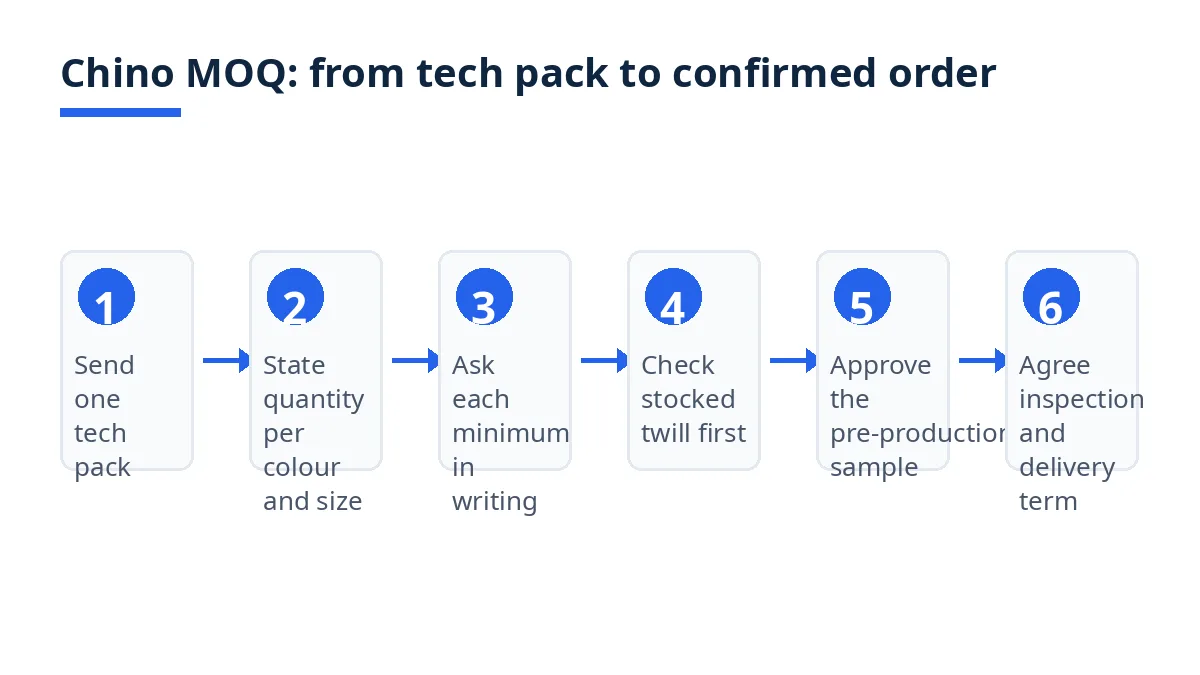
Draw the grid before you write the brief. List every colour, every waist size and every inseam length, with the pairs in each cell and the size ratio inside each colour. Circle the thinnest cell. Reshaping that cell now is cheaper than renegotiating it later.
Put one tech pack in front of every candidate. Cover twill composition, construction and weight, fit and rise, waistband and fly build, pocket style and pocketing, button and zip specification, the waist-by-length size chart, any wash, labels and packing, so every reply prices the same trouser.
Ask each factory to name the layer that binds. Request the roll position for the twill, the dye lot for each colour, the floors for waistband and pocket parts, the smallest workable size cell and any separate label and carton floors, then ask which of those decides the answer for your grid.
Separate stock from dye-to-order. Note, colour by colour, whether the twill, the waistband tape, the pocketing and the buttons are stock items or bought in for your order. Stocked inputs are usually where a shorter run becomes possible.
Sign samples off on paper. Take a proto sample, then a pre-production sample in the actual twill, colour, waistband build and wash. Measure it, wash it where a wash applies, compare its shade with the approved swatch, and record approval or corrections in a written note.
Fix inspection, delivery term and set-up lines before confirming. Put the inspection level and AQL values on the purchase order, following ISO 2859-1, which defines a system of acceptance sampling plans for inspection by attributes, indexed by acceptance quality limit (AQL) for lot-by-lot inspection.5 State a single Incoterm with a named place on every quotation, since the Incoterms 2020 rules set out 11 rules with a clear allocation of cost, risk and obligations,6 and list any set-up charges apart from the unit price at the same time.
Ways to move the binding layer. The levers below all work the same way: they shrink the layer that binds instead of asking the factory to ignore it. Record each agreed change in the order papers.
Prune the colour list. Each colour you drop removes a vessel, a pocketing run and a label run, and lifts the pairs in every colour that remains at the same order total. Dropping one colour often clears the exact dye lot that was blocking the order.
Cut two fits from one dyed cloth. When a slim leg and a straight leg use the identical twill colour, they consume a single dye lot between them, even though patterns and markers stay separate. Ask the factory to confirm, in the quotation, that the twill floor may be reached by adding both fits together.
Lean on stock. A standard khaki or navy twill held in stock, with stock tape and pocketing, removes the vessel and part of the set-up. Ask for the stock list while colours are still open.
Itemize set-up separately. Dye charges, wash recipe set-up and label runs can sit as their own lines instead of inside the unit price. A shorter run then becomes possible, and set-up already paid for can carry into the repeat.
Costs, timelines and documents
What are the typical costs and timelines?
No guide can state typical costs or timelines as fact, for the same reason no guide can state a typical floor. Each factory prices your twill weight and finish, your fit, your waistband and pocket build, your wash, your labels and cartons, your finishing and packing, and the delivery term you select.6
Timing turns on twill availability and correction rounds for sampling, and on dyeing slots, wash capacity, component arrival and line availability for bulk. Ask for sampling, twill-ready, production and inspection dates as separate lines rather than one delivery week.
Which documents are needed?
Order papers first: tech pack, itemized quotation, purchase order, each showing the floor for every colour and size cell. Shipment papers second: check the enclosure list on the current Bangladesh Customs export-clearance page before loading.7
Bangladesh-specific rules and tips
Check the membership claim, then set it aside. When a supplier claims BGMEA membership, confirm it with the association itself. BGMEA represents the woven, knitwear and sweater sub-sectors,1 so membership tells you about the business, not about the floor on offer or the capacity for your trouser run.
Match the name on all four papers. Customs paperwork identifies an exporter and a foreign buyer,7 and a mismatch between the trade licence name, the quotation name, the proforma invoice name and the payment account name creates queries at exactly the wrong moment. Read all four before you confirm and correct any variant spelling.
Watch shade across rolls, and settle labels at sample stage. Twill shade can drift slightly from roll to roll, and a chino leg shows that drift plainly, so ask how shade is checked across the rolls in your order. The fiber content on the label follows the twill you approve, including any elastane in a stretch chino, and the EU rule requires fiber names and percentages in descending order.4 Settle label text at sample stage.
Mistakes and red flags
What are the most common mistakes?
Judging the order by its headline figure. A comfortable grand total can hide a single colour or a single size cell that sits under its floor, and that cell then either draws a surcharge or leaves the order. Judge the grid cell by cell instead.
Slipping a colour in after dyeing is planned. A colour added once the dye plan is set opens a fresh vessel and a fresh component run. It is the most expensive late change on a trouser order, and it is often made without a second thought.
Lining up quotations that price different trousers. A lower floor on stocked twill, an unwashed finish, stock labels or a different delivery term is a different offer. Line up only replies to the same tech pack on the same Incoterm.6
Trusting a spoken yes. Talk is not an agreement: until a revised floor, a pooled lot or a waived charge is written against your exact split in the order papers, it can evaporate. Get it recorded before paying anything.
Taking a badge for capacity evidence. A supplier listing helps you start, and a badge summarises checks already carried out on documents and photographs.8 9 Neither shows a line cutting your fit in your cloth, and neither speaks to dates. Test capacity with the tech pack and the sample, not the profile.
Checklist
Run through this list before you sign anything.
Grid drawn: every colour, waist size and inseam length, with pairs per cell and one size ratio per colour.
Binding layer named: roll, dye vessel, component run or size cell, for your exact split.
Twill status noted per colour: stocked or dyed to order.
Waistband, pocketing, button, zip, label and carton floors confirmed apart from the garment floor.
Set-up charges listed apart from the unit price, with paid set-ups recorded for the repeat.
Pre-production sample measured, washed where a wash applies, shade-checked and signed off on paper.
Inspection level and AQL values on the purchase order.5
Quotations lined up on the same specification and the same Incoterm.6
Shipment papers checked against the current customs page before the goods move.7
How Exportain helps
Use the RFQ board to put one grid in front of suppliers, and ask every reply to name its binding layer and its floor per colour and per size cell, so the quotations arrive comparable. When you accept a quotation, Exportain creates one order and issues one proforma invoice from the accepted terms.8
Treat any badge as a record of document and photo checks, not as a promise about line capacity or delivery dates.8 9 See how supplier verification works on Exportain and the MOQ definition guide.
FAQs
What should I know first about chino trousers?
A chino is a woven cotton twill trouser, and its floor is set layer by layer: the roll, one dye vessel per colour, waistband and pocket part runs, and a waist-by-length grid. The layer that binds for your split decides whether the order can run, so start from the cloth and the grid rather than from the headline total.
What are the typical costs and timelines?
Standard figures would mislead, because every factory prices, floors and schedules one specification at a time. What moves price is twill, fit, waistband and pocket work, wash, the colour and size split and the delivery term,6 and what moves timing is dyeing slots, wash capacity, component arrival and line availability.
Which documents are needed?
You need the tech pack, an itemized quotation and a purchase order showing the floor per colour and per size cell, plus the shipment set. Check the current customs page for its enclosure list before loading.7
What are the most common mistakes?
They are judging by the headline total, adding colours after dyeing is planned, comparing offers built on unlike specifications or terms,6 trusting spoken concessions, and taking a badge for capacity evidence. A badge summarises document and photo checks, not capacity, quality or dates.8
Next steps on Exportain
Start with suppliers, then put your tech pack summary, colour and size grid and delivery term on the RFQ board and ask for floors per colour and per size cell. Before confirming, read the chino trousers quality control checklist.
Sources
- Bangladesh Garment Manufacturers and Exporters Association (BGMEA). Devex (accessed )
- RMG exports rise 6.10pc to US$10.58b in July-Sept of FY27. The Financial Express, (accessed )
- Men's or boys' suits, ensembles, jackets, blazers, trousers, bib and brace overalls, breeches and shorts (other than swimwear). GOV.UK (accessed )
- Regulation (EU) No 1007/2011 on textile fibre names and related labelling and marking of the fibre composition of textile products. European Union, (accessed )
- ISO 2859-1:2026 - Sampling procedures for inspection by attributes — Part 1: Sampling schemes indexed by acceptance quality limit (AQL) for lot-by-lot inspection. ISO (accessed )
- Incoterms® 2020. International Chamber of Commerce (ICC) (accessed )
- Customs Clearance Procedures for Export. Bangladesh Customs, National Board of Revenue (accessed )
- Trust & Safety Center. Exportain (accessed )
- Supplier verification: Earn trust badges buyers can see. Exportain (accessed )
- MOQ
- supplier verification
- buyer guide
- woven garments
- Bangladesh sourcing
- bangladesh garments
- Chino trousers
About the author
Sourcing from Bangladesh?
Post a request for quotation and suppliers on Exportain can send you their quotes directly.
Post an RFQ


