

Chino Trousers Lead Time From Bangladesh: Production and Shipping Timeline
Chino trousers lead time guide from Bangladesh: cotton-twill approval, waistband and pocket gates, front and crease decisions, hem finishing, labelling, inspection, and export documents, with a worked stone-coloured chino example.
Short answer
A chino trousers lead time from Bangladesh runs on approval gates, not a single production run: cotton-twill and shade approval, graded pattern and first pair, waistband construction and fit approval, pocket construction approval, front style and crease decisions, bulk sewing, hem finishing, pressing, wash-care labelling, inspection, export documents, and transit. Every duration is an illustrative planning example only. Replace it with the written quote and the dated forwarder estimate before setting a selling date.

On this page
Key takeaways
Cotton-twill approval comes before cutting: a new lot reopens the gate, because trousers cut from unmatched lots will not read as one order.
Waistband construction and fit must be approved on a pressed sample, because a waistband fault often appears only after pressing and handling.
Front slash pockets and back welt pockets need separate approvals, since each style is sewn, stressed, and finished differently.
Flat-front or pleated front and crease retention are buyer-specification items to record in writing, with a pressed sample showing the front and the leg crease.
Hem finishing is a checked stage with its own sample, and export documents gate loading, so every duration must be replaced by the written quote and the dated forwarder estimate.
A chino order is decided at the waistband, the pocket mouth, and the leg line, long before bulk sewing starts. A waistband that rolls, a pocket mouth that gapes when the trouser hangs, and a leg crease that fades unevenly are all faults a buyer can spot at a glance, and all of them are set by approvals made before cutting and bulk assembly.
A gate is a named approval, sample, or document that must close before the next stage starts. Every duration in this guide is an illustrative planning example only, or an item to confirm in the written quote and the dated forwarder estimate. No duration here is a promise for any real order. Replace every example figure with the written quote and the dated forwarder estimate before setting a selling date.
Why this matters for buyers and sellers
For a buyer, the risk in a chino order sits in parts that look plain in a photograph. The twill itself is the first risk: chino fabric is a cotton twill with a diagonal weave, made by spinning cotton fibre into yarn, weaving it in twill, and dyeing it, often with reactive dyes for lasting colour.1 A twill lot that differs in shade or hand feel from the approved sample will change how every pair in the order reads, even when the pattern is correct.
For a seller, the same gates protect the schedule. Recorded twill, waistband, pocket, crease, hem, and label approvals give both sides a fixed target to repeat across sizes and lots. The chino-specific order is twill before cutting, waistband and pockets before bulk assembly, and hem and labelling as checked stages rather than closing tasks.
Step-by-step: how it works
Read the order against eight gates.
Gate 0: Cotton-twill fabric approval
Gate 0 fixes the twill before cutting. When buying fabric, a manufacturer checks whether the hand feel is soft, whether the twill texture is free of burlap faults, picks the right thickness, and selects the fabric most compatible with the customer design.2 A Gate 0 approval should name the twill weave, the fibre blend where the buyer has specified one, the shade reference, the width, and the lot that cutting will follow.
Ask the seller to confirm in writing whether the twill is in stock, is to be dyed or finished for this order, or is to be woven for this order, and which shade lot each size will be cut from. A new lot reopens Gate 0, because trousers cut from two unmatched lots will not read as one order.
Gate 1: Pattern, grading, and the first pair
Gate 1 produces the first complete pair from the approved twill, with waistband, fly, pockets, seat, legs, and hem in place. Cutting must be precise so that each part fits together as drawn, since a small cutting error in a trouser leg shows as twist or uneven hang.2 Record every correction in writing.
Gate 1 closes only when the graded pattern, the first pair, and the measurement table for every size are approved together. The measurement table is the contract for bulk: each size, each point of measure, and the tolerance the seller will work to.
Gate 2: Waistband construction and fit approval
Gate 2 is the gate that most separates a chino order from a simpler trouser order. Waistbands need care: use a medium-weight interfacing that is not stiff, and divide the waistband and the trousers in fourths to align and distribute ease evenly.3
A Gate 2 approval should name the waistband construction, the interfacing, the belt-loop positions and stitching, and the fly construction, with a sample that proves the result: a waistband that lies flat, closes cleanly, and holds its shape after pressing. Ask for the sample to be pressed before approval, because a waistband fault often appears only after pressing. If the interfacing or the waistband construction changes, Gate 2 reopens.
Gate 3: Pocket construction approval
Gate 3 approves the pockets before bulk sewing locks them in. Pocket openings should lay flat against the body, and bar tacks with reinforced seams at pocket openings and belt loops add durability at high-stress points.4 3 Two pocket styles are buyer-specification options to confirm in writing for this order: slash pockets at the front, and welt pockets at the back.
A Gate 3 approval should name the pocket style for each position, the pocketing fabric, the mouth reinforcement, and the topstitching, with a sample the buyer can open and hang. Check the front slash mouth for gaping, the back welt for a clean, flat finish, and the pocket bag for depth and strength. If a pocket style, pocketing fabric, or reinforcement is substituted, Gate 3 reopens.
Gate 4: Flat-front or pleated front, and crease retention as buyer-spec items
Gate 4 fixes two appearance decisions that must be written down before bulk, because each changes cutting, pressing, and inspection. First, flat-front or pleated front is a buyer-specification option: pleats should be pressed flat above the crotch line, and where a leg crease runs the full length of the leg, it should merge with the crease in the pleat.3 A pleated front needs the pleat depth, direction, and pressing point recorded.
Second, crease retention is a buyer-specification item to confirm in writing for this order: whether a pressed leg crease is required, how it should read after pressing, and how it will be checked on the bulk sample. Medium-weight cotton twill is described as giving structure and crease retention without stiffness, which is why the crease check belongs in the specification.4 Record both decisions in the tech pack.
Gate 5: Bulk sewing against the approved samples
Gate 5 runs bulk sewing only after Gates 0 to 4 have closed. Sewing quality decides appearance directly: stitching must be even and firm, with no unstitching, and each operation must be checked as it is sewn.2 During bulk, check work against the approved samples at every stage: twill shade and lot, waistband shape, pocket mouths, front style, and measurements. A fault tracing back to an earlier gate sends the order back to that gate, and a waistband or pocket fault sewn into bulk pairs cannot be pressed away.
Gate 6: Hem finishing approval
Gate 6 treats hem finishing as a stage with its own approval, not as tidying at the end. Trousers are hemmed with a slight angle to the back, and a deeper hem can add weight that helps the trousers hang better in some styles.3 A Gate 6 approval should name the hem style, the hem depth, and the stitching finish, with a sample that proves the result: a hem that hangs evenly, with no twist at the leg opening. Check the hem after pressing, on both legs. If the hem style or depth changes, Gate 6 reopens.
Gate 7: Pressing, wash-care labelling as a buyer-spec item, inspection, and documents
Gate 7 fixes the finish and the labelling the buyer requires, in writing, before bulk finishing starts. After sewing, twill trousers are ironed so they lie flat and look clean, and ironing also removes folds formed during sewing.2 Pressing sets the leg crease and shapes the waistband and pockets, so the pressed sample approved at Gates 2, 4, and 6 is the standard bulk pressing must match. Wash-care labelling is a buyer-specification item to confirm in writing for this order: wash-care, fibre content, size, and country-of-origin wording for the destination market, not a blanket rule for every market. Final inspection then checks finished pairs against every earlier gate, covering fabric quality, sewing, size, and appearance.2
Costs, timelines and documents
Costs move with twill, dyeing and finishing route, pocketing, waistband materials, inspection, freight, and the delivery term, and the timetable moves with sample revisions, waistband corrections, pocket revisions, crease and hem changes, and document arrival. Every duration below is an illustrative planning example only.
Stage | Illustrative planning example only | Gate that closes the stage |
|---|---|---|
Cotton-twill approval | Illustrative planning example: 3 weeks | Gate 0 twill, shade, and lot approved |
Pattern, grading, and first pair | Illustrative planning example: 2 weeks | Gate 1 graded pattern and pair approved |
Waistband construction and fit | Illustrative planning example: 1 week | Gate 2 pressed waistband approved |
Pocket construction | Illustrative planning example: 1 week | Gate 3 pocket samples approved |
Front style and crease | Illustrative planning example: 1 week | Gate 4 front and crease sample approved |
Bulk sewing | Illustrative planning example: 3 weeks | Gate 5 inspection against samples passed |
Hem finishing and pressing | Illustrative planning example: 1 week | Gate 6 hem and pressed sample approved |
Labelling, inspection, and documents | Illustrative planning example: 1 week | Gate 7 labels, report, and packing list complete |
Documents and transit | Confirm in the dated forwarder estimate | Documents complete, goods loaded |
A worked example shows how the gates change a date. A buyer orders a stone-coloured chino for a retail capsule, with a flat front, slash front pockets, welt back pockets, and a pressed leg crease. The twill approval passes, but the first waistband sample rolls at the centre back after pressing, so Gate 2 stays open for a revised interfacing. The revised waistband passes, but the front slash pocket mouth gapes when the pair hangs, so Gate 3 stays open for a revised mouth reinforcement. Bulk sewing then runs cleanly, but the first hemmed sample twists at one leg opening, so Gate 6 stays open for a revised hem setting.
For cost reading, use example figures only to compare quotes, and replace them with the written quote. Illustrative planning example only: a single shipment at USD 21,000 on one delivery term, USD 1,500 for ocean freight, and USD 280 for marine insurance. Those figures are not a price for any real order.
The document set gates loading and clearance. Goods shall not be allowed to load or ship for export unless an export declaration, known as the Bill of Export or Shipping Bill, is submitted to Customs in the prescribed format and approved by the Customs authority.5 Documents enclosed with it include the commercial invoice, the packing list, the EXP form certified by Authorized Dealers, and the certificate of origin.5 Keep the invoice, packing list, inspection report, and shipping bill consistent on quantity and description.
Bangladesh-specific rules and tips
Bangladesh-specific timing comes from the document chain as much as from production: the export document set must be complete before loading, and a buyer who treats loading as a factory date, rather than a document date, will misread the schedule. Ask the seller to confirm, in writing, who prepares each document and who checks it against the invoice and packing list. A second point is shade continuity across twill lots: a lot approved at Gate 0 must be the lot cut for bulk. A third point is the finishing queue: pressing, hem checking, and labelling for the bulk quantity need capacity confirmed in writing, not only for the sample pair.
Mistakes and red flags
Approving twill on a finished swatch without a shade and lot approval.
Approving a waistband on an unpressed sample as a fit approval.
Approving a pocket on the front only, not the back welt as well.
Changing interfacing, pocketing, or pocket reinforcement after approval without a new sample.
Approving only a middle size and assuming the graded range measures within tolerance.
Leaving flat-front or pleated front, and crease retention, out of the written specification.
Starting bulk before the twill, waistband, pocket, front, and crease samples are approved.
Setting a selling date from the first sample date, with no buffer after waistband approval and after final inspection.
Comparing quotes on different delivery terms without pricing each to the same point.
Checklist
Use this checklist before bulk.
[ ] Twill weave, shade reference, width, and shade lot in the tech pack, Gate 0 sample named.
[ ] Graded pattern and first pair approved, measurements for every size recorded.
[ ] Waistband construction, interfacing, and fit approved on a pressed sample.
[ ] Front slash and back welt pocket styles, pocketing, and reinforcement approved on samples.
[ ] Flat-front or pleated front recorded, and crease retention requirement recorded in writing.
[ ] Bulk inspection plan agreed: twill shade, waistband shape, pocket mouths, front, and measurements.
[ ] Wash-care, fibre content, size, and origin wording approved for this order.
[ ] Delivery rule, named place, and edition in the contract, cost split confirmed.
[ ] Dated forwarder estimate received, replacing every illustrative example here.
How Exportain helps
Exportain gives buyers a place to put the gate table from this guide into a sourcing request, so each reply can be compared gate by gate rather than date by date. A buyer can list the twill approval, graded pattern, pressed waistband sample, pocket samples, front and crease sample, hem sample, and document dates as requirements, and ask each seller to reply against them in writing.
FAQs
What should I know first about chino trousers?
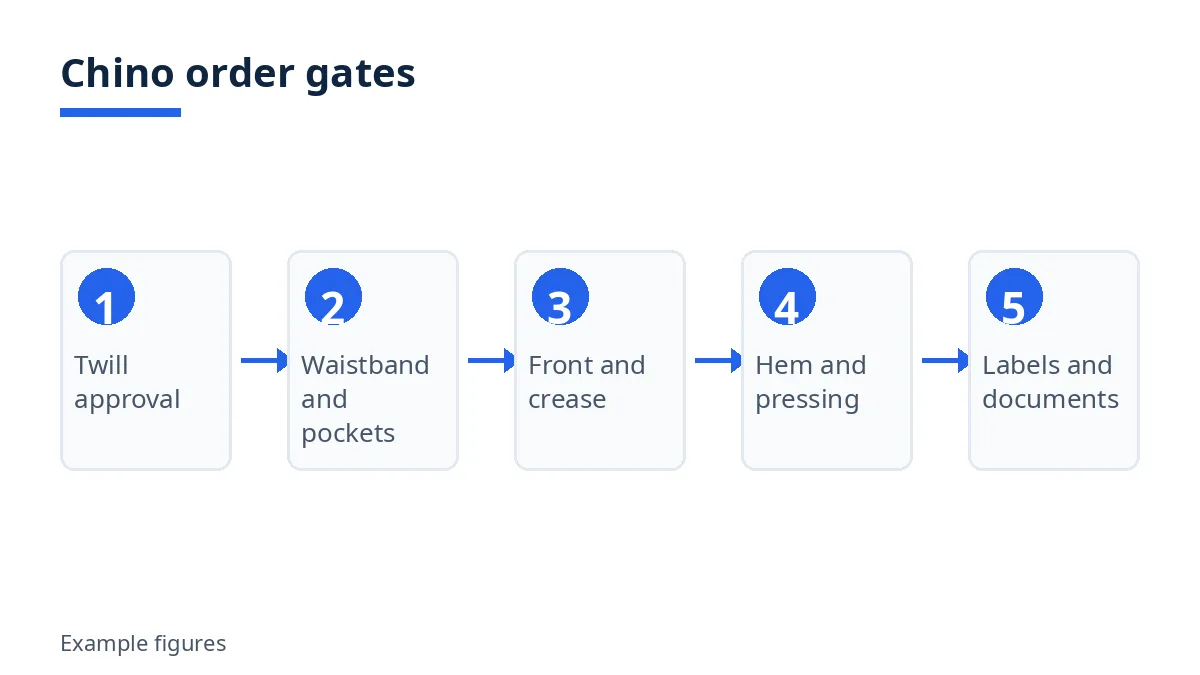
Start with the order of approvals: twill before cutting, waistband and pockets before bulk assembly, front style and crease before finishing, hem as a checked stage, and documents before loading. Ask for the gate table before discussing a date.
What are the typical costs and timelines?
There is no single figure fitting every chino trousers order. Costs move with twill, dyeing and finishing route, pocketing, waistband materials, inspection, freight, and the delivery term, and the timetable moves with sample revisions, waistband corrections, pocket revisions, crease and hem changes, and document arrival. Use the illustrative examples here only to read a quote, and replace them with the written quote and the dated forwarder estimate.
Which documents are needed?
The export set gates loading and clearance from Bangladesh: the contract or purchase order, commercial invoice, packing list, EXP form, certificate of origin, and shipping bill, with the bill of lading or air waybill issued by the carrier.5 The approval set gates bulk: the twill approval, the graded pattern and first pair, the pressed waistband sample, the pocket samples, the front and crease sample, the hem sample, and the approved label wording.
What are the most common mistakes?
The most common mistakes are approving twill without a lot approval, approving a waistband before pressing, approving a pocket on one position only, changing interfacing or pocket reinforcement without a new sample, and leaving front style and crease retention out of the specification.
Next steps on Exportain
Compare the gate table against current listings on the Exportain supplier directory, check the cost and risk split for your delivery term in the Incoterms guide, and post the gate requirements through Exportain RFQs.
Sources
- What Is Chino Fabric? A Complete Guide. Knowing Fabric (accessed )
- What are chinos pants. Huilin Fashion (accessed )
- Tips for Professional Results with Pants. ASG (accessed )
- What Fabric Are Chinos Made From? Cotton, Blends & Care Tips. SewingTrip (accessed )
- Customs Clearance Procedures for Export. Bangladesh Customs, National Board of Revenue (accessed )
About the author
Sourcing from Bangladesh?
Post a request for quotation and suppliers on Exportain can send you their quotes directly.
Post an RFQ


