CFR for Small Importers: Is It the Right Incoterm for Your First Order?
A decision guide for first-time and small importers: when CFR fits a first sea order from Bangladesh, what to price and insure, and when FCA or CIF fits better.
Short answer
CFR fits a first order only when the shipment travels by sea or inland waterway, one destination port is named, insurance is arranged in writing, and a destination broker is ready before sailing. Under CFR the seller pays freight to the named port, but risk passes to the buyer at loading and no insurance is included. If the order travels by air, use FCA instead; if the seller should insure, consider CIF.
On this page
Key takeaways
CFR suits a first sea order only when one destination port is named, insurance is agreed in writing, and a destination broker is appointed before sailing.
Under CFR the seller pays freight to the named destination port, but risk passes to the buyer when the goods are loaded on board, and no insurance is included.
CFR cannot describe air freight: for a first order by air, use FCA, and for a container handover at a terminal, discuss FCA, CPT or CIP.
Price every CFR quotation to the warehouse, not to the port, and confirm every destination and insurance line with the broker in writing.
Export clearance in Bangladesh must be approved before loading, and the Bill of Export set, including the EXP form and certificate of origin, must match the invoice.
A first order from Bangladesh is usually small on purpose: enough stock to test the product and the supplier, without tying up cash in a shipment you have never managed before. The decision is whether you are ready to carry what CFR leaves with you: the sea risk, the insurance, and the destination side.
Under CFR (Cost and Freight), the seller contracts and pays for carriage to the named port of destination, while delivery and risk transfer happen when the goods are loaded on board at the port of shipment.1 CFR imposes no insurance obligation on either party, because only CIF and CIP oblige the seller to arrange insurance for the buyer.1 CFR is limited to sea and inland waterway transport, so it cannot describe an air shipment. For air freight, use FCA, an any-mode rule.2
Before you accept a CFR quotation, test it: sea or inland waterway journey, one named port, insurance in writing, and a broker ready before sailing. If any part fails, choose a different rule.
Why this matters for buyers and sellers
For a small importer, CFR concentrates the whole test in one shipment. A first order has one sailing, one set of documents, and one arrival, and its risk passes at loading while it is still at sea, even though the seller is paying the freight.1 For the seller, CFR keeps control of the freight booking. The seller chooses the carrier, contracts the carriage, pays the freight, completes export formalities, and bears the related costs.1 For the buyer, that help ends at the destination port. The buyer completes import formalities and pays destination unloading charges where the carriage contract does not place them with the seller.1
The gap that catches first-time buyers is insurance. Because CFR leaves insurance to agreement rather than obligation, a buyer who never briefs an insurance broker has no cover for the sea leg by default. Under CIF, by contrast, the seller must obtain insurance at the minimum level of Institute Cargo Clauses (C), with the option to agree a higher level.3 Confirm with broker and insurer on every insurance line, in writing, before confirming the order.
Step-by-step: how it works
Follow these checks in order. If a check cannot be answered in writing, pause and change the rule or the arrangement before the order is confirmed. For all 11 rules, read the Incoterms guide for shipments from Bangladesh.
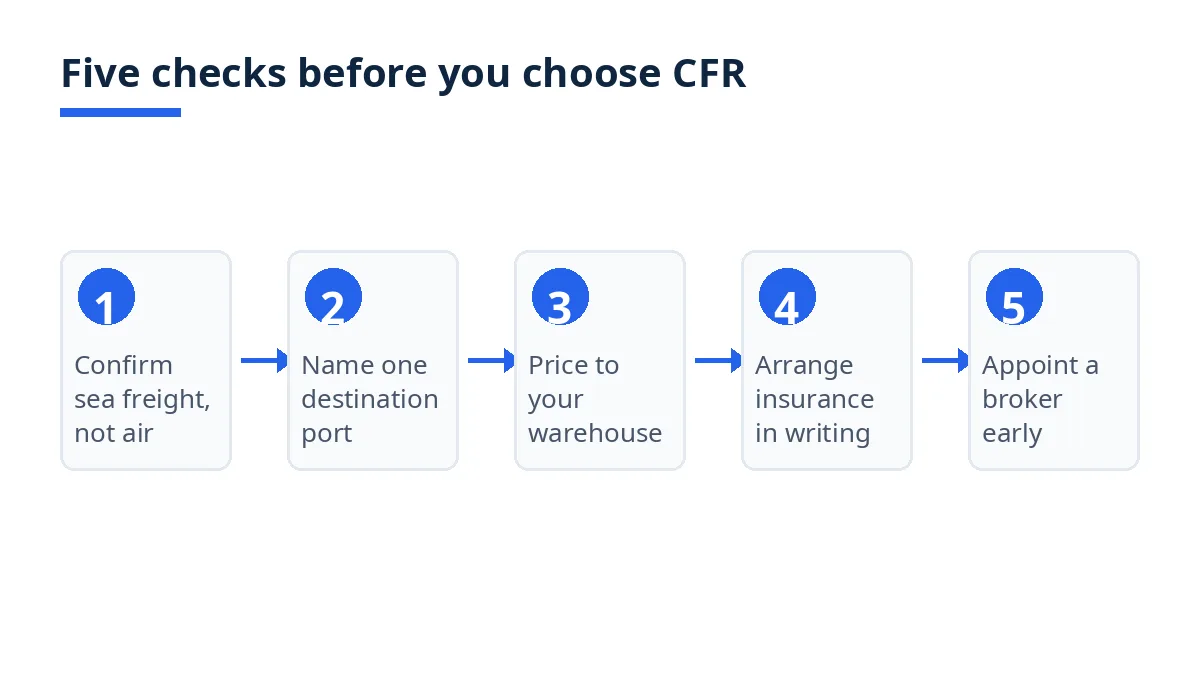
Confirm the journey fits CFR. CFR describes sea and inland waterway carriage with delivery on board. If the order travels by air, stop and use FCA instead.2 If the goods travel in a container handed to the carrier at a terminal before loading, discuss FCA, CPT or CIP, because those rules pass risk at handover to the carrier rather than only on board.4
Name the rule, the port and the edition in full. Write "CFR [named destination port], Incoterms 2020" on the quotation, the order, the invoice and the bill of lading, using one port only.
Ask for the freight build in separate lines. Ask the seller to show the goods value, the freight charge, and any surcharges or terminal lines inside the freight price separately, with the validity period stated. Ask the destination broker to confirm with broker in writing which destination charges the carriage contract includes.1 Treat any charge named in neither document as yours until confirmed.
Brief the insurance broker before confirming the order. State the goods, value, route, packing and term, and record the recommended clause, sum insured, currency and transit wording. Check the certificate before loading.
Appoint the destination broker before sailing. Ask for written confirmation of the registration required, the duty and tax basis, and the documents still needed. For the European Union, an EORI number is mandatory for customs clearance.5
Check the export set and the draft bill of lading. Check that names, description, quantity, weight, marks, ports, vessel and date match across the invoice, packing list and draft bill of lading, confirm the on-board notation and freight-prepaid mark, and send the checked set to the broker before sailing.
Inspect on arrival before signing. Count the packages against the bill of lading, photograph damage in the container or vehicle, and write the damage and date on the receipt before signing. Notify the carrier and insurer in writing without delay.
If step one points to air freight, choose FCA. For a container handover, ask about CIP.4 If you cannot arrange cover you understand, ask about CIF.3 Compare them in the CIF guide.
Costs, timelines and documents
The cost lines a first order must price
There are no typical CFR costs a guide can state as fact, because the freight build, destination charges and duty basis depend on the route, shipment shape and destination market. Price every quotation to your warehouse, and confirm with broker on every line.
Cost line | Who pays by default | First-order check |
|---|---|---|
Freight to the named destination port | Seller | Confirm with broker which lines sit inside the freight price |
Marine insurance for the sea leg | Buyer arranges and pays separately | Confirm with broker the clause, sum insured and transit wording |
Destination unloading and handling, where not in the carriage contract | Buyer | Confirm with broker whether unloading is included |
Import clearance, duty and tax at destination | Buyer | Confirm with broker the duty basis and broker fee |
Inland transport to the warehouse | Buyer | Confirm with broker the haul and the delivery point |
Timelines a first order should plan around
No fixed transit or clearance time can be stated as fact. Export approval depends on the export set: goods shall not be loaded unless the Bill of Export is submitted and approved.6 Registration adds lead time: an EORI number must be in place for EU customs operations,5 and a GB EORI number can take up to 5 working days where checks are needed.7 Ask each broker for its fee and timeline in writing. Confirm with broker on every timeline line.
Example figures: one small first order, priced to the warehouse
Example figures: a first order of 600 hand-painted ceramic mugs, Dhaka to Felixstowe, CFR Felixstowe, Incoterms 2020, illustrative only. The goods value is USD 9,600 and the seller-paid freight build is USD 980, giving an example CFR value of USD 10,580. The buyer-paid destination lines are a terminal charge of USD 210, handling of USD 120, a broker fee of USD 180 and onward transport of USD 290, giving USD 800 before duty and tax. Duty and tax are excluded. Confirm with broker on every example line.
Example line | Example figure | Bill |
|---|---|---|
Goods value | USD 9,600 | Seller invoice |
Freight build to Felixstowe | USD 980 | Seller, inside the CFR price |
Example CFR value | USD 10,580 | Goods plus freight build |
Destination lines (terminal, handling, broker, onward transport) | USD 800 | Buyer |
Duty and tax at destination | Per broker schedule, not in example total | Buyer |
The documents a first order must have ready
Goods shall not be loaded or stuffed for export unless an export declaration, known as the Bill of Export or Shipping Bill, is submitted and approved.6 The documents enclosed include the export letter of credit, or the approved contract, purchase order or guarantee where there is no letter of credit; the signed commercial invoice; the packing list; the EXP form certified by Authorized Dealers; the certificate of origin; the VAT certificate; and the Taxpayer Identification Number.6
The destination set is the customs declaration, transport document, invoice, packing list, proof of origin where required, and any license or certificate required. The insurance set is the policy or certificate, checked before loading. Keep one legal name across every paper.6
Bangladesh-specific rules and tips
Export clearance belongs to the seller under CFR, and it happens before loading. Section 131 of the Customs Act, 1969 requires clearance of customs for export, and goods shall not be loaded unless the Bill of Export is submitted and approved.6 Request the EXP form and the certificate of origin first. The EXP form is certified by Authorized Dealers, and the certificate of origin is issued by the Export Promotion Bureau or a Chamber of Commerce and Industry.6
Check the declared description, value, quantity and buyer name against the invoice: the export declaration specifies the goods, value, and the names of exporters, foreign buyers and transport operators.6 Ask whether your product needs an extra certificate, such as an Export Registration Certificate for jute, jute goods and tea.6
The handover point needs the same early attention. Containers are often handed to a carrier at a terminal before loading on board, and under CFR delivery and risk transfer occur on board, so the handover and the risk point fall on different days.1 4 Discuss that gap before agreeing CFR, and consider FCA, CPT or CIP.4
Mistakes and red flags
Choosing CFR before confirming the mode. CFR cannot describe air freight, and it describes a container handover at a terminal only imperfectly. An order that travels by air needs FCA.2
Reading freight-paid as insured and delivered. The seller pays freight to the named destination port, but risk passes at loading and no insurance is included.1 A buyer who budgets only the CFR price arrives short of destination charges, duty and tax, the broker fee, the inland leg and the insurance premium. Reprice every quotation to the warehouse, and confirm with broker on every added line.
Appointing the destination broker at arrival. The broker needs the invoice, packing list and bill of lading to prepare the declaration, and registration such as an EORI number must be in place for customs operations in the EU.5 Appoint the broker before sailing.
Comparing headlines across different rules. A CFR price, a CIF price and an FCA price contain different journeys. A CIF price carries minimum insurance that a CFR price does not carry at all.3
Accepting a vague destination or a lump-sum freight figure. "CFR Europe", "CFR USA" and "CFR UK" name no port. A single freight number hides which surcharges and terminal lines sit inside it.
Leaving insurance to assumption or to the seller. CFR imposes no insurance obligation on the seller, and a seller policy that does not name the buyer interest does not protect the buyer.1 Check the certificate before loading. If the seller offers cover voluntarily, get its clause, sum insured and premium payer in writing as a separate agreement.
Treating a supplier badge as a substitute for checks. Verification on Exportain is a document and photo review, not a factory inspection.8 A badge does not clear customs, arrange insurance, or guarantee that a first order will arrive undamaged. Sample approval, document checks and inspection stay with the buyer.
Checklist
Before the order is confirmed, every line should be answered in writing by the party who owns it.
Journey confirmed as sea or inland waterway; air freight routed to FCA instead.2
Term, edition and one named destination port agreed, with identical wording on every document.
Freight build itemized with validity stated; destination charges confirmed with broker.1
Insurance briefed and certificate checked before loading.
Destination broker appointed before sailing; registration confirmed, including EORI for EU destinations.5
GB EORI position checked for Great Britain destinations, with the personal-use exception confirmed as not applicable to a commercial order.7
Export set complete and approved before loading.6
Draft bill of lading checked against the invoice and packing list.
Landed cost repriced to the warehouse, with no CFR quotation treated as a delivered or insured cost.
Arrival plan set: count, photograph, remark, notify in writing, settle after inspection.
Next steps on Exportain
Start with the how-to-buy guide. Then post your requirement on the RFQ board with the quantity, the named destination port, the full CFR wording, and the insurance position stated. Read the badges for what they record: verification is a document and photo review, not a factory inspection, and membership never grants a badge.8 Keep sample approval, document checks and inspection as your own controls.
Post a free RFQ on Exportain and get quotes from Bangladeshi suppliers →
What should I know first about CFR?
CFR is a sea and inland waterway rule under which the seller pays freight to the named destination port, while delivery and risk transfer occur when the goods are loaded on board at the port of shipment.1 CFR imposes no insurance obligation on either party, so the buyer arranges cover separately.1 For a first order, check four things: the journey fits CFR, one port is named, insurance is agreed in writing, and a destination broker is appointed before sailing. If the order travels by air, use FCA instead.2
What are the typical costs and timelines?
There are no typical CFR costs or transit times a guide can state as fact, because the freight build, destination charges, duty basis and registration lead time depend on the route, shipment shape and destination market. The seller bears the goods, export clearance and freight lines; the buyer bears insurance, destination charges outside the carriage contract, import clearance, duty, tax and onward transport.1 Ask the seller and the destination broker for the freight build, validity period and each destination line in writing, and confirm with broker on every cost and timeline line.
Which documents are needed?
The export set is the Bill of Export with the contract or letter of credit, signed invoice, packing list, EXP form, certificate of origin, VAT certificate and Taxpayer Identification Number.6 The buyer needs the invoice, packing list and bill of lading details before sailing, so the destination broker can prepare the import filing from agreed papers. The insurance set is the policy or certificate showing the insured party, goods, sum insured, clause letter and transit wording, checked before loading.
What are the most common mistakes?
The most common mistakes are choosing CFR for air freight or for a container handover without discussing the risk gap, reading freight-paid as insured and delivered, appointing the destination broker at arrival, comparing CFR, CIF and FCA headlines without repricing to the warehouse, accepting a vague port or a lump-sum freight figure, and leaving insurance to assumption.3 1 2 Each is fixed the same way: get the term, port, freight build, insurance position and broker lines in writing, with the price and validity stated, before the goods sail. Confirm with broker on every line that is still open.
Sources
- Incoterms® 2020 C rules vs D rules: Risk transfer explained. ICC Academy (accessed )
- Incoterms 2020 FCA: Spotlight on Free Carrier. Shipping Solutions (accessed )
- Incoterms® 2020. International Chamber of Commerce (ICC) (accessed )
- CIF & CIP Incoterms 2020 explained: Key differences. ICC Academy, (accessed )
- Economic Operators Registration and Identification number (EORI). European Commission, Taxation and Customs Union (accessed )
- Customs Clearance Procedures for Export. Bangladesh Customs, National Board of Revenue (accessed )
- Get an EORI number. UK Government (accessed )
- Supplier verification: Earn trust badges buyers can see. Exportain (accessed )
About the author
Sourcing from Bangladesh?
Post a request for quotation and suppliers on Exportain can send you their quotes directly.
Post an RFQ