

Using Cash Against Documents (CAD) When Buying From Bangladesh: Bank Rules and Tips
Cash Against Documents (CAD) when buying from Bangladesh: how the bank term works, what it costs, the Bangladesh Bank rules to confirm, and what to check before signing.
Short answer
Cash Against Documents (CAD) is a payment term in which the buyer's bank releases the documents only when the buyer pays at sight. In bank wording it is documents against payment (D/P) under URC 522: banks act as agents with no payment promise, unlike a letter of credit. The contract and the collection instruction must state the release rule in words, and Bangladesh Bank rules on authorised dealer banks, document wording, and presentation routes need confirmation before shipment.
On this page
Key takeaways
CAD is the commercial label buyers see in quotations; the bank instruction wording is documents against payment (D/P), releasing documents only on payment at sight.
Under URC 522, banks act as agents under a separate collection instruction, with no payment promise of their own, unlike a letter of credit.
CAD is not cash against acceptance: a time draft releases documents on acceptance, before payment, and must not appear in a CAD document set.
Bangladesh Bank's consolidated export-trade circular names CAD as a shipment basis, requires greater care on CAD shipments, and sets authorised dealer bank document rules.
There are no universal CAD charges or timelines: confirm every charge, presentation route, and refusal plan in writing with both banks before shipment.
When a supplier quotation from Bangladesh says "CAD", it is offering a payment term, not a price, a shipping method, or a design file. CAD stands for Cash Against Documents: you pay when the shipping documents are presented to your bank, and your bank releases those documents to you only against that payment. The goods have already shipped, so what you pay for is the document set that lets you take delivery and clear customs.
In bank language, the same release rule is called documents against payment, shortened to D/P. The International Trade Administration describes a documentary collection in which a draft requires the importer to pay the face amount at sight, and it names that sight form "document against payment (D/P) or cash against documents".1 CAD is the commercial label buyers see in quotations, and D/P is the instruction wording banks act on. Writing both labels in your contract removes a common confusion: a quotation that says only "CAD" leaves the bank to infer the release rule.
This guide is for the buyer reading that quotation. It covers what CAD promises and what it does not, how to word the term so the bank instruction matches the contract, and which Bangladesh-specific bank rules change the paperwork.
Why this matters for buyers and sellers
For a buyer, CAD answers a specific worry: paying before anything has shipped. Under CAD you pay only after shipment, once the documents reach your bank. The International Trade Administration notes that under a documentary collection the importer is not obligated to pay before shipment, and that collections are generally less expensive than letters of credit.1 That is why CAD appears often in mid-trust trade: it costs less than a letter of credit, and the buyer does not fund production sight unseen.
For a seller, CAD answers the opposite worry: shipping without any hold on the goods. The seller keeps control of the documents until payment, because the delivery document stays inside the banking channel. One CAD explainer puts it plainly: the bank holds and releases documents strictly as instructed, and unlike a letter of credit, the bank does not promise payment.2 The seller still carries the risk that you refuse to pay.
What the letters CAD do and do not say
Three readings of "CAD" circulate in trade paperwork, and only one is a payment term. In a quotation or contract, CAD means Cash Against Documents. In currency lists, CAD is the code for the Canadian dollar, so "CAD 23,750" without a payment-terms clause is a currency, not a term. Outside trade, CAD also means computer-aided design, which has no place in a payment clause. Check the sentence around it: beside a bank name or a document list, it is the payment term. Beside an amount with no bank or document context, ask the supplier to confirm in words which reading applies.
CAD, D/P, and cash against acceptance
CAD and D/P describe the same release event: payment at sight, then documents. Cash against acceptance is a different event: documents are released when the buyer signs a time draft promising payment later. The International Trade Administration draws exactly that line, pairing sight payment with D/P or cash against documents, and a specified future date with D/A or cash against acceptance.1 A quotation that says "CAD" but attaches a time draft is inconsistent; catch it before shipment.
By contrast, a letter of credit carries a bank undertaking: Exportain's letter of credit guide defines a credit as a bank's written undertaking to pay a seller a stated amount, provided the seller presents documents that comply exactly with the terms of the credit.3 CAD deliberately uses no such undertaking, which is why it is simpler and usually less costly, while an open account removes the bank from release entirely.
Step-by-step: how it works
Each step names the buyer action that keeps the term working as written.
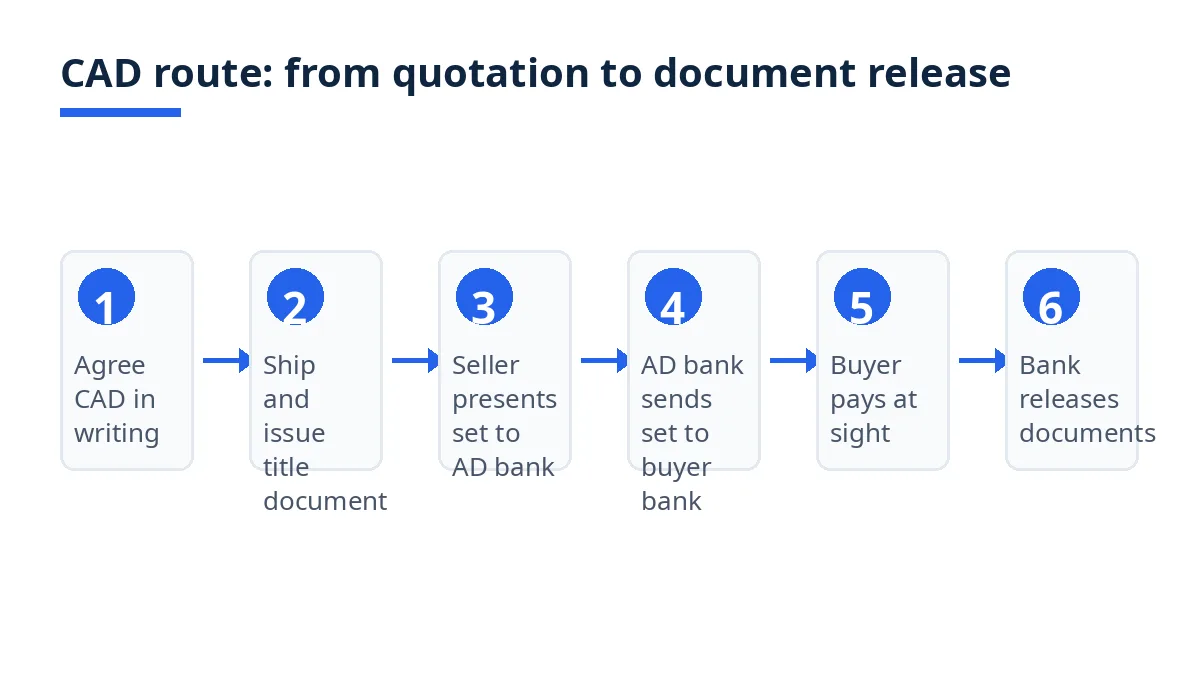
Agree the term in words. Write "Cash Against Documents (CAD), documents against payment (D/P): documents to be released only against payment at sight, with no partial release and no release against acceptance" in the quotation, the contract, and the collection instruction. Name the set, banks, charge split, and refusal plan.
Confirm the banks before shipment. Ask your bank to confirm it will act as presenting bank, and ask the seller which authorised dealer bank in Bangladesh will remit the documents.
Wait for shipment, then for presentation. The seller ships, then presents the set with a collection instruction to its bank. The ICC stresses that a separate collection instruction must accompany every collection subject to its rules, and that banks will not examine documents in order to look for instructions.4
Check the documents at your bank. Compare the invoice amount, the document list, and the transport document against the contract. This is a document check, not a goods check: banks do not verify documents or inspect cargo.1
Pay at sight, take the documents, and confirm the funds route. Once payment is secured, your bank releases the set, and you use the transport document to take delivery and clear customs.
Worked example
Example figures only, not a bank offer. A buyer in Canada agrees CAD terms with a ceramics producer for dinnerware sets priced at USD 23,750. The contract states CAD with documents against payment, lists the sight draft, invoice, packing list, and ocean bill of lading, and names the presenting bank and the charge split. The seller ships by ocean and presents the set through its authorised dealer bank. The buyer checks the invoice, pays USD 23,750 at sight, receives the bill of lading, and clears the dinnerware through customs.
If the buyer had refused to pay, the documents would have stayed with the presenting bank, and the seller would have faced storage, return freight, or a search for another buyer in Canada. The seller keeps the documents, but the documents are not the goods. Agree the refusal plan before shipment, including who pays storage and who may resell.
Costs, timelines and documents
There are no universal CAD charges or timelines: charges depend on the banks, amount, currency, and document set, and timelines depend on shipment, document assembly, and the funds return. Every figure below is a confirmation item, not a rate.
Item | Confirm before shipment |
|---|---|
Remitting and presenting bank charges | Who pays each, and whether deducted from proceeds or billed separately |
Presentation and conversion costs | Route, any intermediary deduction, and the exchange rate basis |
Storage and demurrage if payment is refused | Who bears port and detention costs, and from when |
Return freight or resale costs | Who decides on return or resale, and who funds it |
Funds return confirmation | How the seller confirms receipt |
The document set is set by the contract and the instruction, not by a single standard list. A typical CAD set includes a sight draft, invoice, packing list, and the transport document that controls delivery, usually an ocean bill of lading. A CAD explainer notes that the bill of lading should be issued "to order" or blank endorsed so the bank can hold and release it only after payment.2 Other certificates are included only where named. Two traps deserve attention: First, a time draft in a CAD set contradicts the sight-payment rule, so check the draft type before the set leaves Bangladesh. Second, an air waybill does not control delivery the way an ocean bill of lading does: the International Trade Administration warns that goods under air and overland shipments are more difficult to control, since the buyer may receive them with or without payment unless the exporter uses agents to hold delivery.1 For air freight, agree the delivery hold in writing before shipment.
Bangladesh-specific rules and tips
Bangladesh Bank's consolidated export-trade circular treats CAD as a named basis of shipment, not as an informal label. Its guidance for authorised dealer banks states that, for shipments against contract alone and shipments on a CAD or DA basis, greater care should be taken, including discreet inquiries into the bona fides and credentials of buyers abroad where necessary.5 Your seller's bank may therefore ask about your company and your bank before the collection proceeds. Answering early, through your own bank, avoids a due-diligence delay.
Three further rules from the same circular shape the paperwork. First, authorised dealer banks are advised to observe the latest version of the Uniform Rules for Collections for sales-contract collections, while local regulations prevail in case of contradiction.5 State in the contract that the collection is subject to URC 522. Second, transport documents for exports by land or sea must be drawn to the order of an authorised dealer bank, with a parallel rule for air waybills drawn to the order of a bank nominated in the importing country.5 If a supplier proposes transport documents drawn directly in your name, ask why: that wording can break the bank's hold on delivery. Third, the prescribed period for repatriating export proceeds is four months, and exporters must submit shipment information and the signed export form material to their authorised dealer within 14 days of shipment.5 A buyer who needs documents urgently should agree the presentation timetable in the contract.
Electronic presentation is conditional. Bangladesh Bank permits authorised dealer banks to process export documents through bank-to-bank electronic channels for both documents against payment and documents against acceptance, following URC 522 and its electronic supplement, eURC.6 It depends on mutual agreement between the local and overseas banks, including agreement on document formats and the place of presentation, and sales contracts must state that the collection will be handled electronically under eURC.6 Title documents must still be sent physically where electronic transferable records are not recognised.6
No CAD-only Bangladesh Bank circular was opened for this guide, so no CAD-specific fee or timeline is stated as a Bangladesh Bank rule. Confirm any shipment-specific requirement with the authorised dealer bank.
Mistakes and red flags
The most common CAD mistakes are ordinary wording and timing slips, each avoidable before shipment.
Treating CAD as a bank promise. The bank does not promise to pay if you refuse.
Writing "CAD" without the release rule. Write "CAD (documents against payment, D/P)" in full.
Including a time draft in a CAD set. A time draft signals acceptance terms, not sight payment.
Shipping by air without a delivery hold. Without a hold, the goods may be collectable before payment.
Accepting transport documents drawn in the buyer's name. That wording can defeat the bank hold described above.
Paying against copies. Release follows the original transport document, not a copy.
Agreeing charges vaguely. Name each charge and who pays it.
Having no refusal plan. Agree who pays storage and who decides on return or resale.
Assuming electronic presentation. If one bank requires physical title documents, release is delayed.
Red flags include a CAD term paired with documents in your name, a CAD term with no named banks, a draft described only as "draft", and pressure to pay before the document set reaches your bank.
Checklist
Use this list before signing, and again before the first shipment.
The contract states "Cash Against Documents (CAD), documents against payment (D/P)" and the release rule in words.
The document set is listed, including the sight draft type, and every certificate is named or excluded.
Both banks are named, and each bank charge is named, with who pays it.
The transport document is drawn to the order of the authorised dealer bank, or the air delivery hold is agreed.
The refusal plan names who pays storage and who decides on return or resale.
The presentation route, physical, electronic, or mixed, is confirmed with both banks.
The funds return route and confirmation are agreed, and quality terms are agreed separately, since CAD checks documents, not goods.
How Exportain helps
Exportain helps buyers and sellers agree CAD terms in writing before either side approaches a bank. A buyer can post a request for quotation stating the goods, quantity, price, shipment terms, and the payment term cash against documents, and compare supplier responses on the same terms. The recorded quotation trail keeps the request, every quotation version, every counter-offer, and the accepted terms in one place.7
Before paying, agree the Incoterm, payment schedule, inspection, and shipment terms in writing, as Exportain's buyer protection page advises.7 Payment for goods is settled directly between buyer and supplier on the accepted quotation terms, unless both sides agree to a funds hold, and Exportain does not act as a party to the contract.7 Exportain's payment terms are separate from bank charges on any collection: they cover payments to Exportain and platform memberships, not money paid directly between two companies outside the platform.8 For a buyer who decides a bank promise is needed, Exportain's letter of credit guide explains the undertaking route that CAD deliberately does not use.3
FAQs
What should I know first about cash against documents?
Cash against documents means you pay at sight, when the shipping documents reach your bank, and your bank releases them only against that payment. Banks act as agents, with no payment promise. The term controls documents, not goods, so quality terms must be agreed separately.
What are the typical costs and timelines?
There are no typical costs or timelines for every CAD collection. Charges depend on the banks, amount, currency, and document set, and timelines depend on shipment, document assembly, and the funds return. Confirm every charge and route in writing with each bank before shipment.
Which documents are needed?
The documents are those named in the contract and the collection instruction. A typical set includes a sight draft, a commercial invoice, a packing list, and the transport document that controls delivery, usually an ocean bill of lading. Other certificates are included only where named.
What are the most common mistakes?
The most common mistakes are treating CAD as a bank promise, writing the bare label without the release rule, including a time draft by mistake, shipping by air without a delivery hold, accepting transport documents drawn in the buyer's name, paying against copies, agreeing charges vaguely, having no refusal plan, and assuming electronic presentation. Avoid them by writing the term, the set, the charge split, and the refusal plan clearly before shipment.
Next steps on Exportain
Start with the deal terms, not the bank form. Post a request for quotation on Exportain at Exportain RFQs, stating the goods, shipment terms, and the payment term cash against documents. Read the letter of credit guide and buyer protection for what Exportain does and does not cover. Once terms are agreed in writing, take the contract to both banks and confirm the instruction, charges, and refusal plan before shipment.
Sources
- Documentary Collections. International Trade Administration (accessed )
- Cash Against Documents (CAD): Process, Risks & Alternatives. Razorpay (accessed )
- LC Meaning (Letter of Credit). Exportain (accessed )
- URC 522 - Uniform Rules for Collections. ICC Knowledge 2 Go (accessed )
- Consolidated circular on foreign exchange regulations — export trade transactions (FEPD-1 Circular No. 26, July 30, 2026). Bangladesh Bank (accessed )
- BB permits e-submission of export documents under collection regulations. The Business Standard, (accessed )
- Buyer protection: What Exportain does to protect buyers. Exportain (accessed )
- Payment and Membership Terms. Exportain (accessed )
About the author
Sourcing from Bangladesh?
Post a request for quotation and suppliers on Exportain can send you their quotes directly.
Post an RFQ


