Typical MOQ for Cargo Pants in Bangladesh (and How to Negotiate It Down)
No single cargo pants MOQ in Bangladesh: how cloth roll yield, wash lots and pocket and reinforcement component lots set the minimum per colour, and how to change the structure to order less.
Short answer
There is no single typical MOQ for cargo pants from Bangladesh. Each factory sets its minimum per colour, per wash lot and per component for your specification, driven by cloth roll yield, dye lots, wash batches, pocket and reinforcement lots and the trouser size run. Ask for every floor in writing, then negotiate the structure: fewer colours, stocked cloth, shared rolls and set-up paid apart from the unit price.
On this page
Key takeaways
There is no single typical MOQ for cargo pants from Bangladesh, because each factory sets its minimum per colour, per wash lot and per component for your specification.
Cloth roll yield comes first: a colour below the roll yield still draws on a whole roll, and the balance must be carried forward, charged or shared.
Wash lots and pocket and reinforcement component lots bind separately from the garment count, so confirm each floor apart from the total.
Negotiate the structure first: fewer colours, stocked cloth, cloth shared across styles and set-up paid as a separate line.
Exportain verification is a document and photo review, not a factory inspection, and a badge is not a guarantee.
A cargo pant order is governed first by cloth, not by the headline quantity. Woven twill arrives in rolls of a fixed width and length, and the cutting marker must fit leg panels, pocket bags, pocket flaps, waistband pieces and reinforcement patches inside that width. Example figures: a 150-metre roll with consumption of 1.6 metres per pair yields 93 pairs, since 150 divided by 1.6 is 93.75. A colour ordered below that roll yield still draws on a whole roll, and the balance must be carried forward, charged to the order or shared with another style. That single fact explains most cargo pant minimums, and it is the question to settle before any negotiation begins.
Cargo pants add three more floors on top of the cloth roll. Pocket and reinforcement components are bought or cut in their own lots: pocketing cloth, flap fabric, buttons, rivets, zips and drawcords each carry a minimum that is separate from the garment count. A wash lot is a batch: every pair that must match in shade and hand feel goes through the wash together, so a colour split into two small wash loads can fail even when the total quantity looks adequate. Finally, a trouser size run spreads across waist sizes and leg lengths, and the smallest sizes still need enough pairs to cut without wasting the marker. Ask for each of these floors separately, because the smallest one inside your specification decides whether the order can run.
There is no single typical MOQ for cargo pants from Bangladesh. Each factory sets its minimums for your specification, and the binding one is usually per colour, per wash lot or per component rather than for the order as a whole. The rest of this guide shows how to read those floors, how to change the structure behind them and what to confirm in writing.
Why this matters for buyers and sellers
For the buyer, the minimum decides how much cash sits in stock and whether a first order can test a pocket layout or fit before a larger repeat. Cargo pants are a detail-heavy trouser: a change to pocket count, flap shape or reinforcement after sampling can move the cloth consumption and the component lots, which moves the minimum with it.
For the seller, the minimum protects the run against cloth and components that cannot be sold to another buyer. Twill dyed in your colour, pocketing cut to your pocket shapes and labels printed with your brand have no second customer, and a short run still uses a full roll, a full wash load and a line change. Cost per pair rises as quantity per colour falls, because the fixed lots are spread across fewer pairs. A factory that refuses a very small colour is usually protecting that arithmetic.
Bangladesh has a large woven base to draw bidders from. Woven garment exports reached $4.614 billion in July to September 2026, up 5.11 percent year on year, within ready-made garment exports of $10.578 billion, according to data released by the Export Promotion Bureau (EPB).1 That scale gives a buyer choice, but no shared minimum, since each factory buys cloth, components and wash capacity on its own terms.
Step-by-step: how it works
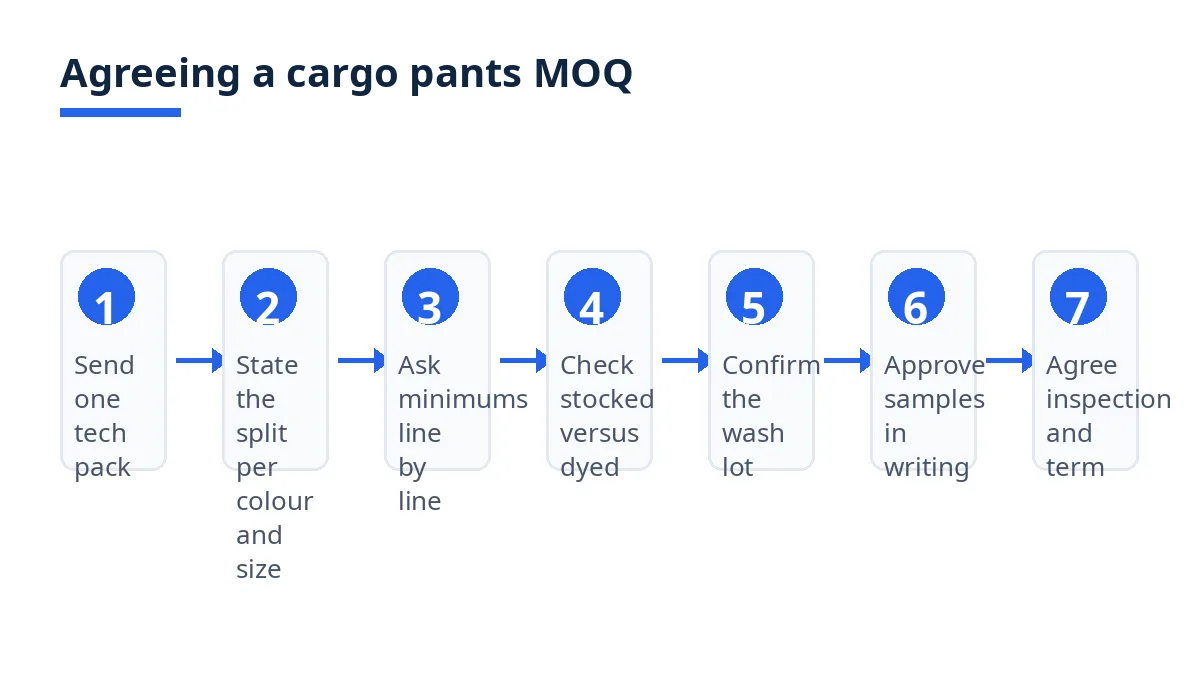
Send one tech pack to every candidate. State the fabric composition, construction and weight, pocket count and placement, flap and closure details, reinforcement points, waistband and leg opening, size chart with waist and leg lengths, artwork and label positions, and packing method.
State the split, not only the total. Give the quantity per colour, per size and per leg length. A total without a split cannot be answered with a usable minimum, because the roll, wash and component floors all sit inside the split.
Ask for the minimums line by line. Ask for the cloth roll yield per colour, the wash-lot minimum per wash, the minimum per pocket and reinforcement component, and any separate trim, label, tag and carton minimums, and which line binds for your split.
Ask what is stocked. Record whether each twill colour is stocked or dyed to order, and whether pocketing, buttons, rivets, zips and drawcords are stock items. Stocked inputs are where a lower minimum is most often possible.
Confirm the wash lot before sampling. Agree which pairs share one wash load, how shade is checked across the load and what happens to pairs outside the lot.
Approve samples in writing. Order a proto sample, then a pre-production sample in your actual cloth, colour, pocket construction, wash and labels. Measure it, wash it and check pocket strength and closure function, then approve or list corrections in writing.
Agree inspection and delivery term before you confirm. Write the inspection level and acceptance quality limit (AQL) values into the purchase order, and state one delivery term and named place for every quotation. ISO 2859-1 defines a system of acceptance sampling plans for inspection by attributes, indexed by AQL for lot-by-lot inspection.2 The Incoterms 2020 rules set out 11 rules with a clear allocation of cost, risk and obligations,3 so compare minimums only on the same term.
Negotiation levers that change the structure. Reduce the number of colours first, since colours multiply dye lots, wash loads, trim sets and cutting runs, and cutting one colour raises the quantity per remaining colour at the same total. Share one cloth across a cargo pant and a related trouser style where the design allows it, so the roll yield is met across both styles combined, and get that agreement in writing. Use stocked twill and stock trims where the design allows, which removes the dye lot and part of the component set-up. Where the floor comes from a wash load or a component run, ask for that cost apart from the unit price, so the run can be shorter and the same set-up serves the repeat order. Simplify pocket work only if the product still meets your brief. If the factory cannot move, place a smaller first order in fewer colours with a written repeat price and minimum for the same specification, and do not negotiate by removing sample approval or inspection.
Floor | What sets it | State in your enquiry |
|---|---|---|
Cloth roll | Roll length and width, marker consumption per pair | Composition, construction, weight, pocket layout |
Colour | Dye lot per colour | Quantity per colour |
Wash lot | Batch size per wash, shade matching | Wash type, pairs per wash load |
Components | Pocketing, buttons, rivets, zips, drawcords | Component spec per style |
Size run | Waist sizes and leg lengths in the marker | Quantity per size and leg length |
Labels and cartons | Separate print runs | Label, tag and carton spec |
Example figures: a buyer splits 900 pairs across three colours at 300 per colour. If the wash lot for the chosen wash is 450 pairs, each colour needs a second load or a shared-load agreement, and the wash cost is spread across fewer pairs than a two-colour split at 450 per colour. The example shows structure only, not a typical MOQ, price or lead time.
Costs, timelines and documents
What are the typical costs and timelines?
There are no typical costs or timelines a guide can state as fact, for the same reason there is no typical MOQ. Each factory prices your cloth, pocket and reinforcement work, wash, components, labels and cartons, finishing and packing, and the delivery term you choose.3 A wash-heavy style carries a different cost shape from an unwashed one, and many pockets add component and stitching work.
For timelines, sampling depends on cloth availability and correction rounds, and bulk production on dyeing, washing, component delivery and line capacity. Ask for sampling, cloth ready, wash, production and inspection dates as separate lines, not a single delivery week, and keep the wash date visible, since wash capacity is often the slowest step for a cargo order.
Which documents are needed?
The order documents are the tech pack, the itemized quotation and the purchase order, with the minimum per colour, per wash lot and per component on both the quotation and the order. For export clearance, the shipment follows the customs export declaration procedure published by Bangladesh Customs.4
Bangladesh-specific rules and tips
Check the classification for your trouser. In the Harmonized System, heading 6203 covers suits, ensembles, jackets, blazers, trousers, bib and brace overalls, breeches and shorts, other than swimwear, for men or boys, not knitted or crocheted, and subheading 620342 covers trousers of cotton under that heading.5 Confirm the subheading for your fibre mix with your supplier and your customs broker before the order is priced, since fibre mix and construction decide the code. See the HS code for cargo pants guide.
Paperwork that disagrees on the exporter's name stalls the order. Confirm the registered name on the trade licence first, then check that the quotation, proforma invoice and payment account repeat it exactly — a single character of drift between documents is enough to hold payment and clearance.
Find out what is bought in for your order. Buttons, rivets, zips, drawcords and some pocketing may come from outside suppliers for your specification, and an imported component can set both the minimum and the earliest production date. Lock the size ratio per colour and per leg length before production, since a late ratio change reopens the marker and the roll calculation.
Confirm fibre labelling for the destination market. If you sell into the European Union, Regulation (EU) No 1007/2011 states that a textile product shall be labelled or marked with the name and percentage by weight of all constituent fibres in descending order.6 Put the fibre composition on the tech pack and check it on the pre-production sample label.
Mistakes and red flags
What are the most common mistakes?
Asking for a total MOQ only. The binding minimum is usually per colour, per wash lot or per component. An order can clear the total and still fall below the wash minimum for one colour, which then carries a surcharge, a shared-load compromise or removal of that colour.
Forgetting the wash lot. A buyer who agrees colours and sizes but never agrees wash loads can find that a small colour cannot be washed alone at an acceptable cost. Settle the wash lot at quotation stage, in writing, for each wash type.
Treating pocket and reinforcement components as free. Pocket bags, flaps, bar tacks, knee reinforcement, buttons and rivets each have their own lot. A design with many pockets can meet the garment minimum and still fall below a component run, so confirm component minimums apart from the garment count.
Accepting a lower minimum verbally. A verbal concession on a roll yield or wash load is hard to hold when bulk cutting starts. Get the minimum per colour, per wash lot and per component, the leftover-cloth arrangement and the repeat terms in writing on the quotation and the purchase order.
Comparing minimums on different terms. A lower minimum quoted on one delivery term and one wash type is not comparable with a higher minimum on another term and wash. The Incoterms 2020 rules allocate cost, risk and obligations per rule,3 so compare quotations only on the same specification, wash and term.
Reading a badge as a guarantee. A badge records a document and photo review, not a factory inspection, so sample approval and inspection stay with you. See how supplier verification works on Exportain.
Checklist
Before you confirm, every line should be answered in writing.
Tech pack sent: cloth, pocket layout, flaps and closures, reinforcement, waistband, leg lengths, labels, packing.
Split stated per colour, per size and per leg length, with one size ratio per colour.
Cloth roll yield per colour confirmed; leftover-cloth arrangement agreed.
Wash-lot minimum per wash confirmed; shade checking across the load agreed.
Pocket, reinforcement, trim, label, tag and carton minimums confirmed apart from the garment MOQ.
Set-up and wash costs itemized apart from the unit price; paid set-ups recorded.
Pre-production sample measured, washed and approved in writing, with pocket and closure checks.
Inspection level and AQL values in the purchase order.2
Quotations compared on the same specification, wash and delivery term.3
Export set agreed with the supplier before shipment.4
How Exportain helps
On Exportain, browse suppliers and post a request for quotation (RFQ) on the RFQ board with your tech pack summary, split per colour and size, wash type and delivery term, so suppliers quote against the same specification. Ask each reply for its minimum per colour, per wash lot and per component, and for its leftover-cloth arrangement. Verification on Exportain is a document and photo review by staff, not a factory inspection, and membership plans never grant a badge.7 Read what each badge records before you rely on it.
FAQs
What should I know first about cargo pants?
Know the floors inside the order before you judge the headline quantity. A cargo pant minimum is set by the cloth roll yield, the dye lot per colour, the wash lot per wash type, the pocket and reinforcement component lots and the size run across waist sizes and leg lengths. Cotton woven trousers sit under HS heading 6203, with cotton trousers under subheading 620342.5 Ask for each floor in writing.
What are the typical costs and timelines?
No single figure holds across factories: each one sets its price, minimum and lead time for your specification. Cloth, pocket and reinforcement work, wash type, components, the split and the delivery term drive the price, while cloth availability, wash capacity, component delivery and line capacity drive the timeline. Ask for each date as a separate line.
Which documents are needed?
The order set is the tech pack, the itemized quotation and the purchase order, with the minimum per colour, per wash lot and per component on both the quotation and the order. The shipment follows the customs export declaration procedure published by Bangladesh Customs.4
What are the most common mistakes?
The most common mistakes are asking only for a total MOQ, forgetting the wash lot, treating pocket and reinforcement components as free, accepting a lower minimum verbally, comparing minimums on different specifications, washes or terms,3 and reading a badge as a guarantee. A badge is a document and photo review, not a factory inspection.7
Next steps on Exportain
Browse suppliers, then post the tech pack summary, split per colour and size, wash type and delivery term as an RFQ on the RFQ board, asking each reply to state its minimum per colour, per wash lot and per component. Before you confirm, read the MOQ definition guide.
Sources
- Exports up over 6% to $13.1bn in Q1 of FY27. Dhaka Tribune, (accessed )
- ISO 2859-1:2026 - Sampling procedures for inspection by attributes — Part 1: Sampling schemes indexed by acceptance quality limit (AQL) for lot-by-lot inspection. ISO (accessed )
- Incoterms® 2020. International Chamber of Commerce (ICC) (accessed )
- Customs Clearance Procedures for Export. Bangladesh Customs, National Board of Revenue (accessed )
- UNSD Classification Detail: HS Code 620342. United Nations Statistics Division (accessed )
- Regulation (EU) No 1007/2011 on textile fibre names and related labelling and marking of the fibre composition of textile products. European Union, (accessed )
- Supplier verification: Earn trust badges buyers can see. Exportain (accessed )
About the author
Sourcing from Bangladesh?
Post a request for quotation and suppliers on Exportain can send you their quotes directly.
Post an RFQ