Cargo Pants Lead Time From Bangladesh: Production and Shipping Timeline
Cargo pants lead time guide from Bangladesh: ripstop and canvas approval, cargo-pocket and bartack gates, waistband and knee decisions, hem and cuff finishing, labeling, inspection, and export documents, with a worked olive ripstop cargo example.
Short answer
A cargo pants lead time from Bangladesh runs on approval gates, not a single production run: ripstop or canvas fabric approval, graded pattern and first pair, cargo-pocket construction and placement, bartack positions, drawcord or elastic waistband options, knee reinforcement, bulk sewing, hem and cuff finishing, wash-care labeling, inspection, export documents, and transit. Every duration and figure is an illustrative planning example only. Replace it with the written quote and the dated forwarder estimate before setting a selling date.
On this page
Key takeaways
Ripstop or canvas approval comes before cutting: a new lot reopens the gate, because pairs cut from unmatched lots will not read as one order.
Cargo pockets need placement and volume approvals on a sample that can be opened and loaded, since bellows and flap options behave differently when closed and worn.
Bartack positions are a written buyer-specification list, not a factory default, with each position shown on a finished sample pair.
Drawcord or elastic waistband options and knee reinforcement are approved together on a worn or formed sample, because knee placement only proves itself in movement.
Hem and cuff finishing, wash-care labeling, inspection, and export documents are checked stages, and every duration must be replaced by the written quote and the dated forwarder estimate.
A cargo order is decided at the thigh pocket, the knee, and the cuff, long before bulk sewing starts. A bellows pocket that loses its volume when the flap closes, a knee patch that sits too high once the wearer bends, and a cuff that will not stay where the buyer specified it are all faults a buyer can spot at a glance, and all of them are set by approvals made before cutting and bulk assembly.
A gate is a named approval, sample, or document that must close before the next stage starts. Every duration and cost figure in this guide is an illustrative planning example only, or an item to confirm in the written quote and the dated forwarder estimate. No duration or figure here is a promise for any real order. Replace every example figure with the written quote and the dated forwarder estimate before setting a selling date.
Why this matters for buyers and sellers
For a buyer, the risk in a cargo order sits in parts that carry load and movement. Ripstop fabric is described in one workwear catalog as fabric that makes the garment resistant to ripping and tearing, and the same catalog lists box pleat cargo pockets with a hook-and-loop closure and a reinforced patch on the knee area among the features of a ripstop cargo trouser.1
For a seller, the same gates protect the schedule. Recorded fabric, pocket, reinforcement, waistband, knee, cuff, and label approvals give both sides a fixed target to repeat across sizes and lots.
Step-by-step: how it works
Read the order against eight gates.
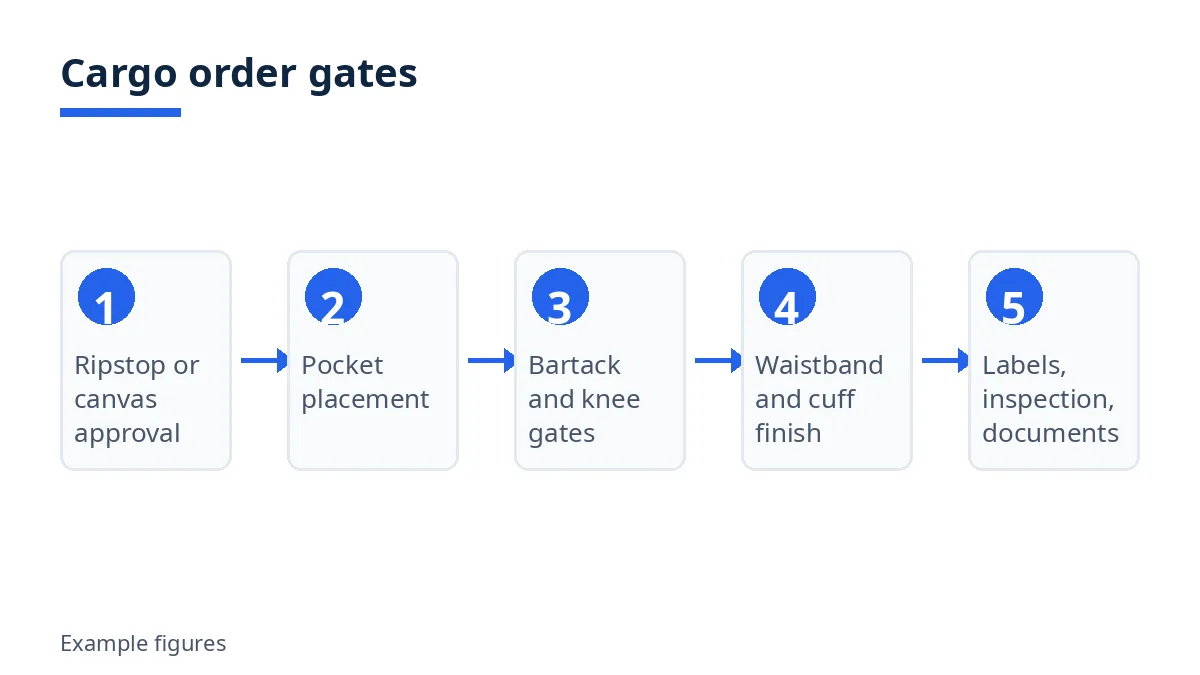
Gate 0: Ripstop or canvas fabric approval
Gate 0 fixes the cargo fabric before cutting. The buyer specification should name whether the order uses a ripstop weave or a canvas weave, the fiber blend where the buyer has specified one, the shade reference, the width, and the lot that cutting will follow.
Ask the seller to confirm in writing whether the fabric is in stock, is to be dyed or finished for this order, or is to be woven for this order, and which shade lot each size will be cut from. A new lot reopens Gate 0, because pairs cut from two unmatched lots will not read as one order.
Gate 1: Pattern, grading, and the first pair
Gate 1 produces the first complete pair from the approved fabric, with waistband, fly, front pockets, thigh cargo pockets, back pockets, knee area, legs, and cuffs in place. Record every correction in writing, including the pocket positions measured from the waistband and the side seam, since a pocket that drifts by a small amount on the pattern will drift on every pair in bulk.
Gate 1 closes only when the graded pattern, the first pair, and the measurement table for every size are approved together. The measurement table is the contract for bulk: each size, each point of measure, and the tolerance the seller will work to.
Gate 2: Cargo-pocket construction and placement approval
Gate 2 is the gate that most separates a cargo order from a simpler trouser order. Approve the cargo pockets before bulk sewing locks them in.
Bellows pockets and flap pockets are buyer-specification options to confirm in writing for this order: a bellows pocket is specified by its expanded volume and its closed profile, while a flap pocket is specified by its flap shape, its closure type, and its overlap. A Gate 2 approval should name the pocket style for each position, the pocketing fabric, the mouth and flap reinforcement, the closure, and the topstitching, with a sample the buyer can open, load, and hang. If a pocket style, pocketing fabric, closure, or reinforcement is substituted, Gate 2 reopens.
Gate 3: Bartack reinforcement at stress points as a buyer-specification item
Gate 3 records bartack reinforcement as a buyer-specification item, not as a factory default. A retail ripstop listing describes felled seam construction with bar-tack reinforcements at stress points.2 A Gate 3 approval should name each bartack position in writing: pocket corners, pocket mouth ends, belt-loop bases, fly ends, and cuff and hem stress points where the buyer has specified them.
Ask for a sample that shows the bartack positions on a finished pair, and check that the positions match the written list rather than a general claim of reinforcement.
Gate 4: Drawcord or elastic waistband as buyer-specification options, and knee reinforcement
Gate 4 approves the waistband option and the knee reinforcement together, because both affect how the pair moves. Drawcord waistbands and elastic waistbands are buyer-specification options to confirm in writing for this order: a drawcord option is specified by its cord type, its cord length, its eyelet or channel construction, and its end finish, while an elastic option is specified by its elastic width, its stretch behavior on the sample, and its casing construction.
Knee reinforcement is approved at the same gate. A Gate 4 approval should name the knee patch shape, its placement measured from the waistband and the inseam, its stitching, and whether it is a single or double layer, with a sample the buyer can bend and kneel in. If the waistband option or the knee reinforcement changes, Gate 4 reopens.
Gate 5: Bulk sewing against the approved samples
Gate 5 is bulk sewing, and it should add no new decisions. Cutting follows the approved lot from Gate 0, pockets follow the Gate 2 approval, bartacks follow the Gate 3 list, and waistband and knee work follow the Gate 4 approval. In-line checks during bulk sewing should compare finished pairs against the approved samples at each stage, rather than waiting for a final check to catch a pocket or knee fault that has already run through the full order.
Gate 6: Hem and cuff finishing
Gate 6 approves hem and cuff finishing as a checked stage. Hem and cuff finishing for a cargo order includes the hem width, the cuff construction where the buyer has specified a cuff, the stitching, and the drawcord or elastic at the cuff where the buyer has specified one.
Ask for a sample pair with finished hems and cuffs, and check the hem for twist, the cuff for even width around the leg, and any cuff drawcord for length and end finish on both legs. If the hem or cuff construction changes, Gate 6 reopens.
Gate 7: Wash-care labeling as a buyer-specification item, inspection, and documents
Gate 7 closes three items together: wash-care labeling as a buyer-specification item, final inspection against the approved samples, and export documents. Wash-care labeling is specified in writing for this order, including the label wording, the label position, and the language versions the buyer requires. If the destination market requires particular labeling or performance wording, record that wording as a buyer specification to confirm in writing, and do not leave it to be added during packing.
Documents gate loading, so the document set must be ready before a ship date is promised. The shipping bill is described by the Bangladesh Trade Portal as an essential document issued by the Bangladesh Customs Authority after the exporter applies for it, and as a mandatory document to complete customs clearance, load the goods, and claim duty drawbacks.3
Costs, timelines and documents
The table below is an illustrative planning example only. Every figure in it must be replaced by the written quote and the dated forwarder estimate for the real order.
Stage | Illustrative planning example | Confirm in the written quote |
|---|---|---|
Fabric approval and first pair | Example planning allowance of 3 weeks from tech pack to approved first pair | Fabric availability, dye or finish route, and courier for samples |
Pocket, bartack, waistband, and knee approvals | Example planning allowance of 2 weeks of sample rounds after the first pair | Number of sample rounds included, and what each round costs |
Bulk sewing, hem, and cuff finishing | Example planning allowance of 4 weeks for the bulk run in the example | Line capacity for the order, and the in-line check schedule |
Labeling, inspection, and documents | Example planning allowance of 1 week before the booked loading date | Inspection booking, and the full document list for the shipment |
Sample courier in the example | Example figure of USD 85 per courier parcel | Courier route, and who pays for each sample round |
Forwarder estimate in the example | Example figure of USD 1,150 for the sea freight leg in the example | Dated forwarder estimate, named places, and the delivery rule agreed in the contract |
A worked example shows why the gates matter. An olive ripstop cargo for an outdoor workwear range reached its second sample round with three faults: the bellows pocket lost volume when its flap closed, the knee patch sat high once the pair was bent, and one cuff drawcord was shorter than the other. The pocket was re-approved with a loaded sample, the knee patch was re-measured on a bent sample, and the cuff drawcords were re-measured on both legs. The bulk run that followed matched the re-approved samples.
Documents to confirm for the shipment include the commercial invoice, the packing list, the certificate of origin, and the shipping bill, together with the transport document for the mode agreed in the contract. 4 The Bangladesh Trade Portal lists the documents required to obtain a shipping bill, including the export contract or purchase order, the commercial invoice, the packing list, the certified EXP form, the certificate of origin, the VAT registration certificate, the taxpayer identification number, and the export registration certificate.3
Bangladesh-specific rules and tips
The shipping bill gates loading, so a loading date promised before the document set is ready is a date built on an open gate. Confirm the delivery rule and the named places in the contract in writing, and price every quote to the same point before comparing two quotes, since different delivery rules leave different legs of the journey to different parties.
Record any market-specific labeling or performance wording as a buyer specification at Gate 7, not as a correction during packing. Keep one dated version of the approved tech pack, measurement table, sample comments, and allowed differences as the production and inspection reference, so a later sample round cannot silently replace an earlier approval.
Mistakes and red flags
Approving a cargo pocket from a flat photograph or a drawing, without opening, loading, and hanging a sample pair.
Approving a bellows or flap pocket without naming its volume, closure, and overlap in writing.
Leaving bartack positions to a general claim of reinforcement, without a written position list and a sample that shows each position.
Changing the waistband option or the knee reinforcement after bulk cutting has started.
Approving a hem or cuff without checking both legs, or approving a cuff drawcord without measuring its length on both legs.
Promising a selling date from this guide's example figures instead of from the written quote and the dated forwarder estimate.
Booking loading before the shipping bill and the rest of the document set are ready.
Checklist
Fabric weave, blend, shade reference, width, and cutting lot approved in writing at Gate 0.
Graded pattern, first pair, and measurement table approved together at Gate 1.
Cargo-pocket style, volume, closure, and placement approved for each position at Gate 2.
Bartack position list approved and shown on a finished sample at Gate 3.
Waistband option and knee reinforcement approved on a worn or formed sample at Gate 4.
Bulk sewing checked in line against the approved samples at Gate 5.
Hem and cuff finishing approved on both legs at Gate 6.
Wash-care labeling, inspection scope, and document set confirmed at Gate 7.
Written quote and dated forwarder estimate received, and the selling date set from those documents, not from example figures.
How Exportain helps
Exportain lists suppliers that buyers can review, and buyers can post a sourcing requirement and compare the quotations that come back against the gates in this guide.
FAQs
What should I know first about cargo pants?
Know the gates before the dates. A cargo order turns on fabric approval, cargo-pocket construction and placement, bartack positions, waistband options, knee reinforcement, hem and cuff finishing, and wash-care labeling, and each gate needs a written approval on a sample.
What are the typical costs and timelines?
Use the illustrative planning example in the costs table above as a starting point only, and replace every figure with the written quote and the dated forwarder estimate. Costs in a real order depend on the fabric route, the number of sample rounds, the inspection scope, the document set, and the delivery rule agreed in the contract, and timelines depend on which gates are already closed when the order is placed. No figure in this guide is a promise for any real order.
Which documents are needed?
Confirm the full set in the written quote, and expect the commercial invoice, the packing list, the certificate of origin, the shipping bill, and the transport document for the agreed mode to be among them. The shipping bill is the document that completes customs clearance and permits loading, and the Trade Portal lists the export contract or purchase order, the commercial invoice, the packing list, the certified EXP form, the certificate of origin, and the registration documents among the items required to obtain it.3
What are the most common mistakes?
The most common mistakes are approving pockets without loading them, leaving bartack positions unwritten, changing the waistband or knee after cutting, approving cuffs on one leg only, and setting a selling date from example figures instead of from the written quote and the dated forwarder estimate. A further mistake is treating a fit sample as approval for bulk fabric: one sampling guide stresses that the production sample must come from the bulk fabric, on the production line, and that bulk production starts only after written sign-off.5
Next steps on Exportain
Review supplier listings on Exportain suppliers and start the conversation with the fabric, pocket, bartack, waistband, knee, cuff, and labeling specifications in writing.
Check the delivery rule for the order in Incoterms for shipments from Bangladesh before comparing quotations written on different delivery rules.
Post the requirement with its gates attached on Exportain RFQs and compare the quotations that come back against the written quote and the dated forwarder estimate.
Sources
- Jonsson Workwear Catalogue - Page 110. Jonsson Workwear (accessed )
- Propper Military BDU Ripstop Trouser 2.0. Devil Dog Depot (accessed )
- Bangladesh Trade Portal FAQ: Export Registration Certificate (ERC). Bangladesh Trade Portal (accessed )
- Bangladesh Garment Export Guide. DHL Express Bangladesh (accessed )
- How Does Garment Sampling Work?. Apex Corporation (accessed )
About the author
Sourcing from Bangladesh?
Post a request for quotation and suppliers on Exportain can send you their quotes directly.
Post an RFQ