

Typical MOQ for Black Tiger Shrimp in Bangladesh (and How to Negotiate It Down)
Black tiger shrimp MOQs stack by grade, presentation, pack and container load. This guide breaks each layer apart and shows how to negotiate the minimum down without dropping inspection or changing the product.
Short answer
A black tiger shrimp MOQ is a set of stacked minimums, not one number: a minimum per size grade, per presentation, per pack or carton, and often per production run or container load. Ask for the basis and unit of each minimum in writing, check every grade line against its own minimum, and negotiate the gap with consolidated grades, standard packs, longer lead time, or a priced trial quantity before comparing prices.
On this page
Key takeaways
A black tiger shrimp MOQ stacks by size grade, presentation, pack or carton, and production run or container load, so each grade line must be checked against its own minimum.
Shrimp count is measured per unit weight on deglazed weight, so the grade, the count range, the presentation, the pack, and the weight basis must all be written into the specification.
Consolidating grades, accepting the standard pack, widening the count band, offering lead time, or committing a repeat quantity can lower the minimum before money is offered.
A below-minimum quantity should be priced separately as a surcharge or a trial price with a written return to standard terms, and a part load must be priced on landed cost, not factory price.
In the EU the establishment of dispatch must appear on the permitted-establishments list where applicable, and in the United States the importer needs written verification procedures, even for a trial order.
A black tiger shrimp MOQ is rarely one number. It is a set of minimums that stack: per size grade, per presentation, per pack or carton, and often per production run or container load. A buyer who asks only "what is your MOQ?" gets an answer that hides most of that structure, and negotiating only the headline number usually gives the saving back in price, pack, or delivery terms. This guide takes the MOQ apart, grade by grade and pack by pack, so you can negotiate each piece separately.
Black tiger shrimp is the giant tiger prawn, Penaeus monodon, whose FAO name is giant tiger prawn.1 Species, size grade, and presentation together define the product. Change any one of them and, in the supplier's production plan, you are ordering a different product with its own minimum.
Why this matters for buyers and sellers
For a buyer, the MOQ decides how much cash sits in frozen stock, how many grades you can carry, and whether a new product can be tested at all. A buyer who needs three grades in small amounts may find each grade carries its own minimum, so the real order is three minimums, not one. For a seller, the MOQ protects a production run: grading, peeling, deveining, glazing, packing, and freezing each have setup and changeover work, and a run that switches grade or presentation partway through costs time and product. A supplier that accepts a tiny run of an unusual grade must recover that setup cost, usually in a higher unit price or a surcharge. That trade is the whole negotiation: you are not asking a supplier to ignore its costs, you are offering something else in return, such as a standard pack, a longer lead time, a repeat commitment, or a consolidated grade list. Compare MOQ only after grade, presentation, pack, delivery term, and inspection terms match, line by line.
Step-by-step: how it works
Work through the MOQ in this order, so the price you compare means the same for every supplier.
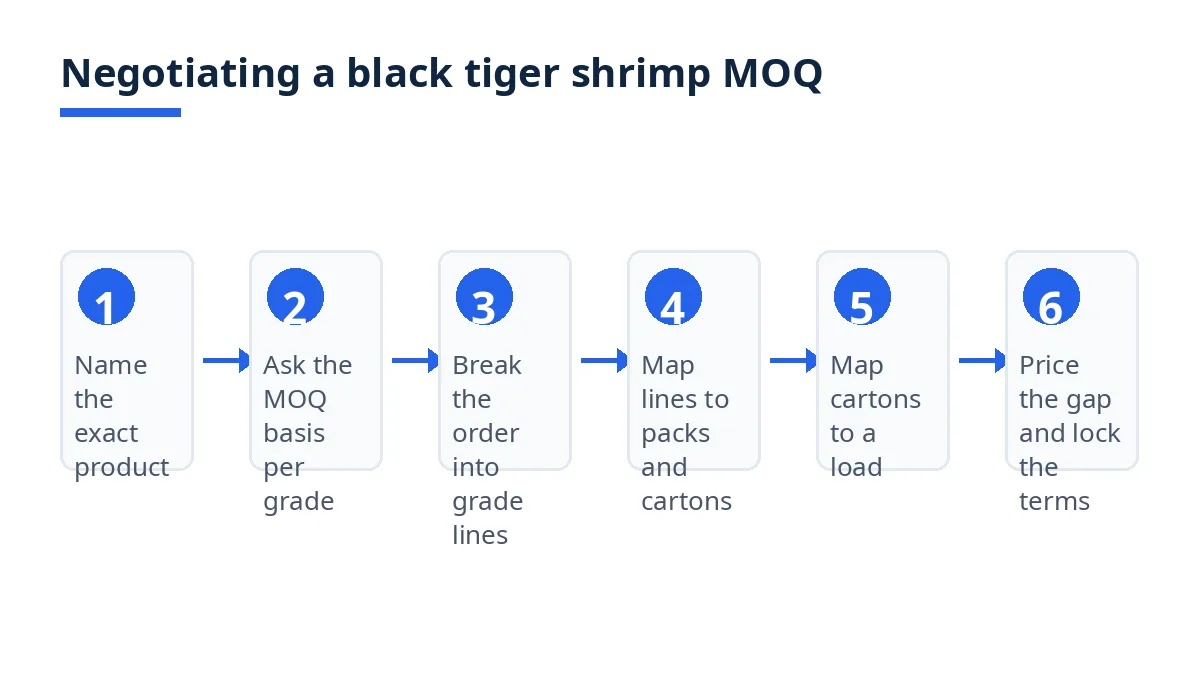
Name the exact product. Write species, size grade, and presentation in one line: black tiger shrimp, one count range, headless shell-on.
Ask for the MOQ basis in writing. Per grade, per presentation, per pack, per carton, per batch, or per load, and in what unit?
Break the order into grade lines. Each grade and presentation is its own line, checked against its own minimum first.
Map each line to a pack. Inner pack weight, inner packs per master carton, and whether the MOQ is counted in cartons.
Map the cartons to a load. Full container load, part load, or a stated carton count, and what changes below a full load.
Price the gap, not just the minimum. Each option priced separately: a surcharge, a standard pack, a longer lead time, or a repeat commitment.
Lock the terms in the order. Grade, presentation, count range, pack, carton count, weight, delivery term, and trial or repeat terms.
How a size grade sets the minimum
Shrimp are sold by count: how many shrimp make up a stated weight. The Codex standard for quick frozen shrimps and prawns provides that, when count is declared on the label, it is determined by counting the shrimp in the container or a representative sample and dividing by the actual deglazed weight.2 A grade is therefore a range, not a single number, and count must be checked on deglazed weight, not glazed weight, which includes the ice coating.
A narrow grade range is harder to fill than a wide one, since a tight count band forces stricter sorting. Widening the band, where your menu or retail pack allows it, is often the cheapest concession a buyer can offer. Presentation works the same way: head-on shell-on, headless shell-on, peeled and deveined, and peeled undeveined are different production lines, each able to carry its own minimum, so consolidating to one or two presentations can bring a small order inside the minimum.
How pack format and container load set the minimum
Pack format sets the minimum twice: once at the inner pack and once at the master carton. If the standard inner pack is a fixed weight and the master carton holds a fixed number of inner packs, the smallest shippable quantity for that grade is one master carton, so ask for those two numbers early. Container load is the last layer: a full load gives one shipment, one set of documents, and one cold chain, while a part load can change freight and delivery terms.
Example figures: three grades, each with a minimum of 500 kilograms, total 1,500 kilograms, but no grade can be cut to 300 kilograms without breaking its own minimum; consolidating to two grades at 750 kilograms each meets both minimums with the same total. The example shows structure only, not market rates or typical minimums.
Costs, timelines and documents
What the MOQ does to cost
There is no typical black tiger shrimp MOQ, price, or lead time a buyer can rely on, because each supplier sets its minimum against its own grading line, pack line, and shipping arrangement for your specification. Treat any number quoted without a grade, presentation, pack, and delivery term as incomplete. The MOQ raises cost four ways: repricing or surcharges below the minimum; rounding up to full cartons or a full load, with freight and cold storage; multiplied setup costs across many grades; and changed freight terms on a part load. Ask for three prices for the same grade and pack: at the minimum, at your quantity with a surcharge, and at your quantity on a standard pack with a longer lead time.
Negotiation levers that actually move an MOQ
Use these in order, cheapest first. Consolidate grades and presentations: fewer lines, each above its minimum, beat many lines, each below it. Accept the standard pack: a custom pack, bag print, or carton count is a setup cost, and dropping it can drop the minimum. Widen the count band where you can, after checking portion size with your customers. Offer lead time instead of volume: a supplier that can slot a small run into a schedule gap may accept a lower quantity. Offer a repeat commitment in writing: a trial quantity plus a specific repeat quantity and date. Pay the gap transparently: a priced surcharge for the trial quantity only, with the standard price restored at the full minimum next time. Do not promise volume you cannot take, drop inspection or document steps, or accept a lower grade or different species to hit a number.
Timelines
Ask for separate dates for each stage: sample approval, production slot, packing, inspection, document issue, and shipment. A trial order can take longer if it waits for a production gap, so agree a longer lead time as part of the MOQ deal. Example figures: a trial slot four weeks out against two weeks for a standard order prices the smaller quantity in time, not money; the figures show structure only, not typical lead times.
Which documents sit in the order file
The order file should carry grade and presentation per line, count range, pack and carton specification, total weight and carton count, delivery term, inspection plan, and agreed MOQ terms including surcharges, trial terms, and repeat terms. The Incoterms 2020 rules set out 11 rules allocating cost, risk, and obligations, so compare quotations only on the same delivery term.3 The export set is separate: goods may not be loaded for export unless a Bill of Export or Shipping Bill is submitted to Customs and approved, with the export contract or purchase order where there is no export letter of credit, the commercial invoice, the packing list, the EXP form certified by an authorized dealer, and a certificate of origin issued by the EPB or a Chamber of Commerce and Industry.4 Confirm who prepares each document, and the health certificate route for your destination, before production starts.
Bangladesh-specific rules and tips
Check the establishment, not just the supplier. In the EU, importers of animal-origin products from third countries must ensure the country of dispatch appears on a permitted-countries list, and the establishment of dispatch on a permitted-establishments list, when applicable.5 Ask for the establishment details that match that list before negotiating quantity.
Confirm the US verification route. In the United States, seafood processors operate under the seafood HACCP rule, and importers must have written verification procedures ensuring imported fish and fishery products were processed in accordance with that rule, including product specifications and steps such as obtaining HACCP and sanitation records or a certificate from a foreign government inspection authority.6 A trial order still needs that verification file.
Use the Bangladesh inspection route early. The Department of Fisheries Fish Inspection and Quality Control section is the competent authority for HACCP and fish health and hygiene matters, and Bangladesh has moved fish and seafood licenses and product test certificates, including health certificates, onto an online certification system connected to customs.7 Ask which certificates your shipment needs, who applies, and how long each takes, and build those steps into the timeline before the production slot.
Write the count, glaze, and weight basis into the specification. State whether weight is net, deglazed, or glazed, and how count is checked: the Codex count method divides by actual deglazed weight,2 so a specification without a weight basis invites a dispute about whether the grade was met. Agree the glaze percentage too, and check it on the sample and on the shipment. Confirm the delivery term before you compare MOQs: two suppliers quoting the same MOQ on different delivery terms are quoting different deals, because the Incoterms 2020 rules allocate cost, risk, and obligations differently by term.3
Mistakes and red flags
Quoting an MOQ without its basis. A buyer who records "MOQ 500 kilograms" without grade, presentation, pack, and unit has recorded a number that cannot be enforced. Splitting a small order across too many grades. Four grades at a quarter of each minimum is four failed minimums; consolidate first, then negotiate what remains. Negotiating price before the MOQ structure. A unit price agreed for a full container load does not apply to a part load of one grade, and a price agreed for a standard pack does not apply to a custom pack. Accepting a trial quantity with no repeat terms. A trial at a surcharge should state when the standard price and minimum return, or the trial price can become the permanent price. Treating a part load as a like-for-like saving. Price the landed cost of the smaller shipment, not just the factory price. Skipping inspection to fit a small order. A trial order still needs its count, weight, and document checks. Pause on any reply that will not state the MOQ basis, pack counts, establishment details, or priced below-minimum option.
Checklist
Before you confirm a black tiger shrimp order, every line should be answered in writing.
Species and product named in one line: black tiger shrimp, size grade, presentation.1
MOQ basis stated per line, with the unit: per grade, per presentation, per pack, per carton, per batch, or per load.
Each grade line checked against its own minimum.
Count range and weight basis written: count on deglazed weight, glaze percentage agreed.2
Inner pack and master carton counts confirmed; quantity rounded to full cartons and priced.
Container load position confirmed, with freight and delivery terms.3
Below-minimum route priced separately: surcharge, standard pack, longer lead time, or repeat commitment.
Trial terms written: trial quantity and price, and when standard terms return.
Inspection plan agreed: count, weight, pack, and document checks before shipment.
Establishment and market route confirmed: EU listing where applicable, US verification file.5 6
Bangladesh certificates and timeline confirmed: health certificate route, export document set.7 4
Order file holds grade, presentation, count, pack, carton count, weight, delivery term, and MOQ terms.
How Exportain helps
On Exportain, browse suppliers and post a request for quotation (RFQ) on the RFQ board with your grade list, presentation, pack preference, and delivery term, so suppliers quote against the same MOQ structure and specification. Ask each reply for its MOQ basis per grade, its pack and carton count, its part-load terms, and its priced below-minimum option, and compare replies only after those four answers match in form. Read the badges for what they record: Exportain verification is a document and photo review, not a factory inspection, and a badge is not a guarantee of capacity, quality, or delivery.8 Your MOQ protection is the written specification, the per-line minimum, the pack and carton record, and the inspection plan, not the badge.
FAQs
What should I know first about black tiger shrimp?
Black tiger shrimp is the giant tiger prawn, Penaeus monodon, whose FAO name is giant tiger prawn.1 For ordering, the species name alone is not a specification: you also need the size grade as a count range, the presentation, the pack, and the weight basis, with count divided by actual deglazed weight when declared.2
What are the typical costs and timelines?
There are no typical black tiger shrimp MOQ, price, or lead time figures a buyer can rely on, because each supplier sets its minimum against its own grading line, pack line, and shipping arrangement for your specification. Ask for separate dates for sample approval, production, packing, inspection, documents, and shipment, and for the below-minimum route to be priced separately.
Which documents are needed?
The order file needs grade and presentation per line, count range, pack and carton specification, weight and carton count, delivery term, inspection plan, and agreed MOQ terms. The export set includes the Bill of Export or Shipping Bill, commercial invoice, packing list, EXP form certified by an authorized dealer, and certificate of origin issued by the EPB or a Chamber of Commerce and Industry, plus the health certificate route for your destination.4 In the EU, the establishment of dispatch must appear on the permitted-establishments list where applicable,5 and in the United States the importer needs written verification procedures.6
What are the most common mistakes?
The most common mistakes are recording an MOQ without its basis and unit, splitting a small order across too many grades, negotiating price before the MOQ structure is set, accepting a trial quantity with no written return to standard terms, treating a part load as a like-for-like saving, and skipping inspection on a trial order. A further mistake is reading a badge as MOQ protection: verification is a document and photo review, not a factory inspection.8
Next steps on Exportain
Browse suppliers with your grade list and pack preference in hand, then post the same grade, presentation, and delivery term on the RFQ board so each reply states its MOQ basis per grade. Before you confirm, read the MOQ guide, and compare replies only after grade, presentation, pack, and delivery term match.
Sources
- FAO - Penaeus monodon Fabricius. Food and Agriculture Organization of the United Nations (accessed )
- Standard for Quick-Frozen Shrimps or Prawns (CXS 92-1981). Codex Alimentarius Commission (accessed )
- Incoterms® 2020. International Chamber of Commerce (ICC) (accessed )
- Customs Clearance Procedures for Export. Bangladesh Customs, National Board of Revenue (accessed )
- Regulation (EC) No 853/2004 laying down specific hygiene rules for food of animal origin. European Union (accessed )
- Fish and Fishery Products Hazards and Controls Guidance. U.S. Food and Drug Administration (accessed )
- Bangladesh rolls out online certification system to simplify fish and seafood trade. International Collective in Support of Fishworkers (ICSF) (accessed )
- Supplier verification: Earn trust badges buyers can see. Exportain (accessed )
About the author
Sourcing from Bangladesh?
Post a request for quotation and suppliers on Exportain can send you their quotes directly.
Post an RFQ


