Bed Sheets Price in Bangladesh: FOB Cost Breakdown for Buyers
An FOB bed sheets price in Bangladesh is a sum, not a single figure: making costs plus the freight-to-FOB lines up to loading, with thread count as the main lever. Read how each component moves and how to compare quotations line by line.
Short answer
Bed sheets price in Bangladesh on FOB terms is the sum of making costs and freight-to-FOB costs: yarn and fabric, dyeing or printing, cutting and sewing, finishing, packing, inland transport, origin handling, export clearance and loading on board the vessel. Thread count is the main price lever, because a higher count uses more yarn per set. Ocean freight, insurance and destination charges sit outside the FOB price. Compare quotations only on the same specification, FOB term and named port.
On this page
Key takeaways
An FOB bed sheets price is the sum of making costs plus freight-to-FOB costs, up to loading on board the vessel at the named port.
Thread count is the main price lever: a higher count uses more yarn per set, so the yarn and fabric line rises first.
Always ask for the thread count followed by the ply, because counting each ply as a separate thread can inflate the stated count.
Ocean freight, marine insurance, destination charges and import clearance sit outside the FOB price and must be budgeted separately.
Exportain verification is a document and photo review, not a factory inspection, and a badge is not a guarantee.
A bed sheets price in Bangladesh quoted on FOB terms is a sum, not a single figure: the cost of making the set, packing it for export, moving it to the port of loading, clearing it for export and loading it on board the vessel. When you can see each part of that sum, you can tell whether two quotations differ because the sheet differs, because the packing differs, or because one quotation stops short of the ship.
This guide is for buyers in the United States, the United Kingdom, the European Union and the United Arab Emirates who are comparing FOB quotations for bed sheets from Bangladesh. It breaks the FOB price into its components, shows what moves each component, and treats thread count as the main price lever.
Under FOB (Free on Board), the seller delivers the goods loaded on board the vessel nominated by the buyer at the port of shipment, and risk of loss or damage transfers to the buyer at that point.1 The seller handles transport to the port, loading, and export formalities.1 The buyer contracts the carrier, pays freight to the destination port, and handles import formalities.1
Why this matters for buyers and sellers
For the buyer, the FOB boundary decides what the quoted price still leaves you to pay. Ocean freight, marine insurance, destination port charges, import clearance and onward transport all sit beyond the FOB price, so a low FOB total does not mean a low landed cost. A quotation that omits one line up to loading is not cheaper, it is incomplete.
The boundary also decides how quotations must be compared. The Incoterms 2020 rules provide 11 rules with a clear allocation of cost, risk and obligations,2 so an FOB quotation and a CIF quotation for the same sheet are different offers. Compare FOB with FOB, at the same named port, for the same set and packing.
Classification sits underneath the price as well. Heading 6302 covers bed linen, table linen, toilet linen and kitchen linen, and bed linen splits by construction, print status and fibre: 6302.10 for knitted or crocheted bed linen, 6302.21 to 6302.29 for printed bed linen, and 6302.31 to 6302.39 for other bed linen.3 A printed cotton set and a plain cotton set therefore sit on different lines, and the classification affects duty treatment at destination, outside the FOB price but inside your landed cost.
Step-by-step: how it works
Work from the sheet outward to the ship, so a difference between two quotations can be traced to a single line.
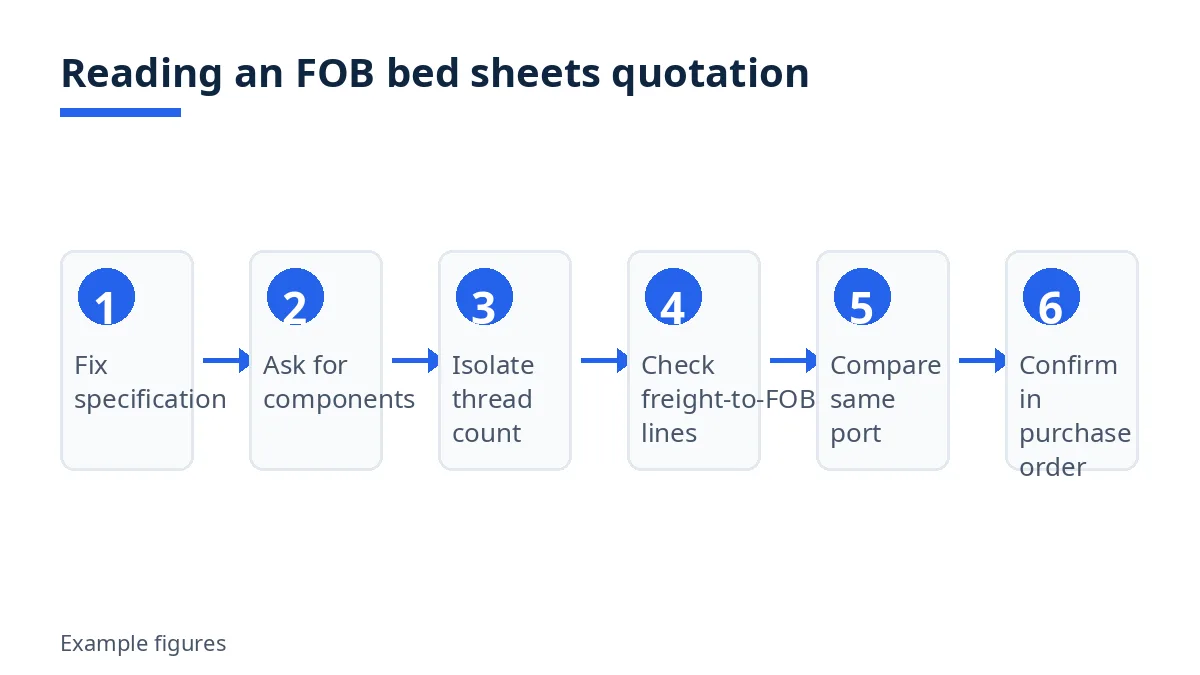
Fix the set and the specification in writing. State the pieces, fibre composition by weight, weave, thread count with ply, finished weight, dimensions, hem and fitted-sheet details, colour or print, labelling and packing.
Ask for the price broken into components. Ask the supplier to state fabric, dyeing or printing, cutting and sewing, finishing, packing, inland transport, origin handling, export clearance and loading as separate lines. A single lump sum hides which line moved.
Isolate thread count before you compare totals. Hold every other line steady and ask what the same set costs at each thread count target.
Check the freight-to-FOB lines, not only the making lines. Confirm what inland transport, origin handling, export clearance and loading each include, and which named port of loading they run to.
Compare only on the same term and port. Put every quotation on FOB terms at the same named port of loading, for the same set and packing.
Confirm the breakdown in the purchase order. Write the component lines, the thread count target with ply, the packing, the named port and the delivery term into the purchase order.
Costs, timelines and documents
An FOB price for bed sheets is made of making costs plus freight-to-FOB costs: the sheet itself, plus everything needed to get the finished, packed set from the factory onto the vessel.
FOB component | What it covers | What moves it |
|---|---|---|
Yarn and fabric | Yarn, weaving, fabric weight | Fibre, blend, yarn count, weave, thread count, weight |
Dyeing or printing | Colour or print on the fabric | Colour, print colours, batch size per colour or print |
Cutting and sewing | Panels, hems, fitted corners, elastic | Set pieces, fitted construction, hem width, elastic |
Finishing | Steps applied after sewing | Finishing route, pressing, folding, quality checks |
Packing | Set packing, inserts, labels, cartons | Pieces per set, retail packing, carton size and weight |
Inland transport | Factory to the port of loading | Factory location, distance, carton volume and weight |
Origin handling and export clearance | Port handling, documents, customs clearance | Port, document readiness, shipment size |
Loading | Loading on board the vessel | Vessel, port handling charges, shipment size |
Example figures: for one cotton percale set with two pillowcases, an itemized FOB quotation might read 58 for yarn and fabric, 12 for dyeing, 14 for cutting and sewing, 8 for finishing and packing combined, and 8 for inland transport, origin handling, export clearance and loading combined, on a scale where the FOB total is 100. The figures show structure only, not market rates. Fabric is the largest line, and the freight-to-FOB lines are a small but real part of the total that a lump-sum quotation hides.
Thread count as the main price lever
Thread count is measured by counting the number of threads contained in one square inch of fabric, including both the length (warp) and width (weft) threads.4 A higher count packs more threads into the same square inch, which uses more yarn per set and usually finer yarn, so the yarn and fabric line rises first. When two quotations for the same size and set differ sharply, thread count is the first line to check.
Ply is the trap inside the number. A yarn made by twisting together multiple finer threads is a plied yarn, and counting each component thread can inflate the stated count without adding threads to the fabric.4 Accepted industry practice, as cited by the National Textile Association, is to count each thread as one, even threads spun as two- or three-ply yarn.4 Ask for the count followed by the ply, in writing, so the same number means the same fabric from every supplier.
Example figures: take the same cotton percale set at the same size, packing and port. At the lower thread count target, the yarn and fabric line reads 52 on a scale where the FOB total is 100. At the higher target, with every other line unchanged, the yarn and fabric line reads 64 and the FOB total rises to 112. The example shows structure only, not market rates.
What FOB includes and what it leaves out
Cost | Inside the FOB price | Outside the FOB price |
|---|---|---|
Yarn, fabric, dyeing, printing, sewing, finishing | Yes | No |
Packing, labels and cartons | Yes | No |
Inland transport, clearance and loading | Yes | No |
Ocean freight to the destination port | No | Yes, buyer contracts the carrier1 |
Marine insurance | No | Yes, buyer arranges unless otherwise agreed |
Destination charges, import clearance, onward transport | No | Yes, buyer handles import formalities1 |
What are the typical costs and timelines?
There is no typical FOB price or timeline a guide can state as fact, because each supplier prices your fibre, weave, thread count target, finished weight, set composition, dyeing or printing route, packing and freight-to-FOB lines. The Incoterms 2020 rules allocate cost, risk and obligations for each rule,2 so compare prices only on the same rule and named port. For timelines, ask for sampling, fabric ready, production, inspection and shipment dates as separate lines.
Which documents are needed?
For export clearance in Bangladesh, goods shall not be allowed to load or ship for export unless an export declaration, known as the Bill of Export or Shipping Bill, is submitted to Customs in a prescribed format and approved by the Customs authority.5 The documents enclosed with the Bill of Export for all export consignments are the export letter of credit, or where there is none the export contract, purchase order or export guarantee approved by the negotiating bank, the commercial invoice, the packing list, the EXP form certified by Authorized Dealers, the certificate of origin issued by the Export Promotion Bureau or a Chamber of Commerce and Industry, the VAT registration certificate, and the Taxpayer Identification Number.5
Keep the buyer documents beside them: the specification sheet, the itemized FOB quotation, the purchase order, the approved sample record, and the label artwork.
Bangladesh-specific rules and tips
Classify each piece before you price it. Heading 6302 splits bed linen by construction, print status and fibre,3 so confirm the full code for each piece in the set before you fix a selling price. A set that mixes a printed flat sheet with plain pillowcases can span more than one line. See the HS code for bed sheets guide.
Write the label from the specification. For the European Union, Regulation (EU) No 1007/2011 states that a textile product shall be labelled or marked with the name and percentage by weight of all constituent fibres in descending order.6 Agree the fibre wording at sampling stage and check that the percentages match the fabric bought.
Keep one legal name across every paper. The export declaration specifies the name of the exporter and the foreign buyer,5 so the name on the trade licence, quotation, proforma invoice, payment account and certificate of origin should match.
State the named port and the packing in every quotation. FOB is always tied to a named port of shipment,1 so a quotation without a named port cannot be compared with one that names it. Pieces per set, carton size and carton weight decide both the packing line and the inland transport line.
Mistakes and red flags
What are the most common mistakes?
Comparing an FOB price with a CIF price. A CIF price includes ocean freight and insurance, while an FOB price stops at loading.1 Put every quotation on FOB terms at the same named port before you compare.
Reading a thread count number without the ply. A count that counts each ply as a separate thread can double or triple the stated number without adding threads to the fabric.4 A quotation that states no ply cannot be compared with one that does.
Accepting a lump-sum quotation. A single total hides whether the gap sits in fabric, in packing, or in the freight-to-FOB lines. Ask for the component lines, and treat a supplier that will not break the price down as a supplier whose price cannot be compared.
Treating packing as free. Set packing, inserts, labels and cartons carry their own line, and a quotation that excludes them will rise when packing is added.
Treating a profile or a badge as a capacity check. A profile is a starting point for enquiries. It does not test whether a supplier can make your sheet at your volume, and a badge is not a guarantee of capacity, quality or delivery.7
Red flags in a reply. A supplier that will not state fibre composition by weight, weave, thread count with ply, or finished weight; a quotation with no named port, no validity period and no component lines; a sample offered only in a substitute fabric; or payment requested to a personal account rather than the company account named in the documents.
Checklist
Specification fixed: pieces, fibre by weight, weave, thread count with ply, finished weight.
FOB price broken into components: fabric, dyeing or printing, sewing, finishing, packing, transport, handling, clearance, loading.
Named port of loading stated, with freight-to-FOB lines running to that port.1
Packing confirmed: pieces per set, carton size, carton weight, labels and inserts.
Quotations compared on the same specification, FOB term and named port.2
Sample approved in writing, including fibre wording for the label.6
Export set agreed: invoice, packing list, EXP form, certificate of origin, Bill of Export.5
Classification confirmed per piece under heading 6302.3
One legal name across quotation, invoice, payment account and origin documents.5
How Exportain helps
On Exportain, browse suppliers and post your set specification, thread count target with ply, packing and named port on the RFQ board, so suppliers quote against the same specification. When you accept a quotation, Exportain creates one order and issues one proforma invoice from the accepted terms.7
Read the badges for what they record. Exportain Verified means Exportain has checked identity, phone, email and business registration, and Export Verified means it has checked the Export Registration Certificate (ERC).7 Factory Verified means it has reviewed photos of the factory, while Trading Company Verified means it has reviewed photos of the office or warehouse.7 Verification is a document and photo review by staff, free, and never granted by membership plans.8 It is not a factory inspection,7 8 so sample approval and inspection stay with you.
FAQs
What should I know first about bed sheets?
Bed sheets are bed linen under heading 6302, split by construction, print status and fibre.3 An FOB price for a set is the sum of making costs plus freight-to-FOB costs. Fix the specification, including thread count target with ply, before you ask for a price.
What are the typical costs and timelines?
There are no typical figures a buyer can rely on, because each supplier prices your fibre, weave, thread count target, finished weight, set composition, dyeing or printing route, packing and freight-to-FOB lines. The Incoterms 2020 rules allocate cost, risk and obligations for each rule,2 so compare quotes only on the same rule and named port.
Which documents are needed?
The order documents are the specification sheet, the itemized FOB quotation and the purchase order, with the thread count target, packing, named port and delivery term on each. The export set is the Bill of Export, commercial invoice, packing list, EXP form certified by an Authorized Dealer, and certificate of origin.5
What are the most common mistakes?
The most common mistakes are comparing an FOB price with a CIF price,1 reading a thread count number without the ply,4 accepting a lump-sum quotation with no component lines, and reading a badge as a guarantee.7
Next steps on Exportain
Browse suppliers, then post your set specification, thread count target with ply, packing and named port on the RFQ board so suppliers quote FOB on the same terms. Before you confirm, read the wholesale bed sheets guide.
Sources
- FOB & FAS Incoterms® 2020 explained: Key differences. ICC Academy (accessed )
- Incoterms® 2020. International Chamber of Commerce (ICC) (accessed )
- HS 2017 - Code 6302: Bed linen, table linen, toilet linen and kitchen linen. United Nations Statistics Division (accessed )
- Thread Count. Apparel Search (accessed )
- Customs Clearance Procedures for Export. Bangladesh Customs, National Board of Revenue (accessed )
- Regulation (EU) No 1007/2011 on textile fibre names and related labelling and marking of the fibre composition of textile products. European Union, (accessed )
- Trust & Safety Center. Exportain (accessed )
- Supplier verification: Earn trust badges buyers can see. Exportain (accessed )
About the author
Sourcing from Bangladesh?
Post a request for quotation and suppliers on Exportain can send you their quotes directly.
Post an RFQ