

Bed Sheets Lead Time From Bangladesh: Production and Shipping Timeline
Plan a bed sheet lead time from Bangladesh by set-matching: weave and size system first, color matched across flat sheet, fitted sheet, and pillowcases from one dye lot, then pressing, folding, and packing as a full stage, with inspection, documents, and loading last.
Short answer
A bed sheet lead time from Bangladesh follows five stages for a matching set: cloth and size system, color matched across the flat sheet, fitted sheet, and pillowcases from one dye lot, cutting and sewing, pressing, folding, and packing as a full stage, then inspection, documents, and loading. Every duration is an illustrative planning example only. Replace it with the dated figures in the written quote and the dated forwarder estimate before setting a selling date.

On this page
Key takeaways
A bed sheet order is a set, not a single piece: flat sheet, fitted sheet, and pillowcases must match in cloth, shade, and size, and the fitted sheet must also match mattress depth including any topper, so all three are specified together before cutting.
Fix weave, fiber, thread count with its ply basis, and finish in writing first: percale is a crisp one-over, one-under weave at 200 to 300 thread count, while sateen is a smoother float weave at 400 to 600, and a count without its weave and ply basis does not describe the sheet.
Judge color across the whole set, not on one swatch: the color code names the intended shade while the dye-lot number names the batch, so lay the flat sheet, fitted sheet, and pillowcases together under daylight and planned room lighting before cutting is approved.
Treat pressing, folding, and packing as a full stage and check hems and elastic after pressing, pack complete sets rather than loose pieces, and read every duration as an illustrative planning example only, replaced by the dated quote and forwarder estimate.
A bed sheet order is never one piece. It is a set that has to look like one set on the bed: flat sheet, fitted sheet, and pillowcases cut from the same cloth, dyed in the same lot, and finished to the same standard. That set logic sets the lead time. A single sheet can be ready while its pillowcases still wait for a color match, and a fitted sheet can be sewn while its pocket depth is still wrong for its mattress. This guide reads the order through that set logic, in five stages, with flat finish as a stage of its own. Three clocks run at once: cloth, color, and flat finish. When one clock stops, the set stops, so plan all three together, with a written specification for each stage and a dated quote and forwarder estimate as the only sources for dates you promise onward.
Why this matters for buyers
A bed sheet fails in ways a buyer can see at first glance: a fitted sheet that is too shallow rides up at the corners, a flat sheet cut short leaves legs uncovered, and pillowcases a shade apart from the flat sheet look mismatched even if each piece passed on its own. Size, weave, color, and finish therefore belong in one specification, agreed before cutting.
Weave comes first because it fixes how the sheet feels and which thread count range makes sense. Percale is a one-over, one-under weave producing a crisp, matte, cool sheet, while sateen floats several threads over one for a smoother, silkier drape with a light sheen.1 A good thread count for cotton percale sits at 200 to 300, and for cotton sateen at 400 to 600, and a count outside the weave's natural range is often reached by counting ply rather than weaving finer yarn.1
Size comes second because a sheet set serves a mattress, not a label. Flat sheets are simple rectangles larger than the mattress so they can be tucked in or left to hang, while fitted sheets must match the width, length, and depth of the mattress.2 Fitted sheets commonly come in standard pockets up to 12 inches, deep pockets for 13 to 17 inches, and extra-deep pockets for 18 inches or more; too shallow slides off, too deep wrinkles and bunches.2 Add any topper to the mattress height before choosing a pocket, and state the size system in writing, since a Queen in one market is not the same bed as a Queen in another.2
Step-by-step: how it works
Read the order in five stages. Each stage closes with a written confirmation and a physical sample or measurement, not with a verbal assurance.
Stage 1: Cloth and size system
Stage 1 fixes the cloth and the size system for the whole set. State weave, fiber content, thread count with its ply basis, and finish or certification in writing, plus finished sizes for the flat sheet, fitted sheet, and each pillowcase, including pocket depth. Check the specification on a cut sample of the actual cloth, and confirm the flat sheet has enough extra width and length for tucking and overhang.2 Stage 1 closes when every piece is sized from the same mattress measurement and size system.
Stage 2: Color across the whole set
Stage 2 fixes color for the set, not for a single swatch. A color name or number identifies the intended shade, while the dye-lot number identifies a particular production batch, so two rolls with the same color code can still differ if they come from different lots.3 Small changes in dye concentration, water chemistry, temperature, processing time, or fibers can alter the finished shade, and a difference hard to see in separate samples may become clear when large pieces sit side by side.3 Lay the flat sheet, fitted sheet, and pillowcases together under daylight and planned room lighting before cutting is approved, and keep the product code and lot number with the order records.3 One dye lot reduces mismatch risk but does not guarantee identical surfaces, so the shade standard and judging light both belong in the specification.3 Stage 2 closes when shade is approved on finished cloth, across the pieces sold together, not only on a lab dip.
Stage 3: Cutting and sewing the set
Stage 3 cuts and sews the flat sheet, fitted sheet, and pillowcases as one job. The flat sheet needs a hem finish that stays flat after pressing, with stated hem depth and stitch type at top and foot. The fitted sheet needs corner seams forming a true pocket, elastic holding the corners under the mattress without pulling the side walls short, and a pocket depth matching mattress height plus any topper, measured from base to top.2 Pillowcases need the same cloth and lot as the sheets, with a stated opening finish and finished size. Stage 3 closes when one complete set, laid on a bed of the stated size, matches the specification in size, pocket, hem, and shade, before the rest is cut.
Stage 4: Pressing, folding, and packing as a stage
Stage 4 is where bed sheets differ most from garments. A sheet is wide, flat, and fully visible, so pressing, folding, and packing decide how it looks when the buyer opens the carton. Press each piece flat, check hems and elastic after pressing rather than before, and fold to a stated fold size so every set stacks to the same height. Pack sets, not loose pieces, so a carton opened at inspection contains complete sets. State fold, set composition per pack, pieces per carton, and carton marking in writing, and check a packed carton against the packing list before sealing. Stage 4 closes when a sealed carton holds complete, matching sets at the stated fold.
Stage 5: Inspection, documents, and loading
Stage 5 checks the packed sets, completes the export documents, and loads the goods. Inspection covers size, pocket depth, hem finish, shade across the set, and packing, on sets drawn from sealed cartons and open pieces. Export documentation for garments and textiles from Bangladesh includes commercial invoices, packing lists, bills of lading or air waybills, export declaration forms, and certificates of origin, with correct Harmonized System codes assigned.4 Under Bangladesh customs rules, goods may not be loaded or stuffed into containers for export until an export declaration, known as a Bill of Export or Shipping Bill, is submitted and approved, with goods description, value, exporter, buyer, and transport operator specified.5 Documents enclosed with the Bill of Export include the export letter of credit or contract or purchase order, the signed commercial invoice, the packing list, the EXP form certified by an authorized dealer, the certificate of origin, the VAT registration certificate, and the taxpayer identification number.5 Stage 5 closes when inspection is recorded, the Bill of Export is approved, and loaded cartons match the documents piece for piece.
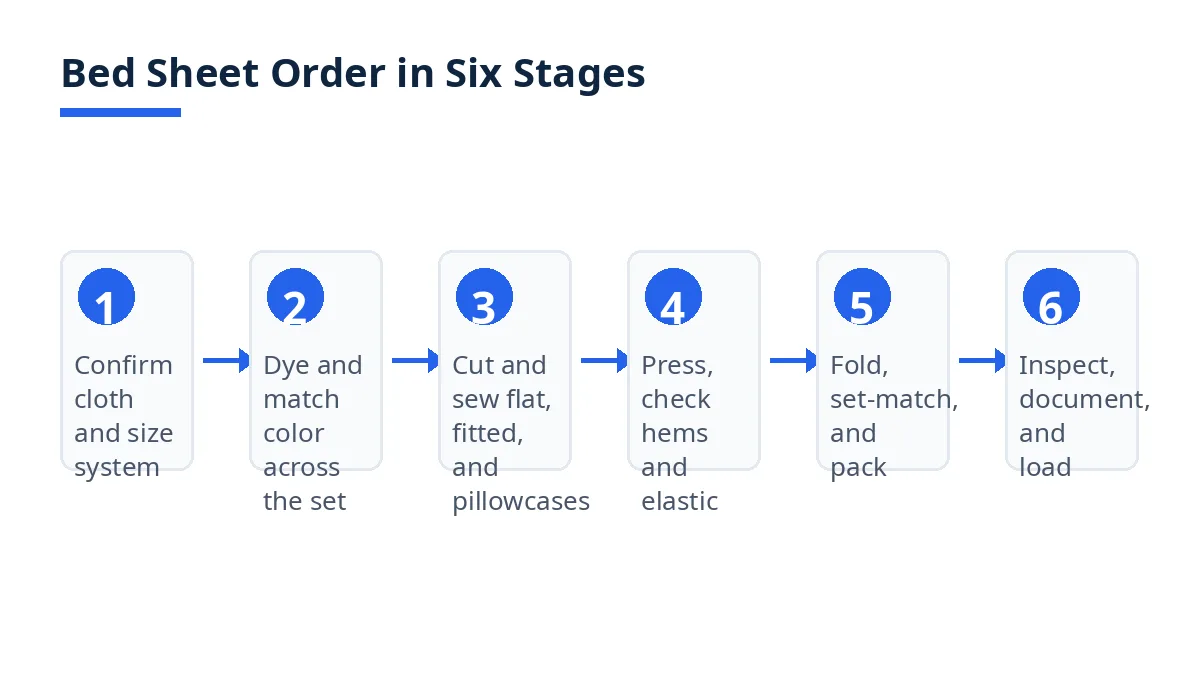
Costs, timelines and documents
Every duration in this section is an illustrative planning example only. Replace each one with the dated figures in the written quote and the dated forwarder estimate before setting a selling date or a delivery promise.
Stage | What to lock in writing | Example planning range only | What moves it |
|---|---|---|---|
Cloth and sampling | Weave, fiber, thread count and ply, finish, size system | 1 to 3 weeks | Cloth availability, sample revisions |
Color approval | Shade standard, light source, dye lot, set-match check | 1 to 2 weeks | Lot change, shade revision |
Cutting and sewing | Hem finish, pocket depth, elastic, set composition | 2 to 4 weeks | Set complexity, size range |
Pressing, folding, packing | Fold size, pieces per pack, pieces per carton | 1 to 2 weeks | Fold change, re-packing |
Inspection, documents, loading | Inspection record, Bill of Export approval, loading | 1 to 2 weeks | Document gaps, inspection findings |
Cost blocks follow the same order as the stages: cloth by weave, fiber, and thread count; dyeing and finishing by shade depth, lot handling, and any named certification; sewing by hem work, pocket construction, and elastic; pressing, folding, and packing by fold size, pack composition, and carton count, where a bulky fold that raises carton count raises freight with it. Freight, insurance, and destination charges follow the delivery term, not the factory price alone.
The delivery term needs care. The Incoterms 2020 rules are eleven three-letter trade terms fixing the delivery point, the point where risk passes, and who pays for carriage, insurance, and customs clearance.6 For containers handed over at a terminal in Bangladesh, FCA, CPT, or CIP often match the handover better than FOB, CFR, or CIF, and under the C rules the seller pays carriage to destination while risk passes much earlier, at origin.6 Price every quote to the same point, ideally the buyer warehouse, and confirm which destination charges, duty, and broker fees each quote already includes.6 Labels should carry size, material composition, care instructions, and country of origin, and certifications such as OEKO-TEX Standard 100 or the Global Organic Textile Standard should be named only where actually held.4
Bangladesh-specific rules and tips
Bangladesh customs procedure shapes the end of every timeline, so build document time into the plan rather than adding it after packing. Goods are loaded only after the export declaration is approved following documentary check and physical verification, and export is complete once the vessel or vehicle leaves the port and the customs officer signs the shipping bill as shipped on board.5 A packing list that does not match the cartons, an invoice that does not match the goods description, or a missing EXP form will hold the shipment where the timeline has the least slack. Check the document set against the packed cartons before the goods move to the port.
Mistakes and red flags
Approving shade on a single swatch, then finding pillowcases a shade apart from the sheets when the set is laid out.
Naming a thread count without its weave and ply basis, so a high number hides a multi-ply count that adds weight without quality.1
Ordering a fitted sheet by bed name alone, without mattress width, length, and height including any topper.2
Checking hems before pressing, then finding hems that sit unevenly once the sheet is pressed flat.
Packing loose pieces instead of complete sets, so inspection cannot check a set as the buyer will receive it.
Treating a freight-inclusive price as a delivered price without checking where risk passes and which destination charges remain with the buyer.6
Sending goods to the port before the Bill of Export is approved, or with a packing list that does not match the sealed cartons.5
Naming a certification the goods do not hold, or leaving required market certificates out of the order specification.4
Checklist
[ ] Weave, fiber, thread count with ply basis, and finish or certification stated in writing for the whole set.
[ ] Finished sizes stated for flat sheet, fitted sheet with pocket depth, and each pillowcase, in one size system.
[ ] Shade standard, light source, and dye lot stated, with flat sheet, fitted sheet, and pillowcases checked together before cutting is approved.
[ ] Hem finish, pocket construction, and elastic stated, and one complete set checked on a bed of the stated size.
[ ] Pressing, fold size, set composition per pack, pieces per carton, and carton marking stated.
[ ] Packed cartons checked as complete sets against the packing list before sealing.
[ ] Inspection recorded, Bill of Export approved, and loaded cartons matched to invoice and packing list.
[ ] Delivery term stated with rule, named place, and edition, and every quote priced to the same point.
How Exportain helps
Exportain lists Bangladeshi suppliers and their product ranges in one place, and buyers can post a sourcing requirement describing the set, sizes, weave, and finish they need. A requirement written with the cloth, color, and flat-finish details from this guide gives suppliers a specification they can quote against, rather than a general request returning prices for different products. Ask each quote to state the Incoterms rule, named place, and included destination charges, so quotes can be checked against this guide's checklist before any date is promised onward.6
FAQs
What should I know first about bed sheets?
Know the set before the price: flat sheet, fitted sheet, and pillowcases matching in cloth, shade, and size, with the fitted sheet also matching mattress depth including any topper.2 Fix weave, fiber, thread count with its ply basis, and finish in writing first, since percale and sateen feel different at different count ranges.1 Fix color as a set, under an agreed light, since lot numbers identify batches and two rolls with the same color code can still differ.3
What are the typical costs and timelines?
Costs split into cloth, dyeing and finishing, sewing, pressing and packing, freight, insurance, and destination charges, each moving with the specification and delivery term. Timelines follow the five stages in this guide, and every range in the table above is an illustrative planning example only. Replace each range with the dated figures in the written quote and forwarder estimate, and price every quote to the same delivery point.6
Which documents are needed?
The export document set includes the export letter of credit or contract or purchase order, the signed commercial invoice with a detailed goods description, the packing list with quantity, weight, and packing information, the EXP form certified by an authorized dealer, the certificate of origin, the VAT registration certificate, and the taxpayer identification number, all enclosed with the Bill of Export.5 Broader export documentation includes invoices, packing lists, bills of lading or air waybills, export declaration forms, and certificates of origin, with correct Harmonized System codes, and labels should carry size, material composition, care instructions, and country of origin.4
What are the most common mistakes?
The most common mistakes are approving shade on one swatch instead of across the set, naming a thread count without its weave and ply basis, ordering a fitted sheet by bed name without mattress height, checking hems before pressing, packing loose pieces instead of complete sets, and reading a freight-inclusive price as a delivered price without checking where risk passes.6 Each is cheap to prevent at specification stage and expensive to fix later, since the fix touches the whole set.
Next steps on Exportain
Start with the specification in this guide, then put it to suppliers in a form they can quote against. Browse Bangladeshi suppliers, read the Incoterms guide for shipments from Bangladesh before agreeing a delivery term, and post the full set specification as an open buying lead so quotes arrive against the same sizes, shade standard, and fold.
Sources
- What's a Good Thread Count for Sheets? Bedding Value Guide. MyHouse (accessed )
- Bed Sheet Sizes Guide: How to Choose the Right Fit. EasyRest (accessed )
- What is Dye-lot?. RoomAI (accessed )
- How to export garments overseas from Bangladesh. DHL (accessed )
- Customs Clearance Procedures for Export. Bangladesh Customs, National Board of Revenue (accessed )
- Incoterms for Shipments From Bangladesh. Exportain (accessed )
About the author
Sourcing from Bangladesh?
Post a request for quotation and suppliers on Exportain can send you their quotes directly.
Post an RFQ


