Bath Towels Lead Time From Bangladesh: Production and Shipping Timeline
Plan a bath towel lead time from Bangladesh by approval gates: terry and GSM, border and hems, dye shade, lint and absorbency, labelling, pressing and folding, then inspection, documents, and loading.
Short answer
A bath towel lead time from Bangladesh runs on approval gates, not a single production run: terry construction, GSM and pile height, hemming and dobby or border design, dyeing and colour consistency, lint and absorbency, wash-care labelling, then pressing, folding, inspection, export documents, and loading. Every duration is an illustrative planning example only. Replace it with the dated figures in the written quote and the dated forwarder estimate before setting a selling date.

On this page
Key takeaways
A bath towel order runs on approval gates in a fixed order: terry construction before GSM and pile height are locked, GSM and pile height before border approval, border before dye shade approval, dye before lint and absorbency approval, and lint, absorbency, and labelling before pressing, folding, inspection, and packing.
State GSM, pile height, and loop density as three separate buyer-spec items in writing, and check them on more than one towel and across the full width, since a heavy towel can still carry short, sparse loops and pile that is thin at the edges will not dry evenly.
Approve dye shade across more than one dye lot and after washing, approve lint and absorbency against a written buyer pass level and test method with no universal threshold assumed, and approve hems only after pressing, since a hem approved before pressing can curl.
Read every duration as an illustrative planning example only, replace it with the dated figures in the written quote and the dated forwarder estimate, and keep a buffer after border, dye, and hem approval, and after inspection.
A bath towel order from Bangladesh is decided at the pile, at the border, at the dye lot, at the hem, and at the label. A towel that measures correctly on paper can still fail when the pile is uneven across its width, when the dobby border sits off-register at one end, when a second dye lot dries a shade lighter than the first, when a short-end hem curls after pressing, or when the wash-care label states a method the towel cannot survive. This guide reads a bath towel order through approval gates, Every duration here is an illustrative planning example only, or an item to confirm in the written quote and the dated forwarder estimate.
Why this matters for buyers
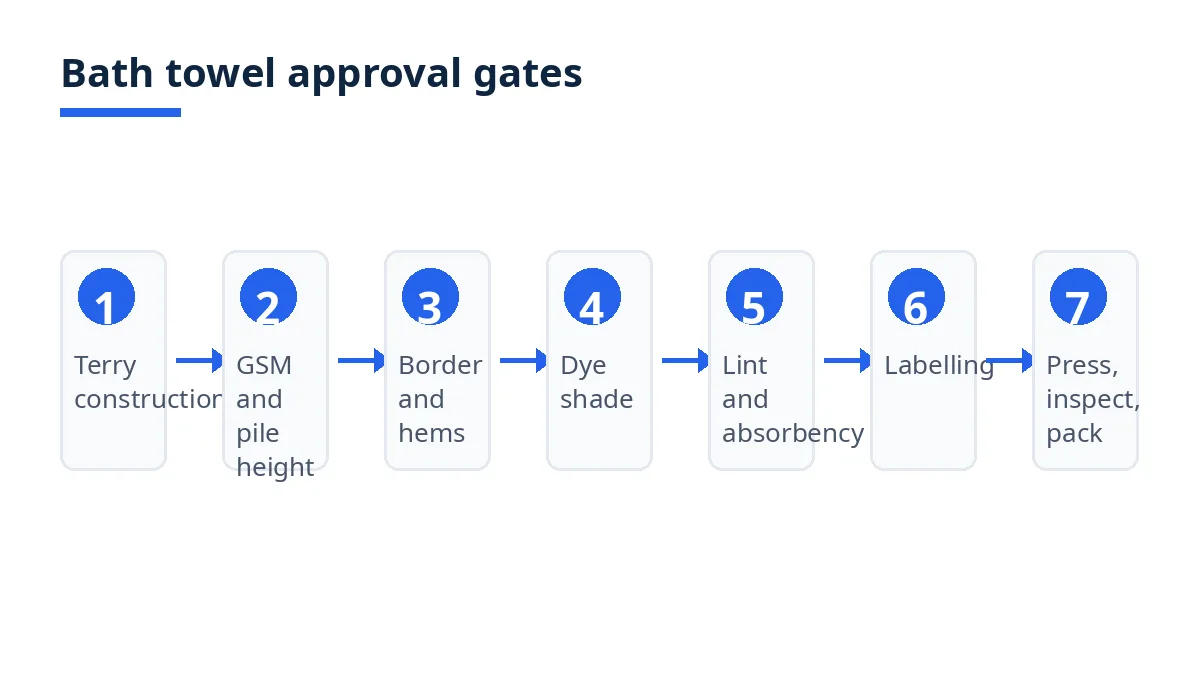
A towel is a surface before it is a size. Its working part is a field of loops, and those loops must stand upright, hold together through washing, and release lint at a level the buyer has accepted in writing. That makes a towel order different from a garment order: there is no fit to hide behind, and every fault shows on a flat, open surface. The towel-specific order is: terry construction before GSM and pile height are locked, GSM and pile height before border approval, border before dye shade approval, dye before lint and absorbency approval, lint and absorbency before labelling, and labelling, pressing, and folding before inspection and packing.
Step-by-step: how it works
Read a bath towel order against seven gates, in this order.
Gate 0: Terry construction
Gate 0 fixes the terry cloth itself, before any size, border, or colour is approved. The buyer states the construction in writing: the yarn type, the spinning method, and whether the towel is single or double terry. A balance of tension between the weft, the warp, and the pile keeps the pile as upright as possible, so the loops can capture moisture and transfer it to the base of the towel.1 Double terry construction improves plushness and longevity, while single terry is the lighter construction.2 Ring-spun yarns deliver longer, smoother, and finer loops, while open-end spinning favors cost-effective, bulkier piles.2 Gate 0 closes when the yarn, spinning method, and terry construction are named in writing and confirmed on a woven sample, not only on a specification sheet.
Gate 1: GSM and pile height as buyer-spec items
Gate 1 approves GSM and pile height as buyer-spec items, stated in writing for this order. GSM means grams per square metre: the more picks, which are horizontal yarns, and ends, which are vertical yarns, the heavier the towel weight per square metre will be.1 Pile height and loop density are separate items from GSM, and all three must be named, because a heavy towel can still carry short, sparse loops. High, open loops maximize surface area for water capture, while short, dense loops improve wicking and resistance to pile pull.2 A Gate 1 approval names the GSM, the pile height, and the loop density, and checks them on more than one towel and across the full width of each towel,. If any of the three numbers is missing, Gate 1 is still open.
Gate 2: Hemming and dobby/border design
Gate 2 approves the border and the short-end hems. A dobby border towel carries a header or border with a simple geometric weave, woven on dobby looms, which can have up to twenty-eight shafts and so allow a greater weave repeat than a standard plain towelling weave.1 Different weave designs are created by using patterns of yarns in dobby borders, and mercerised yarns can give a more lustrous effect than cotton yarns when dyed together.1 Intricate border designs need a different loom: a jacquard attachment allows each individual warp yarn to be raised independently, so intricate and textured designs can be woven.1 Gate 2 fixes, in writing and on a marked sample, the border position, width, pattern, and yarn, plus the hem method, depth, and finish at each short end. It closes only with a check after pressing, on both ends, since a hem approved before pressing can curl or sit unevenly once pressed.
Gate 3: Dyeing and colour consistency
Gate 3 approves the dye shade and its consistency across the order. Reactive and vat dyeing give deep coloration with minimal impact on absorbency, and are suited to cotton towels.2 A dye approval is a shade approval, not a colour name: the buyer states the dye method, the shade reference, and the lot-to-lot tolerance in writing, and checks the shade on a finished towel, not only on a yarn card or a lab dip. Gate 3 also requires a wash check, since a shade that matches dry can shift after washing. It closes only when towels from more than one dye lot sit side by side inside the agreed tolerance, and the washed sample still matches the approved shade.
Gate 4: Lint and absorbency as buyer-spec items
Gate 4 approves lint and absorbency as buyer-spec items, and it exists because the two pull in opposite directions. Less twist means open, fluffy yarns with greater water-holding capacity, but excessive untwisting can reduce pile pull resistance and increase linting.2 Enzyme washing removes loose fibers, reduces linting, and preserves absorbency.2 A Gate 4 approval therefore names, in writing for this order, the test method, the buyer pass level for that method, and the wash condition the test follows. One published method for water uptake is AATCC 79, and vertical wicking is measured by AATCC 197.2 This guide states no universal pass level: the buyer writes the level the order must meet, and the sample is judged against that written level after washing.
Gate 5: Wash-care labelling as a buyer-spec item
Gate 5 fixes the wash-care labelling wording. The buyer states the care instructions, fiber content wording, size marking, and country-of-origin marking required for the destination market, in writing, for this order. Labels for garments exported from Bangladesh carry required information such as size, material composition, care instructions, and country of origin.3 Gate 5 closes when the label wording, position, and care symbols are approved in writing, and the labels are checked on a finished, folded towel, not only on a label sheet, so a label sewn into a short-end hem is still readable and in the agreed position after pressing and folding.
Gate 6: Pressing, folding, inspection, and packing
Gate 6 runs bulk production only after Gates 0 to 5 have closed, and it ends with pressing, folding, inspection, and packing. Pressing and folding are a packing stage, not an afterthought: the buyer states the fold method, whether each towel is folded flat or rolled, the towels per polybag and per carton, the size and colour assortment per carton, and the carton marking, and checks a packed carton against that standard. Final inspection measures the packed towels against the approved samples for each gate. Goods that fail inspection stay out of the packed cartons.
Costs, timelines and documents
The table below is a stage framework only.
Stage | Illustrative planning example only | Gate that closes the stage |
|---|---|---|
Terry construction | Illustrative example: 1 week | Gate 0 approved |
GSM and pile height | Illustrative example: 1 week | Gate 1 approved |
Hemming and dobby/border design | Illustrative example: 1 week | Gate 2 approved |
Dyeing and colour consistency | Illustrative example: 1 week | Gate 3 approved |
Lint and absorbency | Illustrative example: 1 week | Gate 4 approved |
Wash-care labelling | Illustrative example: 1 week | Gate 5 approved |
Bulk, pressing, folding, inspection, packing | Illustrative example: 4 weeks | Gate 6 approved |
Documents and transit | Confirm in the dated forwarder estimate | Documents complete |
A worked example shows how the gates change a date. A buyer orders pale sage bath towels at a stated GSM, with a dobby border of two woven stripes and a reactive-dyed ground. The first sample comes back with pile that is full in the centre and thin at one edge, a border pattern that sits off-register at one short end, and a second dye lot that dries visibly lighter than the first. Gates 1, 2, and 3 stay open while the pile is rebalanced across the width, the border is rewoven on-register, and the shade is re-approved across lots. The corrected sample is approved, but one short-end hem curls after the final press and the towels leave loose fibers on a dark cloth after washing, so Gates 2 and 4 stay open for a second pressed hem check and a restated enzyme-wash step. Each reopened gate moves bulk sewing and packing.
For cost reading, use example figures only to compare quotes, and replace them with the written quote before planning. Illustrative example only: a single shipment at USD 24,600 on one delivery term, USD 1,780 for ocean freight, and USD 310 for marine insurance.
The document set gates loading and clearance. Export documentation for garments from Bangladesh includes commercial invoices, packing lists, bill of lading or air waybills, export declaration forms, and certificates of origin.3 Goods shall not be loaded or shipped for export unless an export declaration, known as the Bill of Export or Shipping Bill, is submitted to Customs in the prescribed format and approved by the Customs authority, and the documents enclosed with it include the commercial invoice, the packing list, the EXP form certified by authorized dealers, and the certificate of origin.4 The Incoterms guide on Exportain explains the 11 rules and the split between cost and risk under each rule.5 Write the rule, named place, and edition together.
Bangladesh-specific rules and tips
Bangladesh-specific timing comes from the document chain as much as from production. The export document set must be complete before loading, and a buyer who treats loading as a factory date, rather than a document date, will misread the schedule. Ask the seller to confirm, in writing, who prepares each document and by which gate date, and confirm the EXP form and certificate of origin owners early, since both sit inside the Bill of Export set.4 A second point is cost validity: the home textile sector, which includes terry towels, faced yarn price surges and gas price and supply pressure in prior years, and Export Promotion Bureau data put its export earnings at USD 871.57 million in the last fiscal year reported, a 2.42 percent increase on the year before.6 Ask for the price validity period in writing on every quote, so a yarn or energy cost move does not silently reopen the price while the gates are still open.
Mistakes and red flags
Approving terry construction without naming the yarn, spinning method, and single or double terry type.
Approving GSM with no pile height or loop density stated alongside it.
Approving a border pattern on a diagram, with no marked sample and no post-press hem check.
Approving a dye shade on one lot, with no cross-lot or post-wash check.
Approving absorbency with no written pass level and no lint check after washing.
Starting bulk before terry, GSM, border, dye, lint, and label wording are approved.
Treating a quoted delivery date as a loading date when the document set is not complete.
Checklist
Use this checklist before bulk starts.
[ ] Terry construction named: yarn, spinning method, single or double terry, confirmed on a woven sample.
[ ] GSM, pile height, and loop density approved, checked on more than one towel and across the full width.
[ ] Border position, width, pattern, and yarn approved on a marked sample; hems approved after pressing, both ends.
[ ] Dye method, shade reference, and lot-to-lot tolerance approved, shade matched across lots and after washing.
[ ] Lint and absorbency pass level written, test method named, sample judged after washing.
[ ] Care, fiber content, size, and origin wording approved, label position checked on a finished, folded towel.
[ ] Pressing, folding, and carton standard agreed, packed carton checked.
[ ] Invoice, packing list, EXP form, certificate of origin, and shipping bill owners and dates confirmed.
[ ] Dated forwarder estimate received, replacing every illustrative planning example here.
[ ] Price validity period confirmed in writing on the quote.
How Exportain helps
Exportain gives buyers a place to put the gate table from this guide into a sourcing request, so each reply can be compared gate by gate rather than date by date. A buyer can list the terry, GSM, pile, border, dye, lint, label, and document points as requirements, and ask each seller to reply against them in writing.
FAQs
What should I know first about bath towels?
Start with the order of approvals: terry construction before GSM and pile height are locked, GSM and pile height before border approval, border before dye shade approval, dye before lint and absorbency approval, lint and absorbency before labelling, and labelling, pressing, and folding before inspection and packing.
What are the typical costs and timelines?
Read costs and durations as a stage framework only. Every duration is an illustrative planning example, and every cost figure is an example figure for comparing quotes. Replace both with the written quote and the dated forwarder estimate before setting a selling date, and keep a buffer after border, dye, and hem approval, and after inspection.
Which documents are needed?
The core set is the commercial invoice, packing list, bill of lading or air waybill, export declaration, and certificate of origin, with the EXP form certified by authorized dealers enclosed with the Bill of Export or Shipping Bill.4 Confirm who prepares each document and by which gate date.
What are the most common mistakes?
The most common mistakes are approving GSM with no pile height or loop density, approving a border with no post-press hem check, approving a dye shade on one lot only, approving absorbency with no written pass level or post-wash lint check, and approving label wording without a check on a finished, folded towel. Each reopens a gate.
Next steps on Exportain
Browse the Exportain suppliers page and compare replies gate by gate.
Read the Incoterms guide for shipments from Bangladesh before agreeing a delivery term.
Post the gate table as a requirement on the Exportain RFQs page and ask each seller to reply against each gate in writing.
Sources
- Towel Weave Techniques Explained. Canningvale (accessed )
- 8 Expert Insights into Towel Absorbency, Loops & Yarn Twist. Circe Towel (accessed )
- How to export garments overseas from Bangladesh. DHL (accessed )
- Customs Clearance Procedures for Export. Bangladesh Customs, National Board of Revenue (accessed )
- Incoterms for Shipments From Bangladesh. Exportain (accessed )
- Home textile sector rebounds after a two-year slump. TOB News, (accessed )
About the author
Sourcing from Bangladesh?
Post a request for quotation and suppliers on Exportain can send you their quotes directly.
Post an RFQ