Using Bank Guarantee in Trade When Buying From Bangladesh: Bank Rules and Tips
A bank guarantee for buyers sourcing from Bangladesh: how an independent demand guarantee works under URDG 758, the bid, performance and advance-payment types, and the costs, documents and expiry terms to confirm with the issuing bank before you rely on one.
Short answer
A bank guarantee for buyers sourcing from Bangladesh is an independent demand guarantee: a bank promises to pay the beneficiary up to a stated amount when a complying demand is presented, examined against the guarantee terms alone under URDG 758 where those rules are stated to apply. Check the guarantee type, amount, expiry date, and demand documents before paying any advance, and confirm the fee with the issuing bank.
On this page
Key takeaways
A demand guarantee is independent of the underlying sales contract: the bank examines the demand and its stated documents alone, and a reference to the contract for identification does not change that character.
A demand guarantee differs from accessory surety, whose issuer may raise the principal's defences against the beneficiary; check the wording to confirm which instrument you hold.
Bid, performance, and advance-payment guarantees cover different buyer risks, and each pays only on a demand that complies with its own terms before expiry.
Under URDG 758, a demand must be supported by a statement of breach, and a non-complying demand is expected to be rejected within five business days with each discrepancy listed.
No guarantee-specific Bangladesh Bank fee, timeline, or validity rule was found in the material opened for this guide, so confirm every figure with the issuing or authorised dealer bank in writing.
A bank guarantee can change who carries the risk when you buy from Bangladesh, but only if the wording matches the risk covered. This guide explains the independent demand guarantee: what the bank promises, what it does not promise, and which terms to settle in writing first.
A demand guarantee is a bank undertaking to pay the beneficiary a stated amount, up to a stated maximum, when the beneficiary presents a demand that complies with the terms of the guarantee. The International Chamber of Commerce rules for demand guarantees, URDG 758, published in 2010 to replace URDG 458, provide the standard framework banks use for these instruments.1 URDG 758 applies only when the guarantee states that it is subject to those rules, so check the guarantee text itself.2
Why this matters for buyers and sellers
Three parties sit behind every demand guarantee: the applicant who asks the bank to issue it, the guarantor bank that gives the undertaking, and the beneficiary who may demand payment under it.1 A guarantee issued at the seller's request in the buyer's favour protects the buyer's advance payment or the seller's performance, while one issued at the buyer's request in the seller's favour can support the buyer's payment obligation. Read the guarantee to see who is applicant and who is beneficiary before you treat it as protection.
The point that matters most is independence. A demand guarantee is independent of the underlying sales contract: the guarantor deals with the demand and its stated documents, not with whether the goods were satisfactory.1 A reference in the guarantee to the underlying contract, for identification only, does not change that independent character.1 That is why the wording is decisive: the bank does not investigate the commercial dispute.
That independence separates a demand guarantee from accessory suretyship. A demand guarantee is independent of the underlying commercial contract, while surety is accessory to that contract.3 The issuer of surety has the same rights against the beneficiary as the principal has under the commercial contract, so it may refuse payment where the principal has disputed the beneficiary's right, while the issuing bank under a demand guarantee is prevented from making that same objection.3 In some countries the word guarantee is used in everyday language for surety, so check whether the document is independent or accessory, and ask for a demand guarantee if independence is what was intended.3
Three guarantee types cover most situations for buyers sourcing from Bangladesh:
Guarantee type | What it secures for the buyer | When it is used |
|---|---|---|
Bid guarantee | Seriousness of a bid where a tender requires security | Before a contract is awarded |
Performance guarantee | The seller carrying out the contract as agreed | From signing until delivery and acceptance |
Advance-payment guarantee | Repayment of an advance if the seller does not ship or perform | Where the buyer pays part of the price before shipment |
A performance guarantee does not certify product quality, and an advance-payment guarantee does not replace inspection. Each one pays only on a complying demand, so the protection is exactly as wide as the guarantee text.
Related instrument, not the same instrument: a standby letter of credit is a separate bank instrument that pays against documents showing non-performance or default, and it is governed by its own credit rules rather than by the demand-guarantee analysis in this guide. Do not treat a standby letter of credit and a demand guarantee as interchangeable: compare the issuing bank's undertaking, the documents required for a demand, and the expiry terms of the instrument you hold, and take advice on the wording before you rely on either one.
Step-by-step: how it works
Each step below turns on documents and dates, not on the commercial argument behind them.
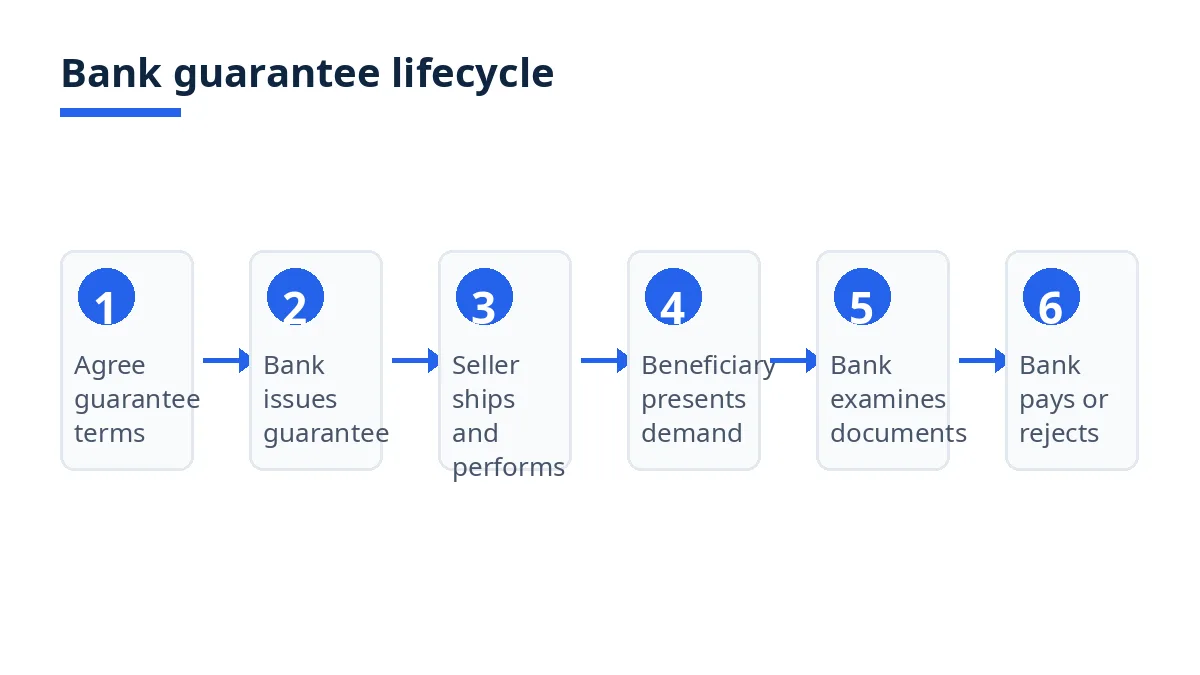
Agree the guarantee in the contract: type, maximum amount, beneficiary, expiry date, demand documents, and whether URDG 758 applies. Put these terms in writing before any advance is paid.
The applicant applies to its bank, mirroring the agreed terms. The bank issues the guarantee and sends it to the beneficiary, directly or through a bank in the beneficiary's country.
The beneficiary checks the guarantee on receipt: amount, expiry date, demand documents, and place of presentation. Ask for an amendment before shipment or before paying an advance if any term does not match the contract.2
The underlying order proceeds. The seller produces and ships, and the buyer pays any advance the guarantee secures. Keep the guarantee, the contract, and the payment evidence together.
If the trigger event happens, the beneficiary presents a demand. Under URDG 758, the demand must be supported by a statement from the beneficiary indicating in what respect the applicant is in breach of its obligations under the underlying relationship.2
The guarantor examines the demand against the guarantee terms alone. Under URDG 758, a guarantor is expected to reject a non-complying demand within five business days following the day of presentation, by a rejection notice listing each discrepancy; otherwise it will be precluded from claiming non-compliance and will be compelled to pay.2
The guarantor pays or rejects in writing. A complying demand is paid up to the guarantee amount, and a rejected demand may still be corrected and re-presented before expiry.2
Worked example
Example figures only, not a bank offer. A buyer in Portugal orders hand-stitched leather desk accessories from a supplier in Bangladesh for USD 42,500, with a 30 percent advance of USD 12,750 before production. The supplier's bank issues an advance-payment guarantee for USD 12,750 in the buyer's favour, expiring 30 days after the agreed shipment date. The buyer pays the advance only after checking the guarantee text. If the supplier ships as agreed, the guarantee runs to expiry without a demand. If the supplier does not ship, the buyer presents a demand with the statement of breach and any documents the guarantee requires, before expiry.
Costs, timelines and documents
No guarantee fee, commission rate, timeline, or validity period applies universally. Every item below is a confirm-with-bank item: ask the issuing bank for its figure in writing.
Item | Confirm in writing before you rely on the guarantee |
|---|---|
Guarantee fee and who pays it | Total fee, charging period, and whether it is deducted from any payment |
Validity period and expiry date | Calendar expiry date, presentation place, and any extension event |
Maximum amount and currency | Amount, currency, and whether partial demands are allowed |
Demand documents | Exact statement of breach wording and every supporting document |
Examination period | How many business days the guarantor has to examine a demand and give a rejection notice |
Amendment procedure | How an amendment is issued, accepted, or rejected |
Governing law and dispute forum | Which law applies and which court or tribunal decides disputes |
Counter-guarantee chain | Where a local bank issues against a foreign bank's counter-guarantee, which bank pays whom |
Expiry deserves separate attention. A demand presented after expiry does not comply, even if the breach is genuine, so diary the expiry date and the presentation route together. Under URDG 758, article 26 gives the beneficiary an extension of 30 calendar days for presentation if the guarantee expires while presentation is prevented by force majeure affecting the guarantor, while no extension applies where force majeure affects the beneficiary's business instead.2 Do not assume a grace period exists unless the guarantee text states one.
Documents to gather before issue, and to keep until expiry, are the sales contract, the guarantee text, the fee confirmation, proof of any advance payment, shipment and inspection records, and every amendment. A missing document is the most common reason a demand fails.
Bangladesh-specific rules and tips
No guarantee-specific Bangladesh Bank rule setting a standard guarantee fee, commission rate, timeline, or validity period was found in the Bangladesh Bank material opened for this guide, so do not rely on a standard figure: ask the seller's authorised dealer bank for the terms that apply to the actual transaction. The guarantee points below are stated only as that material states them.
Under the trade finance framework reported in 2026, authorised dealer banks may process advance payments of any amount for imports if supported by a repayment guarantee from a foreign bank, while advance payments without such a guarantee are limited to USD 20,000, or USD 50,000 from Export Retention Quota accounts.4 That is a rule about the importer's bank handling an advance payment, not a guarantee fee or form, and it shows why both banks need to be in the conversation early.
Bangladesh Bank's consolidated circular on export trade transactions states that where advance payment is received against exports, the export must be executed within one year of receipt, but that instruction does not apply to advance payment received against performance bonds or bank guarantees.5 The same circular directs authorised dealer banks to guide exporters facing transaction problems toward bringing transactions under external payment guarantees as set out in its open-account part.5 Confirm with the seller's authorised dealer bank how both points apply to the order in hand, rather than treating either as a promise about a particular guarantee.
Practical tips are to ask the seller which authorised dealer bank will handle the export, to confirm an authenticated advising channel, to agree type and expiry before paying any advance, and to keep the guarantee text with the quotation record. Where the seller's bank issues against a counter-guarantee from the buyer's bank, confirm which bank the beneficiary presents to and which bank pays.
Mistakes and red flags
The mistakes below can turn a protective-looking guarantee into one that cannot be called on.
Treating a document called a guarantee as independent without checking. If payment depends on proof of actual default or on the principal's defences, it may operate as accessory surety.3
Paying the advance before checking the guarantee text. Amount, expiry, demand documents, and presentation place must match the contract first.
Letting expiry pass while a dispute is argued. A commercial negotiation does not extend the guarantee.
Requiring documents the beneficiary cannot produce. A document depending on a third party who will not issue it makes the guarantee unusable.
Assuming URDG 758 applies. If the guarantee does not state it, examination, rejection, and amendment rules come from the guarantee text and governing law instead.2
Confusing the guarantee with payment for the goods. It pays on a complying demand; it does not pay the invoice, release shipping documents, or certify quality.
Accepting a guarantee from a bank the beneficiary cannot present to. Confirm the presentation place, advising route, and demand language in advance.
Red flags are an expiry date before the realistic shipment and acceptance window, a demand document list that includes a court judgment for what was presented as a demand guarantee, an amendment clause that takes effect unless rejected within a set time, and a governing law that neither party's bank can explain. Any of those is a reason to ask for revised wording before the order proceeds.
Checklist
Use this checklist before you pay an advance or accept a guarantee.
Guarantee type matches the risk: bid, performance, or advance-payment.
Applicant, guarantor, and beneficiary are named exactly as in the contract and bank records.
Maximum amount and currency match the advance or contract value covered.
Expiry date runs past shipment and acceptance, with presentation place and route confirmed.
Demand documents are listed, and the beneficiary can produce every one.
Fee, examination period, amendment procedure, governing law, and dispute forum are confirmed in writing.
Seller's authorised dealer bank and advising route are confirmed before any advance is paid.
Guarantee text, contract, fee confirmation, and payment evidence are filed together until expiry.
How Exportain helps
Exportain is a marketplace where buyers post requirements and receive quotations from Bangladeshi suppliers, and it is not a party to the contract for goods between buyer and seller. Agree guarantee type, issuing bank, maximum amount, expiry date, and demand documents in the quotation record before ordering, alongside price, Incoterm, and shipment terms.
Exportain's own payment arrangements are separate from a bank guarantee. Payment for goods is settled directly between buyer and supplier on the terms in the accepted quotation, unless both parties agree to a funds hold, and the platform's payment terms at https://exportain.com/payment-terms describe service-order holds and goods funds holds rather than bank guarantees.6 Buyer protection on Exportain covers document review for suppliers who apply for verification, a quotation history both sides can see, private document storage, and a route to report problems, and a badge is a record of checks reviewed rather than a delivery or quality guarantee.7
FAQs
What should I know first about bank guarantee?
A bank guarantee in this guide is an independent demand guarantee: a bank undertaking to pay the beneficiary up to a stated amount when a complying demand is presented, examined against the guarantee terms alone.1 First check who is applicant, guarantor, and beneficiary, whether the guarantee is independent or accessory, whether URDG 758 is stated to apply, and the expiry date and demand documents.
What are the typical costs and timelines?
There are no typical costs or timelines that apply to every guarantee. The fee, validity period, examination period, and any extension event are confirm-with-bank items for the transaction. Under URDG 758, a guarantor is expected to reject a non-complying demand within five business days following the day of presentation, with a notice listing each discrepancy.2
Which documents are needed?
The guarantee text itself is the authority for the documents a demand requires, and a URDG 758 demand must be supported by a statement from the beneficiary indicating in what respect the applicant is in breach.2 Beyond the demand, keep the sales contract, the guarantee text, the fee confirmation, proof of any advance payment, and shipment and inspection records.
What are the most common mistakes?
The most common mistakes are paying an advance before checking the guarantee text, treating an accessory document as an independent demand guarantee, letting expiry pass during a commercial dispute, and assuming URDG 758 applies when the guarantee does not state it.3 Check wording, expiry, and demand documents before money moves, and ask for an amendment where a term does not match the contract.
Next steps on Exportain
For the bank-undertaking alternative that pays a seller on complying documents, read the letter of credit guide at https://exportain.com/blog/lc-letter-of-credit.8 For the buyer protection measures that sit around a recorded quotation, read https://exportain.com/buyer-protection.7 When you are ready to source, post your requirement at https://exportain.com/rfqs and state the guarantee type, issuing bank, amount, and expiry you need, so suppliers can confirm whether they can work on those terms.
Sources
- The ICC Uniform Rules for Demand Guarantees URDG 758. City of Jackson (accessed )
- The practical application of the URDG in international trade. Trade Finance Global, (accessed )
- Demand guarantee and surety. Learn Export Finance (accessed )
- Bangladesh Bank launches new trade finance mechanism. The Financial Express, (accessed )
- Consolidated circular on foreign exchange regulations — export trade transactions (FEPD-1 Circular No. 26, July 30, 2026). Bangladesh Bank (accessed )
- Payment and Membership Terms. Exportain (accessed )
- Buyer protection: What Exportain does to protect buyers. Exportain (accessed )
- LC Meaning (Letter of Credit). Exportain (accessed )
About the author
Sourcing from Bangladesh?
Post a request for quotation and suppliers on Exportain can send you their quotes directly.
Post an RFQ