Woven Garments & Denim Sourcing From Bangladesh for Startup Brands
Startup guide to woven garments and denim sourcing from Bangladesh: one hero style, per-colour MOQ, denim wash approval, inspection and export documents for a first order that can grow into repeats.
Short answer
For a startup brand, woven garments and denim sourcing from Bangladesh works best as one hero style with a complete tech pack, a quantity split per colour, and a supplier that accepts trial orders. Agree the per-colour minimum, approve a washed sample for denim, write inspection and one delivery term into the purchase order, and confirm the export document set before production.
On this page
Key takeaways
Start with one hero style and a complete tech pack, and ask first whether the supplier accepts trial orders at your quantity.
The binding minimum is usually per style, per colour or per wash lot, not a single order total, so state the split per colour in every enquiry.
For denim, approve a washed sample in the final wash and record the wash reference, shade tolerance and shrinkage allowance in writing.
Write the inspection plan, AQL values and one delivery term into the purchase order, and compare quotations only on the same term.
Exportain verification is a document and photo review, not a factory inspection, and a badge is not a guarantee of capacity, quality or delivery.
A startup brand buying woven garments and denim from Bangladesh faces a different sourcing problem from a large retailer. The order is small, the budget is tight, and every unit that does not sell sits in stock that a new brand paid for in cash. This guide is written for that buyer: one or two hero styles, a first order that tests the market, and a supplier relationship that can grow into repeats.
Bangladesh has a deep woven base to draw on. The Bangladesh Garment Manufacturers and Exporters Association (BGMEA) represents the readymade garment industry, particularly the woven garments, knitwear and sweater sub-sectors, and has around 4,500 member factories, of which around 60 percent are woven garment manufacturers.1 That depth means a startup can usually find factories that already make its product type. It does not mean every factory will take a small order, and finding the ones that will is the core work of this guide.
Why this matters for buyers and sellers
For a startup buyer, the first order is a test, not a commitment to a range. One well-made shirt or jean that sells tells you more about your market than five styles that split your budget and your attention.
For a seller, a small order still carries the full set-up: pattern making, markers, cutting, line set-up, wash recipes for denim, trim and label runs. A factory that accepts a small first order is investing line time in a buyer that may or may not return. Startups that understand this, and that make the order easy to run, get better answers than startups that ask for a large-brand service level at a trial quantity.
Full package. The supplier sources the fabric, trims and labels, makes the garment, and delivers it under the agreed term. This is the simplest level for a first order, because one party owns the inputs and the timeline.
Cut, make and trim. You supply the fabric, or nominate it, and the supplier cuts, sews and finishes. This suits a brand that already owns fabric or has a fabric supplier, but it adds a second supply chain for a startup to manage.
Sourcing support. A supplier or agent helps you find fabric, wash capacity or trims, while production stays with a factory. Use this only where you have a gap you cannot fill yourself, and keep responsibility for each input in writing. For a first woven or denim order, full package is usually the practical choice, because it keeps fabric, wash and trims under one quotation and one timeline. Whichever level you choose, state it in the enquiry so quotations can be compared on the same basis.
Step-by-step: how it works
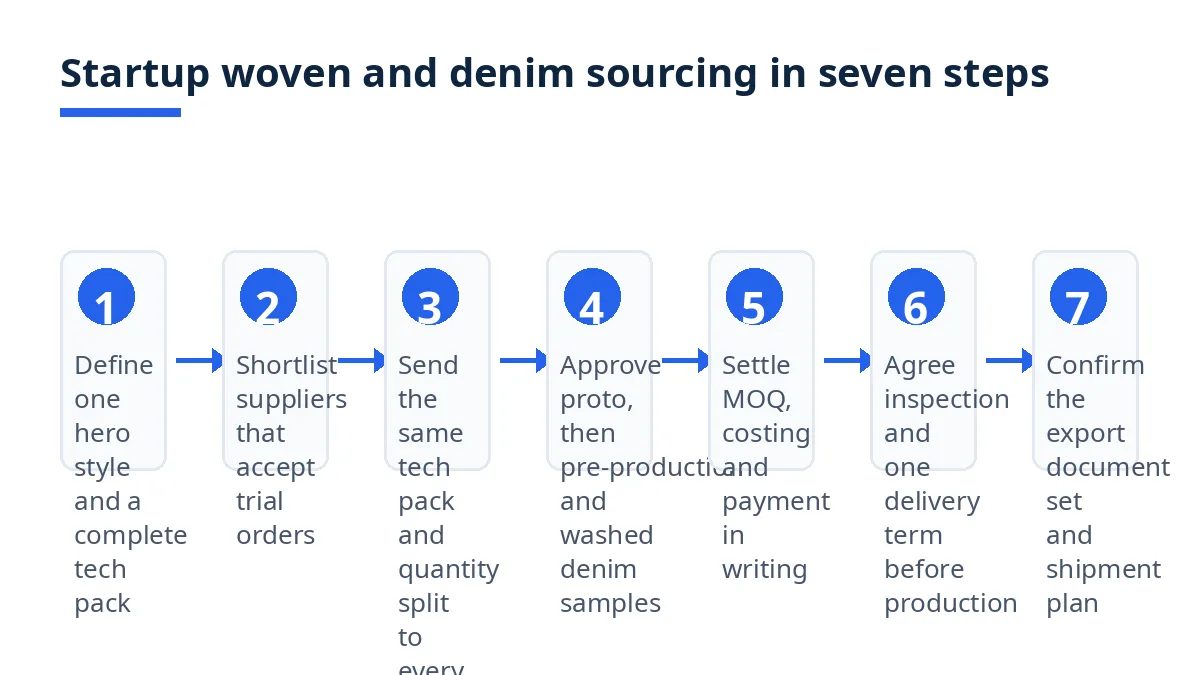
Define one hero style and write a complete tech pack. State the product type, fabric composition and weight, construction details, measurements for every size, pocket and closure details, stitch and seam requirements, artwork and label placement, packing method, and the size ratio across the range.
Shortlist suppliers that already make your product type and accept small first orders. Ask directly whether they take trial orders at your quantity, and what their minimum per style and per colour is, before you send the full tech pack.
Send the same tech pack and the same quantity split to every candidate. State the quantity per style, per colour and per size, the service level, and the delivery term, so every quotation answers the same question.
Approve samples in stages. Order a proto sample to check construction and fit, then a pre-production sample in the actual fabric, colour, trims and labels. For denim, approve a washed sample in the final wash, and record the wash recipe reference on the approval.
Settle costing, MOQ and payment in writing. Ask which line sets the minimum: fabric lot, dye lot, wash lot, trim run or label run. Record any agreed split, set-up charge or repeat price on the quotation and the purchase order.
Agree inspection and delivery before production starts. Write the inspection plan into the purchase order, and state one delivery term and named place for every quotation.
Confirm the export document set and the shipment plan, and check that the name on every document matches.
Costs, timelines and documents
What are the typical costs and timelines?
There is no typical cost or timeline a guide can state for a startup order, because each factory prices your fabric, construction, wash, trims, labels and delivery term. The cost drivers below are the lines to ask about, not figures to budget from.
Cost line | What drives it for a startup order |
|---|---|
Fabric | Composition, weight, whether the colour is stocked or dyed or woven to order |
Denim wash | Wash type, laundry capacity, and whether the wash is run as a small lot |
Trims and labels | Buttons, rivets, zips, woven labels, hang tags and cartons, each with its own run |
Making | Construction complexity, pocket and closure work, and line set-up spread over a small quantity |
Inspection | Who inspects, at which stage, and against which sampling plan |
Freight and delivery | The delivery term chosen, and who books and pays freight and insurance |
Example figures: a startup orders 600 shirts in two colours at 300 per colour, and the same 600 shirts in six colours at 100 per colour. The total is identical, but the six-colour split carries six dye and trim sets against two, so the cost per piece and the chance of a minimum-quantity problem are both higher. The example shows structure only, not a typical price, MOQ or lead time.
For timelines, ask for sampling, fabric ready, production, wash, inspection and shipment dates as separate lines, not a single delivery week. Sampling depends on fabric availability and correction rounds, bulk production on dyeing, washing, trim delivery and line capacity, and a startup order can wait behind larger orders if its dates are not written into the purchase order.
Which documents are needed?
For export clearance in Bangladesh, goods shall not be allowed to load or ship for export unless an export declaration, known as the Bill of Export or Shipping Bill, is submitted to Customs in the prescribed format and approved.2 The documents enclosed with the Bill of Export for all export consignments include the export letter of credit or, where there is no export letter of credit, the export contract or purchase order or export guarantee approved by the negotiating bank, the commercial invoice, the packing list, the EXP form certified by Authorized Dealers, and the certificate of origin issued by the Export Promotion Bureau or a Chamber of Commerce and Industry.2
Your order file should therefore hold the tech pack, the itemized quotation, the purchase order with the agreed split and delivery term, the sample approvals, the inspection report, and the export set above.
Bangladesh-specific rules and tips
Confirm association claims at the source. If a supplier claims BGMEA membership, confirm it with the association itself. BGMEA represents the woven, knitwear and sweater sub-sectors,1 so membership signals an active garment business, not capacity for your order or a willingness to take a small quantity.
Classify the product before you ask for duty or freight advice. Woven garments sit in Chapter 62 of the Harmonized System, which covers articles of apparel and clothing accessories, not knitted or crocheted. Within it, heading 6204 covers women's or girls' suits, ensembles, jackets, blazers, dresses, skirts, trousers and shorts, with 6204.62 covering trousers of cotton, and heading 6205 covers men's or boys' shirts, with 6205.20 covering shirts of cotton.3 State the wearer, the garment type and the fibre content in every enquiry and let the forwarder or customs broker confirm the full code for the destination.
Plan labelling for the destination from the first order. If you sell into the European Union, Regulation (EU) No 1007/2011 lays down harmonised provisions on textile fibre names and related labelling and marking of the fibre composition of textile products.4 Put the fibre composition, care information and label artwork into the tech pack, not into a message sent after production has started. Agree inspection on a sampling plan: ISO 2859-1 defines acceptance sampling plans indexed by acceptance quality limit (AQL) for lot-by-lot inspection, and AQL is the maximum average percentage of defective items considered acceptable during random sampling.5 Write the inspection level and AQL values into the purchase order.
Treat denim washing as a production stage, not a finishing touch. Agree the wash type, the reference sample, the tolerance for shade variation across the lot, and the shrinkage allowance after washing, all in writing.
Hold the size curve tight on a first order. A wide size range across a small quantity creates many small cutting runs and leftover fabric. Start with the core sizes your customers actually buy, record the ratio per colour, and add sizes on the repeat order once the fit is proven.
Use one delivery term for every quotation. The Incoterms 2020 rules provide 11 rules with a clear allocation of cost, risk and obligations.6 Compare quotations only on the same rule and the same named place.
Mistakes and red flags
What are the most common mistakes?
Launching with too many styles and colours. A startup range of five styles in four colours is twenty production set-ups. Start with one hero style, prove fit and sales, and expand from the repeat order.
Approving denim before washing. The wash changes colour, hand feel and size. Approve the washed sample, keep it as the reference, and measure shrinkage from it.
Asking for a total MOQ only. The binding minimum is usually per style, per colour or per wash lot. An order can clear the total and still fall below the minimum for one colour, which then carries a surcharge or removal.
Comparing quotations on different terms. A lower price on a different delivery term, service level or fabric is a different offer. Compare only replies to the same tech pack on the same Incoterm.6
Accepting a verbal agreement. Record the agreed MOQ, split, wash reference, set-up charges, inspection plan and delivery term on the quotation and the purchase order, with the split they apply to.
Treating a profile or a badge as a guarantee. A profile is a starting point for enquiries. A badge records a document and photo review, not a factory inspection, and it is not a guarantee of capacity, quality or delivery.7
Skipping inspection to save time or money. Sampling under ISO 2859-1 checks a lot against an agreed AQL,5 and for a startup the first order is the stock the brand launches with, so inspection is the last control before that stock ships.
Red flags to pause on include a supplier that will not state its per-colour minimum in writing, a quotation that omits the wash stage for denim, and a sample that arrives in a different fabric from the tech pack without explanation. Pause, ask in writing, and do not confirm until the answer is on the record.
Checklist
Before you confirm a first woven or denim order, every line should be answered in writing.
Hero style chosen: one product type, one fabric, one construction.
Tech pack complete: fabric, measurements, construction, trims, labels, packing, size ratio per colour.
Split stated per style, per colour and per size, with one size ratio per colour.
Service level stated: full package, cut make and trim, or sourcing support.
MOQ confirmed per style and per colour; binding line named, whether fabric, dye, wash, trim or label.
Denim wash agreed: wash type, reference sample, shade tolerance, shrinkage allowance.
Pre-production sample measured, washed where applicable, and approved in writing.
Inspection level and AQL values in the purchase order.5
Quotations compared on the same specification, service level and Incoterm.6
Export set agreed: invoice, packing list, EXP form, certificate of origin, Bill of Export.2
Labelling for the destination in the tech pack, including fibre composition.4
How Exportain helps
On Exportain, browse suppliers for woven garment and denim suppliers, and post your tech pack summary, quantity split per colour and delivery term on the RFQ board so suppliers quote against the same specification. Read how to buy first: it sets out eight steps from first search to shipment, including reviewing supplier profiles, understanding trust badges, posting an RFQ, comparing versioned quotations, and arranging freight and inspection.8
Read the badges for what they record. Verification is free, Exportain staff review every submission, approved checks earn the badges, and it is a document and photo review, not a factory inspection.7 Membership plans are a separate product and never grant a trust badge.7 Sample approval and inspection therefore stay with you, even when a supplier carries a badge.
FAQs
What should I know first about woven garments and denim sourcing from Bangladesh for startup brands?
Start with one hero style and a complete tech pack, and expect the binding constraint to be a per-style, per-colour or per-wash-lot minimum rather than a single order total. Bangladesh has a deep woven base, with around 60 percent of BGMEA member factories making woven garments,1 but a small first order still needs a supplier that accepts trial quantities, so ask that question before you send the tech pack. For denim, approve a washed sample, not an unwashed one.
What are the typical costs and timelines?
There are no typical figures a buyer can rely on, because each factory sets its price, MOQ and lead time for your specification. Fabric, wash, construction, the colour split, the service level and the delivery term drive the price, and sampling, dyeing, washing and line capacity drive the timeline.6 Ask for sampling, fabric ready, production, wash, inspection and shipment dates as separate lines.
Which documents are needed?
The order documents are the tech pack, the itemized quotation, the purchase order with the agreed split and delivery term, the sample approvals and the inspection report. The export set is the Bill of Export, the commercial invoice, the packing list, the EXP form certified by an Authorized Dealer, and the certificate of origin issued by the Export Promotion Bureau or a Chamber of Commerce and Industry.2
What are the most common mistakes?
The most common mistakes are launching with too many styles and colours, approving denim before washing, asking only for a total MOQ, comparing quotations on different terms,6 accepting agreements verbally, and reading a badge as a guarantee. A badge records a document and photo review, not a factory inspection.7
Next steps on Exportain
Browse suppliers, read how to buy, then post your hero style, quantity split per colour and delivery term on the RFQ board so suppliers state their per-style and per-colour minimums against the same specification.
Sources
- Bangladesh Garment Manufacturers and Exporters Association (BGMEA). Devex (accessed )
- Customs Clearance Procedures for Export. Bangladesh Customs, National Board of Revenue (accessed )
- HS Nomenclature 2017, Chapter 62: Articles of apparel, not knitted or crocheted. World Customs Organization (accessed )
- Regulation (EU) No 1007/2011 on textile fibre names and related labelling and marking of the fibre composition of textile products. European Union, (accessed )
- ISO 2859-1:2026 - Sampling procedures for inspection by attributes — Part 1: Sampling schemes indexed by acceptance quality limit (AQL) for lot-by-lot inspection. ISO (accessed )
- Incoterms® 2020. International Chamber of Commerce (ICC) (accessed )
- Supplier verification: Earn trust badges buyers can see. Exportain (accessed )
- How to source and buy from Bangladesh. Exportain (accessed )
About the author
Sourcing from Bangladesh?
Post a request for quotation and suppliers on Exportain can send you their quotes directly.
Post an RFQ