Hotels and Hospitality Buyers: Woven Garments and Denim From Bangladesh
Hotel and hospitality buyers sourcing woven garments and denim from Bangladesh: how to specify a uniform program by property and role, laundry-trial samples, run a pilot property, and lock replenishment terms.
Short answer
A hotel uniform program from Bangladesh should be specified by property, role and garment, with one brand standard per role, a laundry-trialled pre-production sample, a pilot property worn before the full rollout, and written replenishment terms. Compare supplier quotations only on the same tech pack, property split and delivery term, and judge every lot against a retained reference sample.
On this page
Key takeaways
A hotel order is a uniform program, not a single order: specify it by property, role and garment, with one brand standard per role.
Approve a pre-production sample only after a laundry trial under the property laundry condition, and retain a signed reference sample for every later lot.
Run a pilot property and collect wear and laundry feedback before cutting the remaining properties.
Compare quotations only on the same tech pack, property split and delivery term, and put replenishment terms in writing before bulk ships.
Exportain verification is a document and photo review, not a factory inspection, and a badge is not a guarantee.
A hotel does not buy woven garments the way a retailer buys a seasonal range. It buys a uniform program that has to look the same at every property, survive repeated laundering, and be replenished in the same colours and fits months after the first delivery. A front-office shirt, a housekeeping tunic, a food and beverage apron and a denim item for a casual property are different garments, but they belong to one brand standard, and the sourcing plan has to treat them that way from the first enquiry.
Bangladesh is a practical place to place that kind of program. The Bangladesh Garment Manufacturers and Exporters Association (BGMEA) states that around 60 percent of its member factories are woven garment manufacturers, and that its member factories account for 100 percent of woven garment exports from the country.1 In the July to September quarter of fiscal 2026-27, woven exports reached 4,614.80 million dollars, up 5.11 percent year on year, according to data released by the Export Promotion Bureau (EPB).2 That scale means woven capacity is usually available, but it does not remove the work of specifying the program, approving samples against laundry use, and agreeing replenishment terms before the first bulk order.
Why this matters for buyers and sellers
For a hotel buyer, the risk is not one bad shirt. It is drift across properties and over time: a replacement batch in a slightly different navy, a collar that loses shape after commercial laundering, or a size curve that fits one property and not another. Guests notice inconsistency at reception, in the restaurant and at the door. A program that holds its colour, fit and branding through repeat orders protects the standard the property sells.
For a seller, a hotel program is repeat business rather than a single order, provided the first delivery earns the repeat. The factory holds the fabric, dye, trim and logo approvals for the program, and each replenishment reuses them. That is why sellers ask for a full program brief, not a single garment quantity. The program logic also changes how minimums work: a hotel order is split by role, property and size, and a factory minimum that looks easy on the total can fail on one colour or one size run. State the split from the start, and ask which line is binding.
Step-by-step: how it works
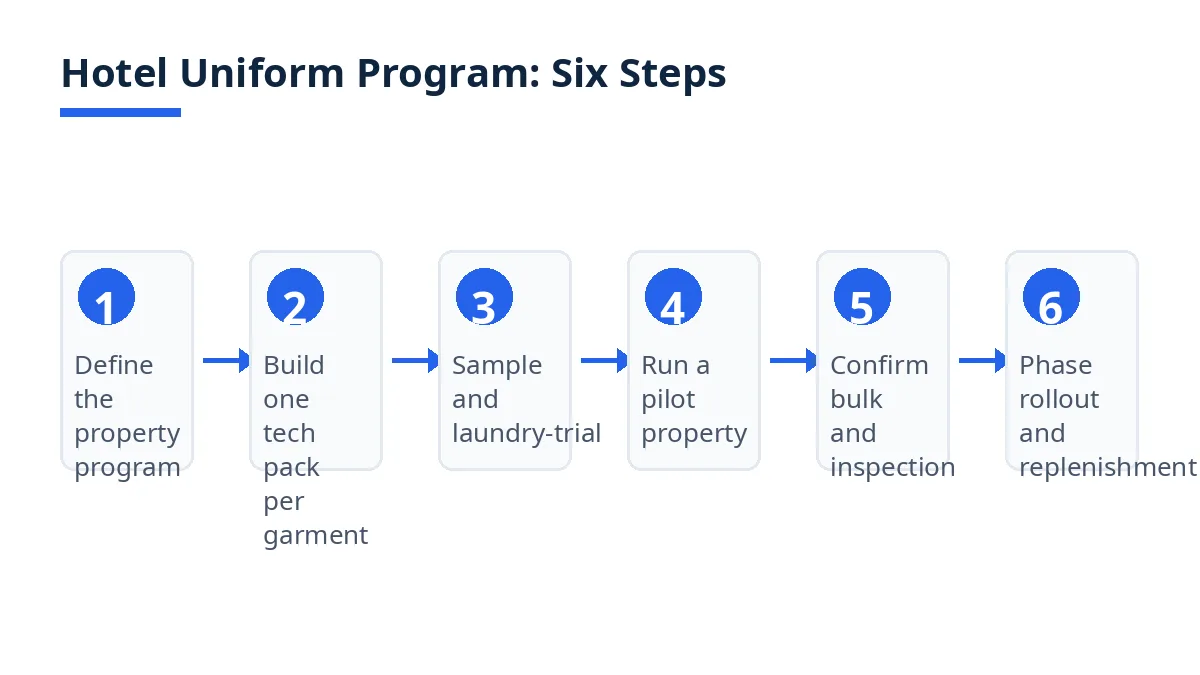
Define the property program. List every property in scope, every role that wears a uniform, and the garments per role: front office, concierge, housekeeping, food and beverage service, kitchen support, spa and leisure, and any denim item for a casual or resort property. Record the brand standard per role: colour, logo placement and trim.
Build one tech pack per garment. State fabric composition and weight, weave, colour standard, sizes and size ratio per property, stitching and pocket details, logo method and placement, buttons and trims, care label content, and packing per property. Add the laundry condition the garment must survive: commercial wash, drying method and pressing, as used by the property laundry or its contractor.
Sample, then laundry-trial the sample. Approve a proto sample for fit and appearance, then a pre-production sample in the actual fabric, colour and logo. Wash and press it under the property laundry condition, measure it before and after, and record colour, shrinkage and appearance against the approved standard in writing.
Run a pilot property first. Place the first bulk lot for one property, or one department across properties, and put it into service before committing the full estate. Collect fit, comfort, laundry and branding feedback, and correct the spec before the remaining properties follow.
Confirm bulk, inspection and delivery terms. Agree the inspection plan, the delivery term and the packing split per property in the purchase order, then run production against the approved sample and the retained reference sample.
Phase the rollout and lock replenishment. Deliver in the agreed sequence, hold a small replenishment stock for new joiners and replacements, and record the reorder process: minimum per garment and colour, lead time, price validity and who holds the fabric, dye and logo approvals.
In the Harmonized System, heading 6203 covers suits, ensembles, jackets, blazers, trousers, bib and brace overalls, breeches and shorts, other than swimwear, for men or boys, not knitted or crocheted.3 Confirm the heading per garment with the destination customs broker, since duty and documentation follow the garment, not the program.
Costs, timelines and documents
What are the typical costs and timelines?
There are no typical costs or timelines a guide can state as fact for a hotel program, because each factory prices the fabric, weave, wash or finish, logo method, trim, size range and property split in the enquiry, together with the delivery term. The Incoterms 2020 rules provide 11 rules with a clear allocation of cost, risk and obligations,4 so compare quotations only on the same rule and named place.
Cost drivers a hotel buyer should expect to see itemized are fabric and dye per colour, any denim wash or finish, embroidery digitising and logo application per placement, buttons, zips and other trims, labels and care labels, size-range cutting, packing per property, inspection, and freight under the chosen term. A program with five properties and four roles carries more packing and size-split work than a single-property order of the same total quantity, and that work belongs in the quotation, not in a later surcharge.
For timelines, ask for separate dates rather than one delivery week: sample approval, fabric ready, dye and wash completion, bulk production, inspection, and shipment per property phase. A pilot property also needs service time in the diary: the point of the pilot is wear and laundry feedback, and that feedback has to arrive before the remaining phases are cut.
Example figures: a buyer plans 2,400 uniform pieces across four properties, split by role and size per property. If one property needs 300 pieces in a dyed-to-order colour, that colour lot may carry its own minimum and timing apart from the 2,400 total.
Which documents are needed?
For export clearance in Bangladesh, goods may not be loaded unless an export declaration, the Bill of Export or Shipping Bill, is submitted to Customs and approved.5 Enclosed documents include the export contract or purchase order where there is no export letter of credit, the commercial invoice, the packing list, the EXP form certified by an authorized dealer, and a certificate of origin issued by the EPB or a Chamber of Commerce and Industry.5
The buyer-side set is the program brief, one tech pack per garment, the approved sample record with laundry-trial results, the itemized quotation, the purchase order with the property split, the inspection plan, and the replenishment agreement.
Bangladesh-specific rules and tips
Confirm association claims at the source. If a supplier claims BGMEA membership, confirm it with the association itself. BGMEA states that around 60 percent of its member factories are woven garment manufacturers.1 Membership signals an active woven business, not capacity for a hotel program, a laundry standard, or delivery to a phased rollout.
For sales into the European Union, Regulation (EU) No 1007/2011 requires textile products to be labelled or marked to give an indication of their fibre composition whenever they are made available on the market, and states that the labelling and marking shall be durable, easily legible, visible and accessible.6 Agree before bulk who supplies the label content, in which languages, and whether the property brand or the supplier name appears on the label.
For the United States, the United Kingdom, the European Union and the United Arab Emirates, confirm destination labelling, care and import requirements per market with the importer or customs broker before confirming bulk.
Agree the inspection plan before production. ISO 2859-1:2026 defines a system of acceptance sampling plans for inspection by attributes, indexed by acceptance quality limit (AQL) for lot-by-lot inspection, and AQL is the maximum average percentage of defective items considered acceptable during random sampling.7 For a hotel program, set the AQL values per garment type, and add the laundry-trial and branding checks that sampling alone does not cover: colour against the retained standard, logo placement, button and zip function, and measurement after washing.
Hold the reference standards physically. Retain one approved sample per garment, one washed sample showing the post-laundry result, and one fabric and thread colour standard, signed and dated. Every later lot is judged against those retained pieces, not against a photograph or a description in an email thread.
Plan replenishment as part of the first order. Record who holds the fabric and dye approvals, how long they are held, the reorder minimum, the price validity period, and what happens when a fabric or trim is discontinued.
Mistakes and red flags
What are the most common mistakes?
Approving a sample that has never been laundered. A shirt that measures correctly before washing and shrinks or fades after commercial laundering fails in service, not in the factory. Always laundry-trial the pre-production sample under the property condition and record the result.
Using one size curve for every property. Staff populations differ by property, and a curve built for one hotel will misfit another. Build the size ratio per property and per role, and confirm it with the property before bulk.
Letting logo colour drift between lots. Embroidery thread, print colour and fabric dye are separate processes, and a later lot can drift from the first without a retained thread and fabric standard. Judge every lot against the retained standard.
Ordering the full estate before the pilot has been worn. The pilot exists to catch fit, comfort and laundry problems while they are cheap to fix. Skipping it moves the same problems into every property at once.
Comparing quotations on different delivery terms. A lower unit price on a different Incoterm, or with packing per property excluded, is a different offer. The Incoterms 2020 rules allocate cost, risk and obligations for each rule,4 so compare only replies to the same tech pack, property split and term.
Treating a profile or a badge as a guarantee. A profile is a starting point for enquiries. It does not test whether a factory can hold a hotel colour standard through repeat lots, and a badge is not a guarantee of capacity, quality or delivery.8
Accepting a verbal replenishment promise. If the reorder minimum, price validity and fabric-holding period are not on the purchase order or a written program agreement, the next property opening starts from zero. Put the program terms in writing before the first bulk lot ships.
Checklist
Before you confirm, every line should be answered in writing.
Program defined: properties, roles and garments per role, with one brand standard per role.
Tech pack per garment: fabric, weight, weave, colour, sizes and ratio per property, trims, logo, care label, packing per property.
Laundry condition stated: wash, drying and pressing method as used by the property laundry.
Pre-production sample measured, laundry-trialled and approved in writing, with a retained reference sample.
Pilot property agreed, with wear and laundry feedback collected before the remaining phases are cut.
Inspection plan in the purchase order, with AQL values per garment type.7
Quotations compared on the same tech pack, property split and Incoterm.4
Export set agreed: invoice, packing list, EXP form, certificate of origin, Bill of Export.5
Destination labelling confirmed per market, including EU fibre composition labelling where the EU is the destination.6
Replenishment terms in writing: minimum per garment and colour, price validity, fabric holding period, discontinuation process.
Property delivery sequence and packing split agreed per phase.
How Exportain helps
On Exportain, browse suppliers and post the program brief on the RFQ board, with the garment list per role, the property split and the delivery term, so suppliers quote against the same program. Ask each reply for its per-garment and per-colour minimums, its laundry-trial process, and its written replenishment terms, and compare replies on the same Incoterm.4
Read the badges for what they record. Exportain verification is a document and photo review by staff, not a factory inspection, and membership plans never grant a trust badge.8 That review is a starting point, not a substitute for sample approval, laundry trials, inspection and a written program agreement, which stay with the buyer. Exportain is not a party to the goods contract and does not inspect goods, book freight or clear customs.
FAQs
What should I know first about Woven Garments & Denim Sourcing From Bangladesh for Hotels and Hospitality Buyers?
Know first that you are buying a program, not a single order. Define the properties, roles and garments, agree one brand standard per role, and lock the laundry condition, the retained reference sample and the replenishment terms before bulk. BGMEA states that around 60 percent of its member factories are woven garment manufacturers,1 and EPB data put woven exports at 4,614.80 million dollars in the July to September quarter of fiscal 2026-27.2 Capacity alone does not hold a hotel standard across properties and repeat lots. The program documents do that work.
What are the typical costs and timelines?
There are no typical figures a buyer can rely on, because each factory sets its price, minimum and lead time for the program specification. Fabric and dye per colour, any denim wash or finish, logo application, trims, the size range, packing per property and the delivery term drive the price, and the Incoterms 2020 rules allocate cost, risk and obligations for each term.4 Ask for sampling, fabric ready, production, inspection and shipment dates as separate lines per property phase.
Which documents are needed?
The program documents are the program brief, one tech pack per garment, the approved sample record with laundry-trial results, the itemized quotation, the purchase order with the property split, the inspection plan and the written replenishment agreement. The export set is the Bill of Export, commercial invoice, packing list, EXP form certified by an authorized dealer, and a certificate of origin issued by the EPB or a Chamber of Commerce and Industry.5 For EU destinations, settle fibre composition labelling under Regulation (EU) No 1007/2011 before bulk.6
What are the most common mistakes?
The most common mistakes are approving a sample without a laundry trial, using one size curve for every property, letting logo colour drift between lots, ordering the full estate before the pilot has been worn, comparing quotations on different delivery terms,4 and reading a badge as a guarantee. A badge records a document and photo review, not a factory inspection.8 The retained reference sample and the written replenishment terms hold the standard through repeat lots.
Next steps on Exportain
Browse suppliers, then post your program brief, garment list per role and property split on the RFQ board so suppliers quote on the same program and delivery term. Before you confirm, read the how to import workwear and uniforms from Bangladesh guide and the woven garments and denim sourcing guide.
Sources
- BGMEA at a Glance. BGMEA (accessed )
- RMG exports rise 6.10pc to US$10.58b in July-Sept of FY27. The Financial Express, (accessed )
- Classification Detail — HS Code 6203. United Nations Statistics Division (accessed )
- Incoterms® 2020. International Chamber of Commerce (ICC) (accessed )
- Customs Clearance Procedures for Export. Bangladesh Customs, National Board of Revenue (accessed )
- Regulation (EU) No 1007/2011 on textile fibre names and related labelling and marking of the fibre composition of textile products. European Union, (accessed )
- ISO 2859-1:2026 - Sampling procedures for inspection by attributes — Part 1: Sampling schemes indexed by acceptance quality limit (AQL) for lot-by-lot inspection. ISO (accessed )
- Supplier verification: Earn trust badges buyers can see. Exportain (accessed )
About the author
Sourcing from Bangladesh?
Post a request for quotation and suppliers on Exportain can send you their quotes directly.
Post an RFQ