

E-Commerce Brands: Knitwear & T-Shirts Sourcing From Bangladesh
E-commerce sourcing advice for knitwear and t-shirts from Bangladesh: drop planning, MOQ per style and color, marketplace packing and labeling, photo samples, and repeat terms for online brands.
Short answer
For e-commerce brands, knitwear and t-shirt sourcing from Bangladesh starts with the channel plan and the drop split, not the price. Fix the sales channels, launch quantity, creator seeding quantity and returns buffer first, then ask each factory for its minimum per style and per color, its photo-sample terms and its fulfillment packing specification. Approve the garment sample and the photo sample together, and judge suppliers on repeat consistency across drops, not only on the first unit price.
On this page
Key takeaways
E-commerce sourcing starts with the channel plan and the drop split: sales channels, launch quantity, creator seeding quantity and returns buffer come before price, because they decide what can be compared.
Ask for the minimum per style and per color, not a single order total, and agree the smallest seeding quantity, photo-sample terms and repeat-order terms at the first order.
Marketplace fulfillment packing and per-market label artwork must be approved with the garment sample, not after bulk production.
Approve the garment sample and the photo sample together, since a listing photographed in the wrong shade drives returns.
Exportain verification is a document and photo review, not a factory inspection, and a badge is not a guarantee.
An e-commerce brand buying knitwear and t-shirts from Bangladesh is not placing one bulk order for a warehouse shelf. It is buying for a product page, a launch drop and a fulfillment center, where each style must photograph well, match the size chart on the listing, arrive packed for a single customer order, and survive a return and exchange cycle.
Bangladesh is a large knitwear source for this kind of buying. The Bangladesh Knitwear Manufacturers and Exporters Association (BKMEA), established in 1996, is the apex trade body for the knitwear sector and represents approximately 2,540 knitwear member factories.1 In the July to September 2026 quarter, knitwear exports reached $5,963.76 million, up 6.88 percent year on year, within ready-made garment exports of $10,578.56 million, according to data released by the Export Promotion Bureau (EPB).2 The United States was the largest single-country market and the European Union remained the largest destination bloc.2 That scale gives choice, not a shortcut.
Why this matters for buyers and sellers
For an e-commerce brand, a knitwear order is judged one customer at a time. A tee that looks right in a factory photo but fits differently from its size chart comes back as a return, and a shade that shifts between drops shows up in customer photos and reviews. The brand therefore buys in drops: a launch quantity that tests the style, a restock quantity tied to sell-through, and a small seeding quantity for creators, each with its own packing and labeling needs agreed before production.
For the seller, an e-commerce order is attractive because it can repeat in smaller lots across a year, but it demands consistency that a one-time bulk order does not: the same fabric, color and fit on every drop, labels and barcodes matching the listing exactly, and packing suited to a fulfillment center.
What should I know first about knitwear and t-shirt sourcing from Bangladesh for e-commerce brands?
Start with the channel plan, not the price. Decide whether the style will sell on your own store, on a marketplace, or on both, because each channel sets different packing and labeling rules. A marketplace fulfillment program may require its own barcode on every unit and a suffocation warning on every polybag. Then fix the drop plan: styles, colors, sizes, quantities per size, seeding quantity, and returns buffer. Only then ask each factory for its minimum per style and per color, and for the smallest quantity it will run for a photo sample and a seeding batch.
Step-by-step: how it works
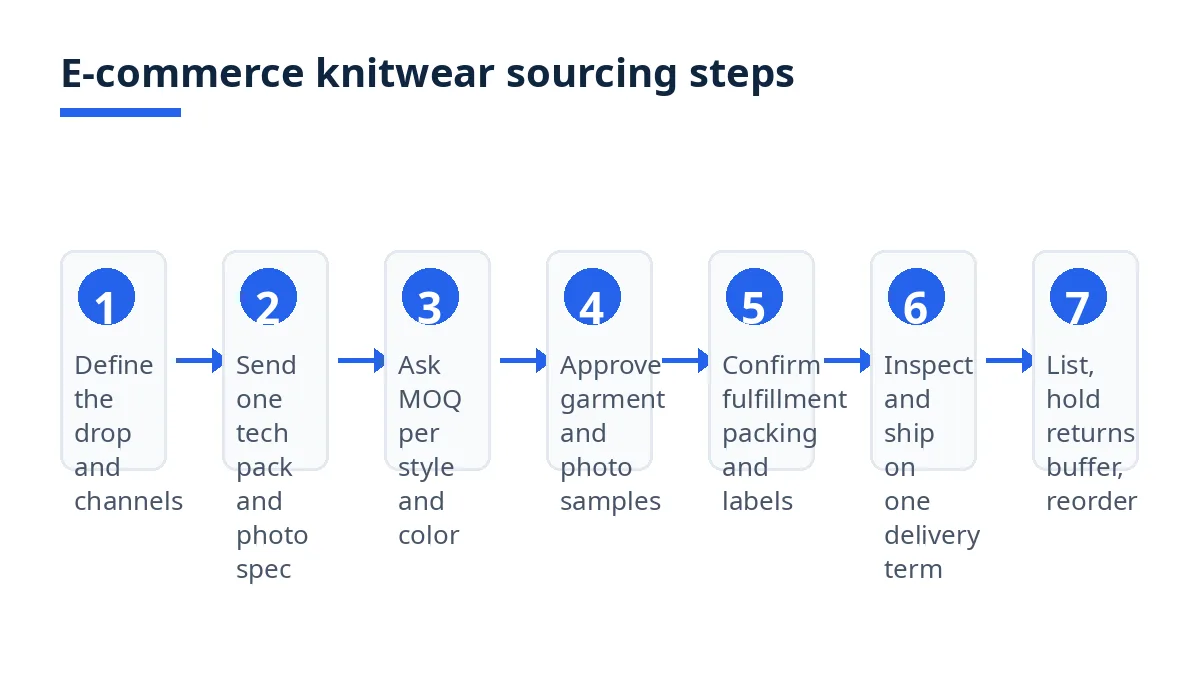
Define the drop and the channels. List each style with fabric composition, colors, sizes and quantity per size. State the launch quantity, the seeding quantity, the returns buffer, and whether each style sells on your own store, a marketplace, or both.
Send one tech pack and one photo specification to every candidate. State fabric composition, construction and weight, artwork method and placement, label and hangtag specification, barcode placement, and packing format. Add the photo specification: flat-lay, on-model or ghost-mannequin shots and the color accuracy standard.
Ask for the minimums line by line. Ask for the minimum per style and per color, the smallest seeding quantity, the photo-sample quantity, and any separate trim, label, tag and carton minimums. Ask which line is binding for your drop split, and get the answer in writing.
Approve the garment sample and the photo sample together. Order a proto sample, then a pre-production sample in the actual fabric, color and artwork, with the actual labels and polybag. Measure it, wash it, scan the barcode, and check the photo sample against the garment for color and fit.
Confirm fulfillment packing and labels before production. Agree the polybag thickness, seal and warning text, the barcode type and placement for each channel, and the carton format for the fulfillment center.
Agree inspection and one delivery term, then ship. Write the inspection standard and the acceptable quality level into the purchase order, and state one delivery term and named place for every quotation. The Incoterms 2020 rules allocate cost, risk and obligations for each term.3
List, hold the returns buffer, and reorder from sell-through. On arrival, check the shipment against the purchase order by style, color and size, then list only the approved stock. Hold the returns buffer apart from saleable stock, and correct the size split from returns data on the repeat order.
Costs, timelines and documents
E-commerce costs sit in more lines than the unit price. Fabric and dye lots set the base, and the color count multiplies it, since each color carries its own dye lot and trim set. Artwork set-up, labels, hangtags, barcodes and cartons are fixed costs spread across the run, so a short drop carries a higher cost per piece. Fulfillment packing adds polybags, warning labels, barcodes and carton formats. Freight, insurance, import duty and local delivery depend on the delivery term chosen,3 and the buyer pays the import duty under most terms except delivered duty paid. Added to those lines are photography, listing work, seeding units, and the returns buffer.
Timelines follow the same logic: sampling depends on fabric availability and correction rounds, bulk production on dyeing, finishing, trim delivery and line capacity, and shipping on the port pair and the delivery term. Ask for each stage as a separate dated line, and build the launch date around the latest acceptable arrival.
Example figures: an online brand orders 900 pieces of one tee style in three colors at 300 per color, with 60 pieces held as a returns buffer and 30 set aside for seeding. The same 900 pieces in six colors at 150 per color would carry twice the dye lots and trim sets at the same total. The example shows structure only, not a typical price or minimum.
Cost line | What drives it | State in your enquiry |
|---|---|---|
Fabric and dye lots | Color count and lot size | Composition, construction, weight, colors |
Artwork and labels | Set-up per design and placement | Method, size, placement, label artwork |
Fulfillment packing | Polybag, warning, barcode, carton | Channel, barcode type, carton spec |
Freight and duty | Delivery term and destination | One Incoterm and named place3 |
What are the typical costs and timelines?
There are no typical costs or timelines a guide can state as fact, because each factory prices your fabric, construction, artwork, color count, packing format and delivery term.3 A core cotton tee in stocked fabric with plain packing is priced differently from a private-label polo in a dyed-to-order color with custom labels and a seeding batch. Ask for an itemized quotation and a dated timeline.
Which documents are needed?
For export clearance in Bangladesh, goods may not be loaded unless an export declaration, the Bill of Export or Shipping Bill, is submitted to Customs and approved.4 Enclosed documents include the export contract or purchase order where there is no export letter of credit, the commercial invoice, the packing list, the EXP form certified by an authorized dealer, and a certificate of origin issued by the EPB or a Chamber of Commerce and Industry.4 The brand also needs the tech pack, the itemized quotation, the purchase order with the drop split, the sample approval record for garment and photo sample, the inspection report, and the listing pack: label artwork, barcode file and approved photos.
Bangladesh-specific rules and tips
Build market labeling into the tech pack for each sales channel. In the European Union, Regulation (EU) No 1007/2011 lays down harmonized provisions on textile fiber names and related labeling and marking of the fiber composition of textile products.5 In the United States, the Textile Fiber Products Identification Act requires labels showing fiber content by generic name for fibers at 5 percent or more of total fiber weight, in descending order, plus the manufacturer or dealer identity and the country of origin.6 The same rules reach online listings, since the regulations mention advertisements disseminated through the internet, so a product description that names a fiber must carry the matching disclosure.6 A brand selling into both markets needs separate label artwork per market, approved before bulk production.
Treat marketplace prep as part of the factory specification. For apparel sent to a major marketplace fulfillment program, polybags must be at least 1.5 mil thick and completely transparent and sealed, with a suffocation warning mandatory for any bag with an opening of 5 inches or larger, and every unit needs a scannable barcode on the outside of the packaging.7 Since January 1, 2026, that marketplace no longer offers prep and item labeling services for fulfillment shipments in the United States store, so units must arrive fully compliant or face rejection fees and stranded inventory.7 Put the bag specification, the warning text and the barcode placement in the purchase order, and check them on the pre-production sample.
Confirm association claims at the source. If a supplier claims BKMEA membership, confirm it with the association itself. BKMEA represents the knitwear sector and its member factories,1 so membership signals an active knitwear business, not the minimum on offer or the consistency across repeats.
Keep one legal name across every paper. The export declaration names the exporter and the foreign buyer,4 so the name on the trade licence, quotation, proforma invoice and payment account should match.
Ask which inputs are imported for your order. Yarns, dyes, zips and some trims may be bought in for your specification, and an imported trim can set both the minimum and the earliest production date.
Plan the repeat at the first order, not after the first drop. Agree the repeat price, repeat minimum, fabric and color hold period, and set-ups held, so the second drop matches the first listing exactly.
Mistakes and red flags
What are the most common mistakes?
Ordering a total without a drop split. A total of 900 pieces means little without the launch quantity, the seeding quantity and the returns buffer. If the seeding units come out of launch stock, the launch sells out early, and if no buffer is held, an exchange waits on a new production run.
Approving the garment but not the photo sample. A correct tee photographed in the wrong shade becomes a listing that drives returns. Approve the photo sample against the approved garment for color and fit before bulk production.
Ignoring marketplace prep until the goods arrive. A shipment that reaches a fulfillment center without the required barcode, bag thickness or warning text is refused or charged rework fees. Agree the full prep specification in the purchase order and check it on the pre-production sample.7
Comparing quotes on different packing or terms. A lower unit price on bulk packing and an ex-works term is a different offer from a higher price on fulfillment-ready packing and a delivered term.3 Compare only replies to the same tech pack, packing format and delivery term.
Treating a profile or a badge as a capacity check. A profile is a starting point for enquiries. Exportain verification is a document and photo review, not a factory inspection, and a badge is not a guarantee of capacity, quality or delivery.8 9
Skipping inspection to protect a launch date. A missed launch hurts, but a full drop of the wrong shade, wrong size mix or wrong labels hurts for the whole selling period.
Letting the listing drift across drops. A repeat order that quietly changes fabric weight, shade or label wording breaks the listing. Hold one approved specification per style and record every agreed change against it.
Checklist
Every line should be answered before you confirm.
Channel plan fixed: own store, marketplace, or both, with the packing and labeling rules of each.
Drop split fixed: launch quantity, seeding quantity and returns buffer per style, color and size.
Minimum confirmed per style and per color, with the binding line named, and the seeding quantity agreed.
Photo specification agreed: shot list, color accuracy standard, photo sample approved.
Label artwork approved per market, with fiber composition, care and origin in the market language.5 6
Fulfillment packing agreed: polybag thickness, seal, warning text, barcode type and placement, carton format.7
Set-up charges itemized apart from the unit price, and paid set-ups recorded for repeats.
Pre-production sample measured, washed, barcode-scanned and photo-checked, approved in writing.
Inspection standard and launch window in the purchase order, with one delivery term for every quotation.3
Export set agreed: invoice, packing list, EXP form, certificate of origin, Bill of Export.4
Repeat terms agreed: price, minimum, fabric hold period, set-ups held.
How Exportain helps
On Exportain, browse suppliers and post a request for quotation (RFQ) on the RFQ board with your tech pack summary, drop split, channel plan and fulfillment packing specification, so suppliers quote against the same online specification. Read how to buy before you post. Ask each reply for its minimum per style and per color, its smallest seeding quantity, its photo-sample terms and its packing options. When you accept a quotation, Exportain creates one order and issues one proforma invoice from the accepted terms.8
Read the badges for what they record: Exportain Verified means identity, phone, email and business registration checked; Export Verified means the Export Registration Certificate (ERC) checked; Factory Verified means factory photos reviewed.8 Verification is a document review by staff, free, and never granted by membership plans.9 It is not a factory inspection,8 9 so sample approval and inspection stay with you.
FAQs
What should I know first about knitwear and t-shirt sourcing from Bangladesh for e-commerce brands?
Know the channel plan and the drop split before the price: fix the sales channels, launch quantity, seeding quantity and returns buffer, then ask for the minimum per style and per color.
What are the typical costs and timelines?
There are no typical figures a buyer can rely on, because each factory sets its price and lead time for your specification, color count, packing format and delivery term.3 Ask for itemized costs and dated stages.
Which documents are needed?
The order documents are the tech pack with the drop split, the itemized quotation, the purchase order, the sample approval record for garment and photo sample, and the inspection report. The export set is the Bill of Export, commercial invoice, packing list, EXP form and certificate of origin.4
What are the most common mistakes?
The most common mistakes are ordering a total without a drop split, approving the garment without approving the photo sample, ignoring marketplace prep until the goods arrive,7 comparing quotes on different packing or delivery terms,3 and reading a badge as a guarantee of capacity or delivery.8
Next steps on Exportain
Browse suppliers, then post your tech pack summary, drop split, channel plan and fulfillment packing specification on the RFQ board so suppliers state their minimum per style and per color and their packing terms. Before you post, read how to buy.
Sources
- BKMEA at a Glance. BKMEA (accessed )
- RMG exports rise 6.10pc to US$10.58b in July-Sept of FY27. The Financial Express, (accessed )
- Incoterms® 2020. International Chamber of Commerce (ICC) (accessed )
- Customs Clearance Procedures for Export. Bangladesh Customs, National Board of Revenue (accessed )
- Regulation (EU) No 1007/2011 on textile fibre names and related labelling and marking of the fibre composition of textile products. European Union, (accessed )
- Textile Fiber Products Identification Act: Labeling Rules. LegalClarity (accessed )
- Amazon FBA Prep Guide: 2026 Compliance Checklist. EP Logistics (accessed )
- Trust & Safety Center. Exportain (accessed )
- Supplier verification: Earn trust badges buyers can see. Exportain (accessed )
- MOQ
- supplier verification
- knitwear
- buyer guide
- Bangladesh sourcing
- bangladesh garments
- Cotton T-shirts
- E-commerce
About the author
Sourcing from Bangladesh?
Post a request for quotation and suppliers on Exportain can send you their quotes directly.
Post an RFQ


