

Corporate & Promotional Knitwear Sourcing From Bangladesh
How corporate and promotional buyers source branded knitwear and T-shirts from Bangladesh: logo decoration, brand-guideline control, campaign timelines, bulk drops by office or region, and repeat-order terms.
Short answer
Corporate and promotional knitwear buying from Bangladesh works as a programme, not a single bulk order: one approved logo artwork, one colour standard, and one size plan are set first, then bulk drops ship by office or region against fixed event dates. Factories quote per style, colour and decoration method, so the buyer should ask for MOQs, set-up charges and repeat-order terms per drop in writing before approving samples.
On this page
Key takeaways
A corporate knitwear order is a programme: one approved logo artwork, one colour standard and one size plan, delivered in drops by office or region against fixed event dates.
Decoration method, placement, finished size and colour or thread count must be recorded per garment, and the logo approved on a physical sample, not on screen.
Drop structure, size plan per office and repeat-order terms belong in the first purchase order, or the second drop is priced as a new programme.
Exportain verification is a document and photo review, not a factory inspection, and a badge is not a guarantee.
A corporate buyer sourcing knitwear from Bangladesh is rarely buying a single bulk lot for a warehouse shelf. The usual job is a programme: the same branded T-shirt, polo or sweatshirt, in the same colours and fit, delivered to several offices or regions, tied to fixed dates such as a conference, a launch, an onboarding intake or a campaign, and then repeated when staff join or a new campaign starts. The unit price matters, but it is not the main risk. The main risk is drift: a logo printed in a different shade at the second drop, a size curve that fits one office and not another, or a repeat order that arrives after the event it was meant to serve.
Bangladesh is a practical source for this kind of programme because its knitwear sector is large and organised around knitted garments. The Bangladesh Knitwear Manufacturers and Exporters Association (BKMEA), established in 1996, is the apex trade body for the knitwear sector and represents approximately 2,540 knitwear member factories.1 That scale gives a corporate buyer choice, but the brand standard still has to be fixed first: artwork, colour reference, decoration method, garment, size plan and drop schedule.
Why this matters for buyers and sellers
For a corporate or promotional buyer, knitwear is brand media as much as clothing. Staff wear it at events, in offices and in photographs, so a colour shift or a distorted logo is visible in a way a plain garment fault is not. The buyer therefore needs control over three things a general garment order can leave loose: the approved print or stitch result, the colour standard each drop is judged against, and the size distribution per office or region.
For the seller, a corporate programme promises repeats but carries costs a one-off order does not: decoration set-up, whether screens, embroidery digitising or transfer plates, is fixed work done once and reused, and dye and fabric lots run per colour. A seller who agrees to small, scattered drops without a written repeat plan absorbs set-up and lot costs that no single drop repays. A buyer who commits the programme in writing, even when the first drop is modest, lets the seller price set-up and repeats against the whole programme.
Product scope also needs a clear definition at the start. In the Harmonized System, heading 6110 covers jerseys, pullovers, cardigans, waistcoats and similar articles, knitted or crocheted.2 T-shirts, polos and sweatshirts sit across knitted garment categories, so name each garment style separately in the enquiry, with its fabric and decoration, rather than asking for a single price for mixed merch. A polo with an embroidered chest logo and a printed event T-shirt are different production jobs even when they carry the same logo.
Step-by-step: how it works
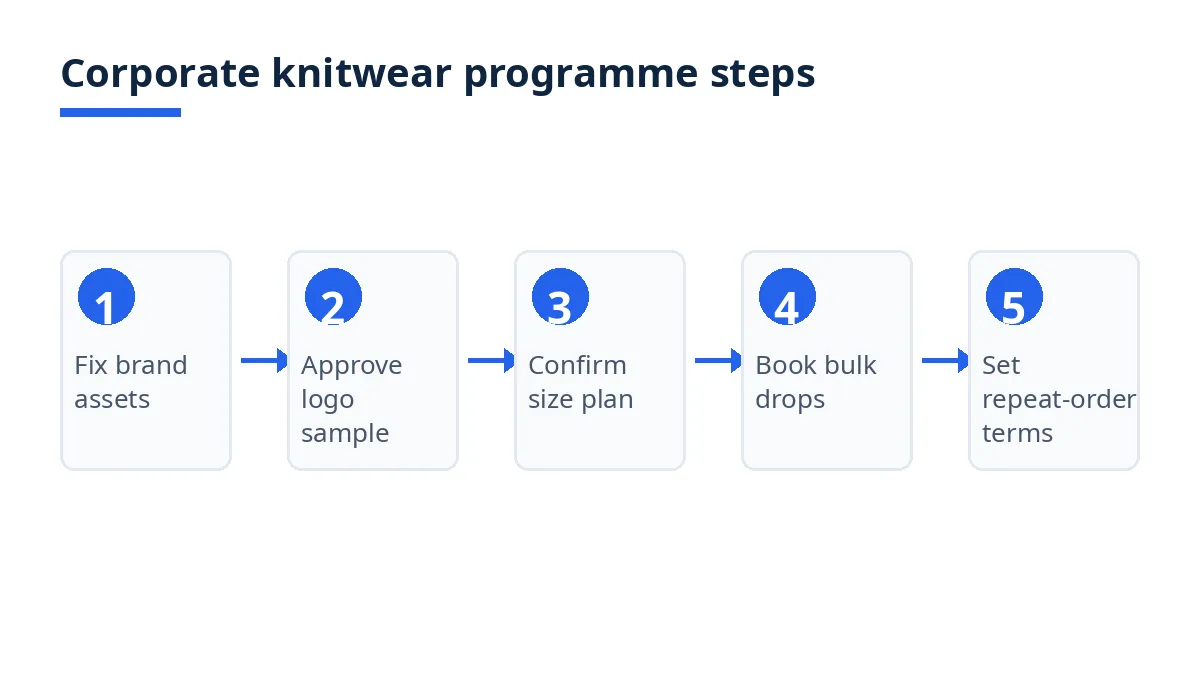
Assemble the brand pack before contacting factories. Include the logo in vector form, colour references from the brand book, minimum clear space and minimum logo size, approved and prohibited background colours, and the exact campaign wording. State which offices or regions receive goods and which event date each drop serves, so a factory quotes the programme, not just the first drop.
Choose the decoration method per garment, in writing. Screen printing suits bold, flat artwork on T-shirts in larger runs. Embroidery suits small chest logos on polos and sweatshirts, but fine detail and small text behave differently in thread than in print. Heat transfer suits short, multi-colour campaign artwork and names or numbers that change per drop. Record the method, placement, finished size and colour or thread count for each garment, and never approve a decoration from a screen image alone.
Approve a physical logo sample on the actual garment. Order a sample in the actual fabric, colour and decoration method. Check it in daylight against the brand colour reference, wash it once under the care instructions that will go on the label, and confirm or list corrections in writing. For the European Union, Regulation (EU) No 1007/2011 sets harmonised rules for textile fibre names and the labelling and marking of fibre composition,3 so confirm fibre composition and care label content at sample stage, not after bulk is cut.
Fix the size plan per drop, not per programme. Ask each receiving office for headcount by size, then agree a size ratio per drop. A programme-wide ratio applied blindly to every office leaves one office short of sizes and another holding stock it cannot use. Record who approves size changes.
Agree the drop schedule against event dates, working backwards. Set artwork approval, sample approval, bulk production, inspection and shipping dates as separate lines. A drop that must serve a conference cannot be recovered by faster shipping if artwork was approved late, so put approval deadlines in the purchase order.
Agree inspection before bulk is confirmed. ISO 2859-1 defines a system of acceptance sampling plans for inspection by attributes, indexed by acceptance quality limit (AQL) for lot-by-lot inspection.4 AQL is the maximum average percentage of defective items considered acceptable during random sampling, and it determines sample sizes and acceptance or rejection thresholds.4 For branded goods, add a decoration check: logo colour against the approved sample and placement measured from a fixed garment point.
Confirm repeat-order terms at the first order. Record how long screens, embroidery files and transfer plates are kept, whether set-up is charged again on a repeat, the minimum per repeat drop and per colour, and how a colour or artwork change is priced.
Costs, timelines and documents
What are the typical costs and timelines?
There are no typical costs or timelines a guide can state as fact for a corporate knitwear programme, because each factory prices the garment, fabric, decoration method and set-up, packing per drop and delivery term for that programme. Ask for every cost as a separate line: garment, decoration set-up, decoration per piece, labels and packing per drop, inspection, freight and any split-shipment charge. A single delivered price hides the line that will change on the repeat order, usually decoration set-up or split-shipment packing.
Timelines work the same way. Sampling depends on fabric availability and correction rounds, decoration approval on the buyer returning a signed sample, and bulk production on dyeing, decoration capacity and line time. Ask for artwork approval, sample approval, fabric ready, decoration ready, bulk production, inspection and ship dates as separate lines. The Incoterms 2020 rules set out 11 rules with a clear allocation of cost, risk and obligations,5 so state one Incoterm and named place on every quotation and confirm who pays for split delivery under that term.
Example figures: 900 pieces in three drops of 300, one per region, shows structure only, not a typical quantity, price or lead time.
Which documents are needed?
The order documents are the brand pack, the tech pack per garment, the itemized quotation with decoration set-up apart from the unit price, the purchase order carrying the drop schedule, size plan, inspection plan and repeat-order terms, and the written sample approval. For export clearance in Bangladesh, goods may not be loaded unless an export declaration, the Bill of Export or Shipping Bill, is submitted to Customs and approved.6 Enclosed documents include the export contract or purchase order where there is no export letter of credit, the commercial invoice, the packing list, the EXP form certified by an authorized dealer, and a certificate of origin issued by the EPB or a Chamber of Commerce and Industry.6 The buyer should also hold the approved artwork file, the signed logo sample record and the decoration specification.
Bangladesh-specific rules and tips
Lock the colour standard to a physical reference, not a screen. Agree the approved sample as the colour reference for every drop, kept by both sides, alongside the brand-book colour reference. Screen colours shift between devices, so a factory judging a bulk drop against a phone image will reach a different answer from a buyer judging it against a printed brand book. Where a campaign colour is unusual, ask in writing whether it is stocked or dyed to order, since a dyed-to-order colour carries its own lot minimum and a longer timeline.
Protect the logo as a brand asset in the paperwork. State in the purchase order that the artwork is supplied for this programme only, that screens, embroidery files and plates are not to be used for other buyers, and that leftover decorated stock is not to be sold on. Confirm what happens to decorated stock if a campaign is cancelled and who owns the set-up files if the buyer moves factory for a later drop.
Confirm association claims at the source. If a supplier claims BKMEA membership, confirm it with the association itself. BKMEA represents the knitwear sector and its member factories,1 so membership signals an active knitwear business, not capacity for a branded programme, decoration quality or multi-office delivery. Ask instead for programme evidence: decorated samples in the same method, a size-plan example from a multi-drop order, and references for repeat supply.
Keep one legal name across every paper. The export declaration names the exporter and the foreign buyer,6 so the name on the quotation, proforma invoice, purchase order and payment account should match. For split drops, confirm whether each office receives its own packing list and invoice line, or one invoice covers the programme.
Mistakes and red flags
What are the most common mistakes?
Approving the logo on screen and skipping a physical sample. Colour, thread texture and print hand-feel cannot be judged from an image. A programme built on a screen approval will dispute every drop against a standard nobody held in hand.
Ordering one size ratio for every office. Offices differ in headcount and size mix. One ratio for all drops creates shortages in one place and dead stock in another, and re-shipping sizes between offices usually costs more than a single ratio saves.
Leaving repeat terms out of the first order. If set-up ownership, repeat minimums and file retention are not written down, the second drop is priced as a new programme. A repeat discount promised verbally is not a programme term.
Comparing quotations with different drop structures. A cheaper unit price for one warehouse delivery is not comparable with a price that includes packing and shipping to several offices, or with a price that excludes decoration set-up. Compare only replies to the same brand pack, drop schedule and delivery term.5
Treating a profile or a badge as decoration competence. A supplier profile shows a business, not a proven ability to hold a brand colour across drops. Judge decoration competence from physical samples and repeat-supply evidence, and keep sample approval and inspection with the buyer.
Checklist
Before you confirm, every line should be answered in writing.
Brand pack supplied: vector logo, colour references, clear space, minimum size, approved and prohibited backgrounds, campaign wording.
Decoration method, placement, finished size and colour or thread count recorded per garment.
Logo sample on the garment approved in writing, including a wash check and label content.3
Size plan agreed per drop and per office, with an owner for size changes.
Drop schedule agreed backwards from each event date, with approval deadlines set.
Decoration set-up itemized apart from the unit price, with file ownership and retention agreed.
Repeat-order terms agreed: minimum per drop and per colour, set-up on repeats, price basis for changes.
Inspection level and AQL values in the purchase order, plus a decoration check against the approved sample.4
Quotations compared on the same brand pack, drop schedule and delivery term.5
Export set agreed: invoice, packing list, EXP form, certificate of origin, Bill of Export.6
Artwork use restricted to this programme in writing, with a rule for leftover decorated stock.
How Exportain helps
On Exportain, browse suppliers and read how to buy, then post a request for quotation on the RFQ board with the brand pack summary, decoration method per garment, size plan per office and drop schedule, so suppliers quote against the same programme. Ask each reply for decoration set-up apart from the unit price, the minimum per drop and per colour, and the repeat-order terms. When you accept a quotation, Exportain creates one order and issues one proforma invoice from the accepted terms.7
Read the badges for what they record. Exportain Verified means Exportain has checked identity, phone, email and business registration, and Export Verified means it has checked the Export Registration Certificate (ERC).7 Factory Verified means it has reviewed photos of the manufacturer factory, while Trading Company Verified means it has reviewed photos of the trading company office or warehouse.7 Verification is a document review by staff, free, and never granted by membership plans.8 It is not a factory inspection,7 8 so logo samples and inspection stay with the buyer, and a badge is not a guarantee of production capacity, product quality or delivery.7
FAQs
What should I know first about Knitwear & T-Shirts Sourcing From Bangladesh for Corporate and Promotional Buyers?
Know that you are buying a programme, not a lot: one approved logo artwork, one colour standard and one size plan, delivered in drops by office or region against fixed event dates, with repeat-order terms agreed at the first order. The Bangladesh knitwear sector gives you a wide choice of factories,1 but brand consistency across drops depends on the standard fixed before bulk production, especially the physical logo sample.
What are the typical costs and timelines?
There are no typical figures a buyer can rely on, because each factory prices the garment, fabric, decoration method and set-up, packing per drop and delivery term for that programme.5 Ask for every cost and date as a separate line, from artwork approval through inspection to shipping, and compare quotations only on the same brand pack, drop schedule and delivery term.
Which documents are needed?
The order documents are the brand pack, the tech pack per garment, the itemized quotation, the purchase order with the drop schedule, size plan, inspection plan and repeat terms, and the written sample approval. The export set is the Bill of Export, commercial invoice, packing list, EXP form certified by an authorized dealer, and a certificate of origin issued by the EPB or a Chamber of Commerce and Industry.6
What are the most common mistakes?
The most common mistakes are approving the logo on screen without a physical sample, applying one size ratio to every office, leaving repeat-order terms out of the first order, and comparing quotations with different drop structures or delivery terms.5 Each turns a repeatable programme into a series of one-off orders, which is where brand drift and missed event dates come from.
Next steps on Exportain
Browse suppliers, then post your brand pack summary, decoration method and drop schedule on the RFQ board so suppliers quote the programme on the same terms. Before you confirm, read how supplier verification works on Exportain so you read each badge for what it actually records.
Sources
- BKMEA at a Glance. BKMEA (accessed )
- Classification Detail — HS Code 6110. United Nations Statistics Division (accessed )
- Regulation (EU) No 1007/2011 on textile fibre names and related labelling and marking of the fibre composition of textile products. European Union, (accessed )
- ISO 2859-1:2026 - Sampling procedures for inspection by attributes — Part 1: Sampling schemes indexed by acceptance quality limit (AQL) for lot-by-lot inspection. ISO (accessed )
- Incoterms® 2020. International Chamber of Commerce (ICC) (accessed )
- Customs Clearance Procedures for Export. Bangladesh Customs, National Board of Revenue (accessed )
- Trust & Safety Center. Exportain (accessed )
- Supplier verification: Earn trust badges buyers can see. Exportain (accessed )
About the author
Sourcing from Bangladesh?
Post a request for quotation and suppliers on Exportain can send you their quotes directly.
Post an RFQ


