

Retailers Buying Industrial Equipment & Lighting From Bangladesh
Retail assortment buying from Bangladesh: retail packs, shelf labelling, MOQ per SKU, conformity files and reorder planning for industrial equipment and lighting.
Short answer
Retailers buying industrial equipment and lighting from Bangladesh should start from the selling unit: fix the retail pack, carton quantity, market marks and labels, and spares and warranty route before asking for a price. Compare suppliers model by model, sample the retail unit in its pack, agree one delivery term and inspection point, and build a landed cost per selling unit before confirming the first order.
On this page
Key takeaways
Start from the selling unit: fix the retail pack, carton quantity, market marks and labels, and spares and warranty route before asking for a price.
Control boards at or below 1000 volts sit under HS subheading 853710, while lamps and fittings sit under heading 9405, and each model carries its own conformity file.
For light sources sold in the EU, the supplier must provide a label printed on the packaging and an electronic label and product information sheet for dealers.
Build a landed cost per selling unit, compare quotations only on the same delivery term, and record the reorder minimum and lead time per model.
Exportain verification is a document and photo review, not a factory inspection, and a badge is not a guarantee of capacity, quality or delivery.
A retailer does not buy industrial equipment the way a project buyer does. A project buyer orders one specification for one site. A retailer orders an assortment that must sell piece by piece, sit on a shelf or in a trade counter, survive a return, and be reordered in the same specification months later. That difference should shape every enquiry you send to Bangladesh: ask about retail packs, spare parts, labels and reorders, not only about unit price.
Industrial equipment and lighting from Bangladesh covers two distinct groups in this guide. The first is control and distribution equipment, such as boards, panels and cabinets fitted with control apparatus. Subheading 853710 covers boards, panels, consoles, desks and other bases for electric control or the distribution of electricity, for a voltage not exceeding 1000 volts.1 The second is lighting: heading 9405 covers lamps and light fittings, including searchlights and spotlights and parts, and illuminated signs and name-plates with a permanently fixed light source.2 A high-bay light, a panel board and a carton of LED tubes are different products with different classifications, marks and labels, and your assortment plan should treat them that way.
What retailers should settle before they source
What should I know first about sourcing industrial equipment for retail?
Settle the selling unit before you ask for a price. The selling unit is what the customer takes home: one high-bay fitting, one panel board, one pack of four tubes, one carton of switches. The supplier quotes by production unit or carton, and the two are rarely the same. State the selling unit, the retail pack contents and the carton quantity in the first enquiry. If the pack changes later, the barcode, shelf label and price all change with it, so fix it early.
Next, settle which markets the stock will be sold in, because the marks and labels follow the market, not the factory. For electrical and electronic products sold in the European Union, CE marking is required, and the CE mark is a declaration that the product meets all legal requirements for safety, health and environmental protection.3 The Low Voltage Directive applies to products rated between 50 and 1000 volts for alternating current and 75 to 1500 volts for direct current, the Electromagnetic Compatibility Directive applies to products that can generate or be affected by electromagnetic disturbance, and the RoHS Directive applies to most electrical and electronic products.3 A product governed by several directives must comply with all of them before the mark is applied.3 Ask which directives the supplier has assessed for your exact model, and ask for the Declaration of Conformity by model, not a single certificate for a whole catalogue.
For lighting sold in the European Union, add the energy label question. Under Commission Delegated Regulation (EU) 2019/2015, suppliers of light sources must ensure that each light source placed on the market as an independent product and in packaging is supplied with a label printed on the packaging, and must make an electronic label and product information sheet available to dealers for each model.4 Note the boundary: the energy label for luminaires has been discontinued since 25 December 2019, but a luminaire that meets the definition of a light source must still bear an energy label, and a product counts as a light source when the light source can be removed for verification without permanent damage.5 Ask the supplier, for each lighting model, whether it is a light source, a containing product or neither.
Finally, settle after-sales before the first order. A retailer, unlike a project buyer, fields the failure. Ask who supplies spare drivers, diffusers, fuses and switches for each model, how long spares remain available, and what the warranty claim route is: who the customer contacts, what proof is needed, and whether a faulty unit is repaired, replaced or credited. A model with no spares route is a model you will eventually have to delist.
Build the assortment, then place the first order
Start from the shelf, not from the catalogue. List the categories your customers already ask for: panel boards, switches and sockets, industrial LED high-bay and flood lights, tube and batten fittings, cables and accessories, and small control gear. For each category, write one line: the selling unit, the voltage and wattage range, the use environment, and the marks and labels the market requires. That one-page assortment sheet becomes the brief for every supplier enquiry.
Then shortlist suppliers against that sheet, not against a general company profile. Ask each candidate for the same answers per model: specification sheet, rated voltage and power, dimensions and weight, retail pack and carton quantity, minimum order per model and per carton, sample lead time, and conformity documents for your market. Compare replies model by model.
Order samples as retail units, not as loose factory samples. Ask for the sample in its retail pack, with its label, manual and carton markings, and test it the way your customer will use it: fit it, switch it, run it at full load, and check that wattage, colour temperature and dimensions match the sheet. Record every correction in writing before production, and keep one approved sample sealed as the inspection reference.
Agree the delivery term and the inspection point in the same document as the price. The Incoterms 2020 rules give 11 rules with a clear allocation of cost, risk and obligations,6 so state one rule and one named place on every quotation. Agree inspection before shipment against the approved sample, and state what happens to a carton that fails: replacement, repair or credit, and who pays the return freight.
The six steps below are the sequence for a first retail order.
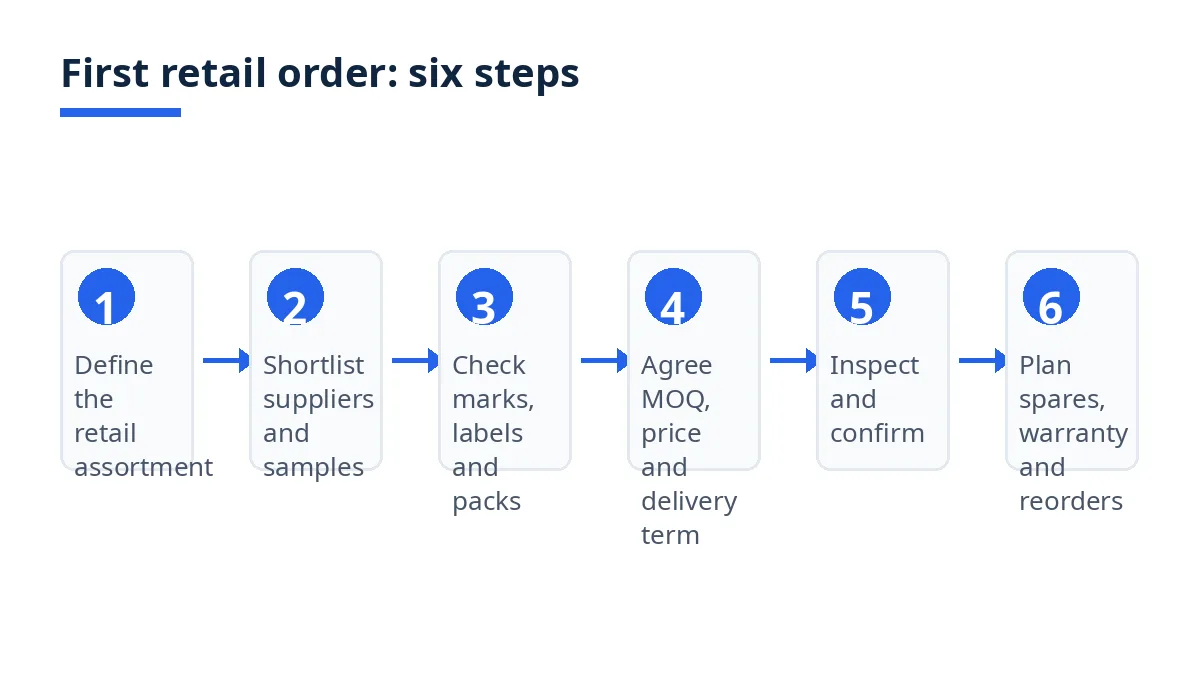
Write the assortment sheet. One line per category: selling unit, voltage and power range, use environment, marks and labels.
Shortlist per model. Ask every candidate the same per-model questions on specification, pack, carton, minimum and documents.
Sample as a retail unit. Test the sample in its retail pack with its label and manual, and record corrections in writing.
Confirm the retail pack and carton. Fix the selling unit, pack contents, carton quantity and markings before production.
Agree price, term and inspection together. One Incoterm and named place on every quotation,6 inspection against the approved sample, and a rule for failed cartons.
Plan spares, warranty and reorder before you pay. Spares availability, claim route, reorder minimum and lead time, all in writing.
Costs, timelines and documents
What are the typical costs and timelines?
There is no typical retail cost or timeline to quote for this category, because the price depends on the model, the pack, the quantity per model and the delivery term. Work instead from a landed cost per selling unit, built line by line: unit price, retail packing, carton and pallet cost, inland freight, export handling, international freight, insurance, import duty and tax, port and clearance charges, inland delivery to your warehouse, and the cost of inspection and of any failed units. A model that looks cheapest on unit price can be the most expensive on the shelf once packing, duty and returns are added.
Example figures: a retailer orders 240 LED high-bay fittings in cartons of 6, at a unit price of 42 currency units, with packing at 1.20 per unit, freight and insurance at 3.80 per unit, duty and tax at 5.10 per unit, and clearance and inland delivery at 1.40 per unit. The landed cost per selling unit is 53.50. If the same order ships in cartons of 2 instead of 6, packing rises to 2.40 per unit and the landed cost becomes 54.70. The example shows structure only, not a typical price, duty rate or freight cost.
For timelines, ask for separate dates, not one delivery week: sample ready, production complete, inspection passed, shipment loaded, and arrival at your warehouse. Record the reorder minimum and lead time per model.
Which documents are needed?
For export clearance in Bangladesh, goods may not be loaded unless an export declaration, the Bill of Export or Shipping Bill, is submitted to Customs and approved.7 Documents enclosed with the Bill of Export include the export letter of credit or, where there is no letter of credit, the export contract or purchase order, the commercial invoice, the packing list, the EXP form certified by an authorized dealer, and a certificate of origin issued by the Export Promotion Bureau or a Chamber of Commerce and Industry.7 As a retailer, ask for invoice and packing list copies that match your purchase order line by line, including retail pack and carton counts.
Shelf, safety and labelling rules for retail sale
Classification decides duty, and the classification follows the product, not the catalogue heading. Boards and panels for electric control or distribution at or below 1000 volts sit under subheading 853710.1 Lamps and light fittings sit under heading 9405, with separate subheadings for ceiling or wall fittings, floor-standing or table lamps, and other electric lamps and fittings.2 Give your customs broker the specification sheet for each model and confirm the code before you price the shelf.
Safety marks and labels are per model. The technical documentation behind a CE mark must be kept available for inspection, and the documentation is stored for ten years as a reference for market authorities.3 For lighting, the supplier must enter the product information sheet parameters into the product database and make the electronic label available to dealers,4 so ask for the database entry reference with the first shipment.
Retail packaging carries its own rules. The label on the pack must match the product inside it: model, voltage, wattage, colour temperature for lighting, and the energy class where the product is a light source.4 Check the first production cartons against the approved sample pack before the balance is paid. A wrong label on a retail pack is stock you cannot sell until it is corrected.
Mistakes and red flags for retail buyers
What are the most common mistakes?
Ordering by carton instead of by selling unit. A carton of 48 switches and a carton of 6 high-bay fittings are different commitments. Compare the landed cost per selling unit, not per carton.
Accepting one conformity file for a whole catalogue. Directives, test reports and energy labels are per model.3 4 A file for a 100-watt fitting does not cover a 200-watt fitting.
Skipping the retail pack sample. A loose factory sample hides pack, label and manual faults. Sample the retail unit, in its pack.
Ignoring spares and warranty. A model with no spare drivers and no claim route becomes a delisting problem after the first failures.
Treating a profile or a badge as a guarantee. A badge is not a guarantee of production capacity, product quality or delivery.8 Supplier verification on Exportain is a document review by staff, not a factory inspection.9
Comparing quotations on different delivery terms. The Incoterms 2020 rules allocate cost, risk and obligations differently under each rule,6 so compare only replies on the same rule and named place.
Retailer checklist before you confirm
Before you confirm, every line should be answered in writing.
Assortment sheet written: selling unit, voltage and power range, use environment, marks and labels per category.
Per-model answers received: specification, retail pack, carton quantity, minimum per model and per carton.
Retail pack sample approved, including label, manual and carton markings.
Conformity file per model: directives assessed, Declaration of Conformity, test reports.3
Lighting labels per model: energy label, product information sheet, database entry reference where the product is a light source.4
Landed cost per selling unit calculated, including packing, freight, duty, tax and clearance.
One Incoterm and named place on every quotation, with inspection against the approved sample.6
Export set agreed: invoice, packing list, EXP form, certificate of origin, Bill of Export.7
Spares availability, warranty claim route and reorder minimum and lead time in writing.
How Exportain helps
On Exportain, browse suppliers and post a request for quotation (RFQ) on the RFQ board with your assortment sheet, selling unit, retail pack, carton quantity and delivery term, so suppliers quote against the same retail specification. Ask each reply for its per-model minimums, pack details, and conformity documents for your market. When you accept a quotation, Exportain creates one order and issues one proforma invoice from the accepted terms.8
Read the badges for what they record. Exportain Verified means Exportain has checked identity, phone, email and business registration, and Export Verified means it has checked the Export Registration Certificate (ERC).8 Factory Verified means it has reviewed photos of the manufacturer factory, while Trading Company Verified means it has reviewed photos of the trading company office or warehouse.8 Verification is a document review by staff, free, and never granted by membership plans.8 9 It is not a factory inspection,8 9 so sample approval and inspection stay with you. See the industrial equipment sourcing guide and the industrial lighting quality control checklist for model-level checks.
FAQs
What should I know first about industrial equipment and lighting sourcing from Bangladesh for retailers?
Start from the selling unit, not the catalogue. Fix the retail pack, the carton quantity, the market marks and labels, and the spares and warranty route before you ask for a price. Control boards at or below 1000 volts sit under subheading 853710,1 while lamps and fittings sit under heading 9405.2
What are the typical costs and timelines?
There are no typical figures a guide can state, because each model is priced by its specification, pack, quantity per model and delivery term. Build a landed cost per selling unit from unit price, packing, freight, insurance, duty, tax, clearance and delivery, and ask for separate dates for sample, production, inspection, loading and warehouse arrival.
Which documents are needed?
The export set is the Bill of Export, commercial invoice, packing list, EXP form certified by an authorized dealer, and a certificate of origin issued by the Export Promotion Bureau or a Chamber of Commerce and Industry.7 The retail set is the specification sheet, Declaration of Conformity and test reports per model,3 plus the energy label and product information sheet for light sources.4
What are the most common mistakes?
The most common mistakes are ordering by carton instead of by selling unit, accepting one conformity file for a whole catalogue,3 4 skipping the retail pack sample, ignoring spares and warranty, and comparing quotations on different delivery terms.6 A badge is not a guarantee of production capacity, product quality or delivery.8
Next steps on Exportain
Browse suppliers, then post your assortment sheet, selling unit and delivery term on the RFQ board so suppliers state their per-model minimums, pack details and conformity documents. Before you confirm, read the industrial equipment sourcing guide and how to import industrial lighting from Bangladesh.
Sources
- Classification Detail — HS Code 853710. United Nations Statistics Division (accessed )
- Classification Detail – HS Code 9405. United Nations Statistics Division (accessed )
- CE for Electronics: Understanding EU Directives and Compliance Requirements for the CE Mark. QIMA (accessed )
- Commission Delegated Regulation (EU) 2019/2015 on energy labelling of light sources. European Union (accessed )
- Some online marketplaces are asking for energy labels for luminaires. Is this required by law?. European Commission, (accessed )
- Customs Clearance Procedures for Export. Bangladesh Customs, National Board of Revenue (accessed )
- Incoterms® 2020. International Chamber of Commerce (ICC) (accessed )
- Trust & Safety Center. Exportain (accessed )
- Supplier verification: Earn trust badges buyers can see. Exportain (accessed )
About the author
Sourcing from Bangladesh?
Post a request for quotation and suppliers on Exportain can send you their quotes directly.
Post an RFQ


