

Home Textiles for Startup Brands: Sourcing From Bangladesh
For startup brands buying home textiles and towels from Bangladesh: how to size a first order, negotiate low minimums, protect cash flow, test before scaling, and reorder only what sells.
Short answer
A startup brand should launch with one hero product and one supporting product in a short colour list, sized from expected sales and cash available rather than from a factory minimum. Ask for the minimum per colour and per size, choose stocked fabrics where possible, approve a washed listing-ready sample, agree payment and repeat terms in writing, then ship small, test with real customers, and reorder only the variants that sell.
On this page
Key takeaways
Launch narrow: one hero product, one supporting product, and a short colour list, sized from expected sales and cash available.
The binding quantity is usually per colour and per size, not the order total, so ask for the minimum line by line and compare replies on the same range and delivery term.
Choose stocked fabrics, approve a washed listing-ready sample, and agree payment, inspection, and repeat terms in writing before bulk production.
Protect cash flow with a repeat-order reserve, ship small, test with real customers, and reorder only the variants that sell.
Exportain verification is a document and photo review, not a factory inspection, and a badge is not a guarantee of capacity, quality, or delivery.
A startup brand does not buy home textiles the way an established retailer does. You are buying your first stock with money that also has to pay for photography, a website, packaging, shipping to customers, and the next order. A towel or sheet set that suits a large buyer can still be wrong for you if it arrives in one large colour run, in a pack size your customers do not want, or with a label that does not match your product page. This guide is written for that position: one small launch range, bought carefully, tested with real customers, and scaled only where sales support it.
Home textiles here means the household linen a new brand usually starts with: bath towels, hand towels, bed sheets, pillowcases, duvet covers, table linen, and kitchen towels. In the Harmonized System, heading 6302 covers bed linen, table linen, toilet linen and kitchen linen, with terry towelling for toilet and kitchen linen under subheading 630260.1 That classification helps with customs and supplier conversations, but it does not decide your order: which products to launch, how many colours to carry, what the retail pack contains, and how much cash each choice ties up.
First-order sizing: how small can you start
Start with the smallest range that still looks like a brand: one hero product, one supporting product, and a short colour list. A bath towel in two colours and a hand towel in the same two colours is a range. A bath towel, a sheet set, a duvet cover, a tablecloth, and six colours each is a warehouse, not a launch.
Size the first order from the back, not from the factory minimum. Work out how many units you can photograph, store, pack, and sell in the first selling period, then check whether that quantity meets the supplier minimum per colour and per size. If it does not, change the range before you change the budget. Dropping a colour usually helps more than raising the order, because each colour carries its own dye lot and its own risk of sitting unsold.
Agree the reorder rule at quotation stage. Ask, in writing, what quantity, price, and lead time would apply to a repeat of the same specification, and whether the repeat can cover only the colours that sold. Without a written repeat term, you renegotiate from zero after your best colour sells out, when you can least afford a delay.
Cash flow belongs in the sizing decision, not after it. A deposit, a balance payment before shipment, freight, import charges, and storage all fall due before customer revenue arrives. Keep a reserve for the second order of the winning variant.
Why this matters for buyers and sellers
For you as the buyer, a small first order limits the cost of being wrong. If a colour, a weight, or a pack size does not sell, the loss is contained. If it does sell, the repeat order proves the relationship is worth a better structure: fewer colours, a shared fabric, or a staged quantity. Suppliers take a new brand more seriously after a clean first order, paid on time.
For the seller, a startup order is small but it is also a test of a different kind. A new brand needs more guidance than a large buyer: help choosing a stocked fabric, a standard colour, and an existing pack, rather than a custom specification for every item.
Brand-story packaging needs the same discipline as the product. A belly band, a woven label, and a hang tag telling one clear story about fabric, care, and maker will serve a startup better than five different inserts. Decide that wording before production and keep it identical on the website.
Step-by-step: how it works
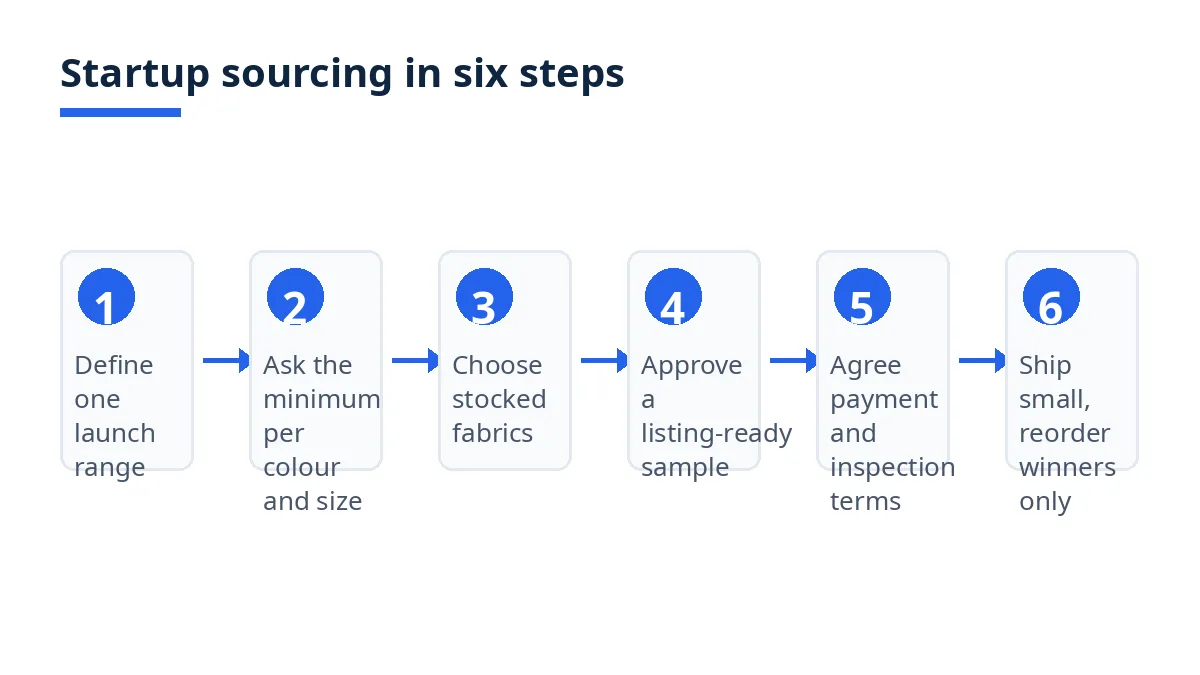
Define one launch range on paper. Name the hero product, the supporting product, the colours, the sizes, and the retail pack for each, with fabric composition, weight, and finish in plain terms.
Ask for the minimum per colour and per size, not only per order. Send the same range to each candidate supplier and ask which line is binding: the dye lot, the cutting run, the label run, or the carton quantity.
Choose stocked inputs where you can. Ask which fabrics and colours are already stocked and which would be dyed for you. A stocked fabric in a standard colour is often the difference between a runnable first order and a minimum you cannot meet.
Approve a listing-ready sample. Order the sample in the actual fabric, colour, pack, and labels, then wash it, photograph it, and pack it as a customer order would be packed. Approve it in writing before bulk production starts. A sample in a substitute fabric proves nothing about the product you will sell.
Agree payment, inspection, and delivery terms in writing. State the deposit and balance timing, who inspects and against what standard, and one delivery term with a named place for every quotation. The Incoterms 2020 rules set out 11 rules with a clear allocation of cost, risk, and obligations.2
Ship small, sell, measure, then reorder winners only. Track sales per colour and per size, messages about feel, weight, and care, and returns by reason. Reorder the variants that earned a repeat, and drop or rework the rest.
Costs, timelines and documents
What are the typical costs and timelines?
There is no typical cost or timeline a guide can state as fact for a startup order, because each supplier prices your fabric, weight, colour count, label and pack runs, finishing, and delivery term for your specification. Ask for the unit price, any set-up charge, the deposit and balance schedule, freight and import charges on the same delivery term, and the cost of a repeat order, each as a separate line. A single blended price hides the line that surprises you later, usually the label run or freight.
For timelines, ask for sampling, fabric ready, production, inspection, and shipment dates as separate lines, not one delivery week.
Example figures: a startup orders 600 bath towels split as 300 in white and 300 in sage, plus 400 hand towels in the same two colours. The total is 1,000 pieces, but the binding quantity is 300 or 200 per colour per product, not 1,000. If the minimum is per colour per product, the hand towel line at 200 per colour may fail while the bath towel line passes. The example shows structure only, not a typical minimum, price, or lead time.
Cost or time line | Ask for it as | Why it matters for a startup |
|---|---|---|
Unit price | Per product, colour, and size | Stops a blended price hiding a surcharge |
Set-up charges | Labels and artwork apart from unit price | Shows what the repeat will not pay again |
Payment schedule | Deposit and balance timing | Sets cash you must hold before revenue arrives |
Freight and import charges | On one stated delivery term | Makes quotations comparable |
Sampling and production dates | Separate dates, not one week | Exposes where a delay will fall |
Repeat terms | Quantity, price, lead time, same specification | Decides whether a selling variant can be restocked |
Which documents are needed?
The order documents are the range sheet, the itemized quotation, the purchase order with per-colour quantities and repeat terms, and the written sample approval. Goods may not be loaded unless an export declaration, the Bill of Export or Shipping Bill, is submitted to Customs and approved.3 Enclosed documents include the export contract or purchase order where there is no export letter of credit, the commercial invoice, the packing list, the EXP form certified by an authorized dealer, and a certificate of origin issued by the EPB or a Chamber of Commerce and Industry.3
Bangladesh-specific rules and tips
Confirm label wording for each destination before production. If you sell into the European Union, Regulation (EU) No 1007/2011 covers textile fiber names and related labelling and marking of fiber composition.4 The fiber names and percentages on your label need to match the finished product, not the sample first approved. Destination rules differ, so check the rules for the United States, the United Kingdom, the European Union, and the United Arab Emirates separately, and confirm final wording with your importer or adviser before the label run is printed.
Treat certificates as documents to check, not claims to repeat. If a supplier offers a test certificate or a product certification, ask for the certificate number, the products it covers, and the expiry date, and confirm those details with the issuing body where you can. A certificate for a fabric is not a certificate for your finished towel. Put the details you relied on into the purchase order.
Ask which inputs are stocked and which are bought in for you. Yarn, dyes, labels, and packaging may be stocked or ordered for your specification, and a bought-in input can set both the minimum and the earliest production date. Agree the size ratio per colour before production, and confirm how a shade difference between sample and bulk will be judged.
Keep the brand story honest and checkable. Every claim on the pack and the website needs a document behind it: fiber composition, country of origin, care instructions, and any certification. If you cannot show the document for a claim, do not print it.
Mistakes and red flags
What are the most common mistakes?
Ordering for the brand you hope to be, not the customers you have. A wide range with many colours ties up cash in slow variants. Launch narrow and widen the range from sales evidence.
Asking for a total minimum only. The binding minimum is usually per colour, per size, or per product. An order can clear the total and still fail on one colour.
Paying for custom labels and packaging before the product is proven. A custom woven label, a printed carton, and a full insert set each carry their own run and cost. Use a simple label and pack for the first order, and invest in custom packaging once the product has sold.
Skipping the wash test to save time. A towel that looks right unwashed and feels wrong after three washes will generate the returns that hurt a startup most. Wash the listing-ready sample as your care label instructs, then judge weight, feel, shade, and size after washing.
Agreeing payment terms you cannot meet. A large balance payment due before shipment, with freight and import charges falling in the same week, can leave a startup unable to pay for the shipment it has sold in advance. Map every payment date against expected revenue, and keep a reserve for the repeat order.
Treating a profile or a badge as a guarantee. A supplier profile is a starting point for enquiries. It does not test whether a supplier can make your towel to your specification, and a badge is not a guarantee of capacity, quality, or delivery.5
Red flags in a reply. Watch for a quotation that does not state the per-colour quantity, a sample offered only in a substitute fabric, a label run quoted without artwork approval, a delivery term missing a named place, or a payment schedule that changes between messages. Ask for the missing line in writing before you proceed.
Checklist
Before you confirm:
Launch range defined: hero, supporting product, colours, sizes, retail pack.
First-order quantity sized from expected sales and cash, not the factory minimum alone.
Minimum confirmed per colour, size, and product; binding line named.
Stocked fabric and colour status recorded per variant.
Listing-ready sample washed, photographed, packed, approved in writing.
Label wording confirmed per destination before the label run.
Certificate number, scope, expiry recorded for any claim relied on.
Payment schedule mapped against cash flow, with a repeat-order reserve.
Inspection standard and delivery term stated; one Incoterm, named place.2
Repeat quantity, price, lead time agreed, same specification.
Export set agreed: invoice, packing list, EXP form, certificate of origin, Bill of Export.3
How Exportain helps
On Exportain, browse suppliers and post a request for quotation (RFQ) on the RFQ board with your launch range, the quantity per colour and size, and your delivery term, so suppliers quote against the same specification. The how to buy guide sets out the steps from first search to shipment.6 Ask each reply for its per-colour minimum, its stocked fabric list, and its repeat terms.
Read the badges for what they record. Exportain Verified means Exportain has checked identity, phone, email, and business registration, and Export Verified means it has checked the Export Registration Certificate (ERC).5 Factory Verified means it has reviewed photos of the manufacturer factory, while Trading Company Verified means it has reviewed photos of the trading company office or warehouse.5 Verification is a document and photo review by staff, free, and never granted by membership plans.7 It is not a factory inspection,5 7 so sample approval and inspection stay with you.
FAQs
What should I know first about Home Textiles & Towels Sourcing From Bangladesh for Startup Brands?
Know your launch range before you ask for a price. One hero product, one supporting product, a short colour list, and a retail pack you can photograph and ship will get you a usable quotation. The binding quantity is usually per colour and per size, not the order total. Heading 6302 covers bed linen, table linen, toilet linen and kitchen linen.1
What are the typical costs and timelines?
There are no typical figures a startup can rely on, because each supplier prices your fabric, weight, colour count, label and pack runs, and delivery term for your specification. Ask for prices, set-up charges, payment terms, and repeat terms as separate lines, and for sampling, production, inspection, and shipment as separate dates.2 Example figures here show structure only, not a typical price or lead time.
Which documents are needed?
The order documents are the range sheet, the itemized quotation, the purchase order, and the written sample approval. The export set is the Bill of Export, commercial invoice, packing list, EXP form certified by an authorized dealer, and a certificate of origin issued by the EPB or a Chamber of Commerce and Industry.3 Confirm label wording per destination before the label run.4
What are the most common mistakes?
The most common mistakes are launching too wide, asking only for a total minimum, paying for custom packaging before the product is proven, skipping the wash test, and agreeing payment terms with no repeat-order reserve. A profile or a badge is not a guarantee of capacity, quality, or delivery.5
Next steps on Exportain
Browse suppliers, then post your launch range and quantity per colour and size on the RFQ board. Before you confirm, read the how to buy guide.
Sources
- HS 2017 - Code 6302: Bed linen, table linen, toilet linen and kitchen linen. United Nations Statistics Division (accessed )
- Incoterms® 2020. International Chamber of Commerce (ICC) (accessed )
- Customs Clearance Procedures for Export. Bangladesh Customs, National Board of Revenue (accessed )
- Regulation (EU) No 1007/2011 on textile fibre names and related labelling and marking of the fibre composition of textile products. European Union, (accessed )
- Trust & Safety Center. Exportain (accessed )
- How to source and buy from Bangladesh. Exportain (accessed )
- Supplier verification: Earn trust badges buyers can see. Exportain (accessed )
About the author
Sourcing from Bangladesh?
Post a request for quotation and suppliers on Exportain can send you their quotes directly.
Post an RFQ


