

Frozen Seafood & Fish Sourcing From Bangladesh for E-Commerce Brands
Frozen seafood from Bangladesh for an online brand: one retail pack, a cold chain to a 3PL, a listing label that matches the pack, and the documents to check before the first shipment.
Short answer
Start with one retail pack, one species and one destination market for frozen seafood from Bangladesh, and agree the pack, cold chain and label in writing before discussing volume. Each supplier sets its own minimum for your pack size, species and carton format, so compare replies on the same specification, confirm the destination market's importer and establishment requirements, and agree the 3PL handover, temperature record and returns rules before the first shipment.
On this page
Key takeaways
An e-commerce order is a retail pack, a cold chain and a listing, not only a species by weight: define one pack, one species and one destination market first.
Each supplier sets its own minimum for your pack size, species and carton format, so compare replies only on the same retail pack specification.
For the United States, confirm importer verification and supplier verification; for the European Union, confirm the permitted country and establishment and the required certificate.
Agree the 3PL handover before dispatch: receiving appointment, frozen storage, temperature record at handover, and rejection and returns rules for thawed, damaged or mislabelled cartons.
The listing must match the physical pack, including species name, net weight, pack count and the allergen line naming the fish or crustacean shellfish type.
An e-commerce brand buying frozen seafood from Bangladesh is not placing a wholesale order in smaller type. It is buying a retail pack that must survive a freezer chain, pass a destination food-safety check, carry a label a shopper can trust, and arrive at a fulfilment centre ready to be picked, packed and shipped again without thawing. This guide covers bangladesh frozen seafood for e-commerce brands from that angle: small batches, retail packs, third-party logistics (3PL) delivery, online listing compliance and returns.
The direct answer is short. Start with one retail pack, one species and one destination market, and get the pack, the cold chain and the label agreed in writing before you talk about volume. Each supplier sets its own minimum for your pack size, species and carton format, so there is no single minimum to look up. Control the specification instead: species, cut, glaze, pack weight, carton count, storage condition and the documents that travel with the shipment.
Why this matters for buyers and sellers
For an online brand, frozen seafood fails differently from a dry product. A thawed carton cannot be sold, and a label error can keep a listing offline or hold a shipment at the border. The costs that matter are therefore not only the price per kilogram. They are the cost of a failed delivery to a 3PL, a return that cannot be resold, and a first production run that does not match the sample shoppers reviewed.
For the supplier, a small e-commerce order is still a production run. Freezing, glazing, packing and carton labelling are set up for your pack, and a retail pack costs more handling per kilogram than a bulk export carton. That is why suppliers ask for pack and carton detail up front, and why a vague enquiry for a small quantity gets a slow or high reply.
The e-commerce angle changes three decisions. First, pack size is a product decision, not a shipping detail, because it sets the listing price, the shipping weight and the portion the shopper cooks. Second, the delivery address is usually a 3PL warehouse, so the handover, the temperature record and the receiving check must be agreed before dispatch. Third, the listing itself is a compliance surface: the title, ingredient and allergen lines, net weight and storage instruction on the page must match the physical pack.
Step-by-step: how it works
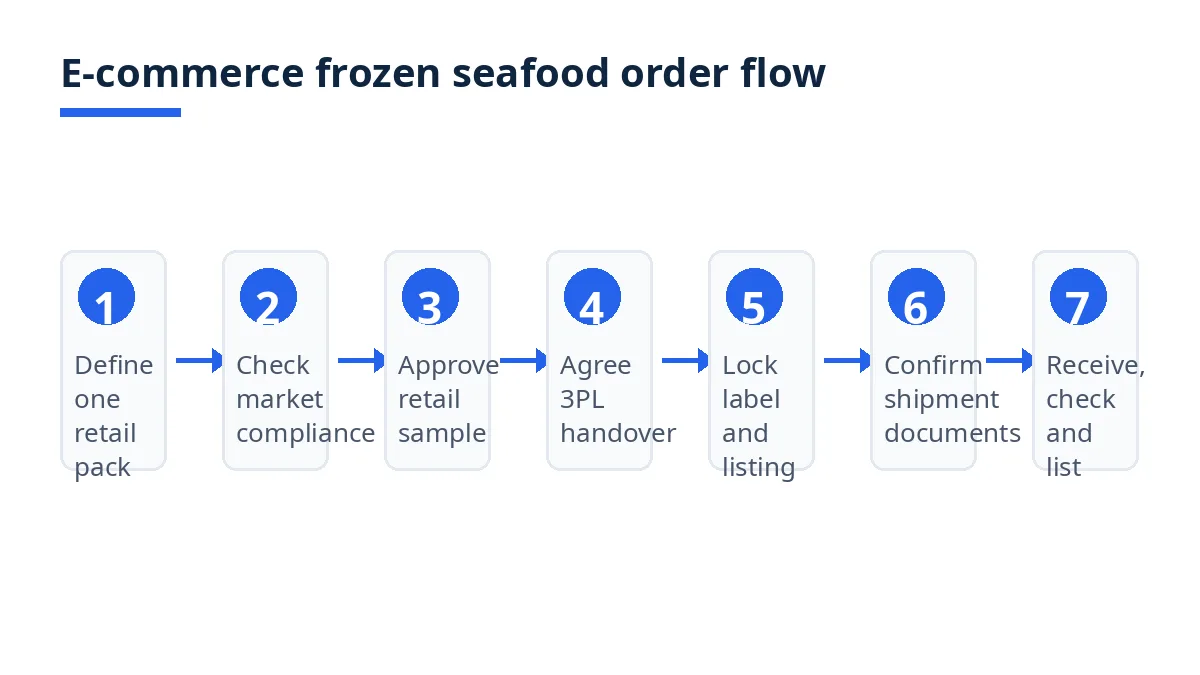
Define one retail pack. State the species, the cut or form, whether the product is raw or cooked, the glaze treatment, the retail pack weight, the number of packs per master carton, and the storage instruction. Add the label language and barcode requirement. Send the same pack specification to every supplier so replies can be compared.
Shortlist on compliance, not only on price. Ask each supplier for its food-safety and export documents for your destination market, and for the establishment details that market requires. For the United States, the importer must run a supplier verification programme, and for the European Union the dispatching establishment must be on the permitted list. Do not move to samples until those two questions have an answer.
Order samples as retail packs. Ask for the sample in the retail pack, with the label, so you can test thawing, cooking, taste, texture and pack appearance together. Record any difference between the sample and the specification in writing.
Agree the carton, the pallet and the 3PL handover. State the master carton size and weight, the pallet pattern if pallets are used, the delivery appointment process at the 3PL, and who supplies the temperature record at handover.
Lock the label and the listing text. Confirm the species name, the ingredient list, the allergen statement, the net weight, the country-of-origin marking and the storage and cooking instructions. Check that the online listing uses the same wording, weight and pack count as the pack.
Confirm the shipment documents before dispatch. Check the commercial invoice, the packing list, the health or export certificate your market requires, and the certificate of origin against the purchase order. A mismatch is easier to fix before loading than at the destination port.
Receive, check and list. At the 3PL, check carton count, pack condition, temperature record and label against the purchase order before the stock is made available for sale. Hold any carton that arrives thawed, damaged or mislabelled, and agree in advance what happens to it and who pays.
Costs, timelines and documents
What are the typical costs and timelines?
There are no typical costs or timelines a guide can state as fact for e-commerce frozen seafood from Bangladesh, because each order prices a different species, cut, glaze, pack size, carton format, destination market and delivery term. Ask for a cost breakdown that separates the product, the retail packing, the carton and pallet work, the export documents, the freight, the insurance and the destination charges. That separation is what lets you work out the landed cost per retail pack, which is the figure your listing price depends on.
For timelines, ask for the same separation: sample production and delivery, label approval, production, inspection and certification, loading, transit, destination clearance and 3PL receiving. A single delivery week hides the step that usually slips, which is document approval or a missed 3PL appointment.
Example figures: a brand tests one species in a single retail pack size, with a first order sized for a small 3PL receiving slot rather than a full container. The example shows the structure of a test order only, not a typical order size, price or lead time.
Which documents are needed?
For export clearance in Bangladesh, goods may not be loaded unless an export declaration, the Bill of Export or Shipping Bill, is submitted to Customs and approved.1 The documents enclosed with the Bill of Export include the export contract or purchase order where there is no export letter of credit, the commercial invoice, the packing list, the EXP form certified by an authorized dealer, and a certificate of origin issued by the Export Promotion Bureau or a Chamber of Commerce and Industry.1
On top of that export set, your destination market adds its own layer. For the United States, the importer verification rule requires written verification procedures for imported fish and fishery products, including product specifications and affirmative steps to confirm the foreign processor meets the seafood safety rule.2 The Foreign Supplier Verification Program rule requires most food importers to analyse hazards, evaluate the foreign supplier and the risk posed by the food, and carry out verification activities such as auditing, sampling and testing, or review of supplier food-safety records.3 For the European Union, an importer of products of animal origin from a third country must ensure the country of dispatch is on the permitted list, the dispatching establishment is on the permitted list where applicable, and the certificate requirements are met.4 General food hygiene rules place primary responsibility for food safety on the food business operator and stress maintaining the cold chain for frozen food.5
For classification, frozen shrimp and prawns fall under heading 0306, which covers crustaceans in shell or not, live, fresh, chilled, frozen, dried, salted or in brine.6 Check the full code for your species and form with your broker before the invoice is issued, because the code drives duty, certificate wording and entry data.
Bangladesh-specific rules and tips
Bangladesh regulates fish and fish products for export through the Department of Fisheries, whose Fish Inspection and Quality Control wing inspects and tests consignments and issues certifications and licences.7 The 2020 inspection and quality control law provides that no person may export fish and fish products, or operate a factory or establishment for their production and processing, without a licence, and that the central competent authority sets the standards for export, production, transportation, storage, marketing and processing.8 Ask which licence covers the establishment and which authority issued the health certificate, and check that the establishment name on the certificate matches the invoice and the packing list.
Bangladesh has also moved fish and seafood licences and product test certificates online, so licences, health certificates, sample collection, inspection, test reports and certificate issuance are handled through the online certification system connected to customs.7 Ask for the certificate and test report references before dispatch, and check them against the shipment documents, rather than discovering a mismatch when the goods reach your 3PL.
Three Bangladesh-specific checks deserve a line in every enquiry. First, confirm the species and form in the local trade name and the scientific name, because a local name can cover more than one species. Second, confirm the glaze and net weight basis in writing: state whether the quoted weight is net of glaze. Third, confirm the port of loading and the cold-storage handover, because a gap between plant, cold store and port is where a temperature break is hardest to prove afterwards.
Mistakes and red flags
What are the most common mistakes?
Ordering a bulk pack and splitting it later. A bulk export carton repacked by you or by a 3PL without a frozen packing line creates a new label, a new hygiene risk and a new temperature break. If the shopper buys a retail pack, source a retail pack.
Approving a sample that is not the retail pack. A loose sample proves taste, not packing, labelling or carton strength. Approve the sample in the retail pack, with the label, or treat the approval as partial.
Leaving the 3PL out of the specification. If the 3PL receiving hours, appointment system, frozen storage capacity and temperature-record requirement are not in the purchase order, the shipment can arrive correctly and still fail at the door. Send the 3PL requirements to the supplier before production, not after dispatch.
Copying a listing from a competitor. Allergen wording, species names, net weight and storage instructions must describe your pack. In the United States, the allergen law defines major food allergens to include fish and crustacean shellfish, with the specific type to be named.9 A listing that names the wrong species, or omits the allergen line, is a compliance error and a shopper-safety error at the same time.
Treating a profile or a badge as a guarantee. A supplier profile is a starting point for enquiries. Exportain badges record document and photo reviews, not factory inspections or guarantees, so sample approval, document checks and your own receiving check stay with you.10
Accepting a thawed or short delivery to keep a launch date. A launch built on compromised stock creates returns, refunds and reviews that cost more than a delayed launch. Agree the rejection, replacement and cost rules for thawed, damaged or short cartons before the first shipment.
Red flags include a refusal to name the processing establishment, a health certificate naming a different establishment from the invoice, a price quoted without a glaze and net-weight basis, a label draft with no allergen line for shrimp or fish, and a supplier who will not confirm the 3PL handover or supply a temperature record. Any one of these is a reason to pause, not a detail to fix after payment.
Checklist
Before you confirm an e-commerce order, every line should be answered.
One retail pack defined: species, cut or form, raw or cooked, glaze basis, pack weight, packs per carton.
Destination market named, with its importer verification, establishment-list and certificate requirements confirmed.
Supplier documents received: establishment licence, food-safety documents and health certificate route for your market.
Sample approved in the retail pack, with the final label, and differences recorded in writing.
Label locked: species name, ingredients, allergen statement naming the fish or crustacean shellfish type, net weight, origin marking, storage and cooking instructions.9
3PL handover agreed: receiving appointment, frozen storage, temperature record at handover, and rejection rules.
Shipment documents matched: invoice, packing list, Bill of Export set, health certificate and certificate of origin checked against the purchase order.1
Landed cost per retail pack calculated from an itemized quotation, not a single headline price.
Returns and rejection rules agreed: thawed, damaged, short or mislabelled cartons, who pays, and what happens to the stock.
Listing checked against the physical pack: title, weight, pack count, allergen line and storage instruction match exactly.
How Exportain helps
On Exportain, browse suppliers and post your retail pack specification on the RFQ board, with the species, pack weight, carton format, destination market and 3PL handover requirement, so replies describe the same product. Read the how-to-buy guide before you confirm, and ask each reply for its establishment documents, its glaze and net-weight basis, and its temperature record at handover.
Read badges for what they record. Exportain verification is a document and photo review by staff, not a factory inspection, and a badge is not a guarantee of capacity, quality or delivery.10 Your controls stay where they belong for an online brand: the retail pack specification, the sample approval, the shipment documents, and the receiving check at the 3PL.
FAQs
What should I know first about Frozen Seafood & Fish Sourcing From Bangladesh for E-Commerce Brands?
Know first that you are buying a retail pack, a cold chain and a listing, not only a species by weight. Define one pack, one species and one destination market, confirm that market's importer verification and establishment requirements, and agree the 3PL handover and the label before you discuss volume.
What are the typical costs and timelines?
There are no typical figures to rely on, because species, cut, glaze, pack size, carton format, destination market and delivery term change both. Ask for an itemized quotation and for sample, label, production, certification, transit, clearance and 3PL receiving dates as separate lines, then calculate the landed cost per retail pack from that breakdown.
Which documents are needed?
The Bangladesh export set is the Bill of Export with the export contract or purchase order, the commercial invoice, the packing list, the EXP form certified by an authorized dealer, and a certificate of origin.1 Your market adds its own layer: United States importer verification and supplier verification records,2 3 and for the European Union a permitted country and establishment and the required certificate.4 Your broker should confirm the classification code for your species and form before the invoice is issued.6
What are the most common mistakes?
The most common mistakes are ordering a bulk pack and repacking it later, approving a loose sample instead of the retail pack, leaving the 3PL out of the specification, copying listing text that does not describe your pack, and reading a profile or a badge as a guarantee.10 For shrimp and fish, the allergen line must name the specific type of fish or crustacean shellfish.9
Next steps on Exportain
Browse suppliers, then post your retail pack specification, destination market and 3PL handover requirement on the RFQ board. Before you confirm, read the how-to-buy guide, the frozen seafood sourcing guide and the how to import frozen shrimp from Bangladesh guide.
Sources
- Customs Clearance Procedures for Export. Bangladesh Customs, National Board of Revenue (accessed )
- 21 CFR Part 123, Fish and Fishery Products, Sections 123.11 and 123.12. US Government Publishing Office (accessed )
- Guidance for Industry: Application of the Foreign Supplier Verification Program Regulation to Importers. US Food and Drug Administration (accessed )
- Regulation (EC) No 853/2004 laying down specific hygiene rules for food of animal origin. European Union (accessed )
- Regulation (EC) No 852/2004 on the hygiene of foodstuffs. legislation.gov.uk (accessed )
- Classification Detail, HS Code 030616, Crustaceans, frozen cold-water shrimps and prawns. United Nations Statistics Division (accessed )
- Bangladesh rolls out online certification system to simplify fish and seafood trade. International Collective in Support of Fishworkers (ICSF) (accessed )
- The Fisheries and Fish Products (Inspection and Quality Control) Act, 2020. InforMEA (accessed )
- Food Allergen Labeling and Consumer Protection Act of 2004 (FALCPA). US Food and Drug Administration (accessed )
- Trust & Safety Center. Exportain (accessed )
About the author
Sourcing from Bangladesh?
Post a request for quotation and suppliers on Exportain can send you their quotes directly.
Post an RFQ


