Using Back-To-Back LC When Buying From Bangladesh: Bank Rules and Tips
Back-to-back LC for Bangladesh buyers: how a master LC and a second LC work through an intermediary, how documents must match across both credits, the Bangladesh rules that affect the chain, and the mistakes that delay payment.
Short answer
A back-to-back letter of credit is two separate credits for one trade, not one credit transferred. The buyer bank issues a master LC to an intermediary, which as applicant asks its own bank to issue a second LC to the supplier. Each bank examines only its own presentation, so documents under the second LC, with the intermediary invoice substituted, must also comply under the master LC before it expires.
On this page
Key takeaways
A back-to-back LC is two separate credits, not one credit transferred: the buyer bank issues a master LC to the intermediary, and the intermediary as applicant asks its own bank to issue a second LC to the supplier, with each bank examining only its own presentation.
The document chain is the risk: a complying set under the second LC, with the intermediary invoice substituted, must also comply under the master LC before its expiry, so the second LC dates must leave a substitution window covering a full examination period.
No bank is obliged to issue a second LC because a master LC exists, and no charge or timeline in this guide is universal: confirm issuance, charges, security, and payment dates in writing with each bank before the supplier starts production.
In Bangladesh, ask which form applies: the intermediary structure, or the factory's own input back-to-back LCs for fabric and trims, and confirm the EXP Form, the four-month repatriation period, and any bonded warehouse or local-currency input condition with the supplier AD bank.
When a buyer orders through a trading intermediary rather than directly from a factory, the payment chain gains a second link. The buyer pays the intermediary, the intermediary pays the supplier, and neither side wants to fund the other side first on trust alone. A back-to-back letter of credit (LC) is the bank structure built for that chain: two separate credits, one for each leg, linked by the same goods and the same document set.
A back-to-back LC is not one credit passed along. The buyer's bank issues a master LC in favour of the intermediary, and the intermediary, acting as applicant, asks its own bank to issue a second LC in favour of the supplier, using the master LC as support.1 Each credit stands on its own terms, and each bank examines only the presentation made under its own credit.
Most documentary credits are issued under UCP 600, the Uniform Customs and Practice for Documentary Credits, 2007 Revision, approved on 25 October 2006, cut from 49 to 39 articles, and implemented on 1 July 2007.2 Under those rules, a credit is irrevocable even if no indication to that effect appears in it, a credit is a separate transaction from the sale contract on which it may be based, and banks deal with documents and not with goods, services or performance to which the documents may relate.3 That last rule matters twice here, because two banks examine two document sets, and neither bank inspects the goods.
For the short definition of an LC, see the letter of credit (LC) guide. This guide covers one structure only: the back-to-back arrangement for a buyer ordering from Bangladesh through an intermediary.
Why this matters for buyers and sellers
For the buyer, a back-to-back chain changes who you are actually paying. Your bank undertakes to pay the intermediary against documents that comply with the master LC, not to pay the factory directly. If the intermediary fails to re-present, or re-presents late, your bank's undertaking is still governed by the master LC alone. You cannot instruct the intermediary's bank. Your control sits before issuance, in the master LC wording and in the commercial terms agreed with the intermediary.
For the intermediary, the structure is both the business model and the exposure. The intermediary earns the difference between the two LC amounts, less charges and costs, but it carries two separate bank relationships. If the supplier presents discrepant documents under the second LC, the intermediary's bank may refuse them while the master LC clock keeps running. If the buyer fails to fund the master LC, the intermediary may still owe the supplier under the second LC. A bank considering a back-to-back request assesses the creditworthiness of both the intermediary and the buyer, the nature of the goods, compliance requirements, and document verification procedures before issuing.1
For the supplier in Bangladesh, the second LC is the payment promise it can rely on, provided it presents documents that comply with that credit. The supplier does not need to know the buyer's identity or the master LC price, but it cannot look to the master LC for payment if the second LC presentation fails.
Back-to-back, transferable, and red-clause LCs are different tools
Structure | How many credits | Supplier-facing credit | What changes |
|---|---|---|---|
Back-to-back LC | Two separate credits | Newly issued; the intermediary is applicant | Terms can differ between the two credits, subject to bank approval |
Transferable LC | One credit, transferred in whole or in part | The existing credit, transferred | The credit must specifically state it is transferable |
Red-clause LC | One credit with a pre-shipment advance clause | No second credit | The nominated bank advances funds before shipping documents, usually against a simple receipt |
A transferable credit must specifically state that it is transferable, and it may be made available in whole or in part to a second beneficiary.3 The transferred credit must accurately reflect the original terms, with only amount, unit price, expiry date, presentation period, and latest shipment date permitted to be reduced or curtailed, and the first beneficiary may substitute its own invoice and draft.3 A back-to-back structure has no such transfer limit, because the second credit is newly issued.
A red-clause LC is different again. Its clause authorizes the advising or negotiating bank to make an advance payment to the beneficiary before presentation of shipping documents, usually against a simple receipt.4 That advance finances production or procurement before shipment; it is not a second payment credit for shipped goods, and it does not create the two-credit document chain this guide describes.
Step-by-step: how it works
The chain runs in this order, and a delay at any step compresses every step after it.
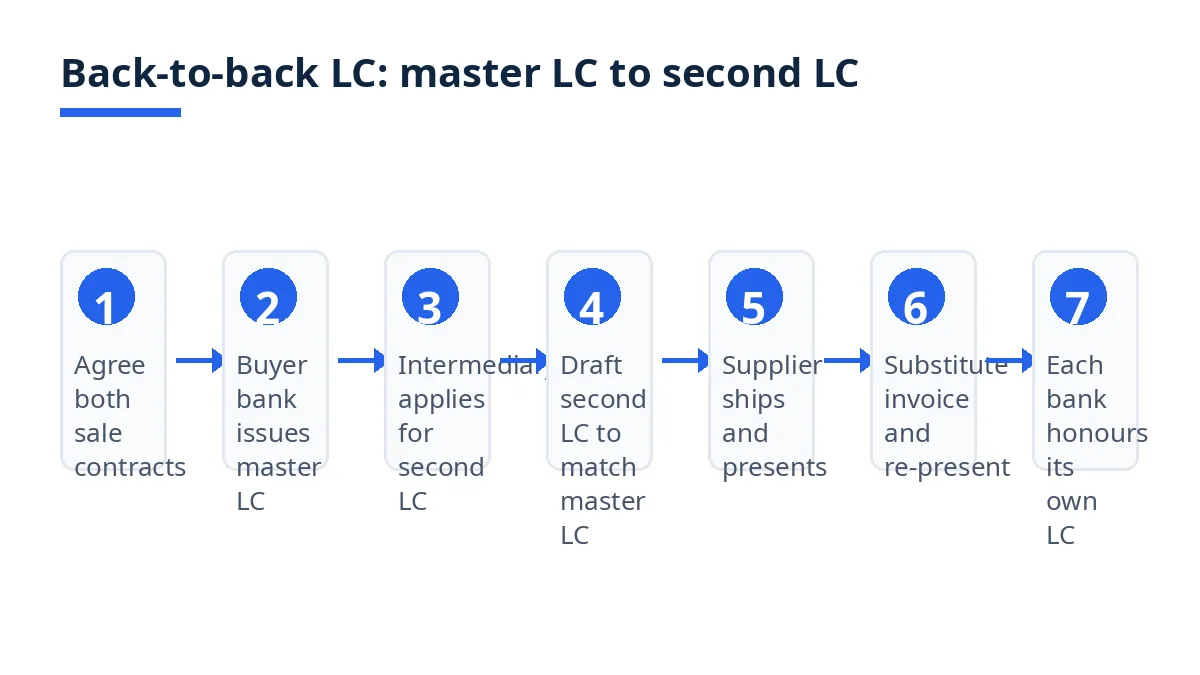
Agree the sale chain in writing before any bank form. The buyer agrees price, goods, quantity, ports, latest shipment date, delivery term, and document list with the intermediary, and the intermediary agrees the same items with the supplier. The two contracts must describe the same goods in compatible words. State who bears each bank charge on each leg.
The buyer's bank issues the master LC in favour of the intermediary. The master LC states the amount, goods description, latest shipment date, expiry date and place for presentation, required documents, and availability by sight payment, deferred payment, acceptance, or negotiation.3 The intermediary checks it line by line, because an issued credit can be amended only with the agreement of the issuing bank, any confirming bank, and the beneficiary.3
The intermediary applies for the second LC as applicant. The intermediary presents the master LC to its own bank and asks for a second LC in favour of the supplier. The bank decides whether to issue at all, and on what amount, margin, security, charges, and dates. No bank is obliged to issue a back-to-back LC because a master LC exists. Confirm the decision in writing before production starts.
Draft the second LC so its documents can satisfy the master LC. The second LC amount is normally lower than the master LC amount, leaving the intermediary's margin and charges, and its expiry and shipment dates are normally earlier, leaving time to substitute the invoice and re-present. A complying set under the second LC, with the intermediary's invoice substituted, must also comply under the master LC. Data in a document need not be identical to data in another document, but it must not conflict with data in that document, any other stipulated document, or the credit.3
The supplier ships and presents under the second LC. The supplier presents its invoice, transport document, packing list, and any other required documents to the bank named in the second LC, within the presentation period and before expiry. Each examining bank has a maximum of five banking days following the day of presentation to determine if a presentation is complying.3 A presentation including an original transport document must be made not later than 21 calendar days after shipment, and in any event not later than expiry.3
The intermediary substitutes its invoice and re-presents under the master LC. The intermediary replaces the supplier's invoice with its own invoice at the master LC price, keeps the documents that satisfy both credits, and presents the full set under the master LC before its expiry. If the substituted invoice creates a new discrepancy, the master LC presentation fails on it, even though the supplier's presentation complied.
Each bank honours or refuses only its own presentation. Honour means to pay at sight if the credit is available by sight payment, to incur a deferred payment undertaking and pay at maturity if available by deferred payment, or to accept a draft and pay at maturity if available by acceptance.3 If a presentation is discrepant, the bank may approach the applicant for a waiver, but the applicant is not obliged to accept it, and re-presentation is possible only before expiry. A waiver under one LC does not cure a discrepancy under the other.
Costs, timelines and documents
No bank charge in this guide is stated as a universal figure, because charges vary by bank, credit type, and amount. Ask each bank, in writing, for its full schedule for its own leg, and record who bears each item in both sale contracts. Confirm the issuing, advising, confirmation, examination, amendment, discrepancy, and courier charges on each leg.
The timetable is two examination windows plus one substitution window, inside two expiry dates. Work backwards from the master LC expiry date: allow substitution time, then the second LC examination period, then the supplier's presentation period, then shipment. Where the master LC is available by deferred payment or acceptance, payment under the second LC may fall due first. Confirm with each bank, before issuance, when each leg pays and who funds any gap.
Each credit has its own required document list, and each list is the authority for its own leg. The documents that commonly appear on both legs are the commercial invoice, the transport document, and the packing list, plus a certificate of origin, insurance document, or inspection certificate where called for. The invoice changes between legs. Every other document must satisfy both credits without alteration.
Bangladesh-specific rules and tips
In Bangladesh, the back-to-back structure appears in two forms. The first is the intermediary structure in this guide: a trader holds a master LC from the buyer and opens a second LC for a Bangladeshi factory. The second is the factory's own input structure: an exporter holding an export LC opens back-to-back LCs for fabric, trims, and accessories. Ask the supplier which form applies.
Bangladesh Bank has issued guidelines to authorised dealer (AD) banks for implementing the Import Policy Order 2026-2029, and under those guidelines export-oriented industrial enterprises may procure production inputs from local sources in local currency through back-to-back LC arrangements and on a free-of-cost basis.5 The same guidelines cover the bonded warehouse system and instruct AD banks to ensure compliance with the Import Policy Order and foreign exchange regulations when settling payments for locally sourced inputs.5 On the export side, Bangladesh Bank's consolidated export-trade circular requires exports to be declared, and the prescribed period for repatriating export proceeds is four months.6 The supplier's AD bank handles the export file, including the EXP Form and transport documents, so a document the master LC requires in a form the AD bank cannot issue is a problem to solve before issuance, not at presentation. Issue a clean master LC early, because a late master LC delays the supplier's input LCs.
Mistakes and red flags
Issuing the master LC without checking the second LC dates. A master LC expiry date that leaves no substitution window breaks the chain before the supplier ships.
Assuming the master LC guarantees the second LC. No bank is obliged to issue a second LC because a master LC exists.
Letting the goods descriptions drift apart. A supplier-leg description that differs from the master LC description creates a conflict.
Substituting only the invoice and forgetting the draft. Where either credit requires a draft, check the drawer, drawee, amount, and tenor on each leg.
Waiving a discrepancy on one leg and assuming the other leg is cured. Each bank decides only its own presentation.
Treating a red flag as a red-clause LC. Here, a red flag means a warning sign, such as a supplier that cannot name its AD bank. It has nothing to do with a red-clause advance.
Hiding the chain from either bank. Disclose the structure to both banks at application.
Checklist
Confirm the structure and each applicant in writing.
Confirm both banks will issue before production starts.
Check both credits line by line before acceptance.
Match descriptions, ports, dates, marks, and documents.
Build a substitution window covering one examination period.
Confirm who bears each charge and funds any payment gap.
Confirm the transport document route with the AD bank.
Confirm amendment handling and costs on both legs.
Confirm EXP Form, repatriation period, and input-LC conditions.
Keep both credits, document sets, and bank correspondence.
How Exportain helps
Exportain connects buyers with Bangladeshi sellers and providers, and the quotation record is the place to agree goods description, quantity, ports, shipment date, document list, and payment terms before any bank form is drafted. Platform membership and payment terms are separate from the bank undertaking: Exportain's Payment and Membership Terms cover payments to Exportain and memberships, not money paid directly between two companies outside the platform.7 The Buyer Protection page states that a badge is a record of checks reviewed, not a capacity, quality, or delivery guarantee.8
Post a free RFQ on Exportain to start a sourcing conversation with suppliers who can work on clear LC terms: Post a free RFQ.
FAQs
What should I know first about back-to-back LC?
Know that it is two separate credits, not one credit transferred. Your bank issues a master LC to the intermediary, the intermediary as applicant asks its own bank to issue a second LC to the supplier, and each bank examines only its own presentation. Documents that comply under the second LC, with the intermediary's invoice substituted, must also comply under the master LC before its expiry.
What are the typical costs and timelines?
There are no universal back-to-back charges or timelines to quote, because each bank sets its own schedule for its own leg. Confirm issuing, advising, confirmation, examination, amendment, discrepancy, and courier charges in writing with each bank. For timelines, allow up to five banking days of examination on each leg, a presentation period ending no later than 21 calendar days after shipment where an original transport document is included, and a substitution window between the two expiry dates.
Which documents are needed?
Each credit states its own required documents, so the answer is the document list in each credit, not a fixed universal list. The lists commonly include the commercial invoice, transport document, and packing list, plus a certificate of origin, insurance document, or inspection certificate where called for. The invoice changes between legs, because the intermediary substitutes its own invoice at the master LC price.
What are the most common mistakes?
The most common mistakes are issuing a master LC with no substitution window, assuming a master LC guarantees a second LC will be issued, letting goods descriptions drift between the two credits, forgetting a required draft on one leg, and assuming a waiver on one leg cures the other leg.
Next steps on Exportain
Start with the commercial terms, then take them to the banks. Read the letter of credit (LC) guide, check the Payment and Membership Terms and Buyer Protection pages, and Post a free RFQ to find suppliers who can work on clear LC terms.
Sources
- Transferable vs Back-to-back letters of credit (LCs). ICC Academy (accessed )
- ICC's new rules on documentary credits now available. International Chamber of Commerce, (accessed )
- Uniform Customs and Practice for Documentary Credits (UCP 600). LegalGuide (accessed )
- Glossary for Letter of Credit (L/C Glossary). LeadXpress (accessed )
- BB issues guidance on implementing Import Policy Order 2026-2029. The Business Standard, (accessed )
- Consolidated circular on foreign exchange regulations — export trade transactions (FEPD-1 Circular No. 26, July 30, 2026). Bangladesh Bank (accessed )
- Payment and Membership Terms. Exportain (accessed )
- Buyer protection: What Exportain does to protect buyers. Exportain (accessed )
About the author
Sourcing from Bangladesh?
Post a request for quotation and suppliers on Exportain can send you their quotes directly.
Post an RFQ