

Baby Clothes Lead Time From Bangladesh: Production and Shipping Timeline
How to read a baby clothes lead time from Bangladesh: soft-fabric and hand-feel approval, size-range grading, snap attachment, compliance documents, wash-care labeling, inspection and transit as dated stages, with a stage table, document checks and red flags.
Short answer
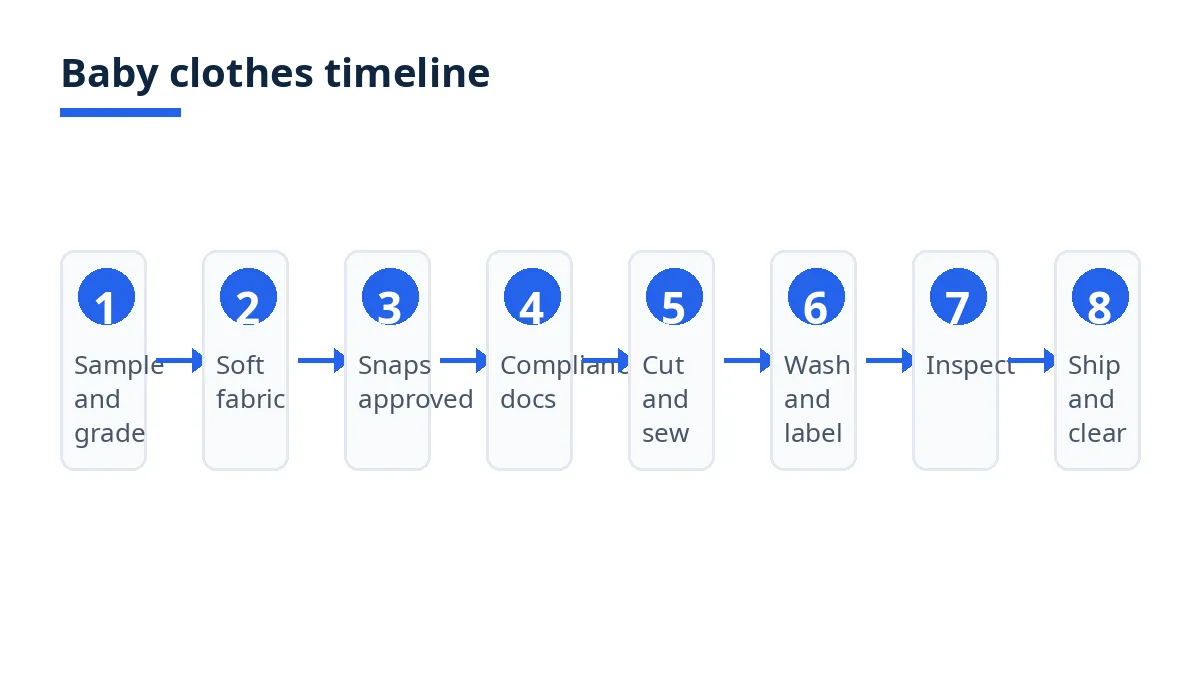
A baby clothes lead time from Bangladesh is a chain of dated stages: soft-fabric and hand-feel approval, size-range grading, snap and button attachment approval, safety and compliance documentation, cut-and-sew, wash and wash-care labeling, inspection, and documents and transit. No single figure fits every order. Ask for dated stages, named approvals, and a forwarder estimate, then work backward from your selling date with a buffer after inspection.
On this page
Key takeaways
A baby clothes lead time is a chain of dated stages, not a single number, with baby-specific gates for soft-fabric hand-feel approval, size-range grading, snap and button attachment approval, and safety and compliance documentation.
Bulk cutting should wait for size-set approval in every size, checking diaper room and movement at the smallest and largest sizes, not a middle-size sample alone.
Snap and button attachment must be approved by trim, sample, method, and recorded result, and repeated after washing where the buyer specification requires it.
Safety and compliance items, including drawstrings and cords, small parts, flammability, and chemical limits, are buyer-specification items to confirm in writing for the specific garment and market, with a provider and a date.
Wash-care labeling, inspection defect lists, and the Bangladesh document set are stages in their own right: each needs a dated check and a correction route before loading, and transit must be read from a dated forwarder estimate.
A baby clothes lead time from Bangladesh is a chain of dated stages, not a single number in a quote. The stages that most often decide whether a baby order ships on time are small and specific: a soft fabric whose hand feel was never approved, a size at the end of the infant range that was never tried, a snap whose attachment was never recorded, or a compliance document left until packing.
Why this matters for buyers and sellers
For a buyer, a baby clothes order is judged against the selling date and against the fit, feel, and fastening of a garment worn by an infant. A missed stage early in sampling can cost more than a missed sailing, because rework after bulk cutting touches every size.
For a seller, a dated stage table is a clearer offer than a short total. Naming each stage, its closing approval, and its date lets the buyer plan.
Step-by-step: how it works
Stage 1: Soft fabric and hand-feel approval
Baby clothes are worn against sensitive skin, so fabric approval starts with feel as well as weight and color. One babywear sampling account lists fabric softness and breathability alongside fit and seam placement as items to check on a sample, noting that bulky seams can irritate.1 Ask the quote to name the fabric, its weight range, and the approved hand-feel sample, recorded in writing before bulk fabric is booked.
Bulk fabric needs its own check: a buying-house account describes bulk fabric checked against the approved sample for color and hand feel, with out-of-shade lots rejected before bulk cutting.2 For baby clothes, ask that the check cover softness after the agreed wash route.
Stage 2: Sampling and size-range grading for infants
Sampling turns a tech pack into a garment the buyer can approve, and for baby clothes the sample must settle the whole size range, not only a middle size. A babywear production account lists finalized size charts and grading for all baby sizes as readiness items before bulk production.3 A sampling account adds that a review should check fit and movement, including room for diapers and movement at shoulder and leg, and that samples should be snapped, unsnapped, stretched, and washed before approval.1
Ask for size-set samples in each size before bulk cutting is approved: a buying-house account describes one or two pieces in each size, with bulk cutting approved only after the size set is approved.2 Record whether diaper room and leg movement were checked on the smallest and largest sizes, since a middle-size sample cannot settle those.
Stage 3: Snap and button attachment approval as a buyer-specification item
Snaps and buttons are the fastenings a parent uses most often on baby clothes, so treat their attachment as a separate approval. The babywear sampling account lists snap, button, and zipper safety among the features to check on a sample, with secure attachment and smooth operation as the checks.1
Ask for the approval in writing: snap or button type, fabric layers, method, sample, and recorded result. A children's inspection checklist lists buttons and snaps among items to check for secure attachment and function, alongside loose threads, sharp objects, and decorative elements that must stay attached.4 Do not accept a general statement that trims were checked, and ask that the check be repeated after washing where required.
Stage 4: Safety and compliance documentation as a stage gate
Children's-product safety requirements belong in a baby clothes timeline as a documentation gate, not as an afterthought at packing. Confirm in writing with the buyer and the compliance provider: drawstrings and cords, small parts and detachable decorations, flammability where the garment type and market require it, and chemical limits where the market requires them. None is a universal requirement for every baby order, and no limit, age band, or test figure is stated here.
A babywear production account names market-specific frameworks as context, listing CPSIA compliance for the United States and EN 14682 for Europe among items a buyer may need to confirm.3 A children's inspection checklist likewise lists CPSIA for the United States and REACH for the European Union, with flammability, choking-hazard, and chemical testing among its items.4 Use those names only as market context. The practical question is which documents, test reports, and labels this buyer requires for this garment in this market, who provides them, and by what date they must be in hand. If that date is not in the stage table, the gate is open.
Stage 5: Cut-and-sew
Cut-and-sew joins the approved fabric and trims into finished baby garments. Ask for the sewing sequence: how seams are finished so they sit flat against skin and how snap positions are kept consistent across sizes. A children's inspection checklist covers the checks here: seams securely stitched, no loose threads, no sharp objects, and decorative elements securely attached.4 Ask for weekly reporting by size.
Stage 6: Wash, shrinkage, and wash-care labeling
Baby clothes are washed often, so a measurement taken off the machine is not the final measurement. The babywear sampling account lists fabric after washing, including shrinkage and colorfastness, and labeling covering size, fiber content, and care instructions as sample review items.1 Agree whether garments will be measured before washing, after washing, or both, and what shrinkage allowance applies, then put the re-check date in the stage table.
Wash-care labeling for baby garments is a buyer-specification item in its own right. Confirm label content, position, and durability in writing: size, fiber content, and care instructions matching the agreed wash route.4 If label content changes after sample approval, it needs a new approval.
Stage 7: Inspection
Inspection is a stage in its own right, not a formality at the end. During-production checks catch a systematic fault, such as a snap that loosens after washing, while remaining units can still be corrected. AQL sampling, defined in ISO 2859-1, sets how many garments are inspected and how many defects of each type are allowed before rejection, with commonly used thresholds of zero for critical, 2.5 for major, and 4.0 for minor defects.5
Agree in writing which faults count as major for baby clothes: a snap or button that detaches or fails to close, a seam that opens, a measurement outside tolerance, a label that is wrong or unreadable, a shade mismatch, and any drawstring, cord, or decoration that does not match the written buyer specification.4
Stage 8: Documents and transit
Transit starts when packed, inspected goods are handed to the carrier and ends when they reach the buyer warehouse, cleared for import. Its variables are sailing schedule, transhipment, port congestion, documentation readiness, and destination clearance. No transit leg should be read as a fixed number of days.
Bangladesh Customs requires an export declaration, known as a Bill of Export or Shipping Bill, to be submitted and approved before goods are loaded or stuffed, with the commercial invoice, packing list, EXP form certified by an authorized dealer, certificate of origin, VAT registration certificate, and taxpayer identification number enclosed.6 Confirm who prepares each document and who checks the size split on the packing list. For containers handed over at a terminal in Bangladesh, FCA, CPT, or CIP describe the handover more accurately than FOB, CFR, or CIF in many cases.7
Costs, timelines and documents
How to read a supplier timeline
Ask for a table with five columns: stage, start date, finish date, approval closing the stage, and what happens if it slips. Use the table below only as a planning example, not a promise about any order. Replace every cell with the dated figures in the written quote and forwarder estimate.
Stage | Illustrative planning example | Confirm in writing |
|---|---|---|
Soft fabric and hand-feel approval | 1 to 2 weeks across samples | Fabric and hand-feel sample |
Sampling and size-range grading | 2 to 4 weeks across rounds | Size-set approval, every size |
Snap and button attachment approval | Within the sampling stage, as agreed | Trim, sample, method, result |
Safety and compliance documentation | Before bulk cutting, as agreed | Buyer and market documents |
Cut-and-sew | 2 to 5 weeks after fabric is in hand | Weekly reporting, by size |
Wash, shrinkage, and wash-care labeling | 3 to 7 days after sewing, plus rework | Wash route and label approval |
Inspection | After packing, before loading | Defect list and AQL levels |
Documents and transit | Dated forwarder estimate only | Document set and sailing |
How to read the costs
Read costs the same way: as a breakdown to compare, not as a single price. Separate the garment price from sampling and testing charges, inspection charges, inland transport in Bangladesh, export documentation, freight, insurance, and destination handling, duty, and delivery. Price every quote to the same delivery point and delivery term before comparing. Ask which charges change if a stage slips, which charges apply again after rework, and which document or test fees sit outside the garment price.
Documents to check before loading
Check the document set against the order, not against a generic list. The Bangladesh export set includes the commercial invoice, packing list, EXP form, certificate of origin, and the Bill of Export or Shipping Bill described above.6 Add the buyer-side set: the purchase order, the size and quantity split, the approved label and packing specification, the inspection report, and the safety and compliance documents agreed at Stage 4. Check that the packing list matches the inspection report on quantity by size.
Bangladesh-specific rules and tips
Bangladesh export clearance runs on the approved declaration, so document readiness is a timeline item, not a packing-day task. Goods are not loaded or stuffed until the Bill of Export or Shipping Bill is approved, and the declaration carries the description of goods, value, exporter, buyer, and transport operator.6 Build the document dates into the stage table at the start.
Three tips follow. First, confirm the size split on the packing list early, because a baby order is split across many small sizes and a packing error in one size is easy to miss in a total count. Second, confirm the delivery term against the real handover: for containers handed over at a terminal, FCA, CPT, or CIP match the handover better than FOB, CFR, or CIF in many cases.7 Third, treat the forwarder estimate as the transit figure.
Mistakes and red flags
Bulk cutting approved on a middle-size sample only, with no size-set approval for the smallest and largest sizes.
A hand-feel approval recorded for one fabric, then a substitute fabric used without a new approval.
Snap or button approval given in general terms, with no trim, sample, method, or result recorded.
Safety and compliance documents left until packing, with no buyer or market document named at sampling.
Wash-care labeling approved before the wash route is agreed, so the label does not match actual washing.
A single total in place of a dated stage table, so no one can see which stage is holding the order.
A transit figure quoted as a fixed number of days, with no forwarder estimate for the exact route and port pair.
An inspection report with no defect categories for baby clothes, so a detached snap and a loose thread count the same.
A packing list giving a total quantity only, with no split by size to check against the inspection report.
A delivery term chosen for its price rather than for where the goods are actually handed over.
Checklist
Work backward from the date the garments must be in hand, cleared for import, with a buffer after inspection.
Ask for a dated stage table with an approval closing every stage and a correction route for every approval.
Approve soft fabric and hand feel in writing, and re-approve any substitute fabric before bulk cutting.
Approve size-set samples in every size, checking diaper room and movement at the smallest and largest sizes.
Record snap and button approval by trim, sample, method, and result, repeating the check after washing where required.
Name the safety and compliance documents for the specific garment and market, with a provider and a date, at sampling.
Agree the wash route, shrinkage allowance, and wash-care label content before bulk production.
Agree the baby-clothes defect list and AQL levels in writing before inspection.
Check the Bangladesh and buyer document sets against the order before loading.
Compare quotes only when priced to the same delivery point and delivery term.
How Exportain helps
Exportain connects buyers with Bangladeshi suppliers and lets buyers post a sourcing requirement that suppliers can answer with a quotation. When you post a requirement for baby clothes, put the stage table in it: the size range, the soft-fabric and hand-feel approval, the snap and button approval, the safety and compliance documents required, the wash-care label specification, and the inspection defect list.
FAQs
What should I know first about baby clothes?
Know that baby clothes are judged on fit, feel, and fastening as well as on price. Before ordering, settle the size range, the soft-fabric and hand-feel approval, the snap and button approval, and the safety and compliance documents for the specific garment and market. Each needs a date in the stage table.
What are the typical costs and timelines?
Costs and timelines are read from the written quote and the dated forwarder estimate, not from a single figure. The timeline is the sum of dated stages above, with every duration shown as an illustrative planning example or a confirm-in-quote item. Costs are compared as a breakdown priced to the same delivery point and delivery term.
Which documents are needed?
On the Bangladesh side, the export set includes the commercial invoice, packing list, EXP form certified by an authorized dealer, certificate of origin, and the approved Bill of Export or Shipping Bill.6 On the buyer side, add the purchase order or contract, the size and quantity split, the approved label and packing specification, the inspection report, and the safety and compliance documents agreed for the specific garment and market.
What are the most common mistakes?
The most common mistakes are approving bulk cutting on a middle size only, accepting a general trim approval with no recorded result, leaving safety and compliance documents until packing, approving a wash-care label before the wash route is agreed, and reading a transit figure as a fixed number of days instead of a dated forwarder estimate.
Next steps on Exportain
Start by browsing Bangladeshi suppliers, then read the Incoterms guide for shipments from Bangladesh to choose a delivery term that matches the real handover. When the stage table is ready, post your requirement with the size range, approvals, documents, and inspection list included.
Sources
- Why Sampling Matters in Baby Clothing Development?. Best Dragon (accessed )
- Preproduction Inspection Stages Followed by Buying House. Online Clothing Study (accessed )
- What You Will Need Before Starting a Babywear Production Run?. Best Dragon (accessed )
- Children's Apparel and Accessories Inspection Checklist and Template. QCADVISOR (accessed )
- AQL Inspection in Apparel: A Practical Guide (2026). Wave PLM (accessed )
- Customs Clearance Procedures for Export. Bangladesh Customs, National Board of Revenue (accessed )
- Incoterms for Shipments From Bangladesh. Exportain (accessed )
- Incoterms
- export documents
- knitwear
- quality control
- buyer guide
- Bangladesh sourcing
- aql inspection
- bangladesh garments
About the author
Sourcing from Bangladesh?
Post a request for quotation and suppliers on Exportain can send you their quotes directly.
Post an RFQ


