

Baby Clothes Exporters in Bangladesh: Verified Supplier Checklist
A supplier checklist for baby clothes exporters in Bangladesh: define the range and age grades, check safety and labelling files, confirm MOQ and price drivers, approve samples, and verify the supplier before you place an order.
Short answer
Use this checklist to choose baby clothes exporters in Bangladesh: define styles, sizes and age grades first, then check knit or woven scope, safety and labelling evidence, minimum order quantity and price drivers, sample approval, and capacity and export documents. Confirm each point in writing before bulk production, because baby garments face stricter safety, labelling and inspection checks than adult clothing.
On this page
Key takeaways
Separate knitted styles in heading 6111 from woven styles in heading 6209, and match each supplier to the construction, age grades and product types it actually makes.
Put destination-market safety and labelling rules in the tech pack and purchase order, and check cords, lead, prints, flammability and tracking labels on the sample, not at final inspection.
Record the MOQ and what drives it, and require a price breakdown by fabric, trims, testing, labels and packing so quotations from different suppliers can be compared.
Treat an Exportain badge as a record of document and photo checks reviewed by staff, not as a factory inspection or a guarantee, and keep samples, testing and inspection in your own process.
Use this checklist to test baby clothes exporters in Bangladesh before you request prices: scope, safety and labelling evidence, capacity, minimum order quantity (MOQ), price drivers, samples and documents. The Bangladesh Knitwear Manufacturers and Exporters Association (BKMEA) states that it was established in 1996 and currently represents approximately 2,540 knitwear member factories.1 Knitted and woven baby garments sit in different headings: 6111 covers babies' garments, knitted or crocheted,2 and 6209 covers babies' garments that are not knitted or crocheted.3
Why this checklist matters
Baby clothes are judged more strictly than adult clothing because the wearer cannot report a problem and skin contact is close and prolonged. A loose snap, a cord in the wrong place, a wrong fibre label or a shade change across a set can stop a shipment at inspection or at the border. The checklist turns those risks into written points agreed before production. It also makes suppliers comparable: two quotations are only comparable when both factories priced the same fabric, trims, testing, labelling and packing. For garment-level checks after selection, use the baby clothes quality control checklist.
Before you start
Do not score suppliers until your specification is complete: a tech pack per style with size chart, fabric, trims, artwork, colour standards, label and packing specification, destination market and its standards. For the European Union, Regulation (EU) No 1007/2011 requires a textile product to be labelled with the name and percentage by weight of all constituent fibres in descending order.4 For the United States, the Consumer Product Safety Commission (CPSC) clothing guidance covers flammability, lead and tracking labels.5
Agree how goods will be sampled and judged. ISO 2859-1 specifies an acceptance sampling system for inspection by attributes, indexed in terms of the acceptance quality limit (AQL), applicable to end items.6 Name the standard, inspection level and acceptance numbers per defect class in the purchase order. This checklist states no acceptance figure as a universal rule.
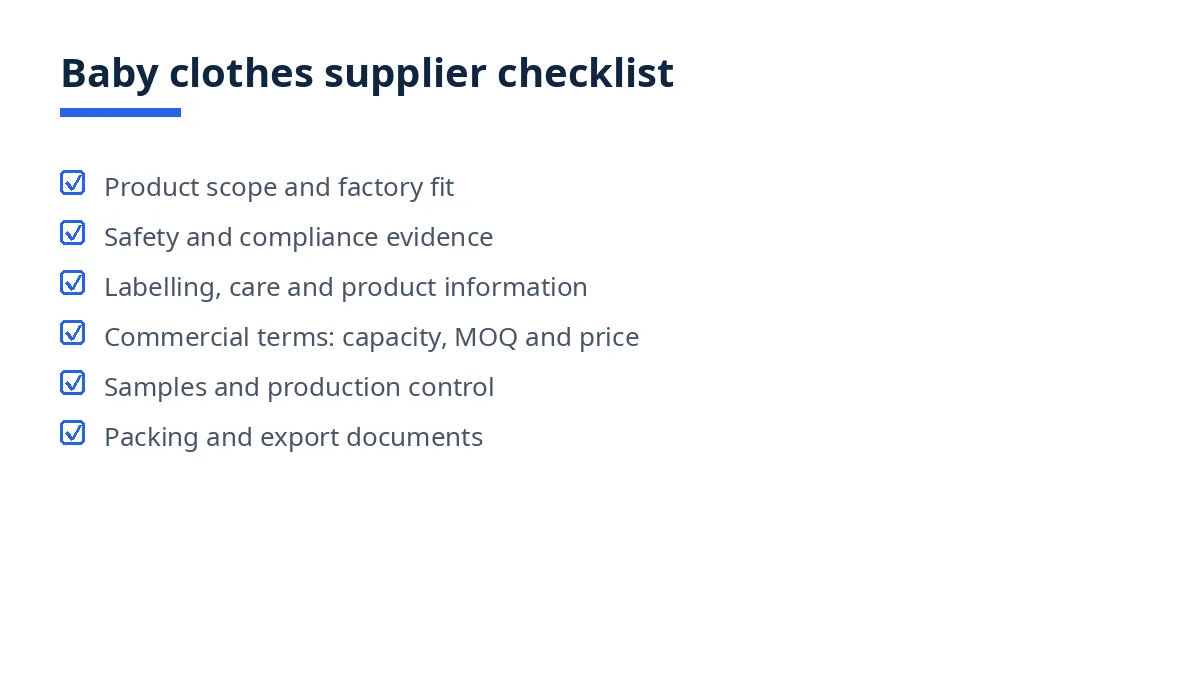
The full checklist (numbered, printable)
Product scope and factory fit
Separate knitted styles from woven styles, and confirm baby clothes are a core product. Heading 6111 covers babies' garments, knitted or crocheted, including cotton at 611120.2 Heading 6209 covers babies' garments that are not knitted or crocheted, including cotton at 620920.3
Match the supplier to your age grades, sizes and product types, such as bodysuits, rompers, sleepwear, bibs and sets.
Ask which operations are in-house, such as knitting, dyeing, printing and sewing, and which are subcontracted.
Check association and export standing as a starting point only. BKMEA represents the knitwear sector and states that it currently represents approximately 2,540 knitwear member factories.1 Membership is not evidence a factory can make your order.
Confirm location, monthly capacity for baby styles, and other orders in your delivery window, in writing.
Safety and compliance evidence
List destination-market safety rules per style in the purchase order, confirmed in writing before sampling.
Check cords and drawstrings. Under EN 14682:2014, as summarised in a United Kingdom government assessment, garments for young children shall not have drawstrings or functional cords in the head, neck or upper chest area, and decorative cords elsewhere in that area shall have free ends no longer than 7.5 cm, with no knots, toggles or embellishments.7
For the United States, check lead on accessible components. The CPSC states that accessible components must be tested to the lead content limit of 100 parts per million, including metal or plastic parts such as buttons, snaps and zippers.5
Check painted parts and print inks. The CPSC states that painted parts are subject to lead in paint requirements, that coatings must not contain lead above 90 parts per million, and that print inks are also covered.5
Check whether the style is a child care article. The CPSC states that bibs and sleepwear for children ages 3 and younger are among the products considered child care articles, subject to the ban on specified phthalates.5
Check flammability by garment type. The CPSC states that children's sleepwear outside the infant garment and tight-fitting definitions is subject to 16 CFR part 1615 (sizes 0 through 6X) or part 1616 (sizes 7 through 14), and sleepwear inside those definitions to part 1610.5
Confirm testing is done at a third-party, CPSC-accepted laboratory, as the CPSC requires for children's wearing apparel, and that the importer then issues a Children's Product Certificate.5
Check tracking labels. The CPSC states that children's products and packaging require tracking labels, permanent marks including manufacturer, production date and location, and batch information.5
If a harmful-substances claim will appear on the product, check certificate scope and class. Hohenstein states that OEKO-TEX STANDARD 100 Product Class I covers textiles for babies and young children up to three years of age, and that the label is awarded only if all components meet the criteria, including fabric, threads, prints and accessories.8
Pull every small part in the tech pack, including snaps, buttons and appliques, by hand on the sample, and record any loosening as a failure.
Labelling, care and product information
Check the fibre label before bulk printing. For the European Union, it must give the name and percentage by weight of all constituent fibres in descending order.4
Check care symbols against the agreed standard. ISO 3758 establishes graphic symbols for textile articles, giving the most severe treatments that do not cause irreversible damage during care.9
Check that size, age grade, origin, brand and barcode labels match the purchase order, and that garment size matches the size chart.
Confirm any printed claim is covered by a certificate naming this supplier, this product and a current validity date.
Commercial terms: capacity, MOQ and price drivers
Get the MOQ per style, colour and size in writing, and record what drives it, such as fabric, dye-lot or trim minimums. Read the MOQ minimum order quantity explainer first.
Ask for a price breakdown, not a single price: fabric, trims, printing, testing, labels, packing, and costs to the agreed Incoterm.
Confirm which costs change with quantity, fabric substitution or added testing, and record revised prices in writing.
Confirm lead times stage by stage: fabric, trims, approval, sewing, inspection and shipment.
Agree payment terms, Incoterm and inspection point in the purchase order, including who pays for re-inspection.
Samples and production control
Approve a sample per style and colour against the tech pack, and keep a sealed counter sample.
Check hand feel against the standard, seam softness inside, rough stitching at neck, armholes and leg openings, and snap action.
Require a pre-production sample when bulk fabric, colour or trims differ from the approved sample, and stop cutting until it is approved.
Agree the inspection plan before production, naming the sampling standard, stage and acceptance numbers per defect class.6
Record shade approval per colour, and re-check shade between pieces in a set and across sizes before packing.
Packing and export documents
Confirm folding, packaging, set ratios, stickers and carton markings against the packing specification, and check for pins or hard tags.
Check the export document set: invoice, packing list, certificate of origin where required, test reports for this lot, and bill of lading.
Confirm company name and address match on quotation, invoice, export documents and profile, before you pay.
Common failures and how to fix them
The most frequent failure is comparing prices for different products: one factory priced the specified fabric and testing, another a lighter fabric with no test budget. Fix it by sending the same tech pack to every supplier and requiring the breakdown at point 21.
Next is a safety point found at final inspection that was never in the tech pack, such as a neck cord or untested snap. Cords for young children are restricted under EN 14682:2014,7 and metal and plastic components must be tested for lead for the United States.5 Fix it by moving points 6 to 15 into the purchase order.
A third failure is a certificate that does not cover the shipped product. Under OEKO-TEX STANDARD 100, the label is awarded only if all components meet the criteria.8 Fix it at point 19. MOQ disputes trace to an unstated minimum: fix them at point 20.
Downloadable template / summary table
Copy the table into your sourcing sheet and record the evidence you saw per supplier.
Section | Points | Evidence to record |
|---|---|---|
Product scope | 1 to 5 | Knit or woven scope, in-house operations, capacity note |
Safety and compliance | 6 to 15 | Rules, cord, lead, phthalate, flammability and test reports |
Labelling and care | 16 to 19 | Fibre label proof, care symbols, certificate scope and dates |
Commercial terms | 20 to 24 | MOQ, price breakdown, lead times, payment, Incoterm |
Samples and production | 25 to 29 | Sealed sample, approvals, inspection plan, shade |
Packing and documents | 30 to 32 | Packing check, document set, matching company details |
How Exportain helps
Exportain is a B2B marketplace connecting buyers with Bangladeshi suppliers, so these points can be raised at the enquiry stage. Browse suppliers, read how supplier verification works on Exportain, and compare profiles before you shortlist. A badge records which document and photo checks staff have reviewed. The verification guide states that verification is a review of documents and photos by staff, not a factory visit or a check against a government database, and not a guarantee of capacity, quality or delivery.10 Exportain is not a party to the goods contract and does not inspect goods.
FAQs
When should this checklist be used?
Use it at shortlisting and selection, before samples are paid for and the purchase order is signed. Reuse the safety and packing points at final inspection.
Who should complete it?
The buyer or sourcing agent who owns the tech pack, with the supplier providing documents, samples and test reports as evidence.
What are the most common failures?
Prices compared across different specifications, safety points left out until final inspection, certificates that do not cover the finished garment, and unrecorded MOQ drivers.
Can a third party do it?
Yes. An inspection company or local agent can complete it if you share the tech pack, destination rules, acceptance numbers and approved sample first.
Next steps on Exportain
Finish the tech pack, set destination rules per style, and read how to import baby clothes from Bangladesh and find suppliers in Bangladesh. Then post a free RFQ via RFQs and use this checklist with each supplier that quotes.
Sources
- BKMEA at a Glance. BKMEA (accessed )
- Classification Detail — HS Code 6111. United Nations Statistics Division (accessed )
- HS 2012 Classification Detail: Code 6209, babies' garments and clothing accessories, not knitted or crocheted. United Nations Statistics Division (accessed )
- Regulation (EU) No 1007/2011 on textile fibre names and related labelling and marking of the fibre composition of textile products. European Union, (accessed )
- Clothing Business Guidance. U.S. Consumer Product Safety Commission (accessed )
- ISO 2859-1:2026 - Sampling procedures for inspection by attributes — Part 1: Sampling schemes indexed by acceptance quality limit (AQL) for lot-by-lot inspection. International Organization for Standardization (accessed )
- PRISM: Narrative style risk assessment - non-compliant cords and drawstrings identified in clothing intended for children. GOV.UK (accessed )
- OEKO-TEX STANDARD 100 for textiles tested for harmful substances. Hohenstein (accessed )
- ISO 3758:2023 - Textiles — Care labelling code using symbols. International Organization for Standardization (accessed )
- How Supplier Verification Works on Exportain. Exportain, (accessed )
About the author
Sourcing from Bangladesh?
Post a request for quotation and suppliers on Exportain can send you their quotes directly.
Post an RFQ


