

How to Find ZDHC Certified Factories in Bangladesh
How to check ZDHC evidence for orders from Bangladesh: MRSL conformance, Gateway records, wastewater reports, and Supplier to Zero levels by site.
Short answer
ZDHC is not a factory certification. It is a programme for safer chemistry: the MRSL for chemical inputs, the Gateway for inventory and wastewater records, and Supplier to Zero for facility progress. Verify the InCheck inventory, ChemCheck formulation levels, and a current ClearStream wastewater report by site, not a factory certificate.
On this page
Key takeaways
ZDHC is not a factory certification, not a product quality mark, and not issued to factories; it is a programme for safer chemistry built on the MRSL, chemical management practice, and wastewater guidelines.
Verify three report types by site: InCheck for the chemical inventory, ChemCheck for each key formulation at MRSL conformance Level 1, 2, or 3, and ClearStream for wastewater.
Read wastewater evidence by date, discharge route, and corrective action: a ClearStream report should be no older than one year, direct dischargers need progressive-level evidence, and an MRSL detection triggers root cause analysis and a corrective action plan rather than counting as an automatic failure.
Supplier to Zero Foundational level per site is the entry expectation for a signatory supplier, with Progressive preferred; a Gateway listing is a formulation assessment, not a factory certification.
Start with the correction, because it changes every check that follows. ZDHC is not a factory certification, not a product quality mark, and not a status issued to a factory. The phrase in the title, "ZDHC Certified Factories", is common search phrasing, not a real ZDHC status. ZDHC runs the Roadmap to Zero programme for safer chemistry in the textile, leather, and footwear supply chain, organised around input, process, and output.1 Input is the ZDHC Manufacturing Restricted Substances List (ZDHC MRSL); process is chemical management practice; output is wastewater evidence against the ZDHC Wastewater Guidelines.1 A buyer therefore asks for three kinds of evidence, not a factory certificate: an inventory conforming to the MRSL, wastewater results against the guidelines, and a Gateway record tying them together.
The ZDHC Gateway is where that evidence lives. Its Chemical Module is a verified database of safer chemistry for evaluating formulation conformance levels, and its Wastewater Module lets facilities register and share wastewater test data.2 Three reports sit on top of those modules: InCheck for a facility's chemical inventory, ChemCheck as a product passport for a single formulation, and ClearStream for wastewater conformance.2 None is a factory certificate. Each answers a narrower question, and a buyer should ask which question each document actually answers.
The MRSL levels describe how thoroughly a formulation has been assessed. Conformance to the ZDHC MRSL V3.1, at levels 1, 2, or 3, allows suppliers to assure themselves and their customers that banned chemical substances are not intentionally used during textile and footwear production processes.3 Level 1 rests on a safety data sheet review plus formulation testing.1 Level 2 adds an on-site management systems assessment plus evidence that Level 1 principles are fulfilled.1 Level 3 adds chemical hazard assessment capability plus evidence that Level 1 and Level 2 principles are fulfilled.1 A higher level means a deeper assessment, not a cleaner factory. A formulation also sits at the Chemicals to Zero entry point, called Foundational, simply by meeting any of the three levels.3
Supplier to Zero is the facility-level programme. A signatory supplier must be registered to the Gateway and implement the MRSL, report on MRSL conformance using InCheck where applicable, and have achieved Supplier to Zero Foundational level for each production site, unless the MMCF module applies.4 Progressive is listed as preferred, not as the entry requirement.4 Read such a claim like an MRSL level: which level, for which site, evidenced by what. A claim covering a company in general, with no site named, has not answered the question.
Wastewater evidence turns on the distinction between a limit and a detection. Under the Wastewater and Sludge Guidelines, at least the foundational limit values must be met, and values higher than foundational limits for conventional parameters, anions, and heavy metals are treated as a failure leading to non-conformance.5 MRSL substances are handled differently: their limits are reporting limits, and a detection over a reporting limit indicates a substance is present, which is not a fail in itself but should trigger a root cause analysis and, where necessary, a corrective action plan.5 Suppliers are expected to complete the plan within the indicated timeline and keep records for verification in the next testing cycle.5
The discharge route also matters. Direct discharge applies only to facilities discharging directly into natural water bodies or land, excluding discharge into communal sewers leading to a communal effluent treatment plant.5 For a direct-discharging wet processor, the signatory requirements expect evidence of at least progressive level under the latest Wastewater and Sludge Guidelines.4 For a wet-processing supplier generally, they expect at least one ClearStream report uploaded to the Gateway, no older than one year, with any corrective action plan required.4 When a supplier sends a wastewater report, check the date, the discharge route, and whether a corrective action plan is attached.
Why this matters for buyers and sellers
For a buyer, the main risk is paying for assurance the documents do not contain. A sheet headed "ZDHC Certified Factory" contains no MRSL inventory, no wastewater result, and no Gateway record, so it cannot support a claim about the chemicals used or the water leaving the facility. A second risk is level confusion: a Level 3 ChemCheck for one formulation presented as if it covered the whole inventory, or a Foundational result for one site presented as if it covered every site. A third risk is date drift: a two-year-old ClearStream report says nothing about the chemistry in the current order, which is why the one-year expectation is a useful buyer rule even for non-signatories.4
For a seller, the same discipline protects the order. A supplier handing over a current InCheck report, ChemCheck levels for the formulations used, a current ClearStream report with any corrective action plan, and the Supplier to Zero level by site gives a buyer a file checkable before shipment and defensible afterwards.
Step-by-step: how it works
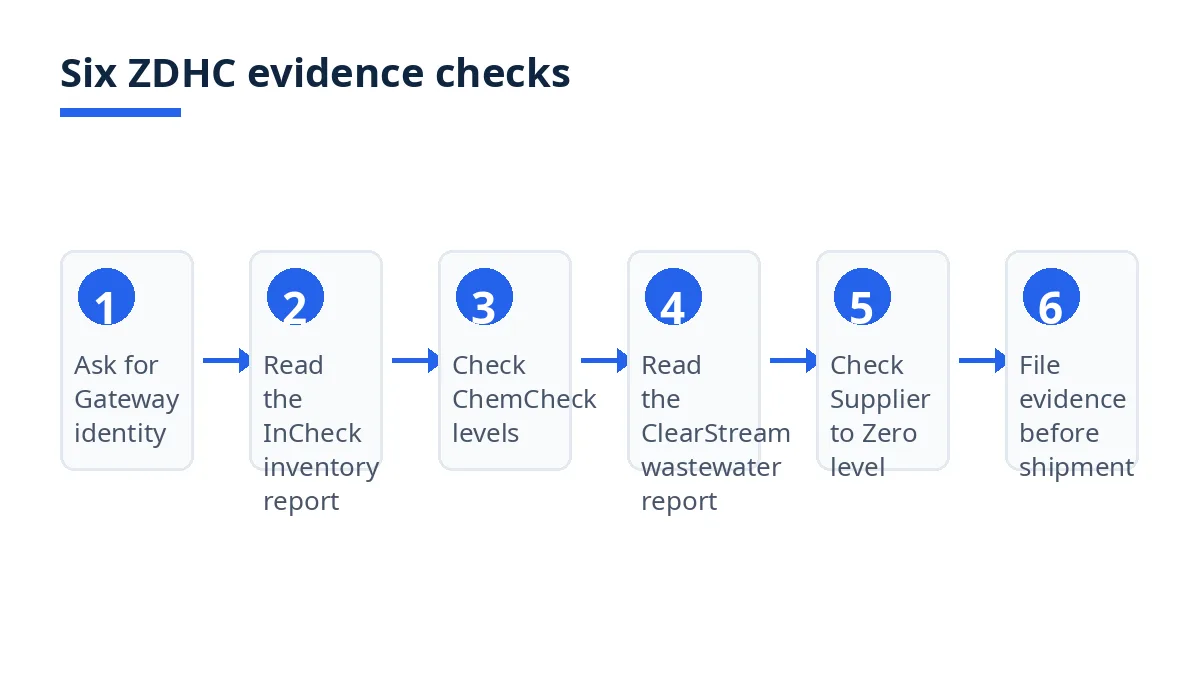
Work through the evidence in programme order: input, then process, then output. That stops a clean wastewater result from hiding an unexamined inventory, and a good inventory from hiding an overdue wastewater test.
First, ask for the supplier's Gateway identity and site list. A signatory supplier is registered to the Gateway and implements the MRSL.4 Confirm that the site that will dye, wash, print, or finish the order is the site named in the reports. A report for a sister site or a head office with no wet processing does not cover the order.
Second, read the InCheck report for the inventory. Ask what share is covered, which formulations sit at which level, and what the plan is for any formulation with no conformance evidence.2 A report covering only part of the inventory is a partial answer, and the order should be priced and dated on that basis.
Third, check the ChemCheck levels for the formulations that matter most. Each report includes the MRSL level achieved plus an explanation of the levels.2 Ask for the report for each high-use formulation, not a sample of one, and compare it with the level in the quotation.1
Fourth, read the ClearStream report for wastewater. Check the date against the one-year expectation, the discharge route, and every MRSL detection against its corrective action plan.4 5 Where the facility discharges directly, check for evidence at the progressive level.4 Where a detection has no root cause analysis or completed plan, record it as an open item with an owner and a date, not as a pass.
Fifth, check the Supplier to Zero level by site: Foundational per site is the entry expectation, with Progressive preferred.4 Ask for the level, site, and date achieved.
Sixth, put the whole set in the order file before agreeing shipment dates, with the date each item was checked. Any item that changes mid-order triggers a fresh check before shipment.
Work through one case before agreeing terms. A buyer orders dyed cotton knit fabric from a wet-processing supplier near Dhaka. The supplier sends a one-page letter headed "ZDHC Certified" and an undated wastewater summary. That file fails at the first step: no Gateway identity, no InCheck inventory, no ChemCheck level, and no dated ClearStream report. The corrected file names the dyeing site, shows a current InCheck report, gives ChemCheck levels for the dyes and auxiliaries used, and attaches a ClearStream report dated within the last year, with a completed corrective action plan for any MRSL detection.4 2 5
Costs, timelines and documents
No programme fee or testing price is stated here, because no opened ZDHC source used here states a single fee that fits every facility. Treat costs as drivers, and confirm each one in writing with ZDHC, the supplier, or the testing provider before budgeting: inventory size and complexity; assessment depth, since Level 2 adds an on-site assessment and Level 3 adds hazard assessment capability;1 wastewater testing scope by discharge route and parameters; corrective action work after a detection;5 and record-keeping for Gateway registration and report sharing.
Timelines follow the same logic. A supplier holding current InCheck and ClearStream reports can be checked quickly. A supplier that must build its inventory, assess unexamined formulations, or complete a corrective action plan needs longer, with the plan completed within its indicated timeline and documented for the next cycle.5 Do not promise a claim date before the underlying reports exist.
Item | What to check | Why it matters |
|---|---|---|
Gateway identity | Registration and site list | Ties every report to the site doing the work |
InCheck report | Inventory coverage and conformance | Shows what the facility actually uses |
ChemCheck levels | Level 1, 2, or 3 per formulation | Levels mean different depths of assessment |
ClearStream report | Date, route, detections | Wastewater evidence goes stale |
Supplier to Zero level | Level, site, date | Entry level is Foundational per site for signatories |
Bangladesh-specific rules and tips
There is no Bangladesh-specific ZDHC rule that changes the MRSL, the Gateway, or the wastewater guidelines, and no Bangladesh facility count or ranking is stated here, because no opened ZDHC source used here states one. The Bangladesh work is practical: identify which sites actually do wet processing, and apply the wastewater checks to those sites. If the order is cut-and-sew only, the wastewater evidence belongs to the wet-processing subcontractor or mill, and the buyer should request its reports rather than accepting the garment factory's file as a substitute. If the supplier does its own wet processing, the ClearStream date, discharge route, and corrective action plan checks apply directly to that site.4 5
Two cautions follow. First, do not accept a Gateway listing as a certification: the Chemical Module lists products with their conformance levels, showing a formulation assessment, not a factory status.2 Second, do not mix up the two level systems: MRSL levels describe formulation assessment depth, while Supplier to Zero and wastewater levels describe facility and discharge performance. A Level 3 formulation with an overdue ClearStream report still has an overdue wastewater check. Plan earlier for the strongest file: the supplier needs time to complete its inventory, close any corrective action plan, and refresh a report approaching one year old.
Mistakes and red flags
The most common mistake is accepting a factory claim as programme evidence. A letter, slide, or product page calling a factory "ZDHC certified", "ZDHC approved", or "ZDHC registered" identifies no Gateway record, no inventory report, and no wastewater result, and it is unverified until those items are produced.
A second mistake is reading one report as if it covered everything. A ChemCheck for one dye does not cover the auxiliaries, a current InCheck report does not replace an overdue ClearStream report, and a result for one site does not cover a second site.
A third mistake is treating an MRSL detection as either a disaster or a detail. A detection over a reporting limit is not a fail in itself but triggers root cause analysis and, where necessary, a corrective action plan.5 The error is to stop at the detection: rejecting the supplier without reading the plan, or accepting the supplier without checking whether the plan was completed.5
A fourth mistake is level inflation: a Level 1 formulation presented as Level 3, or a Foundational result presented as Progressive. Compare the level in the quotation with the level in the report, character for character, before agreeing terms.
Checklist
Gateway identity and site list confirmed; wet-processing site for the order named.
InCheck read: inventory coverage, formulations without conformance evidence listed.
ChemCheck levels checked for each key formulation, matching the quotation.
ClearStream checked: dated within the last year, discharge route identified, every MRSL detection matched to a corrective action plan, completion documented.
Supplier to Zero level confirmed by site and date; gaps recorded with an owner and a date.
Order file holds all items above plus the date checked.
Any new formulation, site, or wastewater result flagged for a fresh check before shipment.
How Exportain helps
Exportain's supplier checks are a document and photo review, not a ZDHC chemical or wastewater check, and they do not replace the checks here. The Trust Center states that supplier verification is a document review, not a factory inspection or a check against any government database, and that a badge is not a guarantee of production capacity, product quality, or delivery. A buyer can use Exportain to describe the product, the wet-processing steps, and the evidence required before dates are set. The certification services category currently renders "No services published in this category yet", so request the Gateway identity, InCheck, ChemCheck levels, and ClearStream report directly from the supplier.
FAQs
What should I know first about ZDHC?
Know first that ZDHC is not a factory certification and not a product quality mark. It is a programme for safer chemistry in the textile, leather, and footwear supply chain, built on the MRSL for inputs, chemical management practice, and wastewater guidelines for output.1 What a buyer verifies is an inventory against the MRSL, wastewater results against the guidelines, and a Gateway record tying them together, through InCheck, ChemCheck, and ClearStream.2 The title phrase is common search phrasing, not a ZDHC status.
What are the typical costs and timelines?
There is no typical figure for every facility. Costs turn on inventory size, assessment depth across levels 1, 2, and 3, wastewater testing scope by discharge route, corrective action work, and record-keeping.1 5 Timelines turn on whether current reports already exist or new testing and corrective work is needed, with plans completed within their indicated timeline and documented for the next cycle.5 Confirm the breakdown for the specific site with ZDHC, the supplier, or the testing provider before budgeting or promising a claim date.
Which documents are needed?
The core set is the Gateway identity and site list, InCheck, ChemCheck reports for each key formulation, ClearStream, any corrective action plan for MRSL detections, and the Supplier to Zero level by site.4 2 Hold them in the order file, matched to the same site and formulations, with the date each item was checked.
What are the most common mistakes?
The most common mistakes are accepting a factory claim as programme evidence, reading one report as if it covered the whole inventory or every site, treating an MRSL detection as either an automatic failure or a detail to ignore, and inflating a level beyond the level in the report. The correction is the same: ask for the Gateway identity, InCheck, ChemCheck levels, the dated ClearStream report with its corrective action plan, and the Supplier to Zero level by site, and record any gap before agreeing shipment dates.
Next steps on Exportain
Describe the product, wet-processing steps, and ZDHC evidence required, then run the checklist before agreeing shipment dates. Post a free RFQ on Exportain with the Gateway identity, InCheck, ChemCheck, and ClearStream evidence stated. For background on platform checks, read the Trust Center and seller verification pages.
Sources
- ZDHC Certification and Chemical Compliance. TÜV SÜD (accessed )
- ChemCheck - Gateway Reports. ZDHC (accessed )
- Chemicals to Zero. ZDHC (accessed )
- ZDHC Signatory Supplier - Specific Eligibility Requirements. ZDHC (accessed )
- ZDHC RtZ Programme - Change log: Wastewater and Sludge Guidelines. ZDHC (accessed )
About the author
Sourcing from Bangladesh?
Post a request for quotation and suppliers on Exportain can send you their quotes directly.
Post an RFQ


