

Workwear and Uniforms Price in Bangladesh: FOB Cost Breakdown for Buyers
No single workwear price in Bangladesh: how cloth, durability treatments, hi-vis tape, branding, PPE certification, and replenishment terms build the FOB price, and how to compare quotations layer by layer.
Short answer
Workwear and uniforms price in Bangladesh has no single FOB figure, because the price is a build-up of woven cloth, durability treatments, reflective tape, branding, and, for protective clothing, laboratory testing and certification. A plain uniform and a certified hi-vis set therefore cannot be ranked on one per-piece total. Ask suppliers to itemize each layer on the same delivery term, approve a washed sample, and lock the size curve and replenishment terms before ordering.
On this page
Key takeaways
Workwear price is a layer build-up, not one figure: cloth, treatments, tape, branding, and protective compliance each carry their own cost, and a plain uniform cannot be ranked against a certified protective set.
High visibility class is measured on the smallest size, so ask for the class calculation on the smallest size in your size curve, and keep branding clear of reflective tape.
Protective category decides the paperwork cost: Category II high visibility clothing needs a Notified Body examination, and Category III needs that plus ongoing assessment, under Regulation (EU) 2016/425.
Approve a washed sample by the workforce wash method before bulk production, because shrinkage, fading, tape adhesion, and treatment durability only show after washing.
Lock the size curve and the replenishment price basis at the first order, so repeat orders match the original cloth, colour, tape, and branding instead of being repriced as new developments.
A workwear order is priced as a working system, not as a single garment. The buyer is usually buying a set that must survive daily wear, repeated laundering, and a defined hazard, in sizes that match a workforce rather than a retail size curve. That changes what the FOB price contains: the cloth must hold up, the treatments must last through washing, the branding must sit where it does not block safety features, and any protective claim must be backed by testing and paperwork that a fashion garment never needs.
Read a workwear quotation line by line and the FOB total breaks into layers a buyer can test one at a time: base cloth and sewing, durability treatments, reflective tape and branding, protective testing and certification, then packing, inspection and the delivery term. A quotation that folds all of them into one per-piece figure cannot be compared with another, because two suppliers may have included different layers.
Bangladesh supplies workwear and uniforms within a large woven garment trade. In the July to September quarter of fiscal 2026-27, woven garment exports reached $4,614.80 million, up 5.11 percent year on year, within ready-made garment exports of $10,578.56 million, according to data released by the Export Promotion Bureau (EPB).1 That scale means several suppliers can quote on a uniform program, but it does not produce a standard workwear price, because no two uniform specifications carry the same cloth, treatment, branding, and protective requirement.
Why this matters for buyers and sellers
For the buyer, the price question is really a replacement question. A uniform that fades, shrinks, or loses its reflective tape after repeated industrial washing has to be replaced early, and the replacement order costs more than the saving on the first order. The buyer therefore needs the price per wearing cycle, not only the price per piece at the port, which means asking how many wash cycles the treatment and tape are rated for.
For the seller, a uniform program is usually a repeat program: the first order sets the cloth, colour, branding placement, and size curve, and later orders must match it exactly. A seller who prices the first order without holding that specification and keeping the same tape and trim sources will lose money on replenishment orders. A buyer who understands that can negotiate a replenishment price in writing at the first order.
The distinction between an ordinary uniform and protective clothing decides which paperwork the price must carry. Protective clothing sold into the European Union falls under Regulation (EU) 2016/425, which classifies PPE into three risk categories, each requiring the manufacturer to produce an EU Declaration of Conformity.2 Category II products, which include high visibility clothing, require an EU Type Examination by a Notified Body, while Category III products require that examination plus ongoing assessment of compliance.2 A plain corporate uniform with no protective claim carries none of that cost. A hi-vis or flame-resistant uniform carries it in full, and the buyer should see it as its own line.
Step-by-step: how it works
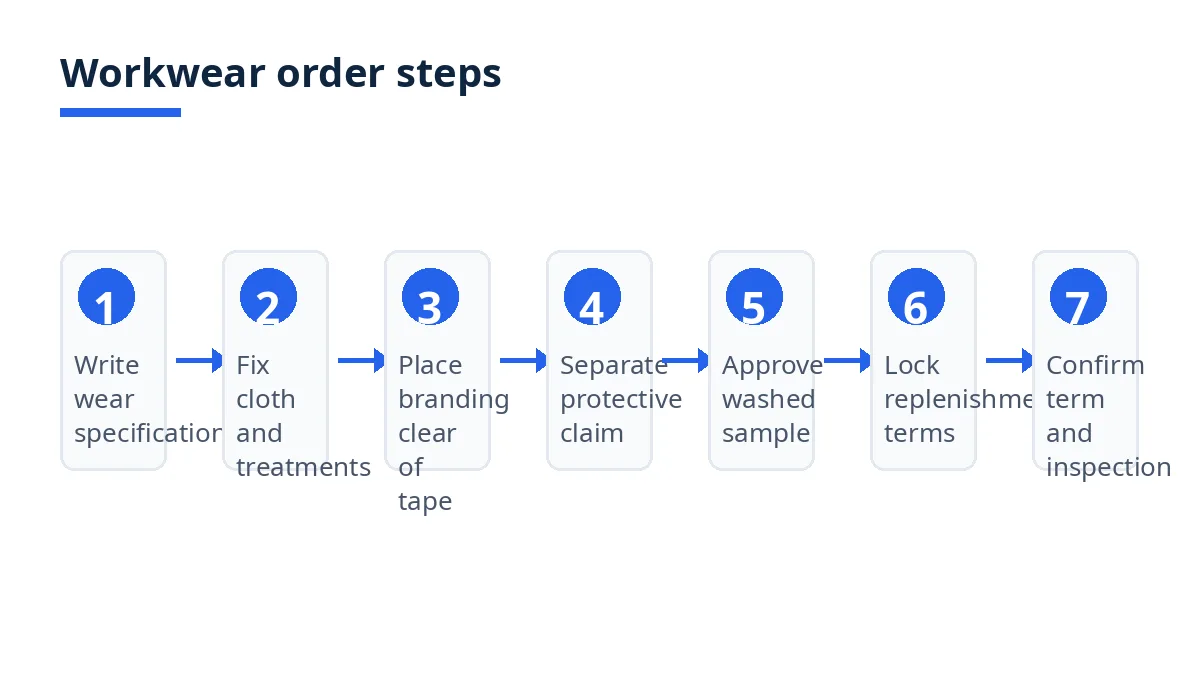
Write the wear specification before the style specification. State the job, the hazard, the wash method, and the expected life in wash cycles. A warehouse uniform, a road-crew hi-vis set, and a kitchen uniform are three different specifications even when they look similar on a hanger.
Fix the cloth by weight, weave, and blend, not by name alone. State the fibre blend, cloth weight, and weave, and whether the cloth is stocked or dyed to order for your colour. Workwear cloth is heavier and more tightly woven than fashion shirting, so consumption per garment and the cloth share of the price are both higher.
Place branding around the safety features, not over them. Mark every logo position on the tech pack drawing, and confirm in writing that embroidery or print does not cover reflective tape or reduce the visible area the standard requires. For high visibility clothing, the standard sets minimum areas of fluorescent and retroreflective material by class, and the areas are measured on the smallest size.3
Separate the protective claim from the garment claim. If the garment must meet a protective standard, name the standard, the class or performance level, and the certification route in the enquiry. General protective clothing requirements cover ergonomics, harmlessness, size designation, ageing, compatibility, and marking, and must be used together with the standard for the specific protection claimed.4
Approve a washed sample, not only a new sample. Order the pre-production sample in the actual cloth, colour, tape, and branding, then wash it by the method the workforce will use and measure it again. Colour, shrinkage, tape adhesion, and print or embroidery appearance after washing are the points where workwear orders most often fail.
Lock the replenishment terms before the first bulk order. Agree the repeat price basis, the size curve, the colour standard, and the re-test triggers in writing, so a later order of 200 pieces does not get priced as a new development.
Confirm one delivery term and one inspection plan on the purchase order. The Incoterms 2020 rules give 11 rules with a clear allocation of cost, risk, and obligations,5 so compare FOB quotations only with other FOB quotations, and state the inspection level and the wash-test points in the order.
Costs, timelines and documents
What are the typical costs and timelines?
There is no published typical FOB price for workwear and uniforms from Bangladesh, because the specification decides the price. The table below shows the layers a buyer should ask to see itemized, rather than a price for any one layer.
FOB layer | What it contains | Ask to see itemized |
|---|---|---|
Base garment | Woven cloth, sewing, standard trims, basic packing | Cloth weight, blend, and consumption per piece |
Durability treatments | Water repellency, stain release, crease resistance, flame retardancy where claimed | Treatment type, wash durability, and test method |
Visibility and safety | Fluorescent cloth, retroreflective tape, tape application | Hi-vis class, tape width, and tape wash rating |
Branding | Embroidery digitising, print screens, woven labels, name badges | Cost per placement, set-up charged apart from unit price |
Protective compliance | Laboratory testing, technical file, Notified Body examination where required | Standard, category, and who holds the certificate |
Inspection and freight to port | Pre-shipment inspection, wash tests, inland transport, export handling | FOB scope confirmed against the Incoterm named5 |
Example figures: a buyer comparing two quotations for a hi-vis jacket set might see one supplier fold tape and testing into the unit price and the other charge testing as a separate line, so the per-piece figures differ by an amount that has nothing to do with the garment. The example shows structure only, not a typical price, and the buyer should re-price both quotations on the same layer structure before ranking them.
Example figures: a replenishment order of mixed sizes can also change the unit price without any change to the garment. If the repeat order is weighted toward small sizes, cloth consumption per piece falls, and if it is weighted toward large sizes, it rises. The example shows why the size curve belongs in the quotation, not only the total quantity.
For timelines, ask for separate dates rather than one delivery week: cloth ready, treatment and tape complete, washed sample approval, bulk production, inspection, and port delivery. Treatment and certification sit on the critical path for protective workwear, because a failed test sends the batch back to treatment or re-testing rather than to packing.
Which documents are needed?
The order documents are the wear specification, the tech pack with branding positions marked, the itemized quotation on one named delivery term, and the purchase order carrying the standard, class, size curve, and replenishment terms. For the export declaration itself, see the Bangladesh Customs export clearance page for the current enclosed-document set.6
Bangladesh-specific rules and tips
Name the protective category in the enquiry, not in the artwork brief. A supplier cannot price certification it has not been told to provide. State whether the garment is a plain uniform, a Category II high visibility garment, or a Category III garment, since the certification route and cost differ by category under Regulation (EU) 2016/425.2 Ask who holds the EU Declaration of Conformity and whether it names your exact garment, colour, and tape combination, because a certificate for a different combination does not cover your order.
Check the hi-vis class against the smallest size. High visibility clothing is classed by the minimum area of fluorescent material and retroreflective material: Class 1 requires at least 0.14 square metres of fluorescent material and 0.10 square metres of retroreflective material, Class 2 requires 0.50 and 0.13, and Class 3 requires 0.80 and 0.20.3 The amount is calculated on the smallest size available, with the garment flat on the table.3 A design that meets Class 2 on a large size can fall below it on a small size, so ask for the class calculation on the smallest size in your curve.
Treat ageing as a price factor, not a care-label note. The general requirements for protective clothing include ageing, meaning the change of a property over time to the detriment of the clothing, alongside ergonomics, harmlessness, size designation, compatibility, and marking.4 For workwear this is practical: tape adhesion, fluorescent colour, and treatment performance all decline with washing, so the wash rating and the re-test point after a stated number of cycles belong in the quotation.
Keep fibre labelling consistent with the destination market. If you sell into the European Union, Regulation (EU) No 1007/2011 sets harmonised rules for textile fibre names and the labelling and marking of fibre composition.7 The blend on the label must match the blend in the quotation and the test report, because a mismatch between the three documents is a common reason a compliant-looking garment is held at the destination.
Mistakes and red flags
What are the most common mistakes?
Comparing a plain uniform price with a protective garment price. A hi-vis or flame-resistant set carries tape, treatment, testing, and certification costs that a plain uniform does not. Rank quotations only after each supplier has stated which layers its unit price includes.
Letting branding cover the safety area. A large chest logo placed over reflective tape, or embroidery stitched through tape, can reduce the visible area below the class the garment claims. Mark logo positions on the drawing and confirm the class calculation after branding is placed, not before.
Approving a sample that has never been washed. A new sample shows colour and fit. It shows nothing about shrinkage, fading, tape adhesion, or treatment durability. Wash the approval sample by the workforce method and measure it again before bulk production.
Accepting a protective claim without the certificate holder named. A statement that a garment "meets" a standard is not a certificate. Ask for the standard, the class or level, the test report, and the holder of the Declaration of Conformity, and check that the garment, colour, and tape combination match.2
Ordering replenishment without a locked size curve. A repeat order in different size proportions is a different consumption calculation. Without a locked curve and a repeat price basis, each reorder becomes a new negotiation and the colour and tape can drift between batches.
Treating a profile or a badge as proof of protective competence. A supplier profile shows that a business exists and trades. It does not show that hi-vis tape survives industrial washing or that a flame-resistant treatment holds after repeated laundering. Test evidence and washed samples show that.
Checklist
Before you confirm, every line should be answered in writing.
Wear specification written: job, hazard, wash method, expected life in wash cycles.
Cloth fixed by blend, weight, and weave, with stocked or dyed-to-order status per colour.
Hi-vis class and tape width stated, calculated on the smallest size in the curve.3
Protective standard, category, and certificate holder named, with the exact garment combination covered.2
Branding positions marked on the drawing, clear of reflective tape and safety areas.
Treatment type and wash durability stated, with the test method named.
Washed pre-production sample measured and approved in writing.
Size curve and replenishment price basis locked for repeat orders.
Inspection plan and wash-test points in the purchase order.
Quotations compared on the same FOB layers and the same Incoterm.5
Fibre labelling matched across quotation, test report, and garment label.7
How Exportain helps
On Exportain, browse suppliers and post your wear specification, size curve, and delivery term on the RFQ board, so suppliers quote the same FOB layers for the same garment. Read the verification badges for what they record: Exportain verification is a document and photo review, not a factory inspection.8 See how supplier verification works on Exportain and the MOQ guide before you compare replies.
FAQs
What should I know first about workwear and uniforms?
Know first whether you are buying a plain uniform or protective clothing, because that decision sets the price layers. A plain uniform is priced on cloth, sewing, branding, and packing. Protective clothing adds treatment, tape, laboratory testing, and certification, and under Regulation (EU) 2016/425 the category decides whether a Notified Body examination is required.2 State the job, the hazard, and the wash method in the first enquiry, so suppliers price the same garment.
What are the typical costs and timelines?
There are no typical figures a buyer can rely on, because cloth weight, treatment, tape, branding, and certification differ by specification. Ask for the FOB price broken into the layers in the table above, and ask for separate dates for cloth ready, treatment complete, washed sample approval, bulk production, inspection, and port delivery, all on one named delivery term.5 Treatment and certification sit on the critical path for protective workwear, so a failed test moves the delivery date in a way a plain uniform order does not.
Which documents are needed?
The order documents are the wear specification, the tech pack with branding positions marked, the itemized quotation, and the purchase order carrying the standard, class, size curve, and replenishment terms. For the export declaration itself, see the Bangladesh Customs export clearance page for the current enclosed-document set.6
What are the most common mistakes?
The most common mistakes are comparing a plain uniform price with a protective garment price, letting branding cover reflective tape, approving a sample that has never been washed, and accepting a protective claim without the certificate holder named.2
Next steps on Exportain
Put the wear specification and size curve into an RFQ on the RFQ board after browsing suppliers, and ask every reply to quote the same FOB layers. Read the workwear and uniforms quality control checklist and the MOQ guide before you confirm.
Sources
- RMG exports rise 6.10pc to US$10.58b in July-Sept of FY27. The Financial Express, (accessed )
- Personal Protective Equipment (PPE). SGS (accessed )
- Scotchlite Standards. 3M (accessed )
- EN ISO 13688: 2013 - Protective Clothing – General Requirements. SATRA (accessed )
- Incoterms® 2020. International Chamber of Commerce (ICC) (accessed )
- Customs Clearance Procedures for Export. Bangladesh Customs, National Board of Revenue (accessed )
- Regulation (EU) No 1007/2011 on textile fibre names and related labelling and marking of the fibre composition of textile products. European Union, (accessed )
- Supplier verification: Earn trust badges buyers can see. Exportain (accessed )
- supplier verification
- buyer guide
- Bangladesh sourcing
- bangladesh garments
- Workwear and uniforms
- Woven apparel
About the author
Sourcing from Bangladesh?
Post a request for quotation and suppliers on Exportain can send you their quotes directly.
Post an RFQ


