Workwear and Uniforms Exporters in Bangladesh: Verified Supplier Checklist
A supplier checklist for workwear and uniforms from Bangladesh: end use and hazards, factory papers, cloth abrasion and seams, size grading, hi-vis and heat-flame evidence, industrial wash durability, labels, packing and acceptance terms.
Short answer
Check a workwear and uniforms exporter in Bangladesh by matching the garment to its job first: confirm the papers and the factory, the cloth and seam evidence, the graded size run, the PPE class or heat and flame codes for the hazard, the industrial wash evidence, and the labels and packing, then agree sampling and acceptance numbers in writing before bulk production.
On this page
Key takeaways
Start from the job: name the wearer task, the hazard and the laundry route before cloth is chosen, and run a wear trial on the approved sample.
Ask for cloth abrasion, seam and industrial wash evidence on the bulk fabric, and confirm every report names the exact fabric, colour and procedure.
Grade and measure the smallest and largest sizes, not only the middle size, and check the jacket and trouser overlap on two-piece protective sets.
Treat a wrong PPE class, undisclosed subcontracting, expired papers, or wash evidence that does not match the laundry route as stop items, and agree sampling and acceptance numbers in writing.
A workwear order fails where the garment is worn, not where it is folded. A high-visibility jacket that sheds its reflective tape in an industrial laundry, a coverall that splits at the knee in its second week, or a uniform size run that fits nobody at the extremes all trace back to checks skipped before production. Use this checklist to test a Bangladeshi workwear and uniforms exporter against the job the garment must do.
Why this checklist matters
Workwear and uniforms carry two kinds of risk at once. A uniform must look consistent across a workforce and survive repeated laundering, while protective workwear must also keep its protective performance after washing, abrasion and daily movement. The evidence that matters here is different: wash durability under industrial conditions, tape adhesion after laundering, and performance levels for a named hazard.
The checklist also guards against quiet substitution. Fabric weight, tape supplier or laundry route can change between sample and bulk without changing how the garment looks on a hanger. Written evidence, agreed before the order, is the way to catch that change. Record every check as pass, fail or not applicable.
Before you start
Do not start supplier checks until the job is written down: the wearer task, the hazard, the laundry route, and the size range the workforce needs. A garment headed for home washing and one headed for an industrial laundry need different evidence, and a general uniform needs different evidence from a garment sold as protective equipment. Ask the end user which existing garments failed and how, because those failure modes set the priority.
Gather the references before any factory discussion: a tech pack, a size chart with tolerances, and an approved sample in each colour. Agree who will run the wear trial and who will hold the reference sample.
The full checklist
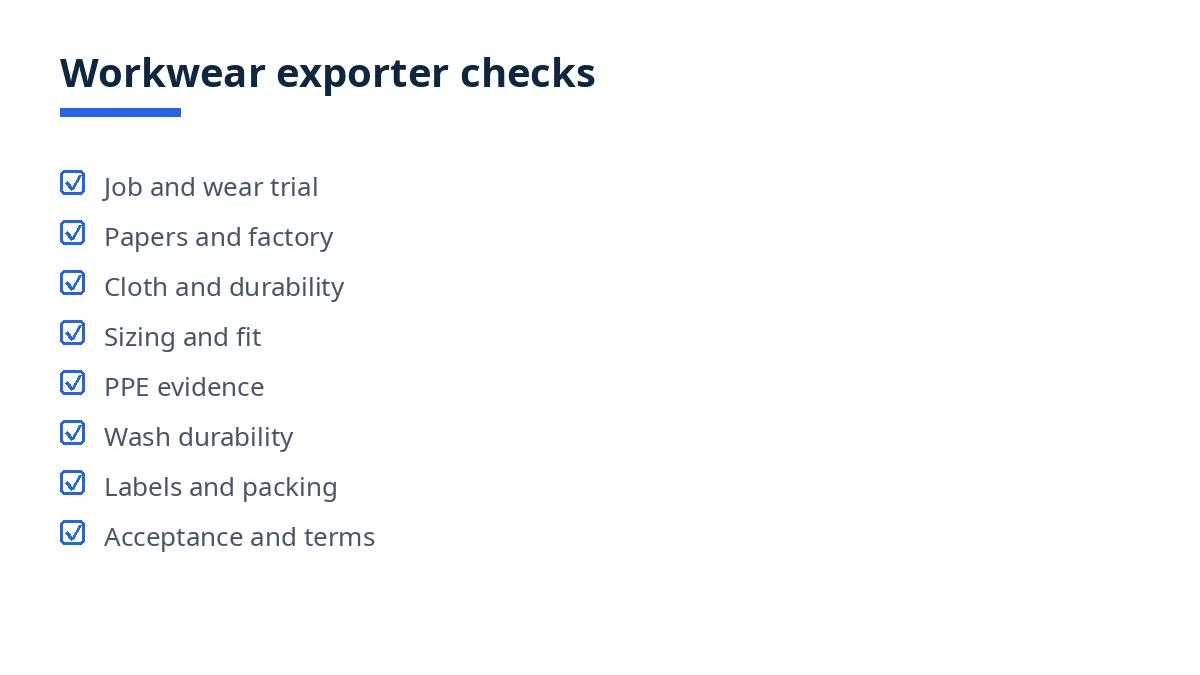
A. Start from the job the garment must do
Write down the end use: task, wearer, environment, and hazards.
State whether each style is general workwear, a uniform, or protective equipment.
Name the laundry route for each style, home washing or industrial laundering, before cloth is chosen.
List the failure modes that would stop the order, such as tape loss or knee failure.
Run a wear trial on the approved sample: kneeling, reaching, sitting and bending.
B. Papers and factory standing
Check the company papers for currency: trade licence, tax identification and fire licence, with matching legal names.1
Check association membership papers where claimed, noting that permanent membership documentation includes an export registration certificate.1
Confirm who actually sews the order, any subcontracted stage, and whether subcontracting was disclosed.
Ask for similar workwear or uniform orders completed before, and check capacity for the order size and date.
Treat expired papers, an undisclosed subcontractor, or a factory that cannot name its maker as stop items.
C. Workwear cloth and durability
Agree the cloth in writing: fibre blend, weave, weight, colour and finish, and check bulk cloth against the swatch.
Ask for Martindale abrasion evidence on the bulk cloth, reported as cycles to specimen breakdown under a defined load.2
Ask for seam strip-test evidence where seams carry load: maximum force to seam rupture, force perpendicular to the seam.3
Check stress points by hand: knees, elbows, pocket corners, crotch and seat seams, for bar tacks or reinforcement.
Check trims as part of the garment: zips, buttons, press studs, drawcords and tapes must work after the wash route.
Check shade across the order, between pieces, sizes, and garment and trims, under the same light.
D. Uniform sizing and fit across the run
Build the size chart from body measurements for the workforce, and mark each garment with the size designation the chart uses.4
Grade and measure the smallest and largest sizes, not only the middle size, because grading errors show at the ends of the run.
For a two-piece protective set, check the jacket and trouser overlap in working positions: the heat and flame rules require a 20 cm overlap.5
Check the wear trial result for every size group, and record any size that restricts movement.
Confirm the size run matches the size curve the workforce needs, and that carton quantities follow that curve.
E. PPE performance evidence
Match the high-visibility class to the risk: fluorescent minimums are 0.14 (Class 1), 0.50 (Class 2) and 0.80 (Class 3) square metres, with retroreflective minimums of 0.10, 0.13 and 0.20.6
Check tape design: background material must encircle the torso, sleeves and trouser legs where applicable, and retroreflective bands should be at least 50 mm wide.6
For heat and flame garments, agree the code letters and levels for the hazard: A limited flame spread, B convective heat, C radiant heat, D and E molten metal splash, F contact heat.5
Check that the certificate or test report names the exact fabric and garment, not a similar style, and that the level matches the hazard in item 1.
Check compatibility with the other equipment worn with the garment.4
Ask for evidence that protective performance survives the laundry route.
F. Wash durability and finished appearance
Agree the industrial washing procedure number in the order: eight washing procedures and two drying procedures test dimensional stability, colour fastness, creasing and seam puckering.7
Ask for dimensional change evidence after washing and drying, measured on garments rather than on cloth alone.8
Check appearance after washing on a washed sample: creasing, puckering, tape adhesion, colour change and shape.
Confirm every wash report names the bulk fabric, colour tested and procedure used.
G. Labels, packing and shipment readiness
Check fibre labelling for the destination market: for the EU, fibre names and percentages by weight appear in descending order.9
Check care symbols, which give the most severe treatments that do not cause irreversible damage during care.10
Check that size, hazard pictograms and performance markings are present, legible and durable to cleaning.4
Check packing against the size curve: pieces per carton, ratios, carton marks and barcodes matching the order.
Weigh and measure sample cartons and check the carton count against the packing list.
H. Sampling, acceptance and order terms
Agree the sampling plan and acceptance numbers in the purchase order before bulk production, using an acceptance sampling system indexed by acceptance quality limit.11
Draw the inspection sample randomly across sizes, colours and cartons, never from pieces the factory selects.
Agree the commercial terms in writing: minimum order quantity, price drivers, lead time, payment, and the rework or rejection route.
Write the stop items into the order: undisclosed subcontracting, expired papers, a wrong PPE class, or wash evidence that does not match the laundry route.
Common failures and how to fix them
The most common workwear failure is reflective tape that looks sound when new and peels or dulls after industrial washing, usually because the tape or application was never tested through the laundry route the garment will face. Stop, wash a sample through the agreed procedure, and change the tape or application before bulk is made.
The next is a coverall or trouser that splits at the knee or seat, which points to cloth, seam or reinforcement chosen for appearance rather than for movement. Re-check the stress points on a worn sample, compare the seam evidence with the tech pack, and add reinforcement before the bulk is sewn.
A third is a uniform size run that fits the middle sizes and fails at the ends, because grading was checked on one size only or the size curve was guessed. Measure the smallest and largest sizes against the chart, run the wear trial in those sizes, and correct the grade before cutting.
A fourth is a protective claim that does not survive its own paperwork: a certificate for a different cloth, a class below the risk, or a finish that fades in washing. Match every report to the exact fabric and garment, match the class to the hazard, and require wash evidence for the finish. Above the agreed acceptance level, options are re-inspection after sorting or rework, partial acceptance, or rejection.
Summary table
Write the tolerances and acceptance numbers into the inspection sheet before scoring starts, and log a result against every check as it is completed.
Section | Checks | Evidence |
|---|---|---|
Job and wear trial | End use, PPE status, laundry route | Job note, trial record |
Papers and factory | Licences, membership, maker, capacity | Current documents |
Cloth and durability | Blend, abrasion, seams, stress points | Cloth and seam reports |
Sizing and fit | Body chart, grading, overlap, curve | Measurements, end-size trial |
PPE evidence | Hi-vis class, tape, heat and flame codes | Reports for exact garment |
Wash durability | Procedure number, change, appearance | Wash reports per colour |
Labels and packing | Fibre, care, markings, cartons | Label check, packing list |
Acceptance and terms | Sampling plan, MOQ, rework route | Purchase order terms |
How Exportain helps
Use Exportain's enquiry stage to agree these checks: browse suppliers, read how supplier verification works, and post a free RFQ via RFQs to compare quotes. A supplier profile shows which document and photo checks have been recorded — it is not a factory inspection. Exportain is not a party to the goods contract and does not inspect goods.
FAQs
When should this checklist be used?
Use it before the order is placed, to test the supplier and agree the evidence, and again at final inspection. For first orders, also use it during production.
Who should complete it?
The runner is whoever you appoint — buyer, local agent, or third-party inspector. What cannot vary is the input set: a sample drawn at random, the approved sample, the size chart, and the hazard note.
What are the most common failures?
Watch for five repeat failures: tape that loses grip after washing, knees and seats that split, size runs failing at the ends, shade drift between lots, and protective claims that do not match the exact fabric or laundry route.
Can a third party do it?
Yes, if the inspector receives the job note, references, tolerances and acceptance levels before it starts, and draws its sample at random.
Next steps on Exportain
Settle the hazard note, size chart, wash procedure and acceptance numbers before production starts, then plan the order from suppliers, the verification guide and the MOQ guide.
Sources
- How to get BGMEA Membership in Bangladesh. TRW Law Firm, (accessed )
- DIN EN ISO 12947-2 Abrasion (accredited). FILK Freiberg Institute (accessed )
- ISO 13935-1:2014 - Textiles — Seam tensile properties of fabrics and made-up textile articles — Part 1: Determination of maximum force to seam rupture using the strip method. International Organization for Standardization (accessed )
- ISO 13688:2013 — Protective clothing — General requirements. International Organization for Standardization, (accessed )
- EN ISO 11612:2015 — Protective clothing against heat and flames. Wenaas (accessed )
- Scotchlite Standards. 3M (accessed )
- ISO 15797:2002 — Textiles — Industrial washing and finishing procedures for testing of workwear. International Organization for Standardization (accessed )
- ISO 5077:2007 - Textiles — Determination of dimensional change in washing and drying. International Organization for Standardization (accessed )
- Regulation (EU) No 1007/2011 on textile fibre names and related labelling and marking of the fibre composition of textile products. European Union, (accessed )
- ISO 3758:2023 - Textiles — Care labelling code using symbols. International Organization for Standardization (accessed )
- ISO 2859-1:1999 - Sampling procedures for inspection by attributes — Part 1: Sampling schemes indexed by acceptance quality limit (AQL) for lot-by-lot inspection. International Organization for Standardization (accessed )
About the author
Sourcing from Bangladesh?
Post a request for quotation and suppliers on Exportain can send you their quotes directly.
Post an RFQ