Women's Dresses Price in Bangladesh: FOB Cost Breakdown for Buyers
No standard FOB price exists for women's dresses from Bangladesh. This guide breaks down how dress length, skirt shape, lining, print, embellishment and finishing set a quotation, and how to compare quotes on the same terms.
Short answer
A women's dress FOB price from Bangladesh has no standard figure. It is set by the dress length and skirt shape, which decide fabric consumption, by the lining scope, by the print method and coverage, by the embellishment stitch or piece count, and by hem and pleat finishing, plus packing and the named FOB port. Compare quotations only on the same dress specification and delivery term.
On this page
Key takeaways
A dress FOB price is set first by length and skirt shape, which decide fabric consumption per dress, then by lining scope, print method and coverage, and embellishment count.
An all-over print, a placement print, machine embroidery and hand-applied sequins are priced by different methods, so they need separate lines on the quotation.
A fully lined dress, a tiered skirt and a pleated finish each add cloth, sewing time or pressing that a straight unlined dress does not carry.
Compare quotations only on the same length, skirt shape, lining, print, embellishment and Incoterm, and approve a washed pre-production sample before bulk cutting.
Exportain verification is a document and photo review, not a factory inspection, and a badge is not a guarantee of capacity, quality or delivery.
A women's dress quotation starts with a length of cloth, not with a price per piece. The same dress pattern cut at knee length, at midi length and at maxi length consumes different amounts of fabric, and a tiered skirt, a flared skirt or a lined bodice each add their own panels, stitching time and finishing passes. When two suppliers quote different FOB figures for dresses that look alike in a photograph, the difference usually sits in one of those choices: how long the dress is, how the skirt is built, whether it is lined, how the print or embellishment is made, and how the hem and pleats are finished.
This guide works through those lines, so a buyer can read a dress quotation the way a factory priced it. There is no published standard FOB price for women's dresses from Bangladesh, and this guide states none. Where numbers appear, they are labelled Example figures and show only how a quotation adds up, not what a dress should cost.
Why this matters for buyers and sellers
For the buyer, a dress order ties up more working capital per style than a simpler garment does, because cloth, lining, print screens and embellishment materials are all committed before cutting begins. A late change, such as adding a tier or switching print methods, can reprice the whole order.
For the seller, the dress silhouette decides the factory line. A straight shift dress sews quickly, while a gathered tier dress needs more handling at each tier join, and a pleated dress needs a pressing stage a plain dress does not. The factory therefore prices the silhouette, not just the fabric.
Two controls keep the comparison honest: one delivery term on every quotation, and an inspection plan agreed before production. The Incoterms 2020 rules set out 11 rules with a clear allocation of cost, risk and obligations.1 FOB is one of those rules, and it names the port of shipment, so two quotations compare only when they name the same term and the same port. ISO 2859-1 defines a system of acceptance sampling plans for inspection by attributes, and AQL stands for Acceptance Quality Limit, the maximum average percentage of defective items considered acceptable during random sampling.2
Step-by-step: how it works
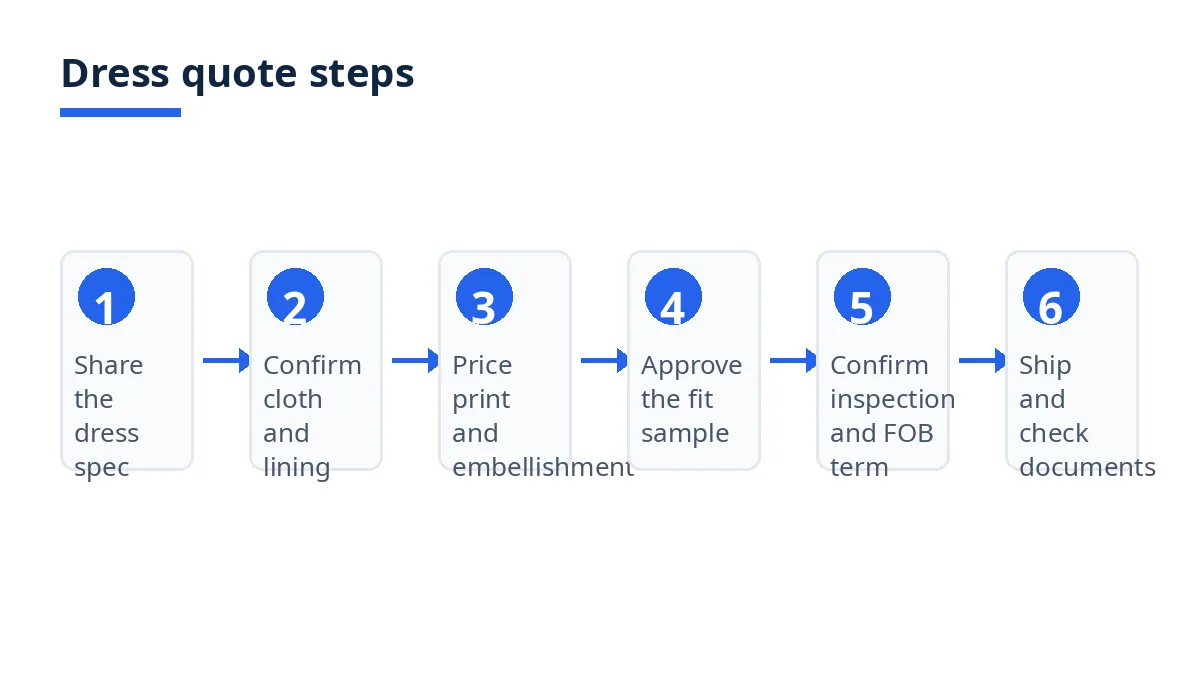
Send one dress specification to every candidate. State the silhouette and length, the fabric and lining, the neckline and sleeve, the skirt construction, the print or embellishment method and coverage, the closure, the size range and ratio, and the packing method.
Ask for fabric consumption per dress, not only a unit price. Ask how many metres the quoted length and skirt shape consume in the middle size, and how that figure changes at the longest length and the largest size.
Price the skirt shape separately. Ask what a tier, a flare, a gather or a pleat adds in fabric, sewing minutes and pressing, compared with the same dress in a straight skirt.
Price lining as its own line. Ask whether the dress is unlined, bodice-lined or fully lined, and what the lining cloth, its cutting and its attachment add to the unit price.
Price print and embellishment by method and coverage. Ask for the print method, the number of colours or screens, the print area, and, for embellishment, the stitch count or the number of hand-applied pieces per dress.
Approve a fit sample, then a pre-production sample. Fit the sample in the middle size, check length, tier joins and hem fall, then approve the pre-production sample in the actual fabric, print and embellishment before bulk cutting.
Agree inspection and the delivery term in writing before you confirm. Write the inspection level and AQL values into the purchase order, and state one Incoterm and named port for every quotation.1 2
Costs, timelines and documents
What are the typical costs and timelines?
There are no typical costs or timelines a guide can state as fact, because each factory prices your dress length, skirt shape, lining, print and embellishment, finishing and packing, and the delivery term you choose.1 A longer dress, a tiered skirt and a fully lined bodice each move the price in a different direction, so a figure quoted for one dress cannot be carried across to another.
Dress fabric. The largest cost line in most dress quotations is the outer cloth, and it is driven by length and skirt shape. A maxi dress consumes more cloth than the same dress at knee length, and a flared or tiered skirt consumes more than a straight skirt in the same length, because the panels widen toward the hem and the cutting marker wastes more cloth between them. State composition, construction, weight, and whether the colour is stocked or dyed to order.
Lining. A lining is a second garment inside the dress. A bodice lining adds a smaller cloth quantity and one attachment stage, while a full lining doubles much of the cutting and adds a hem finish of its own. A dress quoted without lining and the same dress quoted fully lined are different offers, and the lining cloth rate belongs on the quotation.
Dress print. Print cost depends on method and coverage, not only on whether the dress is printed. An all-over print is printed on the cloth before cutting, so the print repeat must match across panels and the print run carries its own minimum. A placement print is printed on cut panels or finished dresses, so it needs screens per colour and a placement check on each size. Ask which method is quoted, how many colours or screens it uses, and what happens to the price if the print area grows.
Dress embellishment. Embellishment is priced by work, not by appearance. Machine embroidery is priced by stitch count and by the number of placements, sequin or bead work by the number of pieces and whether they are applied by machine or by hand, and lace or trim by metres per dress plus attachment time. Hand-applied work also changes the timeline, since it cannot be sped up by adding machines in the same way sewing can.
Dress finishing. Finishing is where a dress quotation often hides its last differences. Tier joins must be pressed flat so the tiers fall evenly, pleats must be pressed and checked after the first wash, hems on a flared or tiered skirt take longer than hems on a straight skirt, and a dress with a zip, buttons or a tie closure needs a closure check that a pull-on dress does not. Ask whether pressing, pleat setting and hem finishing sit inside the unit price or are charged apart.
Cost line | What moves it on a dress | State in your enquiry |
|---|---|---|
Outer fabric | Length, skirt shape, marker waste | Silhouette, length, fabric, weight |
Lining | Bodice-lined, fully lined or unlined | Lining scope and cloth |
Method, colours, coverage area | Method, colours, print area | |
Embellishment | Stitch count, pieces, hand or machine | Method, count, placements |
Sewing | Tier joins, gathers, pleats, closure | Skirt build, closure type |
Finishing | Hem type, pleat pressing, closure check | Hem, pleat and press spec |
Packing | Folded, hangered, bagged | Packing method per dress |
Example figures: a buyer compares the same dress at knee length and at maxi length. The maxi version consumes more cloth per dress, needs a longer hem finish and a longer press pass, so its unit price sits above the knee-length version even though the fabric rate, print and embellishment are identical. The example shows structure only, not a typical price.
For timelines, sampling depends on fabric and embellishment approval, and bulk production on dyeing, print runs, handwork and line time. Ask for sampling, fabric ready, print and embellishment ready, production and inspection dates as separate lines, not a single delivery week.
Which documents are needed?
The order documents are the dress specification, the itemized quotation and the purchase order, with the length, skirt shape, lining scope, print method and embellishment count on both. For export clearance, see the Bangladesh Customs procedure for the Bill of Export and its enclosed documents.3
Bangladesh-specific rules and tips
Confirm which sector the dress falls in before you shortlist. A knitted dress and a woven dress come from different factory bases. The Bangladesh Knitwear Manufacturers and Exporters Association (BKMEA), established in 1996, is the apex trade body for the knitwear sector and represents approximately 2,540 knitwear member factories.4 A woven dress needs a woven factory suited to woven cloth, lining attachment and pleat pressing.
Check the classification line for your dress. In the Harmonized System, heading 6204 covers women's or girls' suits, ensembles, jackets, blazers, dresses, skirts, divided skirts, trousers, bib and brace overalls, breeches and shorts, other than swimwear, for garments that are not knitted or crocheted.5 Subheading 620443 covers women's or girls' dresses of synthetic fibres within that heading.5 Confirm the fibre and construction with your customs broker, since a knitted dress falls under a different chapter.
State the fibre composition exactly as it will appear on the label. Regulation (EU) No 1007/2011 lays down harmonised provisions on textile fibre names and the labelling and marking of the fibre composition of textile products.6 For dresses sold into the European Union, the fibre names on the care label must match the cloth actually used. Put the label specification in the tech pack.
One name, all documents. Settle the registered name first and carry it unchanged through the trade licence, quotation, proforma invoice and payment account — the export declaration itself names the exporter and the foreign buyer,3 so any variant between papers stalls the file.
Ask which inputs are imported for your dress. Lace, sequins, beads, special zips and some lining cloths may be bought in for your specification, and an imported embellishment can set the minimum and the earliest production date. Agree the size ratio per colour before production.
Mistakes and red flags
What are the most common mistakes?
Comparing dresses of different lengths. A knee-length quote and a maxi quote for the same style are not comparable figures. Compare only dresses of the same length, skirt shape and lining scope.
Treating print and embellishment as one line. An all-over print, a placement print, embroidery and hand-applied sequins are priced by different methods. A quotation that merges them into a single allowance cannot be checked, and a later change to one of them reprices the whole allowance.
Approving a dress from a photograph. A photograph hides tier join puckering, uneven hems, pleat drift and lining twist. Approve the fit sample on a form, measure the length at the centre front, centre back and sides, and wash the pre-production sample before bulk approval.
Accepting a spoken exception on a tier or a lining. Any agreed change to length, skirt shape, lining scope or embellishment count belongs in writing on the quotation and purchase order, with the sizes and colours it covers.
Reading a badge as a guarantee. A profile opens the enquiry; it cannot prove a factory makes your dress, and a badge on its own guarantees nothing about capacity, quality or delivery.7
Skipping inspection to save time. Sampling under ISO 2859-1 checks a lot against an agreed AQL,2 the last control before the dresses become your stock.
Checklist
Before you confirm, every line should be answered in writing.
Dress specification sent: silhouette, length, fabric, lining scope, neckline, sleeve, skirt shape, closure.
Fabric consumption per dress confirmed for the middle size, the longest length and the largest size.
Lining scope confirmed: unlined, bodice-lined or fully lined, with lining cloth named.
Print method, colours or screens, and print area confirmed; all-over versus placement stated.
Embellishment confirmed: method, stitch count or piece count, placements, hand or machine.
Hem, pleat and press finishing confirmed inside the unit price or charged apart.
Fit sample and pre-production sample measured, washed and approved in writing.
Inspection level and AQL values in the purchase order.2
Quotations compared on the same length, skirt shape, lining and Incoterm.1
Packing confirmed: folded, hangered or bagged, with tissue and carton spec.
Export set agreed with the supplier before shipment.3
How Exportain helps
On Exportain, open suppliers and raise a request for quotation (RFQ) on the RFQ board with your dress specification, length, skirt shape, lining scope, print method and delivery term, so every supplier quotes the same dress. Require each reply to break out fabric consumption per dress and print and embellishment lines apart from the unit price. Once you accept a quotation, Exportain turns the accepted terms into one order and one proforma invoice.7
Read badges for what they record and nothing more: document and photo checks covering identity, business registration, the Export Registration Certificate, and factory or office photos.7 8 Verification is a staff review of documents and photos, free, and never granted by membership plan — it says nothing on its own about whether a factory can make your dress.
FAQs
What should I know first about women's dresses?
A dress price is set by its length, skirt shape, lining, print method and coverage, and embellishment count, before sewing and finishing. Woven dresses fall under HS heading 6204, which covers women's or girls' dresses among other garments that are not knitted or crocheted,5 while knitted dresses fall under a different chapter.
What are the typical costs and timelines?
There are no typical figures a buyer can rely on, because each factory sets its price and lead time for your dress length, skirt shape, lining, print, embellishment and delivery term.1 Ask for sampling, fabric ready, print and embellishment ready, production and inspection dates as separate lines.
Which documents are needed?
The order documents are the dress specification, the itemized quotation and the purchase order, with length, skirt shape, lining scope, print method and embellishment count on both. For export clearance, see the Bangladesh Customs procedure for the Bill of Export and its enclosed documents.3
What are the most common mistakes?
The most common mistakes are comparing dresses of different lengths or skirt shapes, merging print and embellishment into one unchecked allowance, approving a dress from a photograph without a washed sample, and reading a badge as a guarantee. A badge is not a guarantee of capacity, quality or delivery.7
Next steps on Exportain
Raise your dress specification, length and skirt shape as an RFQ after browsing suppliers, so suppliers quote the identical dress. Before confirming, read how to import women's dresses from Bangladesh and the women's dresses quality control checklist.
Sources
- Incoterms® 2020. International Chamber of Commerce (ICC) (accessed )
- ISO 2859-1:2026 - Sampling procedures for inspection by attributes — Part 1: Sampling schemes indexed by acceptance quality limit (AQL) for lot-by-lot inspection. ISO (accessed )
- Customs Clearance Procedures for Export. Bangladesh Customs, National Board of Revenue (accessed )
- BKMEA at a Glance. BKMEA (accessed )
- HS 620443 - Of synthetic fibres. HSRates (accessed )
- Regulation (EU) No 1007/2011 on textile fibre names and related labelling and marking of the fibre composition of textile products. European Union, (accessed )
- Trust & Safety Center. Exportain (accessed )
- Supplier verification: Earn trust badges buyers can see. Exportain (accessed )
About the author
Sourcing from Bangladesh?
Post a request for quotation and suppliers on Exportain can send you their quotes directly.
Post an RFQ