

Women's Dresses Exporters in Bangladesh: Verified Supplier Checklist
A numbered checklist for women's dresses exporters in Bangladesh: silhouette and hem, cloth drape and lining, print and embellishment, form fit and grading, wash and colour evidence, maker papers, labels and packing, with fixes for common failures.
Short answer
Use this checklist to check a women's dresses exporter in Bangladesh before ordering: hang and walk-test the sample for hem and waist, compare bulk cloth drape and lining with the sample, check print placement and bead security, fit dresses on a form at smallest, middle and largest sizes, review wash and colour evidence, confirm maker papers and capacity, and agree acceptance numbers in the purchase order.
On this page
Key takeaways
Hang and walk-test the sample before bulk, since a hem or waist fault repeats across every size once cutting starts.
Compare bulk cloth drape and lining with the sample, because a cloth change alters the skirt line even when the pattern is unchanged.
Check print placement, cracking and bead security across the run, and fit dresses on a form at smallest, middle and largest sizes so grading keeps sample proportions.
Confirm maker identity, documents and references last, after garment evidence, and agree sampling, acceptance numbers and remedies in the purchase order.
A women's dress is checked as one moving shape, not as separate parts. Bodice, waist, skirt and hem have to agree when the dress is worn, walked in and sat in. A dress correct laid flat can still twist at the waist, flare unevenly or lose its line after washing. This checklist tests the exporter behind the dress before a purchase order is signed, starting with the dress itself and ending with papers and terms.
Work through the list against an approved sample, a signed size chart and a written tech pack. Mark each line as seen, gap or block: seen means evidence shown and matched, gap means a dated shortfall to close, and block means the order waits. Use an agreed sampling plan, pulling pieces across sizes, colours and cartons without letting the factory choose them. ISO 2859-1 specifies an acceptance sampling system for inspection by attributes, indexed in terms of the acceptance quality limit (AQL), applicable to lot-by-lot inspection.1
Why this checklist matters
Dresses concentrate risk in length and movement. A hem level on a hanger can drop on one side once the skirt swings, a waist seam placed a fraction high changes where the skirt falls, and a lining shorter than the shell shows below the hem in wear. The same pattern error repeats across every size after bulk cutting, so it is expensive to correct late.
Surface work is a second risk: prints, embroidery and beading cover bodice and skirt, so a shade shift, cracked print or loose bead shows across the whole dress. The size curve is a third risk: grading that only widens the dress without rebalancing bodice, waist and skirt produces larger sizes that no longer match the sample silhouette.
Before you start
Do not begin until the references are complete: one approved sample per style and colour, the tech pack with construction notes for bodice, waist, skirt, hem and lining, the size chart with tolerances for bust, waist, hip, length and shoulder, and the packing specification. Agree the sampling plan and acceptance numbers in the purchase order before bulk is cut.1
Confirm the label plan before bulk labels are printed. Under Regulation (EU) No 1007/2011, a textile product shall be labelled with the name and percentage by weight of all constituent fibres in descending order.2 ISO 3758 establishes a system of graphic symbols for care labelling, based on the most severe treatments that do not cause irreversible damage during care.3 Confirm who handles export clearance in one written line of the contract.
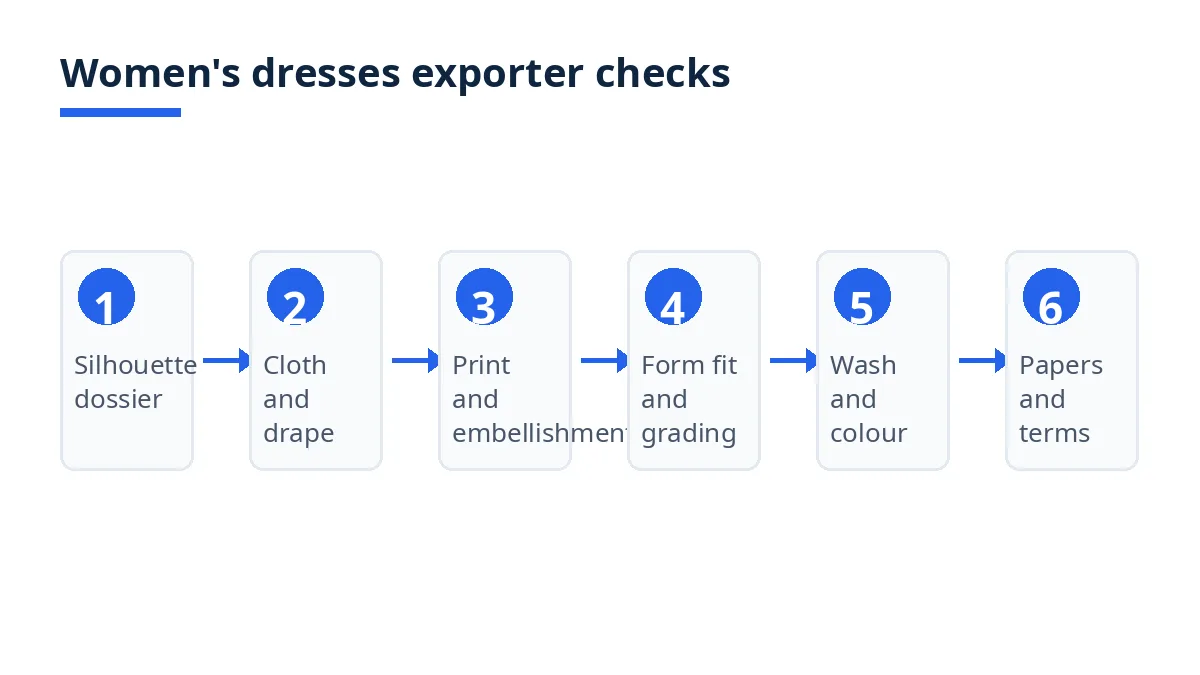
The full checklist (numbered, printable)
A. Dress silhouette dossier
Compare sample with tech pack sketch and notes; log any neckline, sleeve, waist, skirt or hem difference as a gap before bulk.
Hang the sample for a full day, then check the hem all around from floor level for any side that drops, kicks out or curls.
Check the waist seam from front, back and both sides: level, free of puckering, matching the sample position at every chart size.
Walk-test the sample on a form or wearer where permitted: skirt swings without catching the lining, hem returns to level, no seam pulls open at stride.
Keep a separate silhouette record per style, so a correction for one dress length is not applied by mistake to another.
B. Dress cloth, drape and lining
Compare bulk cloth with the sample for weight, hand, weave and finish; record any substitution as a block until accepted in writing.
Drape bulk cloth over the form and compare its fall with the sample: stiffer or softer cloth changes the skirt line, pattern unchanged or not.
Check the lining separately: matching shell tone, shorter than the shell hem by the tech pack amount, attached so it cannot twist inside the skirt.
Check shade under one light across bodice, skirt, sleeves and lining against the approved lab dip; re-sort dresses whose panels come from different dye lots.
Check cloth panel by panel for holes, slubs, broken yarns, stains and oil marks, including the skirt centre back, easily missed when folded.
C. Print, embellishment and surface work
Check print placement on bodice, skirt and sleeves against the tech pack, measuring from fixed points such as neckline and waist seam.
Check print quality across the run: no cracked, blurred or missing elements, no drift between first and last panels, no bleeding into adjoining panels.
Check embroidery and applique edges for fraying, loose threads and missed stitches, and pull-test surface work by hand on sampled dresses.
Check beads, sequins and studs individually: each secured, none missing from the sampled dress, none sharp or loose enough to snag cloth.
Check surface work against the label care method: for a hand-wash-only dress, the embellishment care note must match the label before bulk is finished.
D. Fit on the form and size-curve grading
Fit sampled dresses on a form at smallest, middle and largest sizes, recording bust, waist, hip, shoulder, length and sleeve against chart tolerance.
Check grading rebalances the dress, not only widens it: bodice length, waist position and skirt flare keep sample proportions at the largest size.
Check armholes and sleeves on the form: sleeves hang without twisting, armholes neither bind nor gape, sleeve length matches the chart.
Check closures on the form: zips run without catching the lining, buttons close without pulling the bodice, hooks or ties hold the waist position.
Check the dress from the back on the form: centre seams straight, skirt falling evenly, no panel twisting toward one side.
E. Wash, colour and after-wash shape
Review dimensional change evidence where required, for bodice length, waist, skirt length and hem. ISO 5077 specifies a method for determining dimensional change of fabrics, garments or other textile articles in specified washing and drying procedures.4
Check appearance after washing where required: hem level, waist position, skirt flare, lining length and surface work against the pre-wash sample.
Review washing fastness evidence where required. ISO 105-C06 specifies methods for determining the resistance of textile colour to domestic or commercial laundering using a reference detergent.5
Confirm every wash and colour report names bulk cloth, colour tested and this lot; a report covering different cloth is a gap, not evidence.
F. Maker identity, papers and capacity
Confirm the maker: factory name and address on documents match the premises cutting and sewing the dresses, and any subcontracted stage, such as printing or beading, is named in writing.
Check current trade, tax and factory documents, and BGMEA membership standing where claimed. BGMEA states that before granting membership it ensures, through on-site inspections and verification processes, that applicant factories meet the required standards.6
Check dress-making capacity against the order: cutting, sewing, printing or embellishment, finishing and packing for the quantity and date, with the busiest stage identified.
Ask for two buyer references for comparable dress orders, contact them, and record what was confirmed about delivery, dress quality and repeat orders.
G. Labels, packing and order terms
Check fibre, care, origin, size and brand labels are present, legible and correctly positioned, with fibre names against Regulation (EU) No 1007/20112 and care symbols against ISO 3758.3
Check packing per dress: folded or hung as directed, tissue or covers where specified, size and colour ratios per carton matching the packing list.
Agree acceptance numbers, defect classes, inspection timing and the remedy for a failed lot in the purchase order, using the agreed sampling plan.1
Confirm minimum order quantity, price basis, payment terms and delivery schedule in writing, and read the MOQ minimum order quantity explainer before confirming quantities.
Common failures and how to fix them
Uneven hems in bulk usually come from skirt panels cut from cloth with different drape, or a waist seam sewn under uneven tension. Stop, hang sampled dresses for a day, compare panel cloth with the sample, and re-check the waist seam before more dresses are hemmed.
Print or embellishment drift in bulk often comes from a shifting print plate or beading subcontracted without the same fixing method. Stop, compare first, middle and last bulk pieces against the sample, and re-agree the fixing method before the run continues.
Grading drift means larger sizes widen without rebalancing, so the waist sits high and the skirt flares differently. Stop, fit the largest size on a form, compare its proportions with the sample, and correct the pattern before cutting more sizes.
Downloadable template / summary table
Record a result per dress style against the checklist, size chart, tolerances and acceptance numbers.
Section | Checks | Evidence |
|---|---|---|
Silhouette | Hem level, waist position, skirt swing | Hang and walk test |
Cloth and lining | Drape, shade, lining length | Sample comparison |
Print and embellishment | Placement, cracking, bead security | Pull tests, panel check |
Fit and grading | Form fit, proportions, closures | Measurements per size |
Wash and colour | Dimensional change, fastness | Reports per colour and lot |
Maker and capacity | Identity, documents, references | Documents seen, calls made |
Labels and packing | Labels, ratios, cartons | Packing list |
How Exportain helps
Exportain is a B2B marketplace connecting buyers with Bangladeshi suppliers of women's dresses, so specifications behind this checklist can be agreed at the enquiry stage. Browse suppliers, read how supplier verification works on Exportain to see which document and photo checks are recorded for a supplier, and compare offers through RFQs. Exportain is not a party to the goods contract and does not inspect goods.
FAQs
When should this checklist be used?
Use it before paying a deposit, and again at final inspection, when dresses are finished, pressed and largely packed.
Who should complete it?
The buyer, a local agent or an independent inspector can complete it, using the approved sample, size chart and tech pack, with pieces pulled across sizes, colours and cartons.
What are the most common failures?
An uneven hem, print or embellishment drift across the lot, grading that loses sample proportions at larger sizes, and shade differences between dress panels are the failures buyers find most often.
Can a third party do it?
Yes, if you share the approved sample, tech pack, tolerances and acceptance levels first, and confirm the inspector will fit dresses on a form rather than measuring them flat only.
Next steps on Exportain
Agree your silhouette record, tolerances and label wording, then read how supplier verification works on Exportain and the MOQ minimum order quantity explainer, and post a free RFQ via RFQs to compare quotes.
Sources
- ISO 2859-1:2026 - Sampling procedures for inspection by attributes — Part 1: Sampling schemes indexed by acceptance quality limit (AQL) for lot-by-lot inspection. ISO (accessed )
- Regulation (EU) No 1007/2011 on textile fibre names and related labelling and marking of the fibre composition of textile products. European Union, (accessed )
- ISO 3758:2023 - Textiles — Care labelling code using symbols. International Organization for Standardization (accessed )
- ISO 5077:2007 - Textiles — Determination of dimensional change in washing and drying. International Organization for Standardization (accessed )
- ISO 105-C06:2010 Textiles — Tests for colour fastness — Part C06: Colour fastness to domestic and commercial laundering. International Organization for Standardization, (accessed )
- BGMEA Strengthens Membership Verification and Compliance Standards. BGMEA, (accessed )
About the author
Sourcing from Bangladesh?
Post a request for quotation and suppliers on Exportain can send you their quotes directly.
Post an RFQ


