Wholesale Live Crabs From Bangladesh: Prices, MOQ and Reliable Suppliers
Wholesale live crabs from Bangladesh are bought by grade line: per-line minimums, box counts, flight rhythms and live-arrival terms per line. How to set tiers, mixed-grade rules and mortality allowances before a program order.
Short answer
Wholesale live crabs from Bangladesh are bought by grade line, not by shipment total. Agree a minimum quantity, box size and crabs per box for each line, fix a weekly or fortnightly flight rhythm with a written short-line rule, and set a live-arrival term per line covering the inspection window, DOA evidence and settlement. Count arrival per line on a trial order in the wholesale split before committing to a program.

On this page
Key takeaways
Buy by grade line: a minimum quantity, box size and crabs per box for each line, not a single shipment total.
Fix the replenishment rhythm on flight days, with a written quantity-change rule and a short-line rule.
State the live-arrival term and the mortality allowance per line, with an inspection window, an evidence record and a settlement form.
Mixed grades stay in separate boxes with separate packing-list lines, or per-line DOA counting is impossible.
A badge records a document and photo review, not a holding inspection or a live-arrival guarantee.
A wholesale live crab program from Bangladesh is not one large order repeated. It is a set of grade lines, each with its own minimum, its own box count and its own arrival count, flown on a rhythm your market can sell through before the next shipment lands. Buyers who treat the whole shipment as a single quantity lose money in two places: a grade line that falls below its minimum gets surcharged or dropped, and dead-on-arrival (DOA) crabs counted against the shipment total hide which grade line actually failed.
Wholesale buying changes the question. Instead of asking what one shipment costs, ask what each grade line costs per flight, how often flights can repeat, and what share of each line must arrive alive for the program to pay.
Why this matters for buyers and sellers
For a buyer, the wholesale channel decides working capital and waste. Live crabs cannot be held like frozen stock, so a shipment too large for the selling window produces mortality after arrival, while a shipment too small for the flight minimum produces a high freight cost per crab. The balance is struck per grade line, not per shipment, because a premium hard-shell male line and a lower mixed line sell at different speeds and carry different mortality risk.
For a seller, the wholesale channel decides whether a flight can be filled with crabs that are actually ready. Holding, grading and packing happen against a flight departure, and each grade line must reach its own minimum before packing starts. A seller who accepts a mixed order without line minimums must either hold crabs longer while waiting for one line to fill, which weakens them, or pack short on that line, which breaks the agreed split.
Step-by-step: how it works
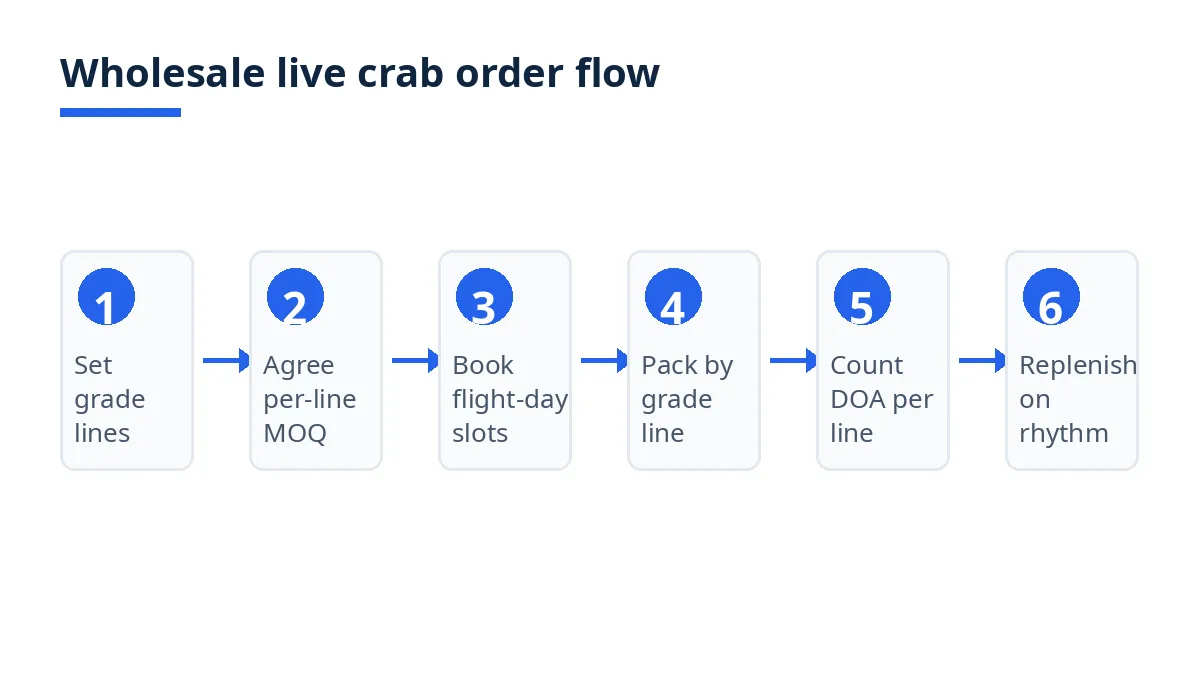
Define the grade lines first. Write each line separately: species and grade, size band, sex where it matters, shell hardness and claw condition. A line is a product with its own price, not a description of a mixed box.
Ask for a minimum per line, not per shipment. Record the minimum quantity for each line, the box size for that line and the crabs per box. A shipment total that clears the supplier minimum can still fail on one line.
Set the replenishment rhythm against flight days. Agree which weekdays shipments fly, how many days before departure the order must be confirmed, and how the order changes if one line is short that week.
Agree the mixed-shipment rule in writing. State whether lines may share a box, and if they may not, require separate boxes and separate lines on the packing list for each grade. Mixed boxes make per-line DOA counting impossible.
Fix the live-arrival term before the trial order. State the live-arrival share per line, the inspection window after landing, the evidence required for a DOA claim and whether settlement is a credit, a replacement on the next flight or a price adjustment.
Run a trial on the wholesale split. Place the trial in the same line split as the planned repeat order, not as a single premium line. A trial of only the premium line proves nothing about the lines that will carry most of the volume.
Count arrival per line and reset the rhythm. Record live, weak and dead counts per line at arrival, compare them with the agreed term, and adjust the next order quantity per line before the next flight is booked.
Wholesale tiers and what each tier changes
A wholesale program usually settles into tiers, and each tier changes a different term. A trial tier tests the split and the arrival count on one or two flights. A regular tier fixes a weekly or fortnightly flight pattern with standing line quantities that move only within an agreed band. A program tier adds a standing reservation of holding capacity for the agreed lines, with a notice period for quantity changes and a written rule for short lines.
Do not let a tier label replace the written terms. A supplier that offers a lower price for a program tier should state, in the same quotation, which term changed: a larger per-line minimum, a longer notice period, a narrower grade band or a different live-arrival term.
Per-line quantities and box counts
Per-line quantities work only when they are tied to boxes. Ask for three numbers per line: the minimum quantity, the standard box count for that line and the crabs per box. Then check that the line quantity divides into whole boxes without a part box, because a part box is where mixed grading creeps in and where DOA counting breaks down.
Example figures: a program orders three lines on one flight. Line A, premium hard-shell males, runs at 120 crabs in 12 boxes of 10. Line B, standard hard-shell mixed sex, runs at 200 crabs in 20 boxes of 10. Line C, a lower grade for a price-led outlet, runs at 100 crabs in 10 boxes of 10. The shipment total is 420 crabs, but no line can be judged from that total. If 12 crabs arrive dead and all 12 sit in Line A, the premium line has lost 10 percent while the other lines are intact, and the settlement must follow the line, not the shipment.
Replenishment rhythms
Replenishment rhythm is set by three clocks: the flight schedule, the holding window and the selling window. Live mud crabs and eels are usually exported by air,1 so the flight day anchors the rhythm. Work backwards from landing day: the selling window after arrival decides how many crabs each line can absorb, the holding window before packing decides how early the order must be confirmed, and the flight day decides which weekday the cycle repeats.
Costs, timelines and documents
What are the typical costs and timelines?
There are no typical wholesale costs or timelines a guide can state as fact, because each program prices its own grade lines, box counts, flight routing and delivery term. The Incoterms 2020 rules set out 11 rules with a clear allocation of cost, risk and obligations,2 so compare wholesale quotations only when they state the same rule and the same named place.
Cost drivers apart from the crab price are air freight per box, packing materials and labour per box, the certificate and inspection steps for the destination, and the DOA allowance built into the price. Timeline drivers are the confirmation cut-off before the flight, the holding period before packing, the certificate step and the inspection window after landing. Ask for each as a separate line.
Example figures: a buyer compares two quotations for the same three-line split. One quotes a lower crab price but packs 12 crabs per box and flies a longer routing. The other quotes a higher crab price, packs 10 crabs per box and flies direct. The second quotation can still cost less per live crab at arrival if its per-line DOA is lower, because freight and packing are paid on shipped boxes while revenue comes only from live arrivals. The example shows structure only, not a typical price, freight rate or mortality rate.
Which documents are needed?
For export clearance in Bangladesh, goods may not be loaded unless an export declaration, the Bill of Export or Shipping Bill, is submitted to Customs and approved.3 Enclosed documents include the export contract or purchase order where there is no export letter of credit, the commercial invoice, the packing list, the EXP form certified by an authorized dealer, and a certificate of origin issued by the Export Promotion Bureau or a Chamber of Commerce and Industry.3
For live crabs, add the destination health certificate set to that export set. The Department of Fisheries e-certification system gives access to licences, health certificates, additional health certificates as per the importing country's requirements, sample collection, inspection, test reports and certificate issuance, and it is directly connected to customs.4 Match the certificate type to the destination before you discuss price, because approval for one market does not transfer to another.
Bangladesh-specific rules and tips
What should I know first about live crabs?
Live crabs are a live-animal shipment, not a seafood shipment that happens to be fresh. Under one destination protocol, edible aquatic animals must be examined clinically by an official veterinarian before export and confirmed healthy, free of clinical symptoms of contagious disease and suitable for transport.1 Build the wholesale timetable around that examination and the certificate it produces, not around the flight alone.
Live handling rules also shape the packing specification. Live shellfish must be kept moist or humid in air, since shellfish that dry out in air die, and boxes should allow some air to enter from the top and sides while not letting a draught dry the animals out.5 Freshwater is harmful and should not be used for moistening.5 Write the moistening material, the ventilation and the drainage into the packing specification for each line, and test it on the trial flight rather than on the first program flight.
Wholesale tips for Bangladesh supply
Ask where holding sits relative to the departure airport and how holding capacity is reserved for your lines, since holding far from the airport adds a road leg before the flight, and that leg is part of the transit time the packing method must survive. Ask for the holding record per line for a recent program flight, not a general statement about capacity.
Mistakes and red flags
What are the most common mistakes?
Ordering a shipment total instead of line quantities. A total hides a short line, a mixed box and a DOA problem in one number. Order per line, pack per line and count arrival per line.
Agreeing a DOA term on the shipment instead of per line. A 5 percent allowance on a 420-crab shipment absorbs 21 dead crabs wherever they fall. The same 21 dead crabs concentrated in the premium line is a 17.5 percent loss on that line in the example above. State the allowance, the claim threshold and the settlement per line.
Accepting a mortality allowance without an evidence rule. An allowance means nothing without a count method, an inspection window and a photo or video record for the claim. State who counts, within how many hours of landing, and what record settles the claim.
Mixing grades to fill a box. A box filled across grades to reach a box count destroys the per-line price and the per-line DOA record at once. Require separate boxes per line, and reject a packing list that shows a mixed box without a written exception and a separate price for it.
Comparing wholesale prices on different live-arrival terms. A lower price with no DOA term, or with a term counted on the shipment total, is not comparable with a higher price that carries a per-line live-arrival term. Compare the cost per live crab at arrival, per line, on the same delivery rule.2
Treating a profile or a badge as a wholesale qualification. A badge records a document and photo review, not a holding inspection or a live-arrival guarantee. See the verification section below before relying on any badge for a program decision.
Checklist
Before you confirm a wholesale program, every line should be answered in writing.
Grade-line table agreed: species, size band, sex, shell hardness and claw condition per line.
Minimum quantity, box size and crabs per box stated per line, with no part boxes unless agreed in writing.
Mixed-shipment rule agreed: separate boxes per line, separate packing-list lines per grade.
Replenishment rhythm agreed: flight days, confirmation cut-off, quantity-change rule and short-line rule.
Live-arrival term agreed per line: live share, inspection window, evidence record and settlement form.
Mortality allowance stated per line, with a claim threshold per line, not on the shipment total.
Packing specification agreed per line: moistening material, ventilation, drainage and crabs per box.5
Certificate set matched to the destination: licence, health certificate and any additional health certificate required by the importing country.4
HS classification confirmed with the customs broker: live, fresh or chilled crabs under HS 0306.33, with the destination extension.6
Export set agreed: Bill of Export, commercial invoice, packing list, EXP form and certificate of origin.3
Trial order placed on the wholesale split, with arrival counted per line before any program order.
Delivery rule and named place stated identically on every quotation compared.2
How Exportain helps
Exportain is a B2B marketplace for sourcing from Bangladesh. Buyers search published products by keyword and category, and can filter by supplier badge, sample availability and MOQ, then post a request for quotation stating quantity, target price, destination, delivery term and deadline. Each supplier profile shows its verification level, location and main products, and supplier badges record the document and photo checks the Exportain team has reviewed and approved.7 8
FAQs
What should I know first about live crabs?
Live crabs are a live-animal shipment. Under one destination protocol, edible aquatic animals must be examined clinically by an official veterinarian before export and confirmed healthy, free of clinical symptoms of contagious disease and suitable for transport.1 Keep the crabs moist in transit, since shellfish that dry out in air die.5
What are the typical costs and timelines?
There are no typical wholesale costs or timelines a guide can state as fact, because each program prices its own grade lines, box counts, flight routing and delivery term. Compare quotations only on the same Incoterms rule and named place,2 and ask for freight per box, packing per box, certificate steps and the DOA allowance as separate lines.
Which documents are needed?
The export set is the Bill of Export, commercial invoice, packing list, EXP form certified by an authorized dealer, and certificate of origin issued by the Export Promotion Bureau or a Chamber of Commerce and Industry.3 For live crabs, add the destination health certificate set through the Department of Fisheries e-certification system, including any additional health certificate the importing country requires.4
What are the most common mistakes?
The most common mistakes are ordering a shipment total instead of line quantities, agreeing a DOA term on the shipment instead of per line, accepting a mortality allowance without an evidence rule, mixing grades to fill a box, comparing prices on different live-arrival terms, and reading a badge as a wholesale qualification. Each mistake hides the line that actually failed, and the per-line arrival record is the control that catches all six.
Next steps on Exportain
Browse suppliers and filter the listings by badge and MOQ for live seafood. Before you confirm a program, read how supplier verification works on Exportain so you know what each badge covers. Then post a free RFQ with your grade-line table, per-line minimums, replenishment rhythm and live-arrival term, and compare the quotations that come back on those identical terms.
Sources
- Compliance certificate for exporting crab, eel mandatory under Chinese protocol. The Financial Express (accessed )
- Incoterms® 2020. International Chamber of Commerce (ICC) (accessed )
- Customs Clearance Procedures for Export. Bangladesh Customs, National Board of Revenue (accessed )
- Bangladesh rolls out online certification system to simplify fish and seafood trade. International Collective in Support of Fishworkers (ICSF) (accessed )
- Crabs and Lobsters. Seafish (accessed )
- HS Code for Crabs. FreightAmigo (accessed )
- Trust & Safety Center. Exportain (accessed )
- Supplier verification: Earn trust badges buyers can see. Exportain (accessed )
About the author
Sourcing from Bangladesh?
Post a request for quotation and suppliers on Exportain can send you their quotes directly.
Post an RFQ