How to Find UKCA marking Certified Factories in Bangladesh
How to check UKCA marking for products from Bangladesh: the UK declaration of conformity, approved-body route and importer checks for Great Britain.
Short answer
UKCA marking is not a factory certification and not a product quality mark. It is the manufacturer's declaration that a product conforms to applicable Great Britain legislation, affixed after the applicable conformity-assessment procedure. A UK-recognised approved body is involved only where legislation requires third-party assessment. Buyers should check the UK declaration of conformity, route, and product model, not a factory claim.
On this page
Key takeaways
UKCA marking is not a factory certification and not a product quality mark; it is the manufacturer's declaration for a product under applicable Great Britain legislation.
A UK-recognised approved body is involved only where Great Britain legislation requires third-party assessment, and its scope must be checked in the UKMCAB database.
The buyer check is the UK declaration of conformity for the exact product model, plus the route statement and, where applicable, the approved-body scope.
For many product types the Great Britain sector table allows UKCA or CE marking, but the sector position must be confirmed in writing before relying on CE recognition.
UKCA marking is not a factory certification, not a product quality mark, and not a status any authority grants to a factory. It is the manufacturer's declaration that a product conforms to applicable Great Britain legislation, affixed by the manufacturer or its authorised representative after the applicable conformity-assessment procedure. No authority issues a UKCA certificate to a factory, and no public directory lists factories as UKCA certified. The title phrase, "UKCA marking Certified Factories", is therefore common search phrasing, not a real status.
What a buyer can check is narrower: a named product model, the Great Britain legislation that applies to it, the conformity route for that model, and the UK declaration of conformity that records it. UKCA and CE markings demonstrate that the manufacturer believes the product meets the relevant product requirements, and the regimes span over 20 product types.1 A product must comply with all relevant regulations before marking, and marking is only necessary where sector-specific regulations require it.1
Why this matters for buyers and sellers
For a buyer, the main risk is paying for a claim that cannot be traced to a product. A profile stating that a company is UKCA certified proves nothing about a particular model, because UKCA marking attaches to a product model under named Great Britain legislation, not to a company. A second risk is route error: a supplier may describe an approved-body route for a product that allows self-declaration, or the reverse.
A third risk is market error. Great Britain is England, Scotland and Wales. A product that meets European Union requirements is not automatically ready for Great Britain, and a product marked for Great Britain is not automatically ready for Northern Ireland or the European Union.
Step-by-step: how it works
Start with the product, not a company name. Note the exact model, its intended use, and the Great Britain market. Ask the supplier to name every Great Britain regulation that applies. If the supplier cannot name the legislation, the route cannot be checked, and the order should not proceed on a UKCA claim.
Next, establish the route. Ask whether the manufacturer self-declared conformity or used a UK approved body, and, where a body was used, its name, number, and scope. Under certain UK legislation, the manufacturer can self-declare conformity, and the GOV.UK guide lists that scope, including all products under the Electrical Equipment (Safety) Regulations 2016 and the Electromagnetic Compatibility Regulations 2016, and Category I personal protective equipment.1 Other regulations specify circumstances where some or all products must be assessed by a conformity assessment body.1 If the answer contradicts the sector rule, ask for the legislation text or the body's scope that supports it.
Then check the approved body, where one was used. UK approved bodies undertake work for the Great Britain market, are accredited by the UK Accreditation Service, and can only be used to certify products for UKCA marking.1 The UK Market Conformity Assessment Bodies database lists them.1
Then ask for the evidence set. Manufacturers must prepare a technical file, which in most cases can be in digital format and should include test reports, design documents, risk assessments, and any other information set out in the sector guidance.1 Once the manufacturer is assured the product is compliant, a declaration of conformity must be created by the manufacturer or its authorised representative as agreed.1 It may include the manufacturer name and address, model identification, a statement of full responsibility, approved-body details where applicable, legislation, standards references, signer, and date issued.1 Check that it identifies the exact model being ordered.
Then check the marking and the importer position. Markings must be in standard form, scaled proportionately, at least 5 mm in height unless a different minimum applies, and easily visible, legible, and indelible.1 Legislation currently enables the UKCA marking to be placed on a label affixed to the product, or on a document accompanying the product, until 11 pm on 31 December 2027.1 The importer, a business established in the UK who supplies a product from outside the UK in a commercial activity, must ensure the manufacturer carried out the correct conformity processes, drew up the technical documentation, affixed the correct marking, and fulfilled identification obligations.1 If the buyer is the UK importer, those duties fall on the buyer, even when the goods were made in Bangladesh.
Work through one concrete route before agreeing terms. Take a toy under the Toys (Safety) Regulations 2011, where designated standards covering the essential requirements exist and have been applied in full. The self-declaration table lists all toy products except where such standards do not exist, have not been applied in full or in part, or have been published with a restriction.1 The manufacturer therefore draws up the technical file, signs the UK declaration for the exact toy model, and affixes the UKCA marking. The importer then checks that the file exists, the declaration matches the model, and the marking and identification details are correct. If the supplier instead claims an approved-body certificate for that toy, ask which table condition was not met.
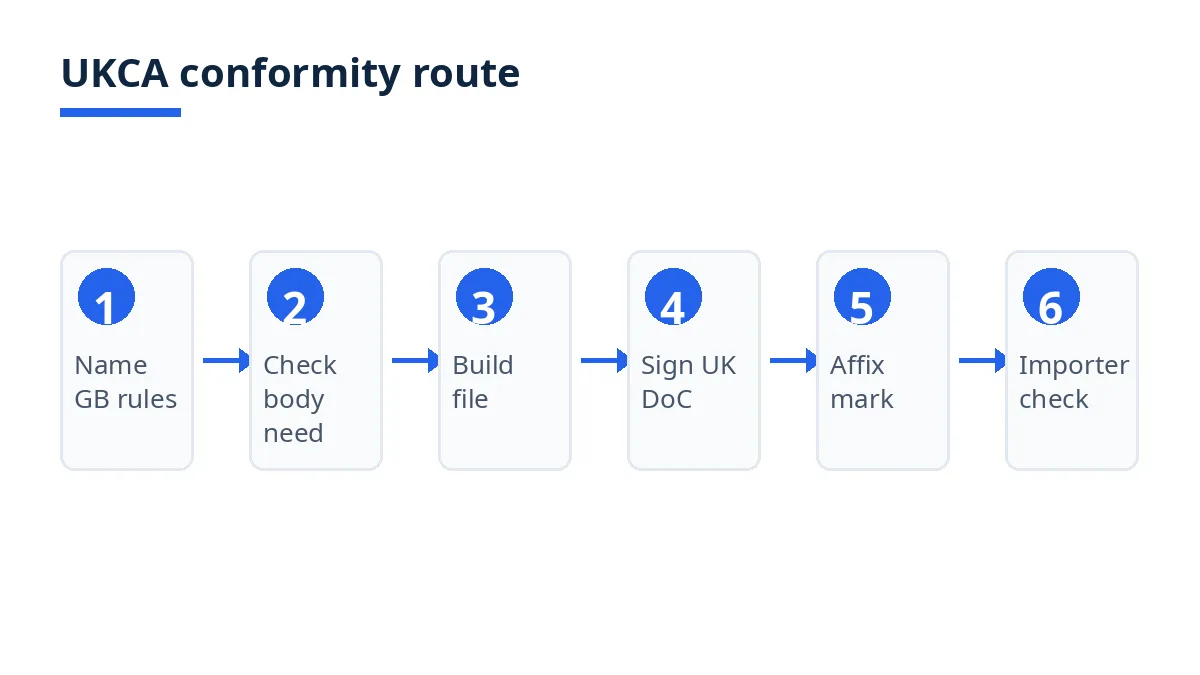
Finally, file the route per model and re-check it for any change. Keep the legislation, route, approved-body details where applicable, declaration copy, and date checked together. Documentation must be kept for the period specified in the legislation, typically 10 years after each individual product is placed on the market.1 A new model, changed design, or changed legislation means a new check.
Costs, timelines and documents
There is no single public figure for UKCA costs, so this guide gives cost drivers instead of numbers: testing, any UK approved-body assessment where required, compiling the technical file, and rework after a design or legislation change. Ask for a written breakdown for the actual model, and confirm cost and timing items with the conformity-assessment provider where one is involved, and with the manufacturer where self-declaration applies. Do not accept a flat fee for "UKCA certification" of a company, because the work attaches to a product model and a route, not to a company.
Timelines depend on the product, the route, approved-body availability where required, and any repeat testing after a change. A supplier should confirm in writing how long the assessment, any approved-body step, and the declaration step take for the actual model. The 10-year period is a record-keeping duty, not a delivery timeline.1
The document set is short: the UK declaration of conformity for the model, a written route statement, the approved-body name, number, and scope where involved, and commercial documents identifying the same model. A brochure, a company certificate, or a declaration for a different model is not part of this set.
Item | What to check | Why it matters |
|---|---|---|
UK declaration of conformity | Model, legislation, standards, signer, date | The declaration for this model |
Route statement | Self-declaration or approved body, with sector rule | Shows whether third-party assessment was required |
Approved-body details | Name, number, scope in the UKMCAB database | Scope must match the product and procedure |
Marking check | Visible, legible, indelible, correct proportions, 5 mm minimum | A faulty mark signals a faulty route |
Importer check | UK importer identity and file retained | The importer must show the process was done |
Shipment match | Declaration model matches shipped model | A declaration for another model proves nothing |
Bangladesh-specific rules and tips
There is no Bangladesh-specific UKCA rule, because UKCA marking is Great Britain legislation that applies to the product, not to the country of manufacture. Judge a supplier in Bangladesh on the same route evidence as a supplier anywhere else. Do not accept a claim that a Bangladeshi factory holds a UKCA certificate, or that a product is exempt because it was made in Bangladesh.
The Bangladesh work is therefore about evidence handling, not a local UKCA register. There is no public directory of UKCA-marked factories, and the verification route is the declaration plus the route statement plus, where applicable, the approved-body check in the UKMCAB database. Ask for those items before the order is confirmed, with the same model name as the order. If the buyer is established in the UK and brings the product in from Bangladesh, the buyer carries importer duties, including ensuring the conformity process was done and retaining technical documentation.1
On the CE choice, GOV.UK guidance is sector-specific: confirm the sector position before relying on it. Legislation came into force on 1 October 2024 to continue recognition of the CE marking, and the sector table lists many types, including electrical equipment, toys, machinery, and personal protective equipment, for which the Great Britain marking is UKCA or CE.2 The placing-manufactured-goods guidance states that continued recognition will apply to 21 product regulations, and that the announcement does not apply to medical devices, construction products, marine equipment, rail products, cableways, transportable pressure equipment, and unmanned aircraft systems, which have specific arrangements.3 The sector table itself also lists medical devices and construction products as UKCA or CE for Great Britain, so where those pages appear to point in different directions, do not guess: confirm the sector position with the UK importer or the approved body for the exact product before ordering. Fast-Track UKCA is separate: under the Product Safety and Metrology (Amendment) Regulations 2024, a manufacturer can mark a product with UKCA where recognised EU requirements and processes have been met, drawing up a UK declaration of conformity listing compliance with the relevant EU legislation.1
Northern Ireland note: this guide covers Great Britain only. The sector table shows Northern Ireland requiring CE, or UKNI and CE, for the product types listed, rather than UKCA alone.2 Do not apply a Great Britain route to a Northern Ireland order without checking its rules for that product.
Mistakes and red flags
The most common mistake is treating a company claim as a product declaration. A statement that a factory is UKCA certified, UKCA approved, or UKCA registered does not identify a model, legislation, or route, and is unverified until the declaration and route statement are produced. A second mistake is using the wrong route for the sector. The correction is the same: check the sector rule for the exact product, then match the route to it.
Other red flags include an approved-body number with no named body or scope, a declaration with no model, a declaration signed by someone other than the manufacturer or its authorised representative, and a supplier that will not share the declaration before the order is placed. A supplier that offers to add the mark after shipment, or describes it as a certificate to be bought for the company, is describing a different process. A further mistake is assuming the mark proves quality or covers every market: it demonstrates that the manufacturer believes the product meets the relevant requirements, and it must comply with all relevant regulations before marking.1
Checklist
Use this checklist before a first order, and for every new model.
Product model, intended use, and Great Britain market noted.
Every applicable Great Britain regulation named.
Route stated: self-declaration or UK approved body, matched to the sector rule.
Approved-body name, number, and scope checked in the UKMCAB database where involved.
UK declaration of conformity received for the exact model, with legislation, standards, signer, and date checked.
Technical file confirmed as existing and retained, typically for 10 years after each product is placed on the market.
Marking checked as visible, legible, indelible, correctly proportioned, and at least 5 mm unless otherwise specified.
UK importer identity and duties agreed, with the file to be retained by the importer.
CE choice or Fast-Track UKCA position confirmed for the sector, where that route is relied on.
Shipment documents matched to the declaration by model, not by company name.
Any design, legislation, or manufacturer change flagged for a fresh review.
Any gap recorded, with a decision on whether to proceed.
How Exportain helps
Exportain's supplier checks are a document and photo review, not a Great Britain conformity check, and they do not replace the declaration and route checks here. The Trust Center states plainly that supplier verification is a document review, not a factory inspection and not a check against a government database, and that a badge is not a guarantee of production capacity, product quality, or delivery.
A buyer can use Exportain to describe the model, legislation, route, and declaration requirement, and to request the checklist documents before agreeing dates. The seller verification page describes the same document and photo review from the seller side. The certification services category currently renders "No services published in this category yet", so do not assume a certification service is available through that category at the time of checking; request the declaration and route evidence directly from the supplier.
FAQs
What should I know first about UKCA marking?
Know first that it is not a factory certification and not a product quality mark. It is the manufacturer's declaration that a product conforms to applicable Great Britain legislation, affixed after the applicable conformity-assessment procedure. No authority grants UKCA status to a factory, and an approved body is involved only where legislation requires third-party assessment.
What are the typical costs and timelines?
There is no typical figure for every product. Costs depend on testing, any approved-body assessment where required, compiling the technical file, and rework after a change. Timelines depend on the same factors, plus approved-body availability where required. Confirm the breakdown and timing for the actual model, with the conformity-assessment provider where one is involved.
Which documents are needed?
The core set is the UK declaration of conformity for the exact model, a written route statement, the approved-body name, number, and scope where involved, and shipment documents identifying the same model. The technical file is held by the manufacturer and, for the importer, must be retained, typically for 10 years after each product is placed on the market.1
What are the most common mistakes?
The most common mistakes are treating a company claim as a product declaration, using the wrong route for the sector, accepting an approved-body number with no scope, matching the company name but not the model, and assuming the mark proves quality or covers Northern Ireland or the European Union. The correction is the same: ask for the legislation, route, declaration for the exact model, and, where applicable, the approved-body scope, and record any gap.
Next steps on Exportain
Start by describing the model, the Great Britain legislation you expect to apply, and the declaration and route documents you require, then run the checklist before agreeing shipment dates. Post a free RFQ on Exportain with the model and UKCA evidence stated. For background on platform checks, read the Trust Center and the seller verification page.
Sources
- Placing UKCA or CE marked products on the market in Great Britain. GOV.UK (accessed )
- Product regulations by sector and current approaches to product marking: UKCA and CE regimes. GOV.UK (accessed )
- Placing manufactured products on the market in Great Britain. GOV.UK (accessed )
About the author
Sourcing from Bangladesh?
Post a request for quotation and suppliers on Exportain can send you their quotes directly.
Post an RFQ