

Terry Bathrobes Exporters in Bangladesh: Verified Supplier Checklist
A 32-check evidence checklist for buyers checking a terry bathrobe exporter in Bangladesh: identity and export right, terry making, washed samples, labels and claims, payment stages, and shipment checks, filed as one order record.
Short answer
A terry bathrobe exporter in Bangladesh should be checked on evidence, not reassurance: identity and export documents, whether the terry work is done in-house, washed samples at the size extremes with a sealed approval, label and claim documents for each market, payment stages tied to evidence, and a pre-shipment inspection record. Any stop check with missing evidence stops the order.
On this page
A terry bathrobe order goes wrong in quiet ways: the sample feels thick and soft, the bulk robes arrive thinner, belt loops pull out after washing, or the label states a fiber mix the fabric does not match. None of that shows in a product photo. This checklist changes the question: instead of asking for reassurance, collect evidence — a document, a test result, a signed approval, or a shipment record. If the evidence is missing, the check is not passed.
Use the list in order on every shortlisted exporter, and keep the copy with the purchase order. That file protects a repeat order.
Why this checklist matters
A bathrobe is not a towel with sleeves. It is worn, washed, and belted, and must keep its shape, color, and label claims through that use. A check that only looks at price and delivery time misses where robe orders fail: bought-in terry, a dye lot approved on one robe and applied to thousands, a belt too short for the largest size, or a care label written for a different market.
This checklist is built around an evidence file, not a score: a check with no evidence is "evidence missing," not a pass. It separates the exporter from the robe, since a capable factory can ship a poor robe if the approval was vague.
Before you start
Do not contact exporters until you can state four things in writing.
First, the robe: shawl collar, kimono, or hooded; size range; wearer group; and retail, hotel, or spa use.
Second, the fabric brief: fiber content by weight, terry construction (woven or knitted), and absorbency expected after washing, in testable words.
Third, the market: destination countries, label wording for each, and the claims you will and will not make. Claims are checked separately below, because an unproven claim is a liability even when the robe itself is sound.
Fourth, the order shape: size curve, color range, packing per carton, and inspection point. Example figures: a first order across three sizes and two colors, inspected before packing, gives a comparison point for later orders.
The full checklist (numbered, printable)
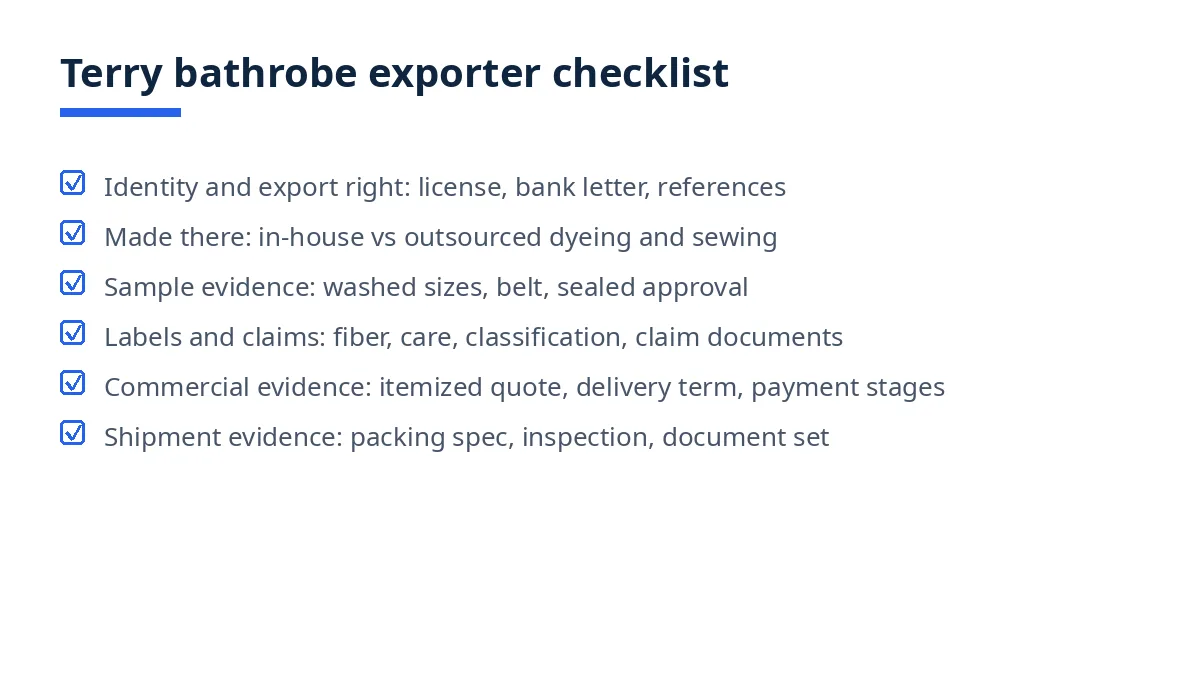
Work through the checks in order, recording evidence seen, evidence missing, or not applicable. Stop at any stop check whose evidence is missing.
1. Evidence of identity and export right
Legal name, registered address, and trade license matching the invoice, packing list, and bank account. Stop check: unexplained name differences end the process.
Export registration and tax identification documents, with copies kept in the file, not described in an email.
A named contact with a role and direct email address, plus a second contact for production questions.
Bank details confirmed on company letterhead, with payment instructions matching the contract name exactly.
Two trade references you can contact, with order types and years, not logos on a website.
2. Evidence the robe is actually made there
Steps in-house versus outsourced: terry weaving or knitting, dyeing, cutting, sewing, finishing. Stop check: outsourced dyeing or sewing must name the subcontractor and its checks.
A recent production record for a comparable robe: style, quantity, and delivery outcome.
Capacity evidence for your order shape: terry lines, current workload, and the production window in weeks.
A factory visit record, or a live video walkthrough, covering terry stock, cutting, and packing. Showroom photographs alone do not pass.
Subcontractor control: a written note of how outsourced work is inspected before goods return to the exporter.
3. Bathrobe-specific sample evidence
A sample in each size at the extremes of the range, not only a middle size, so belt, sleeve, and shoulder fit are tested where they most often fail.
A terry sample washed under the label's care instructions, then measured and photographed, so shrinkage, loop loss, and hand feel are judged after washing.
Belt and belt-loop evidence: belt length for the largest size, loop attachment method, and a pull test result with the method named.
Closure and pocket evidence: how the style closes, where patch pockets sit, and whether pocket stitching survives the washed sample.
A sealed approval sample signed by both sides, recording fabric, color, size, belt, label, and packing. Stop check: no signed approval, no bulk production.
Shade evidence: color judged under one light source against one reference swatch, each color approved separately.
4. Label, claim, and market evidence
Fiber composition for each style, by fiber name and percentage by weight in descending order for multi-fiber robes.1
A label proof for each destination market, checked before printing. In the EU, textile products must be labeled with fiber composition, durably, legibly, visibly, and accessibly, with the label securely attached.1
For the United States, a label listing fiber content, country of origin, and the identity of the manufacturer or another business responsible for the product, with care instructions.2
Classification evidence: the robe code confirmed from its construction and wearer group in the destination tariff, not copied from a towel listing. The Harmonized System uses six digits: two for chapter, four for heading, six for subheading.3 A robe is a garment, so use the garment headings, not the terry towel line.3 4
Claim evidence: for every label or listing claim, the certificate or test report behind it, checked for scope, expiry, and product covered. Stop check: an undocumented claim is removed from the label.
Care-label evidence: care symbols and wording tested against the washed sample in check 12, so the label describes a wash the robe has survived.
5. Commercial and payment evidence
A written quotation separating robe price, packing, inland transport, and freight, so two quotes compare line by line.
The delivery term named in full, with named place and risk point understood by both sides. Under Incoterms 2020, risk points vary by term, and for containers FCA is typically better than a sea-only rule.5
Payment terms tied to evidence points: each stage released on a named document or inspection result, not on a date alone. Example figures: a first-order payment split across stages, each linked to an approval, inspection, or shipping document.
A change-control note: how a change to fabric, color, size, or packing is proposed, priced, and approved in writing, and what happens to goods in production.
A cancellation and delay clause stating what each side does if production slips, including notice time and the evidence required for a revised date.
6. Shipment and repeat-order evidence
A packing specification: robes per carton, carton marking, and protection for belts, hoods, and light colors, approved on the sample carton.
A pre-shipment inspection record, with inspection point, sample drawn, and result filed before goods leave.
A consistent document set: invoice, packing list, and transport document carrying the same style names, quantities, and marks, with export clearance confirmed.6
A repeat-order rule: the second order is produced against the sealed approval sample and the first order's evidence file, and any change restarts section 3.
A complaint record: how a defect claim is raised, what evidence the buyer sends, and the response time allowed, agreed before the first shipment.
Common failures and how to fix them
Each failure below looks small at the sample stage and grows at bulk volume.
Shrinkage out of fit traces back to an unwashed approval: approve only a washed sample, with washed measurements for every size at the extremes.
A belt too short, or loops that fail, traces back to a middle-size sample: require the largest size in check 11 and name its belt length.
A shade dispute traces back to approvals under different lights or references: fix one light source and one swatch in check 16, and approve each color.
A label dispute traces back to a proof approved for one market and printed for another: require a separate proof per destination in check 18, and check fiber percentages against the fabric record.
A payment dispute traces back to a single payment tied to a date: tie each stage to an evidence point in check 25.
Repeat-order drift traces back to a second order produced from a fresh sample: enforce check 31.
Downloadable template / summary table
Copy this table into your order file, one row per check.
Section | Checks | Evidence to file | Decision |
|---|---|---|---|
Identity and export right | 1–5 | License, registration, bank letter, references | Proceed, fix, or stop |
Made-there evidence | 6–10 | In-house and outsourced steps, capacity, visit record | Proceed, fix, or stop |
Bathrobe sample evidence | 11–16 | Washed samples, belt record, sealed approval, shade refs | Proceed, fix, or stop |
Label, claim, and market evidence | 17–22 | Label proofs, classification note, claim documents | Proceed, fix, or stop |
Commercial and payment evidence | 23–27 | Itemized quote, delivery term, payment stages, clauses | Proceed, fix, or stop |
Shipment and repeat-order evidence | 28–32 | Packing spec, inspection record, document set, complaint rule | Proceed, fix, or stop |
Any stop check marked "evidence missing" means the order does not proceed.
How Exportain helps
Exportain supplier profiles record business and verification information a buyer can read before first contact, and the verification process is described on Exportain.7 Use that record as the starting point, not as a substitute: read the profile, run the 32 checks, and file the evidence yourself.
An RFQ lets you send the same one-page brief to more than one exporter, so returning quotes compare line by line.
FAQs
When should this checklist be used?
After shortlisting and before any bulk commitment, and again before a repeat order. Shortlist on range first, then run the file on the two or three exporters who remain.
Who should complete it?
The buyer, or the buyer's merchandiser, because the buyer owns the decisions the file records. An agent can collect evidence, but the buyer should review the stop checks and sign the approval sheet.
What are the most common failures?
An unwashed approval, a middle-size-only sample, a shade without a fixed reference, a label proof reused across markets, a payment tied to a date, and a repeat order from a fresh sample.
Can a third party do it?
A third party can inspect, test, and witness. It cannot replace the buyer's decisions on the stop checks, the sealed approval, or the claim documents; file its report alongside the checklist.
Next steps on Exportain
Browse suppliers, then post your brief, with its scope and inspection point, on the RFQ board. Before agreeing a quantity, read how supplier verification works on Exportain.
Sources
- Regulation (EU) No 1007/2011 on textile fibre names and related labelling and marking of the fibre composition of textile products. European Union, (accessed )
- Textile, Wool, Fur, Apparel and Leather Matters. Federal Trade Commission (accessed )
- What is the Harmonized System (HS)?. World Customs Organization (accessed )
- Classifying textile apparel. HM Revenue & Customs (GOV.UK), (accessed )
- Place of delivery & risk transfer in trade contracts. ICC Academy (accessed )
- Customs Clearance Procedures for Export. Bangladesh Customs, National Board of Revenue (accessed )
- How Supplier Verification Works on Exportain. Exportain, (accessed )
About the author
Sourcing from Bangladesh?
Post a request for quotation and suppliers on Exportain can send you their quotes directly.
Post an RFQ


