Tank Tops Exporters in Bangladesh: Verified Supplier Checklist
A tank-top supplier checklist for Bangladesh: papers, making capability, rib, jersey and slub fabric evidence, cut, print and fit grading, wash and colour evidence, labels and packing.
Short answer
Check a tank tops exporter in Bangladesh before ordering: confirm the papers and factory, the rib, jersey and slub fabric evidence, the graded fit for athletic and casual styles, print placement and dye-lot control, wash and colour evidence, and the contract terms in writing.
On this page
Key takeaways
Check the papers, the factory and the graded samples before signing, and treat any undisclosed subcontracting or expired registration as a stop item.
Ask for labelled rib, jersey and slub swatches, one dye lot per colour where possible, and a washed rib sample whose recovery matches the approved sample.
Grade the smallest and largest sizes, not only the sample size, and grade athletic fits for recovery and strap stability and casual fits for drape and a level hem.
Test print on the bulk fabric for placement and cracking on stretch, and agree dimensional change, wash and rubbing fastness evidence per colour before bulk is cut.
A tank top leaves little room to hide a supplier problem. There is no sleeve to absorb a grading error, no collar to cover a neckline fault, and a print sits on one small front panel where every crack and misplacement shows. Checking the exporter behind the garment keeps those faults visible before a purchase order is signed.
The candidate pool for tank tops is wide because production sits inside Bangladesh's knitwear sector: the Bangladesh Knitwear Manufacturers and Exporters Association states that it represents approximately 2,540 knitwear member factories.1 With that many candidates, run every one through the same checks in the same order — do not let the lowest quotation set the pace.
Why this checklist matters
A tank top order fails in ways specific to the garment: a neckline that stretches out of shape, an armhole that binds or gapes, a rib that recovers differently from the body jersey, a print that cracks when the fabric stretches, or one colour arriving in two shades across sizes. Each traces back to a check skipped at the supplier stage.
Use three verdicts: pass (evidence seen and matching), conditional (gap written down, dated and owned, closing before shipment), and stop (the order waits for a name that differs across papers, an expired registration, a fabric or print process the supplier cannot show, a fit block graded for one size only, or undisclosed subcontracting). A stop item is cleared by new evidence, not by reassurance.
Before you start
Before approaching suppliers, settle the styles (athletic or casual, including racerback, muscle or cropped cuts), the tech pack and size chart, the target markets and label requirements, and the payment and inspection plan. Name the stop decision-maker before quotations arrive.
Before comparing any quotation, collect the same five papers from each exporter: association membership certificate, Export Registration Certificate (ERC), VAT registration, Taxpayer Identification Number (TIN) certificate and trade licence. The ERC is the one that takes explaining: it is issued by the Office of the Chief Controller of Imports and Exports under the Ministry of Commerce, and getting one requires a valid trade licence, a TIN, a VAT registration number, a bank solvency certificate and a membership certificate from a recognised chamber or trade association.2
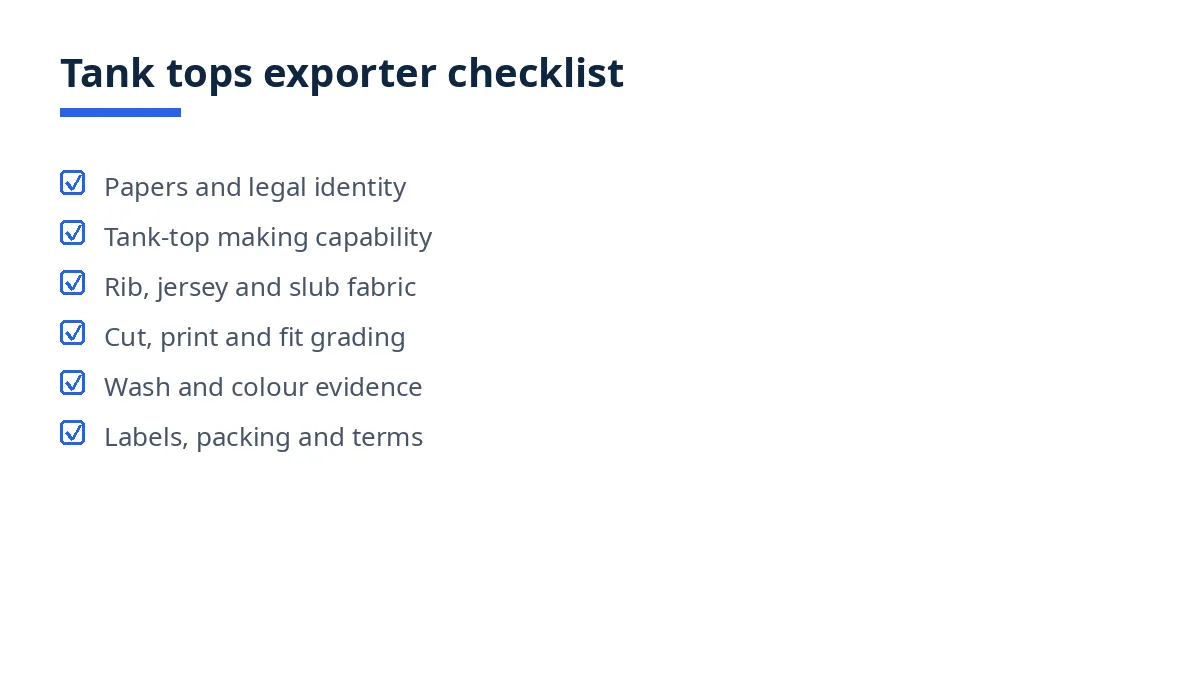
The full checklist (numbered, printable)
A. Papers and legal identity
Check that the legal name is identical on the trade licence, TIN certificate, VAT registration, ERC, quotation and bank account, and record each expiry date. Any difference is a stop item until the papers align.2
Check that the ERC is current and held by the exporter placing the order, not only by an intermediary, and ask in writing who handles each stage if any sits elsewhere.
Check the association membership certificate and its currency, and confirm the factory address given is where the tank tops will actually be made.
B. Tank-top making capability
Ask for a dated machine list and check it against the styles ordered: knitting or cut-and-sew capacity, overlock machines for side seams and armholes, and coverstitch machines for hems and neckline binding.
Check that the supplier has made the exact constructions ordered: bound or ribbed necklines, finished armholes, narrow or racerback straps, and layered or cropped hems.
Ask how prints and other decoration are done, and whether that work is in-house or subcontracted. An undisclosed print subcontractor is a stop item, because print is where tank tops most visibly fail.
Check the plan for strap and binding consistency: how strap width and binding tension are controlled across sizes, and what happens to pieces outside the agreed range.
C. Fabric evidence: rib, jersey and slub
Ask for bulk-fabric swatches for every fabric in the order, labelled by construction (rib, single jersey or slub), with fibre composition and weight per square metre from the tech pack recorded against each swatch.
Check rib evidence separately: rib at necklines, armholes and hems must stretch and recover with the body fabric, so compare a washed rib sample against the approved sample.
Check slub evidence on its own terms: slub yarn gives an uneven surface by design, so agree in writing what counts as intended texture versus defect, against the approved sample, before bulk is cut.
Check dye-lot control for every colour: one dye lot per colour across the order where possible, shade approval against the lab dip, and a plan for sorting complete size runs before packing if more than one lot must be used.
Check that bulk fabric matches the approved swatch in construction, composition and hand, and record any substitution as a failure to be resolved before cutting.
D. Cut, print and fit grading
Check the size chart and points of measure for a tank top specifically: chest, body length, armhole depth, neckline drop and strap width, for every size in the range.
Check the graded sample set, not only the sample size: fit the smallest and largest sizes on the named form or model, and compare armhole depth and strap position across the grade.
Grade athletic and casual fits by different written rules: athletic for close fit, stretch recovery and strap stability in movement; casual for drape, a relaxed body line and a level hem.
Check neckline and armhole finishing on the graded samples: binding that lies flat, sits evenly on both sides and does not ripple, twist or roll after washing.
Check print placement and quality on the graded samples: position measured from the neckline and armhole, not by eye; clean edges on ribbed, slub and smooth surfaces; and no cracking when stretched as in wear.
Check that any decoration is placed on the same position across sizes, and record a misplaced print as a defect rather than a variation.
E. Wash, colour and wear evidence
Review dimensional change evidence where required, for body length, chest and armhole depth. ISO 5077 specifies a method for determining the dimensional change of fabrics, garments or other textile articles in specified washing and drying procedures.3
Review washing fastness evidence where required, especially for dark and saturated colours. ISO 105-C06 specifies methods for determining the resistance of textile colour to domestic or commercial laundering using a reference detergent.4
Review rubbing fastness evidence for tank tops specifically, because the garment rubs under the arms and against outer layers. ISO 105-X12 specifies a method for determining the resistance of textile colour to rubbing off and staining other materials, with one dry and one wet test.5
Check care labelling against the wash evidence, and note that ISO 3758 establishes a system of graphic symbols for care labelling based on the most severe treatments that do not cause irreversible damage during care.6
F. Labels, packing and terms
Check fibre labelling for every target market before bulk labels are printed. Under Regulation (EU) No 1007/2011, a textile product shall be labelled with the name and percentage by weight of all constituent fibres in descending order.7
Check size, origin and brand labels for legibility, correct position and a match to the measured size and the purchase order, and confirm barcode stickers scan and match the order.
Check packing: tank tops folded so straps and bindings are not creased or stretched, size ratios per carton matching the specification, and carton markings matching the packing list.
Agree contract terms in writing before production: the graded sample set as reference, tolerances, test methods and acceptance levels, the dye-lot and print rules, inspection timing, and the remedy for a failed lot.
Common failures and how to fix them
The most frequent tank-top failure is a neckline or armhole that looks right flat and fails in wear: uneven binding tension, or rib that does not recover with the body fabric. Stop, wash a graded sample and compare against the approved sample before restarting the line. Next is shade drift across a colour run, pointing to more than one dye lot: re-sort complete size runs before packing.
Print cracking on stretch usually traces to a print method or cure never tested on the bulk fabric: stretch a printed bulk sample before the print run. Armhole grading faults show first at the extreme sizes, so grade those before bulk is cut. Above the agreed acceptance level, options are re-inspection after sorting or rework, documented partial acceptance, or rejection.
Downloadable template / summary table
Turn the checklist into your working record: file it per supplier together with the tech pack, size chart, tolerances and acceptance levels, and note the verdict and the evidence for each item as you go.
Section | Checks | Evidence |
|---|---|---|
Papers | Legal name, ERC, membership, factory address | Documents seen, expiry dates |
Making capability | Machines, constructions, print route, strap control | Dated machine list, samples |
Fabric | Rib, jersey, slub, dye lots | Labelled swatches, lab dip |
Cut, print, fit | Points of measure, grading, print position | Graded sample set |
Wash and colour | Dimensional change, wash and rubbing fastness, care | Test reports per colour |
Labels and packing | Fibre labels, barcodes, carton ratios | Label proofs, packing list |
How Exportain helps
Exportain is a B2B marketplace connecting buyers with Bangladeshi suppliers, so these specifications can be agreed at the enquiry stage. Browse suppliers, read the how supplier verification works on Exportain explainer, and compare the goods-level checks in the tank tops quality control checklist. Supplier profiles show which document and photo checks have been recorded, not factory inspections. Exportain is not a party to the goods contract and does not inspect goods.
FAQs
When should this checklist be used?
Run it before signing a purchase order, and run it again whenever terms renew or a new style, fabric, print or fit enters the range.
Who should complete it?
You, a local agent or an independent inspector can each run it — whoever does works from the tech pack, the graded sample set and the shared document set.
What are the most common failures?
A neckline or armhole that loses shape, rib that recovers differently from the body fabric, shade drift across a colour run, print that cracks on stretch, and armhole grading faults at the extreme sizes are the failures buyers find most often.
Can a third party do it?
Yes, if you share the tech pack, the graded sample set, the dye-lot and print rules, and the stop decision-maker.
Next steps on Exportain
First agree your styles, fabrics and fit rules, then read the how supplier verification works on Exportain explainer and the tank tops quality control checklist, and check the MOQ minimum order quantity explainer before you discuss order sizes. You can also post a free RFQ via RFQs and compare quotes from Bangladeshi suppliers.
Sources
- BKMEA at a Glance. BKMEA (accessed )
- Export Import License in Bangladesh: Procedure, Requirements, and Legal Framework. Law Firm in Bangladesh, (accessed )
- Regulation (EU) No 1007/2011 on textile fibre names and related labelling and marking of the fibre composition of textile products. European Union, (accessed )
- EVS-EN ISO 5077:2008 - Textiles - Determination of dimensional change in washing and drying. EVS (accessed )
- ISO 105-C06:2010 - Textiles — Tests for colour fastness — Part C06: Colour fastness to domestic and commercial laundering. International Organization for Standardization (accessed )
- ISO 105-X12:2016 - Textiles — Tests for colour fastness — Part X12: Colour fastness to rubbing. International Organization for Standardization (accessed )
- ISO 3758:2023 - Textiles — Care labelling code using symbols. International Organization for Standardization (accessed )
About the author
Sourcing from Bangladesh?
Post a request for quotation and suppliers on Exportain can send you their quotes directly.
Post an RFQ