

Using SWIFT MT103 Payment Confirmation When Buying From Bangladesh: Bank Rules and Tips
SWIFT MT103 payment confirmation for buyers sourcing from Bangladesh: what the message contains, what confirmation means, charges codes OUR, SHA and BEN, costs, timelines, documents, Bangladesh tips, red flags and a field-by-field checklist.
Short answer
An MT103 is a SWIFT customer credit transfer message that carries one bank-to-bank payment instruction, not a guarantee, letter of credit undertaking, escrow, factoring, or insurance. Check field 32A amount, currency and value date, field 59 beneficiary name and account, field 70 invoice reference, and field 71A charges code against the invoice, then confirm credit by the UETR and gpi status or beneficiary bank credit advice, not by the copy. Agree the OUR, SHA or BEN charges code before payment.
On this page
Key takeaways
An MT103 copy proves a payment instruction was sent. It is not a guarantee, a letter of credit undertaking, escrow, factoring, or insurance, and credit to the beneficiary account must be confirmed separately by gpi status or a beneficiary bank credit advice.
Check field 32A amount, currency and value date, field 59 beneficiary name and account, field 70 invoice reference, and field 71A charges code against the invoice before treating any payment as settled.
Under OUR the sender pays the charges, under SHA charges are shared, and under BEN the beneficiary pays them, so the amount credited can be less than the invoice amount unless the charges code is agreed in writing before payment.
No universal MT103 fee or timeline applies, and no Bangladesh-specific MT103 fee, timeline, or rule was stated in the opened material for this guide, so confirm fees, value date, and cut-off time with the sending bank and ask the seller authorized dealer bank what it needs to link the payment to the seller export file.
When a credit fails, correct the first payment through the banks using its sender reference and UETR, rather than sending a second payment that creates a duplicate to recall or refund.
When a buyer abroad pays a Bangladeshi supplier by bank transfer, the document most often asked for as proof is a SWIFT MT103 copy. An MT103 is a SWIFT customer credit transfer message: the bank-to-bank instruction that carries one payment from an ordering customer to a beneficiary, and the confirmation the beneficiary bank receives for that payment. It is not a payment guarantee, not a letter of credit undertaking, not escrow, not factoring, and not insurance.
Each payment arrangement answers a different question. A telegraphic transfer is the payment method that an MT103 message carries. A letter of credit is a bank undertaking to pay when stated documents and conditions are met. Documents against payment and documents against acceptance are collection arrangements in which documents move through banks under collection instructions. An open account sale is one in which goods are shipped and payment falls due later under the sales contract. Cash against documents is a sale in which payment is made against documents.1 An MT103 answers only one question: what payment instruction was sent, for how much, in which currency, to whom, and on what value date. It does not answer whether goods were shipped, whether they matched the order, or whether the beneficiary has been credited.
Why this matters for buyers and sellers
For the buyer, the MT103 copy is the first evidence that can be checked against the invoice. Compare the amount, currency, value date, beneficiary name, beneficiary account, and charges field with the pro forma invoice and the contract payment clause.
For the seller, the same copy is the starting point for tracing a payment inside its own bank. Keep it with the invoice, the purchase order, and the payment instruction, because that set is what a bank will ask for if a repair, an amendment, or an investigation is needed.
Step-by-step: how it works
What the MT103 contains
An MT103 is a single customer credit transfer message, used for one customer payment at a time.2 Field numbers follow the MT format; where a bank now issues the successor format, the same information appears under the successor field names.
Field | What it shows | Why the buyer checks it |
|---|---|---|
20 | Sending bank reference | Use it in every query about the payment |
32A | Value date, currency, amount | Compare all three with the invoice |
50 | Ordering customer | Confirm the payer named in the contract |
52 | Ordering institution | Confirm the sending bank |
56 | Intermediary institution | Identify where delay or deduction may occur |
57 | Account with institution | Confirm the seller bank |
59 | Beneficiary customer | Confirm legal name and account match the invoice |
70 | Remittance information | Confirm the seller can match the invoice |
71A | Details of charges: OUR, SHA or BEN | Confirm the charges field matches the contract |
The ordering customer, beneficiary, value date and amount, and remittance fields are most often used to match a payment to an invoice.3 Under OUR the sender pays all charges, under SHA charges are shared, and under BEN the beneficiary pays the charges.2 Agree that code in writing before payment.
What confirmation means
Confirmation here has a narrow meaning. An MT103 copy, or a SWIFT gpi status update, is evidence that the payment instruction was sent. It is not proof that goods were shipped, not proof that documents were presented, and not, on its own, proof that the beneficiary account has been credited.
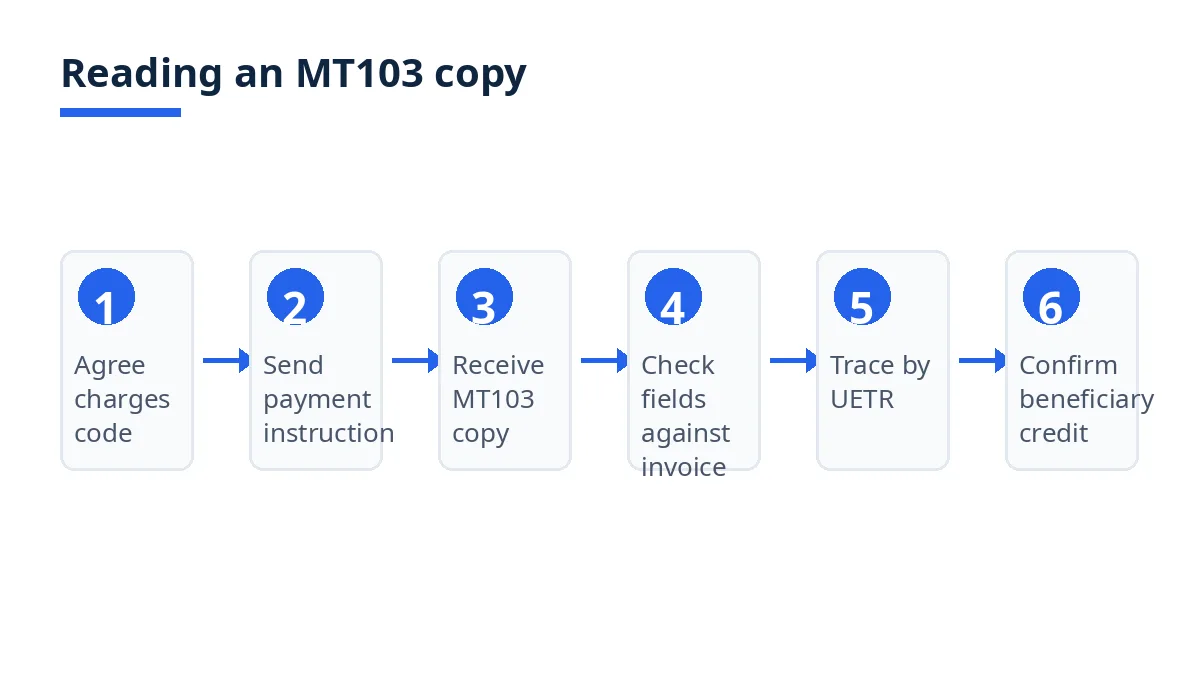
SWIFT gpi tracking works through a unique end-to-end transaction reference, the UETR, carried with the payment and used by each bank in the chain to report its status.4 The beneficiary bank reports the final credit confirmation back through the same chain.4 When credit is in doubt, ask for the UETR and the latest gpi status or the beneficiary bank credit advice, rather than relying on a copy of a sent instruction alone.
For cross-border bank-to-bank payments, the MT103 message has been replaced by the ISO 20022 pacs.008 message, while customers often still call the proof document they receive an MT103.5 What matters is whether the amount, currency, value date, beneficiary and charges information on the copy match the invoice.
What to check on receipt
Check the copy against the invoice in this order: amount and currency in field 32A; value date, which may differ from the instruction date; beneficiary name and account in field 59, character by character; charges field in field 71A; and remittance information in field 70.
Field errors cause repair or delay: a wrong beneficiary account, a misspelled name, a missing intermediary instruction, or a conflicting charges code can send a payment into a repair queue. Do not treat a payment as settled only because a copy has been received.
Costs, timelines and documents
Costs to confirm before paying
There is no universal MT103 fee, and no universal charge amount that applies to every bank, corridor, or currency. Before sending payment, ask each bank in writing for: the sending bank fee, any intermediary deduction under the agreed charges code, the beneficiary bank fee, any conversion charge, and any repair, amendment, or investigation fee.
Under OUR, the beneficiary should receive the full amount, subject to any charge the contract itself allows. Under SHA or BEN, the beneficiary may receive less. State the charges code in the contract, and state who settles any shortfall. As a labelled example only, a USD 30 intermediary deduction on a USD 24,750 payment under SHA would leave USD 24,720 before any beneficiary bank charge.
Timelines to confirm, not assume
There is no universal MT103 timeline that applies to every corridor. A payment can take longer where an intermediary bank holds it for a check, where a field needs repair, or where the value date falls on a weekend or a bank holiday. Before payment, ask the sending bank what value date it expects and what cut-off time applies.
If a payment has not been credited when expected, ask: has the instruction left the sending bank, which bank holds it, and what information does that bank need to release it. An MT103 is generally evidence that the sender bank sent the payment instruction, while the beneficiary receiving and crediting the funds is a later step that can still be delayed by posting rules, compliance checks, or data repairs.6
Documents to have ready
An MT103 is not a shipping document and does not replace the commercial documents for the order. Hold this set: the purchase order or sales contract with the payment clause, including the charges code; the pro forma or commercial invoice showing the seller legal name, seller bank details, amount, currency and invoice number; the buyer payment instruction as given to the sending bank; the MT103 copy and the UETR; and the beneficiary bank credit advice or gpi final credit confirmation once credited.
Bangladesh-specific rules and tips
Bangladesh has no Bangladesh-specific MT103 fee, timeline, or rule stated in the opened material for this guide, and this guide asserts none. A buyer should not accept a fee, a timeline, or a Bangladesh MT103 rule quoted without a bank source, because none was found in the material opened for this article. What the opened material does describe is the wider handling of export proceeds in Bangladesh, and that handling is separate from the MT103 message itself.
Bangladesh Bank has instructed authorized dealer banks to encash the value-added portion of export proceeds within the following working day, and to transfer export proceeds received through banks other than the exporter bank in foreign currency to the exporter designated bank.7 That instruction concerns how repatriated export proceeds are handled once they reach Bangladesh, not what an MT103 copy must contain. A seller should therefore ask its authorized dealer bank what it needs to link an incoming MT103 payment to the seller export file.
Two further tips follow from the field checks above. First, agree the beneficiary legal name exactly as it appears on the seller bank account. Second, put the invoice number in the remittance information field. Neither tip is a Bangladesh law.
Mistakes and red flags
The most common mistake is treating an MT103 copy as proof that the seller has been paid in full. A copy proves an instruction was sent; credit is a separate step. A second common mistake is sending a second payment while the first payment is still in transit. If a payment is delayed, trace the first payment with its UETR before sending any further amount.
A third mistake is accepting a document that is not an MT103 copy or its successor format. Ask for the MT103 copy or the pacs.008 equivalent, with the sender reference and the UETR.
Red flags that should stop a payment until cleared include: a beneficiary account that differs from the pro forma invoice, with no written explanation; a request to change the beneficiary bank or account after invoicing, without separate verification through a known contact at the seller; and a copy that cannot be matched to a sender reference or a UETR. In each case, do not send a further payment.
Checklist
Agree the payment clause in writing before payment: amount, currency, charges code, and who settles any shortfall.
Confirm the seller legal name, seller bank name, bank identifier, and beneficiary account exactly as they appear on the seller bank account.
Put the invoice number in the remittance information field of the payment instruction.
Ask the sending bank for the expected value date, the cut-off time, and the fees under the agreed charges code.
After payment, obtain the MT103 copy or the pacs.008 equivalent, and the UETR.
Check the copy against the invoice: amount, currency, value date, beneficiary name and account, charges field, and remittance information.
Send the copy and the UETR to the seller promptly, and keep them with the invoice and the payment instruction.
If credit is delayed, ask the sending bank for the latest gpi status and the bank currently holding the payment, before sending any further amount.
Obtain the beneficiary bank credit advice or the gpi final credit confirmation, and reconcile the amount credited with the invoice.
Settle any charges shortfall under the contract clause agreed before payment, rather than treating it as a new invoice dispute.
How Exportain helps
Exportain is a marketplace where buyers can find Bangladeshi suppliers and discuss orders, and its payment-terms and buyer-protection pages describe a funds hold arrangement, not MT103 processing. Under a funds hold, money is held until the trade is confirmed. A buyer paying by bank transfer should not expect Exportain to process, amend, or trace an MT103 message.
For an order placed through Exportain, the practical help is in the order record: a written specification, a written payment clause, and a record of the invoice and the payment instruction. Exportain does not guarantee bank credit, does not inspect goods, and does not clear customs, so the MT103 checks in this guide remain the buyer responsibility.
FAQs
What should I know first about SWIFT MT103?
An MT103 is a SWIFT customer credit transfer message that carries one payment instruction from a buyer bank to a seller bank, and a copy of that message is the evidence that the instruction was sent.2 It is not a payment guarantee, not a letter of credit undertaking, not escrow, not factoring, and not insurance. Confirmation means the instruction was sent, and credit to the beneficiary account is a separate step confirmed by a gpi status update or a beneficiary bank credit advice.
What are the typical costs and timelines?
There is no universal MT103 fee or timeline, and this guide states none. Costs depend on the sending bank, any intermediary bank, the beneficiary bank, and the charges code, and timelines depend on the corridor, the value date, and whether any field needs repair or a compliance check. Confirm the fee, the expected value date, and the cut-off time with the sending bank before payment, and confirm the charges code in the contract.
Which documents are needed?
The payment set is the purchase order or sales contract with the payment clause, the pro forma or commercial invoice, the buyer payment instruction as given to the sending bank, the MT103 copy or the pacs.008 equivalent with the UETR, and the beneficiary bank credit advice or gpi final credit confirmation once credited. An MT103 copy is not a shipping document and does not replace the commercial invoice, the packing list, or the transport document.
What are the most common mistakes?
The most common mistakes are treating an MT103 copy as proof of credit, sending a second payment while the first payment is still in transit, accepting a document that is not an MT103 copy or its successor format, and discovering the charges code only after the seller has received less than the invoice amount. Avoid each by checking the copy against the invoice field by field, tracing a delayed payment by its UETR before sending further money, and agreeing the charges code in writing before payment.
Worked example: an account check that stopped a duplicate payment
A buyer in Portugal ordered handwoven cotton throws from a Bangladeshi supplier for USD 24,750, payable by telegraphic transfer with charges code OUR stated in the purchase order. The buyer sent the payment and forwarded the MT103 copy to the supplier the same day. The supplier bank could not post the credit, because the beneficiary account number on the MT103 copy differed by one digit from the account number on the pro forma invoice, and the supplier account on file did not match the account named in field 59.
The supplier did not ask for a second payment. The buyer bank found that the account digit had been mistyped, and sent an amendment through the remitter bank to correct field 59. The supplier bank then repaired the instruction and posted the credit. Check field 59 digit by digit before payment, and when a credit fails, correct the first payment through the banks rather than sending a second one.
Next steps on Exportain
Read the payment terms page to see how a funds hold works, and how it differs from a bank-to-bank MT103 payment. Read the buyer protection page to see what protection arrangements cover, and what they do not cover, before agreeing payment terms on an order. Use both pages together with the checklist above when you agree the charges code and the beneficiary details for a payment to Bangladesh.
Sources
- Securing payment in international trade. The Financial Express (accessed )
- What is MT103 SWIFT Confirmation? Your Essential Guide for International Payments. Razorpay (accessed )
- What Is an MT103? Where to Find and Use It to Track Transfers. Statrys (accessed )
- SWIFT GPI Tracker and UETR: How to Track a Payment. Xflowpay (accessed )
- What Is SWIFT MT103? Meaning, Format, Fields and How to Get One. Xflowpay (accessed )
- SWIFT Payment Tracking: How to Track a SWIFT Payment End-to-End. Fintechly (accessed )
- BB asks banks to encash export proceeds within next working day. The Financial Express (accessed )
About the author
Sourcing from Bangladesh?
Post a request for quotation and suppliers on Exportain can send you their quotes directly.
Post an RFQ


