Sweaters Exporters in Bangladesh: Verified Supplier Checklist
A numbered checklist for checking a sweaters exporter in Bangladesh before ordering: identity and export papers, gauge and yarn capability, samples, testing, labels, inspection and payment terms, with the evidence to file for each check.
Short answer
Work through this checklist before ordering sweaters from Bangladesh: confirm the exporter's legal identity and export registration, check gauge, yarn and stitch structure against your specification with a sample in bulk materials, agree test methods, sampling and acceptance numbers in the purchase order, and inspect before shipment. Exportain badge checks review documents and photos, so your own checks still decide whether to order.
On this page
Key takeaways
A badge check and a capability check are different jobs: Exportain reviews documents and photos, while gauge, yarn, capacity and delivery still need your own written evidence.
Write the specification first: style, gauge, yarn and fiber content, sizes, colors, quantities per style and color, tests, labels and packing, so every quotation answers the same questions.
Approve a sample in bulk yarn and bulk materials, and agree test methods, the sampling plan and acceptance numbers in the purchase order before production starts.
Check every certificate for scope, expiry and issuer, and stop the order when the company name, gauge or sample does not match the written specification.
Three quotations for the same sweater can look alike and still describe three different risks. One supplier may knit the gauge you asked for, another may plan to knit it on a machine that cannot hold the yarn, and a third may have the machine but no export registration in the name on the quotation. This checklist separates those cases before money moves.
Work it as a sheet. Copy it into a spreadsheet, work down the numbered checks for each supplier, and file the evidence beside each answer. A check with no evidence behind it stays open.
Why this checklist matters
A sweater order sets its gauge, yarn and stitch structure before knitting starts, its dye lot when yarn is dyed, and its label wording when labels are printed. Each is cheap to confirm in writing and expensive to correct after bulk production. A checklist forces the confirmations into the same order every time.
The supply base is large. The Bangladesh Knitwear Manufacturers and Exporters Association (BKMEA), the apex trade body for the knitwear sector, was established in 1996 and represents approximately 2,540 knitwear member factories.1 Membership alone says nothing about whether one factory knits your gauge or can meet your date. Treat it as a claim to check: ask for the record, read what it covers, and record what you found.
Before you start
Write the specification before you contact any supplier: style, gauge, yarn fiber and count, stitch structure, sizes, colors, quantities per style and per color, label and packing requirements, tests and delivery terms. Sweaters sit under Harmonized System heading 6110, which covers jerseys, pullovers, cardigans, waistcoats and similar articles, knitted or crocheted.2 Put the heading on the enquiry and confirm the full code for your destination market before you agree a price.
For a first order, finish the identity and capability sections before you approve a sample. For a repeat order, re-run what can change: registration expiry, certificate scope, gauge and yarn, and the delivery plan. Keep one copy per supplier and style, mark each check pass, fail or not applicable, and file the evidence. A fail in the identity, gauge or sample sections stops the supplier.
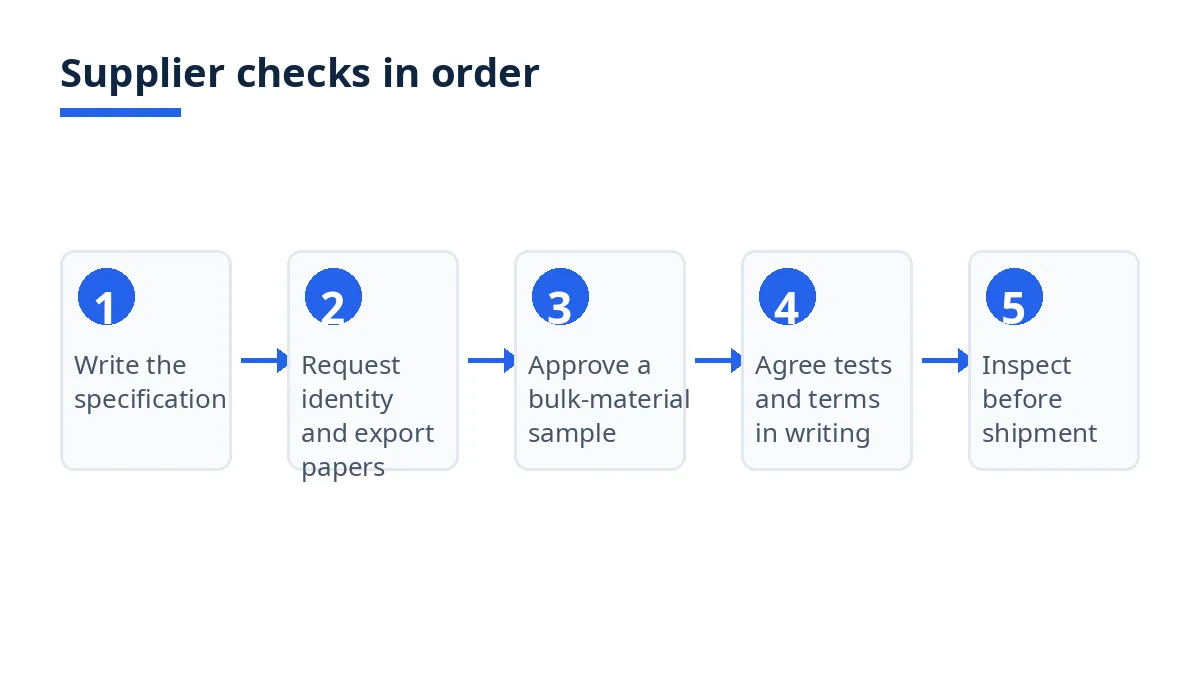
The full checklist (numbered, printable)
Identity and registration
Confirm the legal name, trade name and address match on the profile, quotation, proforma invoice, export registration, trade license and tax document. A name that changes between documents is a stop point until explained in writing.
Ask for the Export Registration Certificate (ERC) in the same company name, current, and covering the goods you are buying. Without one, the supplier must explain in writing how the export will be handled.
If the supplier claims BKMEA membership, check the claim against the association member directory and record the result. Treat it as unchecked until you have that result.
Confirm the contact channels work: a business email, a business phone that answers, and a named contact with a role. Test each once before relying on it.
Capability: gauge, yarn and production
Ask the supplier to state the machine gauge, yarn fiber, yarn count and ply, and stitch structure for your style in writing, against your specification.
Check the gauge direction suits the design. Gauge is needles per inch: lower numbers give coarser stitches, higher numbers finer stitches. As a starting point, 3GG to 5GG suits chunky knitwear, 7GG to 10GG mid-gauge, and 12GG to 18GG finer knitwear.3 A gauge number alone does not guarantee weight, warmth or quality, so judge the swatch and sample, not the number.3
Ask how yarn will be sourced: stock yarn, yarn dyed for your colors, or yarn bought to order. Record the dye route and who approves the lab dip.
Ask for the production route and the location of each step, and whether any step is subcontracted. Undisclosed subcontracting is a fail. Ask for capacity in writing, and two references: style, gauge and quantity.
Commercial terms
Ask for a quotation with separate cost lines: yarn, knitting and linking, dyeing and finishing, trims, testing, packing, and freight to the port where the price ends. A lump sum cannot be compared when an input changes.
Confirm the minimum order quantity (MOQ) per style and per color, and what sets it: yarn dye lot, linking setup or finishing run. Read the MOQ guide before negotiating. Example figures: 1,000 pieces per color for one style and 500 for another, the difference explained by the dye lot. Treat that as an illustration of MOQ structure, not a market rate.
Confirm the price basis, currency, payment terms, Incoterm, validity period and charges outside the quoted price, in the same words in the purchase order. Confirm who bears the cost if an input changes after approval.
Samples and approvals
Approve a knitted swatch for gauge, yarn, structure and hand feel before the full sample is made, and keep it as the bulk reference.
Approve a proto sample, then a pre-production sample in bulk yarn, colors and trims, with the intended washing and finishing applied.
Approve the lab dip for each color against your color standard, under the inspection light source, and record the reference and date per color. Put a change rule in writing: no change after approval without a new written approval.
Testing, certificates and labels
Name the test methods in the purchase order before production. ISO 5077 specifies a method for determining dimensional change of fabrics, garments or other articles in specified washing and drying procedures.4
For surface appearance, agree the pilling, fuzzing and matting method in advance. ISO 12945-2 specifies a modified Martindale method, with visual assessment after defined stages of rub testing.5 Agree the rating scale, and leave acceptance numbers to the purchase order.
For color performance, name the washing, rubbing and perspiration test methods, and require reports to name the bulk fabric, color and lot.
Check the label plan before labels are printed. In the European Union, fiber composition labelling is compulsory under Regulation (EU) No 1007/2011, which requires fiber names and percentages by weight in descending order.6 Check fiber, size, origin and care wording for each market. ISO 3758 gives care symbols for the most severe treatments that do not cause irreversible damage, in the order washing, bleaching, drying, ironing and professional textile care.7
If a harmful-substances claim will appear on the product, check the certificate: coverage, product class, issuing body, number and expiry date. Under OEKO-TEX STANDARD 100, the label is awarded only if all components meet the criteria, and a certificate is valid for 12 months.8
Inspection, packing and shipment
Agree the sampling plan in writing before production. ISO 2859-1 defines sampling schemes indexed by acceptance quality limit (AQL) for lot-by-lot inspection.9 Agree the inspection level, sample size, defect classes and acceptance numbers in the purchase order, and draw the sample at random across sizes, colors and cartons.
Agree who inspects, when, and against which references: approved sample, size chart, label plan and packing specification. Check folding, set contents, carton ratios, markings, barcodes and carton count, and weigh and measure sample cartons.
Agree the shipping documents: commercial invoice, packing list, certificate of origin where required, and named test or inspection reports. Check names, quantities and values match.
Record and decision
Score each section separately: proceed, proceed with conditions, or stop. One failed identity or gauge check outweighs a pass on price. File the checklist with the quotation, specification, approvals, reports and purchase order under one reference.
Common failures and how to fix them
The most common failure is a name that does not match: the company on the quotation is not the company on the export registration, or the bank account name differs. Stop, ask for the correct documents in the correct name, and do not pay until the names agree.
The next failure is a gauge promise without a swatch. The supplier confirms the gauge by email, knits the sample with different yarn or on a different machine, and the bulk fabric misses the design. Accept no gauge until a swatch in the specified yarn is approved, and start no bulk until the pre-production sample in bulk materials is approved.
Certificate failures follow a pattern: a certificate that has expired, covers a different product class, covers only one component, or was issued to a different company. Check scope, expiry and issuer on the document itself, and treat an out-of-scope certificate as no certificate. Under OEKO-TEX STANDARD 100, all components must meet the criteria before the label can be used, so a certificate for the yarn alone does not support a claim on the finished sweater.8
Shade failures usually trace to a sample that was not made in bulk materials: the lab dip was approved, the bulk yarn came from another dye lot, and shade shifts across sizes. Approve the lab dip, then approve the pre-production sample in bulk yarn and bulk colors, and hold bulk until both approvals are recorded.
The quietest failure is the missing acceptance agreement: inspection finds defects, and buyer and supplier disagree about how many are acceptable because no sampling plan was written down. Agree the scheme, defect classes and acceptance numbers in the purchase order, using ISO 2859-1 as the framework.9
Downloadable template / summary table
Copy the numbered checklist into your inspection sheet, add the specification, tolerances and acceptance numbers from the purchase order, and record a result and evidence reference for every check.
Section | Checks | Evidence to file |
|---|---|---|
Identity and registration | 1 to 4 | Trade license, tax document, ERC, directory result, contact test |
Capability | 5 to 8 | Written gauge and yarn statement, swatch, production plan, references |
Commercial terms | 9 to 11 | Itemised quotation, MOQ statement, price and payment terms |
Samples and approvals | 12 to 14 | Swatch, proto and pre-production approvals, lab-dip approvals |
Testing, certificates and labels | 15 to 19 | Test methods in the purchase order, reports, certificate checks, label approval |
Inspection, packing and shipment | 20 to 22 | Sampling plan, inspection report, carton checks, shipping documents |
Record and decision | 23 | Scored checklist, decision line, filed order reference |
How Exportain helps
Exportain is a B2B marketplace where buyers can browse suppliers, compare profiles and quotations, and send one written specification to several suppliers as an RFQ. Sending the same specification to each supplier makes the checklist work: answers arrive in comparable form, and the supplier that cannot answer a check in writing shows that gap before a sample is made. Read how supplier verification works before you shortlist, so you read each profile's badge record for what it actually says.
Badge checks on Exportain are a document and photo review by Exportain staff, not a factory inspection, and membership never grants a badge.10 A supplier can hold up to five badges, each recording a specific check: identity, phone and email, business registration, export registration, and facility photos, with a further record for completed orders without disputes. A badge is not a guarantee of production capacity, product quality or delivery, and it does not replace the gauge, sample and testing checks in this article.11 Use the badge record to shorten the identity section, complete the rest yourself, and send your specification as an RFQ to the suppliers that pass.
FAQs
When should this checklist be used?
Use it before the first order with a supplier, and again when the style, gauge, yarn, market or specification changes. For repeat orders of an identical style, re-run the identity, certificate and delivery sections, and confirm the sample and test positions still match the new run.
Who should complete it?
The buyer, a sourcing agent working to the buyer's written specification, or an independent inspector for the inspection sections. Whoever completes it should work from the same specification, approved sample and purchase order, and file the evidence with the checklist.
What are the most common failures?
Name mismatches across documents, a gauge promised without an approved swatch, certificates that are expired or out of scope, shade changes from a different dye lot, and inspections with no agreed sampling plan or acceptance numbers. Each is fixed by a written check earlier in the order, not by negotiation after the goods are made.
Can a third party do it?
Yes. A sourcing agent can complete the identity and capability sections, and an inspection firm the inspection and packing sections, provided both work to your written specification and file their evidence. The decision to proceed, and the approvals of samples, lab dips and terms, stay with the buyer.
Next steps on Exportain
Write the specification, then browse suppliers and read how supplier verification works before you shortlist, so you know what each badge record does and does not show. Check the MOQ guide before you discuss quantities, so the MOQ for each style and color is agreed on its cost drivers. Then send the specification to the suppliers that pass the identity and capability checks, and work the numbered list to a written decision before production starts.
Sources
- BKMEA at a Glance. BKMEA (accessed )
- Classification Detail — HS Code 6110. United Nations Statistics Division (accessed )
- Sweater Knitting Gauge Guide: 3GG-18GG. KnitSeek (accessed )
- ISO 5077:2007 - Textiles — Determination of dimensional change in washing and drying. International Organization for Standardization (accessed )
- ISO 12945-2:2020 - Textiles — Determination of fabric propensity to surface pilling, fuzzing or matting — Part 2: Modified Martindale method. International Organization for Standardization (accessed )
- Regulation (EU) No 1007/2011 on textile fibre names and related labelling and marking of the fibre composition of textile products. European Union, (accessed )
- ISO 3758:2023 Textiles — Care labelling code using symbols. International Organization for Standardization (accessed )
- OEKO-TEX STANDARD 100 for textiles tested for harmful substances. Hohenstein (accessed )
- ISO 2859-1:2026 - Sampling procedures for inspection by attributes — Part 1: Sampling schemes indexed by acceptance quality limit (AQL) for lot-by-lot inspection. International Organization for Standardization (accessed )
- Supplier verification: Earn trust badges buyers can see. Exportain (accessed )
- How Supplier Verification Works on Exportain. Exportain, (accessed )
About the author
Sourcing from Bangladesh?
Post a request for quotation and suppliers on Exportain can send you their quotes directly.
Post an RFQ