How to Find SEDEX SMETA Certified Factories in Bangladesh
SMETA is an audit report, not a certificate: the 2-pillar and 4-pillar scopes, Sedex platform sharing, the CAPR and follow-up check, and how to read audit evidence for a Bangladesh site before you order.
Short answer
A SMETA-audited site is a site assessed under the Sedex Members Ethical Trade Audit methodology and reported in a full audit report with a Corrective Action Plan Report, not a site holding a Sedex certificate. Ask for the report and CAPR for the exact site, check the 2-pillar or 4-pillar scope, the audit date, every finding, and the follow-up position, and confirm whether sharing is through the Sedex platform or by PDF only before you order.

On this page
Key takeaways
Sedex is a membership platform and SMETA is its audit methodology, not a certification: Sedex issues no factory certificate, and a SMETA audit produces a report and a Corrective Action Plan Report, not a pass or fail grade.
A 2-pillar audit covers labour standards and health and safety, with supplementary elements on management systems, entitlement to work, subcontracting and homeworking, and a shortened environment assessment; a 4-pillar audit adds detailed environment assessment and business ethics.
Sedex membership alone is not audit evidence: membership shows a platform account, while a report shows what was checked, when, and what was found for one exact site.
Verification means reading the full report and CAPR for the exact site and confirming the scope, date, findings, deadlines, evidence, and follow-up position, and confirming whether sharing is through the Sedex platform or by PDF only.
Exportain supplier verification is a document and photo review, not a factory inspection, and a badge is not a guarantee of capacity, quality, or delivery, so it does not replace a SMETA report.
Start with the distinction that decides everything else in this guide. Sedex is a membership platform for sharing ethical supply chain data. SMETA, the Sedex Members Ethical Trade Audit, is the audit methodology used on that platform. Sedex does not issue a factory certificate, and a SMETA audit does not produce a pass or fail certificate. What it produces is an audit report and a Corrective Action Plan Report, known as a CAPR, which the site can share with buyers through the Sedex platform.1 2 The wording in the title reflects the words buyers commonly search for. It does not change that position.
That distinction changes how a buyer should read supplier claims. A Sedex membership record shows that a site has an account on the platform. It does not, by itself, show that an independent audit took place, what was checked, or what was found. A SMETA report answers those questions for one site, on one date, within one agreed scope. Sedex contrasts a static PDF with platform access, noting that platform members can track corrective actions and view audit history.1
SMETA is also not a product test. It does not test fibre content, recycled content, chemical safety, or product quality. It assesses working conditions and responsible business practice at a site, against local law and the ETI Base Code, with International Labour Organization conventions as part of its basis.3 A site can therefore have a SMETA report and still need separate evidence for material claims and quality inspection.
Why this matters for buyers and sellers
For a buyer, the value of a SMETA report is comparability. Because auditors use one shared methodology, a buyer can read findings from different sites in the same format and compare what was actually checked, rather than comparing marketing summaries.1
For a seller, the value is reuse. One SMETA report shared through the Sedex platform can be shown to more than one linked buyer, which reduces repeated audits for the same site.3 The supplier decides which buyers are granted access to the report on the platform.2
The limits matter just as much. SMETA gives no grade that a buyer can accept without reading the findings. Each buyer applies its own judgment about whether those findings are acceptable for its order.
Step-by-step: how it works
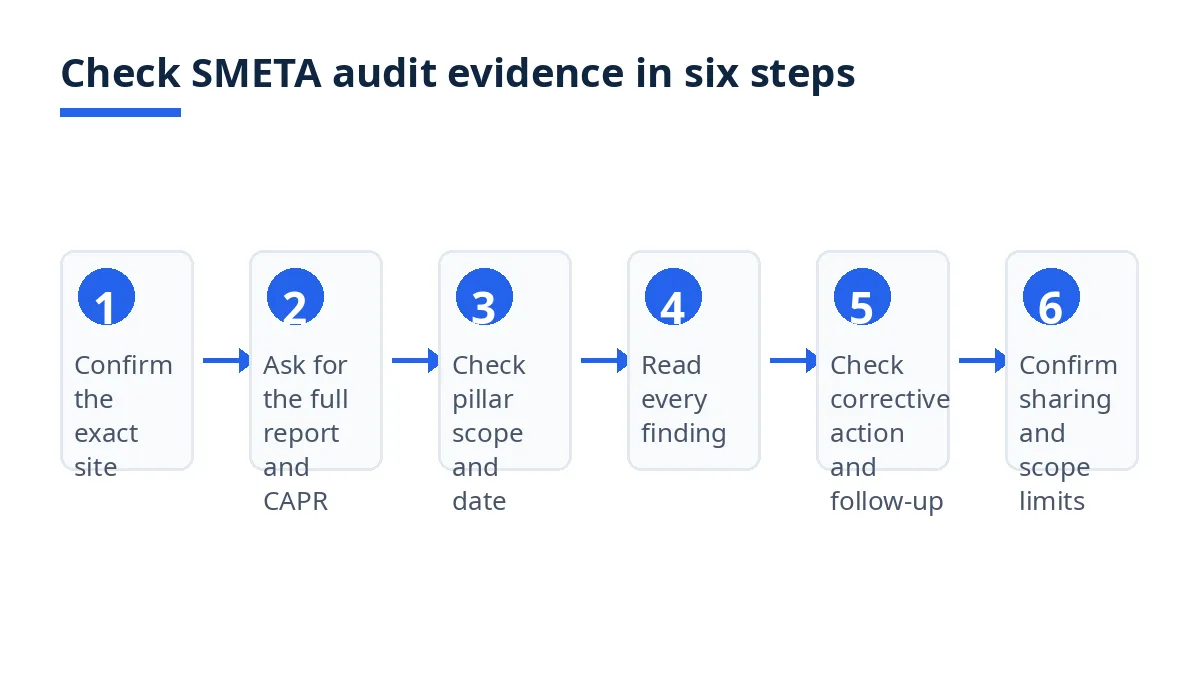
Confirm the exact site. Ask for the legal name and address of the production site, and confirm that the site in the report is the site that will make the order. A report for a head office or a sister unit does not cover a different production unit.
Ask whether the site is a Sedex member and whether an audit has actually taken place. Membership and an audit are separate steps. The supplier registers on the Sedex platform, completes a Self-Assessment Questionnaire, then chooses an approved third-party audit firm and schedules the audit date.2
Confirm the pillar scope. A 2-pillar audit covers labour standards and health and safety, with supplementary elements including management systems, entitlement to work, subcontracting and homeworking, and a shortened environment assessment. A 4-pillar audit adds a detailed environment assessment and business ethics.2 3 Do not assume a 4-pillar scope from a 2-pillar report.
Read the audit itself. The on-site audit combines an opening meeting, document review, site inspection, confidential worker interviews, and a closing meeting where findings are presented to management.2
Read the report and the CAPR together. Findings are compiled into a SMETA Audit Report and a Corrective Action Plan Report, uploaded to the Sedex platform after quality control review.2 Check the deadline and evidence for each item, not only the headline count of findings.
Confirm sharing and follow-up. Ask whether the report will be shared through the Sedex platform or supplied only as a PDF, and whether any follow-up audit or verified corrective action is required. If non-compliances are found, the supplier implements corrective actions by set deadlines and uploads evidence on the platform, and in some circumstances a follow-up audit is required.2
The diagram below summarises that check.
Scope | What it covers | What it does not add |
|---|---|---|
2-pillar SMETA | Labour standards and health and safety, plus management systems, entitlement to work, subcontracting and homeworking, and a shortened environment assessment | Detailed environment and business ethics |
4-pillar SMETA | Everything in the 2-pillar audit, plus detailed environment assessment and business ethics | A product certificate or a pass or fail grade |
The labour standards pillar draws on the ETI Base Code, whose nine provisions cover freely chosen employment, freedom of association, safe working conditions, no child labour, living wages, working hours that are not excessive, no discrimination, regular employment, and no harsh or inhumane treatment.4 Where national law and the Base Code address the same subject, the provision that affords the greater protection applies.4
SMETA 7.0, the current methodology described by Sedex, adds a Management Systems Assessment, which looks at how well a site manages its policies and practices and at root causes rather than symptoms alone.1 It also introduces Collaborative Action Required findings for complex issues that one company cannot solve alone, such as living wages, where buyers and suppliers work together on a longer-term solution.1
Costs, timelines and documents
No standard SMETA price applies across audit firms, sites, and scopes, and this guide states no price for that reason. The supplier chooses an approved audit firm, and the fee is a matter to confirm with that firm for the exact site, worker count, and pillar scope. Confirm who pays and whether the fee covers a follow-up audit.
Timelines also depend on the site and the firm. The on-site audit typically takes a minimum of one day, depending on facility size and the number of pillars.2 Sedex members gain access to audit results within 14 days, while PDF-only handling gives no equivalent real-time view of corrective action progress.1 Do not promise a customer a delivery date that depends on a SMETA report until the audit date, the report date, and any follow-up requirement are confirmed in writing.
Item to confirm | Why it matters | Where to check it |
|---|---|---|
Exact site name and address | A report covers one site, not a company group | Report cover and scope |
Pillar scope, 2-pillar or 4-pillar | A 2-pillar report does not cover detailed environment or business ethics | Report scope |
Audit date and audit firm | Dates and the firm identify the evidence and its age | Report cover |
Full report and CAPR | A summary can hide findings, deadlines, and scope limits | Full report, not a cropped page |
Corrective actions, deadlines, and evidence | Open findings stay open until evidence is verified | CAPR and platform status |
Follow-up audit requirement | Some findings need a follow-up audit, not only a paper closure | CAPR |
Sharing route, platform or PDF only | Platform access gives history and status; a PDF gives a snapshot | Platform access or supplier confirmation |
The documents a buyer should request are the full SMETA Audit Report and the CAPR for the exact site, the Self-Assessment Questionnaire position where relevant, and written confirmation of the sharing route and any follow-up requirement. For a seller preparing for an audit, the set to assemble includes employment contracts, payroll and working-hours records, health and safety procedures and logs, and, for a 4-pillar audit, environmental records and business ethics policies. Records must match practice.
Bangladesh-specific rules and tips
There is no separate Bangladesh SMETA rulebook, and a buyer should be wary of any claim that one exists. SMETA applies the same methodology across countries, grounded in the ETI Base Code, ILO conventions, and relevant local legislation.3 In Bangladesh that means the report must be read against Bangladeshi law as well as the code, with the greater protection applying where the two address the same subject.4
Four Bangladesh-specific checks deserve attention. First, confirm the production site, not only the exporting company. Many Bangladesh exporters work with more than one unit, and subcontracted processes are a named element of the 2-pillar supplementary scope.2 Ask which processes are done in-house, which are subcontracted, and whether those sit inside or outside the scope. Second, respect interview confidentiality and do not ask a supplier to identify interviewees. Third, ask how payroll, hours, and contract records are kept, rather than accepting a single summary sheet. Fourth, do not treat a SMETA report as a substitute for material evidence, product testing, quality inspection, and export documentation.
Settle the pillar scope with the buyer before booking: a buyer that needs detailed environment and business ethics evidence will not accept a 2-pillar report as a substitute. Settle the sharing route early too: a report shared through the Sedex platform can be shown to more than one linked buyer, while a PDF-only route gives each buyer a snapshot with no shared status view.1 3 For a buyer, state the pillar scope, the site, and the follow-up position in the purchase terms.
Mistakes and red flags
Treating Sedex membership as an audit. Membership shows a platform account. An audit shows an independent assessment, a report, and a CAPR. Ask for the report when audit evidence is what the order needs.
Accepting a certificate, badge, or logo as SMETA evidence. Sedex is not a certification body and does not issue certificates or compliance seals.2 A logo, badge, or one-page summary is not a SMETA report.
Accepting a cropped summary or a screenshot. A cropped page can hide the site, the date, the pillar scope, or the findings. Ask for the full report and CAPR, and check those details against the order.
Accepting evidence for a different site. A report for one unit or a head office does not cover a different production unit. Check the scope note and site details line by line.
Reading a 2-pillar report as a 4-pillar report. The scopes differ on environment and business ethics, and a buyer that needs those areas must ask for the wider scope explicitly.3
Treating a report as permanent. A SMETA report is a dated snapshot for one site and one scope. It does not guarantee quality, delivery, or capacity, and it does not stay current without a fresh audit or verified follow-up where required.
Ignoring the CAPR and follow-up position. A report with open findings and no deadlines, evidence, or follow-up date is unfinished evidence. A Collaborative Action Required finding needs a joint plan and a realistic timeframe.1
Treating a self-assessment as an audit. The Self-Assessment Questionnaire is a preparatory step completed before the on-site audit.2 It is not an independent audit.
Checklist
Before you rely on SMETA evidence, answer every line in writing.
Exact site: legal name, site address, and production unit that will make the order.
Membership position separated from audit position: platform account and actual audit confirmed separately.
Full report and CAPR on file for that site, not a logo, badge, summary, or screenshot.
Pillar scope recorded: 2-pillar or 4-pillar, with environment and business ethics confirmed or absent.
Audit date, audit firm, and report version recorded, with the age of the report assessed against the order date.
Every finding read, with its deadline, evidence, and closure status noted.
Follow-up audit requirement confirmed, with a date where one is required.
Sharing route confirmed: Sedex platform access, or PDF only, with the limits of a PDF understood.
Subcontracted processes named, with each process confirmed as inside or outside the scope.
Material, substance, quality, and export documentation checked separately from the SMETA report.
How Exportain helps
Exportain supplier verification is a document and photo review, not a factory inspection, and it is not a check against any government database.5 Verification is free, staff review every submission, and membership plans never grant a trust badge.6 A badge is not a guarantee of production capacity, product quality, or delivery.5 An Exportain badge does not replace a SMETA report, and a SMETA report does not replace an Exportain badge.
Post a free RFQ on Exportain and state the SMETA position you need: the exact site, the pillar scope, the audit date, the full report and CAPR, the corrective action and follow-up position, and the sharing route. Ask each reply to attach the full report and CAPR for that site, rather than a logo or a summary. Read Seller Verification and Trust Center. The certification services category currently states "No services published in this category yet", so treat that page as a category reference only, not as a listing of audit firms.7
FAQs
What should I know first about SEDEX SMETA?
Know first that Sedex is a membership platform and SMETA is its audit methodology, not a certification. Sedex does not issue certificates or compliance seals, and a SMETA audit produces a report and a Corrective Action Plan Report, not a pass or fail certificate.2 Ask for the full report and CAPR for the exact site, and check the scope, date, and findings before ordering.
What are the typical costs and timelines?
There is no standard SMETA price in the sources used for this guide, because the fee depends on the site, the pillar scope, and the audit firm chosen, so confirm the quote with the firm for the exact site. For timelines, plan on a minimum of one day on site, depending on facility size and pillar count, and note that Sedex members gain access to audit results within 14 days.2 1 Confirm the report date and any follow-up requirement before committing to a delivery date.
Which documents are needed?
You need the full SMETA Audit Report and CAPR for the exact site, showing the site name and address, the pillar scope, the audit date and firm, every finding with its deadline and evidence, and the follow-up position.2 You also need written confirmation of the sharing route, platform or PDF only, and a statement of which subcontracted processes sit inside or outside the scope.1 3
What are the most common mistakes?
The most common mistakes are treating Sedex membership as an audit, accepting a logo or cropped summary in place of a full report, accepting evidence for a different site, reading a 2-pillar report as a 4-pillar report, treating a dated report as permanent, and ignoring the CAPR and follow-up position.2 1 Each is avoidable by reading the full report and CAPR for the exact site before ordering.
Next steps on Exportain
Post a free RFQ on Exportain at RFQs, stating the exact site, the pillar scope, the audit date, and the corrective action and follow-up position you need. Read Seller Verification and Trust Center, then ask each reply for the full SMETA report and CAPR for that site.
Sources
- Unlock the Full Value of SMETA Audits with Sedex. Sedex (accessed )
- SMETA Audit - Sedex Members Ethical Trade Audit. TÜV SÜD (accessed )
- SMETA Audits - Sedex Members Ethical Trade Audit. DNV (accessed )
- ETI Base Code. Ethical Trading Initiative (accessed )
- Trust & Safety Center. Exportain (accessed )
- Supplier verification: Earn trust badges buyers can see. Exportain (accessed )
- Compliance & Certification Bodies in Bangladesh. Exportain (accessed )
About the author
Sourcing from Bangladesh?
Post a request for quotation and suppliers on Exportain can send you their quotes directly.
Post an RFQ