School Uniforms Price in Bangladesh: FOB Cost Breakdown for Buyers
A school uniform order is priced as a set, not a single garment. This guide breaks down the FOB lines behind a shirt, trouser or skirt set, from school fabric and crest work to the size run and term-time replenishment, so buyers can compare quotes on the same terms.
Short answer
A school uniform order from Bangladesh is priced as a set, not a single garment. The FOB figure covers school cloth, cutting, sewing, crest work, trims and labels, finishing and packing, and delivery to the vessel, and it moves with the size run across year groups, the crest method and placement, shade matching across pieces, and the price agreed for mid-term replenishment.
On this page
Key takeaways
A school uniform quotation prices a set, not a single garment: every piece, the crest, the tie and any outer piece must be marked as included or excluded before quotes can be compared.
The size run across year groups shapes the price, because cutting, crest placement and packing are handled size by size and small sizes still need their own marker and crest run.
Crest work carries its own set-up per method and placement, and it must be approved stitched or printed on the actual cloth in the smallest size as well as a middle size.
Shade must be matched across the whole set worn together, since pieces cut from different cloth lots can drift apart even when each piece passes alone.
Price the mid-term replenishment before the main order is confirmed: a small top-up spreads the same crest set-up and shade work over far fewer sets.
A school uniform order is bought against a date on a calendar. The term starts whether the delivery arrives or not, the children who will wear the garments span several year groups, and every piece in the set must carry the same school colour and the same crest. Those three facts shape the price more than any single fabric rate does.
A quotation for school uniforms from Bangladesh is therefore best read as a price for a set, not for one garment. A typical set pairs a shirt or blouse with trousers, a skirt or a pinafore, sometimes with a tie, a blazer or a jumper for colder months. Each piece has its own cloth consumption, its own size range and its own sewing time, and the crest work may sit on only one or two of them. A supplier who quotes a single per-piece figure without saying which pieces it covers has not yet given a comparable price.
There is no published standard FOB price for school uniforms from Bangladesh, and this guide states none. Instead, it breaks down the lines inside an FOB quotation for a school set, and how to compare replies on the same set, size run and delivery term. FOB, Free On Board, is one of the Incoterms 2020 rules, which set out 11 rules with a clear allocation of cost, risk and obligations.1 Under FOB, the price covers everything up to loading on board the vessel at the named port, and ocean freight and import duty in the buyer's market sit outside it.
Why this matters for buyers and sellers
What should I know first about school uniforms?
The first thing to fix is what counts as one unit. Ask every supplier to price the set as you will sell or issue it: shirt plus trouser, or blouse plus skirt, with the crest, tie and any outer piece listed as included or excluded. A quote that prices the shirt alone will always look cheaper than a quote that prices the full set, and the gap is not a saving.
The second thing is the size run. School sizes follow year groups rather than an adult curve, so a large share of the order falls in smaller sizes and the quantity per size is spread thinly across many sizes. That spread matters because cutting, crest placement and packing are all handled size by size, and a size with very few pieces still needs its own marker, its own crest run and its own carton count.
For the buyer, the term calendar is the hard constraint. Orders are usually placed so stock lands before a term begins, with a smaller replenishment later in the term for new pupils and replacements. A price agreed for the main order may not hold for that replenishment, because a small top-up run carries the same crest set-up and shade-matching work over far fewer pieces. For the seller, the school colour is the commitment: cloth dyed for one school cannot be sold to another, and a crest digitised for one school has no second buyer.
Step-by-step: how it works
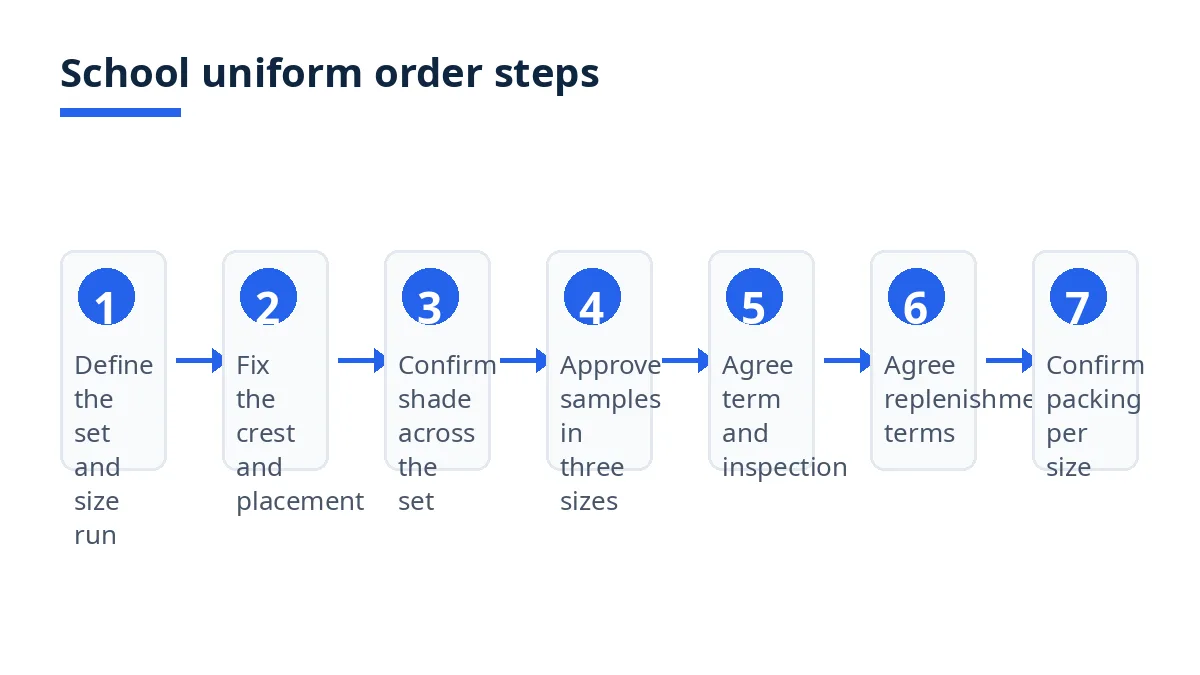
Define the set and the size run. List every piece in the set, the fabric and colour for each piece, and the quantity per size per piece. State which sizes belong to which year groups so the supplier can see where the volume sits.
Fix the crest before anything else. Send the crest artwork, its size, its colours and its placement on each piece, and agree whether it is embroidered, printed or supplied as a woven badge. Crest work has its own set-up, and a change of placement after sampling restarts that work.
Confirm shade across the set. Ask for one shade standard for the school colour and require the shirt, trouser or skirt and any blazer to be matched against it. Pieces cut from different cloth lots can drift apart in shade, and the drift shows most when the pieces are worn together.
Approve samples across the size range. Order samples in the smallest, a middle and the largest size, in the actual school cloth and with the finished crest. Check the crest position on each size, because a placement that sits well on a large shirt can crowd a small one.
Agree the delivery term and the inspection plan in writing. State one Incoterm and named port for every quotation, and write the inspection arrangement into the purchase order, so quotes compare on the same basis.1
Agree replenishment terms before the main order ships. Ask for the price and minimum that will apply to a mid-term top-up, and how long the crest set-up and the shade standard will be kept for it. A top-up agreed after the main run has closed is a new small order, priced as one.
Confirm packing per school and per size. State whether sets are packed as complete sets or as separate pieces, how sizes are assorted in each carton, and what the carton label must show.
Costs, timelines and documents
What are the typical costs and timelines?
There are no typical costs or timelines a guide can state as fact, because each school set prices its own cloth, crest, size run and delivery term. The lines below are the ones to ask for separately, so a low total cannot hide a missing line.
FOB line | What moves it on a school order |
|---|---|
School cloth | Fibre blend, weight, and whether the school colour is stocked or dyed to order |
Cutting | Consumption per piece and the spread of pieces across many small sizes |
Sewing | Pieces in the set, and reinforcement at knees, pockets and seams that take daily wear |
Crest work | Embroidery, print or badge method, stitch count or print colours, and set-up per placement |
Trims and labels | Buttons, zips, ties, care labels and size labels per piece |
Finishing and packing | Pressing, folding, polybags, set packing and carton assortment by size |
Delivery to the vessel | Inland transport, export handling and loading under the agreed term1 |
Example figures: a shirt-and-trouser set is split for illustration as 45 percent cloth, 25 percent sewing and cutting, 12 percent crest work, 8 percent trims and labels, 5 percent finishing and packing and 5 percent delivery to the vessel. The split is labelled Example figures and shows only how a quotation adds up; it is not a typical price, and a set with a blazer or a woven badge will weight the lines differently. A second illustration shows the replenishment effect: Example figures put a mid-term top-up of 100 sets at a unit price 20 percent above the main-order unit price, because the same crest set-up and shade work is spread over fewer sets. Again, the numbers show arithmetic only.
Timelines follow the same logic. Sampling depends on cloth availability, crest approval rounds and corrections across sizes. Bulk production depends on dyeing the school colour, crest production, and line capacity across several small sizes at once. Ask for sampling, cloth ready, crest ready, production and inspection dates as separate lines, and work backwards from the term start date with room for one correction round.
Which documents are needed?
The order documents are the set specification, the crest artwork approval, the itemized quotation and the purchase order, with the quantity per size per piece and the replenishment terms written on both the quotation and the order. For export clearance, see the Bangladesh Customs export clearance procedures page for the Bill of Export and its enclosed documents.2
Bangladesh-specific rules and tips
Start from the woven base. The Bangladesh Garment Manufacturers and Exporters Association (BGMEA), which began its journey in 1983, represents the readymade garment industry, and around 60 percent of its member factories are woven garment manufacturers.3 Most school sets are woven garments, so that base is the natural place to look, but membership alone says nothing about a factory's capacity for your set or your sizes. If a supplier claims membership, check the claim with the association itself.
Classify the set piece by piece. A school set has no single classification line, because each garment is classified by its own type. Heading 6203 covers men's or boys' suits, ensembles, jackets, blazers, trousers and shorts, and heading 6204 covers the women's or girls' equivalents including skirts and trousers.4 Within heading 6203, subheading 620343 covers men's or boys' trousers, bib and brace overalls, breeches and shorts of synthetic fibres.5 Boys' shirts fall under heading 6205 and girls' blouses and shirt-blouses under heading 6206, each split by fibre.4 Confirm the line for each piece with your customs broker, since duty follows the piece, not the set.
Keep the school name and crest identical everywhere. The spelling of the school name on the crest approval, the care label, the carton label and the invoice should match exactly. A crest approved with one spelling and invoiced with another creates a mismatch that is easy to prevent and awkward to explain at delivery.
Ask which inputs are bought in for your set. Crest thread, woven badges, buttons and ties may be bought in for your school colour and design, and a bought-in input can set both the minimum and the earliest production date. Agree the size ratio per piece before production.
Match fibre labelling to your market. For the European Union, Regulation (EU) No 1007/2011 requires a textile product to be labelled or marked with the name and percentage by weight of all constituent fibres in descending order.6 The fibre blend on the label must match the cloth actually cut, including any blend change made to meet a school colour or a wash requirement.
Mistakes and red flags
What are the most common mistakes?
Comparing a set price with a single-garment price. The cheapest reply is often the narrowest one: a shirt alone, a set without the crest, or a set without the tie. Restate every reply as a price for the same set, with the crest included, before ranking it.
Approving the crest on screen only. A crest that looks clean on a screen can sit badly on a small size, pucker on a light cloth or lose a fine line in embroidery. Approve it stitched or printed on the actual cloth, in the smallest size as well as a middle size.
Ordering sizes from an adult curve. An adult size curve puts volume in the middle and upper sizes. A school order puts volume across year groups, with many small sizes. A curve copied from another product will leave the smallest sizes short and the largest sizes overstocked.
Leaving replenishment unpriced. A main order priced without a top-up price leaves the buyer exposed mid-term, when new pupils arrive and a small run is needed urgently. Price the top-up, its minimum and its lead time before the main order is confirmed.
A profile starts enquiries; it settles nothing. Exportain verification is a document and photo review, never a factory inspection, and no badge speaks for capacity, quality or delivery.
Accepting a shade approval for one piece only. Shade must be approved across the set worn together, not on the shirt alone. A trouser dyed in a separate lot can pass on its own and fail next to the shirt.
Checklist
Before you confirm, every line should be answered in writing.
Set defined piece by piece, with the crest, tie and any outer piece marked as included or excluded.
Quantity stated per size per piece, with year groups shown against the sizes.
Crest method, size, colours and placement agreed per piece, with set-up priced apart from the unit price.
One shade standard agreed for the school colour, matched across every piece in the set.
Samples approved in the smallest, a middle and the largest size, on the actual cloth with the finished crest.
Replenishment price, minimum and lead time agreed, with crest set-up and shade retention stated.
Packing agreed: sets or separate pieces, size assortment per carton, and carton label content.
Quotations compared on the same set, same size run and same Incoterm and port.1
Inspection arrangement and delivery dates written into the purchase order as separate lines.
How Exportain helps
On Exportain, browse suppliers and post the set specification, the size run per piece and the delivery term on the RFQ board, so suppliers quote against the same set rather than against a single garment. Ask each reply for the crest set-up apart from the unit price and for the replenishment price that will apply mid-term. Read how supplier verification works on Exportain for what each check records, and the MOQ guide for how a minimum is usually structured per style and colour. When you accept a quotation, Exportain creates one order and issues one proforma invoice from the accepted terms.7
FAQs
What should I know first about school uniforms?
Fix the unit first: price the set as you will sell or issue it, with the crest included, and state the quantity per size per piece. A school order spreads across many small sizes for several year groups, so the size run and the crest work shape the price as much as the cloth does.
What are the typical costs and timelines?
There are no typical figures a buyer can rely on, because each school set prices its own cloth, crest, size run and delivery term. The FOB lines are cloth, cutting, sewing, crest work, trims and labels, finishing and packing, and delivery to the vessel under the agreed term,1 and timelines run from cloth and crest readiness through production and inspection to the term start date.
Which documents are needed?
The order documents are the set specification, the crest artwork approval, the itemized quotation and the purchase order, with the quantity per size per piece and the replenishment terms on both the quotation and the order. For export clearance, see the Bangladesh Customs export clearance procedures page for the Bill of Export and its enclosed documents.2
What are the most common mistakes?
The most common mistakes are comparing a set price with a single-garment price, approving the crest on screen only, ordering sizes from an adult curve, leaving replenishment unpriced, and reading a badge as a guarantee. Verification is a document and photo review, not a factory inspection.7 8
Next steps on Exportain
Browse suppliers, then post your set specification and size run on the RFQ board so suppliers price the same set with the crest included. Before you confirm, read how to import school uniforms from Bangladesh and the MOQ guide.
Sources
- Incoterms® 2020. International Chamber of Commerce (ICC) (accessed )
- Customs Clearance Procedures for Export. Bangladesh Customs, National Board of Revenue (accessed )
- Bangladesh Garment Manufacturers and Exporters Association (BGMEA). Devex (accessed )
- HS Nomenclature 2017, Chapter 62: Articles of Apparel and Clothing Accessories, Not Knitted or Crocheted. World Customs Organization (WCO) (accessed )
- Classification Detail — HS Code 620343. United Nations Statistics Division (accessed )
- Regulation (EU) No 1007/2011 on textile fibre names and related labelling and marking of the fibre composition of textile products. European Union, (accessed )
- Trust & Safety Center. Exportain (accessed )
- Supplier verification: Earn trust badges buyers can see. Exportain (accessed )
About the author
Sourcing from Bangladesh?
Post a request for quotation and suppliers on Exportain can send you their quotes directly.
Post an RFQ