School Uniforms Exporters in Bangladesh: Verified Supplier Checklist
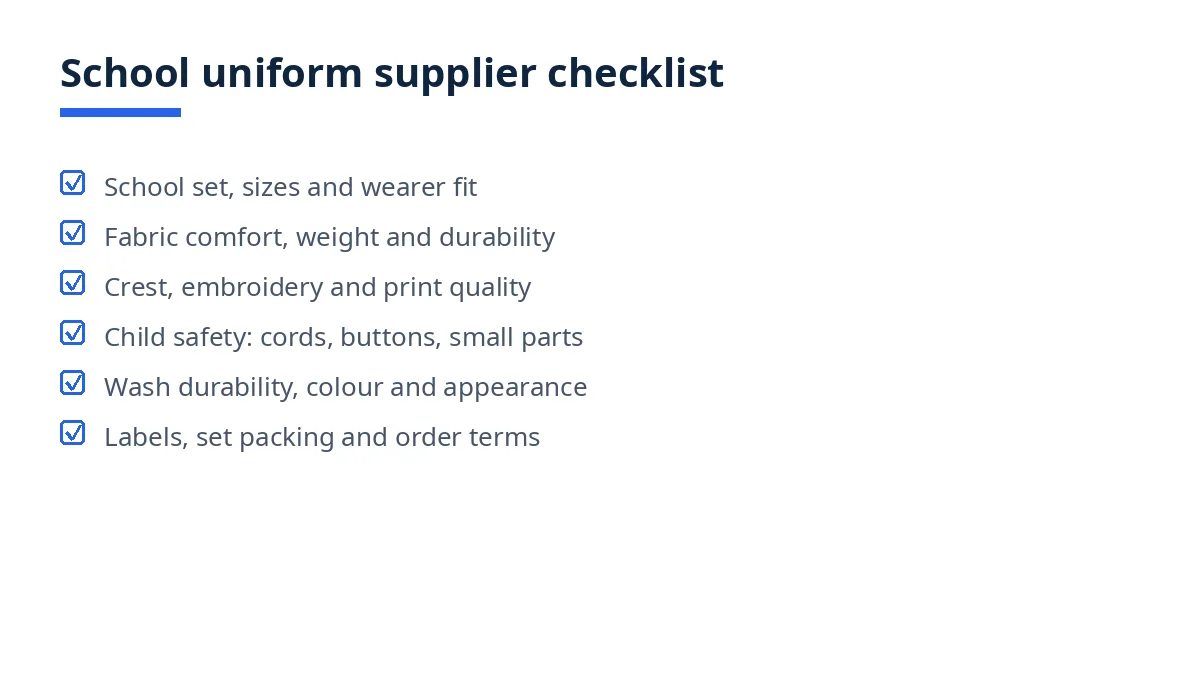
A school-uniform supplier checklist for Bangladesh orders: size range and fit, fabric comfort and durability, crest and embroidery quality, child safety on cords and buttons, wash and colour durability, labels and set packing.
Short answer
Use this checklist to verify a school uniforms exporter in Bangladesh: confirm the full school set and size range, test fabric comfort and durability, check crest and embroidery quality, test cords, buttons and small parts for child safety, review wash and colour evidence, and confirm labels, set packing and order terms before bulk production.
On this page
Key takeaways
Agree the full school set, size chart, crest artwork and acceptance numbers before bulk cutting, and draw the sample randomly across sizes, colours and cartons.
Test fabric comfort, crest quality and child safety on the school set itself, not on a single adult garment, because fit, wear and washing differ across ages.
Check wash durability, colour fastness and size after washing against the agreed methods, and record every result against the approved sample.
Confirm labels, set packing and the delivery split by size and school before cartons are sealed, so a shortfall is visible early.
A school uniform order is judged where pupils wear it: in classrooms, on playgrounds and in repeated home washing. A shirt that pulls out of shape, a crest that frays, or a trouser leg that fades unevenly will reach the school quickly. This checklist tests a Bangladeshi supplier against the school set itself, before ordering. Use an agreed sampling plan for final checks rather than pieces chosen by the factory. ISO 2859-1 specifies an acceptance sampling system for inspection by attributes, indexed in terms of the acceptance quality limit (AQL).1
Why this checklist matters
School uniforms are bought as a matched set for many sizes at once, and worn daily by children of different ages. That makes three checks more important than for a single adult garment: whether every size fits, whether the cloth stays comfortable through a school day, and whether badges and colours survive frequent washing. Work through the checklist in order, record each item as pass, fail or not applicable, and keep the approved sample beside bulk pieces.
Before you start
Do not start until the school pack is complete: the approved sample for each garment, a size chart covering the full age and height range, crest artwork and placement drawing, fibre and care label wording for each market, and the packing plan. Agree the sampling plan, test methods and acceptance numbers in the purchase order before bulk cutting begins.1 Ask the supplier to confirm, in writing, which parts are subcontracted, including embroidery, printing and dyeing.
The full checklist
A. School set, sizes and wearer fit
Confirm every garment in the set is sampled, in matching cloth and colour, including any sweater, blazer, tie or sports kit.
Measure each size against the chart, laid flat and without stretching, and check the grade between sizes for sudden jumps.
Try sampled garments on the body form size named in the pack, checking shoulder, chest, waist, sleeve and trouser length together.
Check school-requested adjustments, such as an adjustable waist or let-down hem, and confirm they work without distorting the garment.
Check closures in use: buttons close without strain, zips run without catching cloth, and elastic waistbands hold position when pulled.
Check that the same size reads the same across colours and cartons, so a class set does not arrive in visibly different fits.
B. Fabric comfort, weight and durability evidence
Handle bulk cloth against the approved sample, and record any piece that feels thinner, rougher or stiffer than the sample.
Check cloth weight and weave named in the pack against the sample, and record any bulk substitution as a failure.
Check seams at pupil stress points: underarm, crotch, pocket corners and waistband joins, pulling each by hand for skipped or broken stitches.
Check pocket bags, linings and facings for correct cloth, secure stitching and no raw edges that will fray inside the garment.
Check trouser knees and seat, skirt pleats and shirt elbows for thinning, shine or weak stitching on sampled pieces.
Where fabric strength or abrasion evidence is required, confirm the method and limit were agreed in advance and the report names bulk cloth and colour.
C. Crest, embroidery and print quality
Compare each crest against approved artwork for shape, colour, lettering and position, measured from the fixed points in the drawing.
Check embroidery for even density, no gaps in fill, no loose threads on face or back, and edges that do not lift when handled.
Check printed crests for sharp edges, complete letters and no cracking when the cloth is flexed gently by hand.
Check that crests sit straight on every size, including the smallest, where a crest for a large shirt can crowd the chest.
Check thread and print colours under the same light as the approved sample, and that the same crest matches across the set and cartons.
Wash a sampled crest piece where the pack requires it, checking for fraying, lifting, fading or distortion before bulk is approved.
D. Child safety: cords, buttons and small parts
Check every cord, drawstring and loop against the destination market rules, and redesign any cord the rules do not allow for the age group.
Under EN 14682, check decorative cords and fixed loops in the head, neck and upper chest area against the 7.5 cm limit in the relevant clauses.2
Under the same standard for older children, check drawstrings with no free ends for a protruding loop when laid flat and at intended fit size, where the maximum is 15 cm.2
Pull buttons, studs, badges and other attached parts by hand on sampled pieces, recording any part that loosens, cracks or leaves a sharp edge.
Check that no small part, broken button or loose bead is left inside pockets, linings or packaging.
Check that ties, sashes and belts fasten as designed and cannot form a loop that hangs where it could catch on playground equipment.
E. Wash durability, colour and finished appearance
Review dimensional change evidence where required. ISO 5077 gives the method for measuring dimensional change of fabrics, garments or other textile articles under specified washing and drying procedures.3
Measure sampled garments again after the agreed wash, checking length, width, sleeve and trouser length, and pleat or cuff shape against tolerance.
Review washing fastness evidence where required. ISO 105-C06 specifies methods for determining the resistance of textile colour to domestic or commercial laundering using a reference detergent.4
Review rubbing fastness evidence for dark colours and printed areas. ISO 105-X12 specifies a method for determining the resistance of textile colour to rubbing off and staining other materials, with one dry and one wet test.5
Check shade within each garment, between garments in a set and across cartons under the same light, against the approved lab dip.
Check pressing and presentation: no shine marks, unwanted creases, loose threads or stains, and pleats falling where the sample shows them.
F. Maker identity, papers and capacity
Ask for supplier legal name, factory address and buyer-required documents, and check names match across order, invoice and packing list.
Check claimed memberships or audit reports by reading the scope and date on each document, rather than accepting a claim at face value.
Ask for recent references for school uniform orders, and contact at least one about fit consistency and repeat colour matching.
Check cutting, sewing, embroidery and finishing capacity against order quantity, school delivery date and peak sizes.
Confirm who signs off the pre-production sample, bulk cloth and final inspection, and what happens if any stage fails.
Record the agreed delivery split by size and school, so a shortfall in small sizes is visible before cartons are sealed.
G. Labels, set packing and order terms
Check fibre labels against destination market rules. Under Regulation (EU) No 1007/2011, a textile product shall be labelled with the name and percentage by weight of all constituent fibres in descending order.6
Check care symbols against the care standard. ISO 3758 establishes a system of graphic symbols for care labelling, based on the most severe treatments that do not cause irreversible damage during care.7
Check size, school name and garment labels for correct wording, legible print and secure attachment on every size.
Check set packing: each set holds the garments and sizes the plan names, sets are grouped as the school asked, and carton marks match the packing list.
Weigh and measure sample cartons, and check carton count and contents against the packing list before shipment.
Confirm shipment documents with your freight provider before the order ships.
Write acceptance numbers, test methods, crest placement, size chart and delivery split into the purchase order, so the checklist can be repeated on a repeat order.
Common failures and how to fix them
The most common failure is size drift: middle sizes fit and the smallest or largest do not. Stop and re-measure the full size curve before more cloth is cut. A crest that sits crooked on some sizes needs placement re-checked from fixed points on every size before embroidery continues. Colour drift between cartons usually points to more than one dye lot packed together: re-sort complete sets by lot. A uniform that shrinks out of tolerance usually traces to cloth not tested to the agreed wash method: wash a test piece to that method before bulk is cut. Above the agreed acceptance level, options are re-inspection after sorting or rework, documented partial acceptance, or rejection.
Summary table
Score from the sheet, not from memory: before any garment is examined, the inspection sheet carries the size chart, the tolerances and the acceptance numbers, and every school check — fabric, crest, size, wash — leaves a written result.
Section | Checks | Evidence |
|---|---|---|
Set and fit | Full set, size curve, closures | Measurements |
Fabric | Hand, weight, seams, stress points | Sample comparison |
Crest and print | Artwork, placement, wash | Washed sample |
Child safety | Cords, buttons, small parts | Cord measurements |
Wash and colour | Size after wash, shade, fastness | Wash reports |
Maker and capacity | Papers, references, delivery split | Documents |
Labels and packing | Fibre, care, sets, cartons | Packing list |
How Exportain helps
Agree the school set, size chart and crest details while you are still at enquiry stage on Exportain: browse suppliers, read how supplier verification works, and check the MOQ guide before agreeing order quantities. Supplier profiles show which document and photo checks have been recorded. Exportain is not a party to the goods contract and does not inspect goods.
FAQs
When should this checklist be used?
Use it before bulk production, when corrections are still possible, and again at final inspection.
Who should complete it?
The runner is whoever you appoint — buyer, school procurement officer, local agent, or third-party inspector. What cannot vary is the input set: a sample drawn at random, the approved sample, and the size chart.
What are the most common failures?
Size drift at the ends of the range, crooked or fraying crests, colour drift between cartons, shrinkage after washing, and loose buttons or unsafe cords are the failures buyers find most often.
Can a third party do it?
Yes — send the inspector the school pack ahead of the inspection: approved sample, size chart, crest artwork, tolerances and acceptance levels, plus the term quantity so it can plan the sample draw — and let it draw its own sample.
Next steps on Exportain
Agree your school set, size chart, crest artwork and acceptance numbers with a supplier, then read the school uniforms quality control checklist for the inspection stage, and post a free RFQ via RFQs to compare quotes from Bangladeshi suppliers.
Sources
- ISO 2859-1:1999 - Sampling procedures for inspection by attributes — Part 1: Sampling schemes indexed by acceptance quality limit (AQL) for lot-by-lot inspection. International Organization for Standardization (accessed )
- EN 14682:2014 - Safety of children's clothing - Cords and drawstrings on children's clothing - Specifications. European Committee for Standardization (accessed )
- ISO 5077:2007 - Textiles — Determination of dimensional change in washing and drying. International Organization for Standardization (accessed )
- ISO 105-C06:2010 - Textiles - Tests for colour fastness - Part C06: Colour fastness to domestic and commercial laundering. International Organization for Standardization (accessed )
- ISO 105-X12:2016 - Textiles — Tests for colour fastness — Part X12: Colour fastness to rubbing. International Organization for Standardization (accessed )
- Regulation (EU) No 1007/2011 on textile fibre names and related labelling and marking of the fibre composition of textile products. European Union, (accessed )
- ISO 3758:2023 - Textiles — Care labelling code using symbols. International Organization for Standardization (accessed )
About the author
Sourcing from Bangladesh?
Post a request for quotation and suppliers on Exportain can send you their quotes directly.
Post an RFQ