

How to Find SA8000 Certified Factories in Bangladesh
How to find SA8000 certified factories in Bangladesh: check the SAAS-accredited certificate, match site and scope, review surveillance, and handle the SA8000:2026 transition before ordering.
Short answer
SA8000 certifies a facility's social accountability management system, not a product or shipment. Find a certified factory by asking for the certificate, confirming the certification body is SAAS-accredited, checking the certificate in the SAAS database, matching site and scope to your order, and reviewing the latest surveillance audit. Note the edition, SA8000:2014 or SA8000:2026, and the 2026 transition deadlines before ordering.
On this page
Key takeaways
SA8000 certifies a facility's social accountability management system, not a product, a shipment, or a single order. Keep social accountability evidence and product quality evidence on separate tracks.
Verify the chain in order: SAI owns the standard, SAAS accredits the certification body, and that body certifies the facility. Check the certificate in the SAAS database and match facility, site, scope, and status to your order.
A certificate is valid for three years with surveillance audits, and TÜV SÜD describes announced audits at six-month intervals to maintain validity. From January 1, 2027, all new certifications and recertifications must be to SA8000:2026.
In Bangladesh, cross-check the certificate against the Bangladesh Labour Act, 2006: 8 hours a day and 48 hours a week as the standard frame, with overtime at twice the basic wage plus dearness allowance.
SA8000 is a certifiable social accountability management-system standard, not a product mark. It certifies that a facility runs a management system for decent work, audited by an accredited certification body. It does not certify a shirt, a fabric, a shipment, or a single order. A buyer who checks the certificate, the site, the scope, and the surveillance record will get the assurance the programme is actually designed to give.
The standard was established by Social Accountability International (SAI) in 1997, and the current version is SA8000:2026.1 It reflects labour provisions in the Universal Declaration of Human Rights and ILO conventions, and it supports national labour laws.1 The 2026 edition has two interdependent sections: management systems covering due diligence and governance, and decent work principles with performance criteria.2 SAI lists the 2026 decent work principles as protection of children and young workers, freedom of association and the right to collective bargaining, free and fair recruitment, employment and termination, decent hours, wages and benefits, freedom from discrimination, health and safety, and privacy.1
Older certificates use a different layout for the same subject: nine elements covering child labour, forced or compulsory labour, health and safety, freedom of association and right to collective bargaining, discrimination, disciplinary practices, working hours, remuneration, and a management system.3 That list is based on the UN Declaration of Human Rights, ILO conventions, UN and national law.4 Note which edition a certificate names first, because the edition decides which checklist the auditor used.
Certification is issued only after audit by a certification body accredited by Social Accountability Accreditation Services (SAAS). DNV notes that SAAS has accredited a small number of certification bodies to audit and issue accredited SA8000 certificates.2 A certificate is valid for three years, with surveillance audits during that period.3 TÜV SÜD describes the maintenance rule more precisely: announced audits at six-month intervals with a positive result are needed to maintain validity.5 Individual certificates can be checked in the SAAS certificate database.5 That chain, SAI owns the standard, SAAS accredits the auditor, and the auditor certifies the facility, is what separates SA8000 from a self-declared code of conduct.
Why this matters for buyers and sellers
For a buyer, SA8000 answers a narrow question with independent evidence: does this facility operate a managed system for worker rights, rather than simply promising good practice in a sales meeting. Intertek describes SA8000 certification as independent, third-party verification that an organisation has implemented and maintains a social accountability management system in line with the standard.3 For brands and retailers, that verification can reduce repeated social compliance audits.3 It does not replace product quality control, delivery management, or pre-shipment inspection. TÜV SÜD states the limit plainly: SA8000 certification does not constitute product certification, provides no direct statement on product quality, and does not guarantee that an organisation complies in each individual case.5
For a seller, the value is access and discipline. A facility that already runs documented policies, worker involvement, and grievance channels has less to rebuild when a buyer asks for evidence. The 2026 management-system section expects leadership commitment, worker involvement, stakeholder involvement, policy coherence, risk assessment, planning and resources, implementation, integrity and transparency, monitoring and grievance mechanisms, and review with continual improvement.1 Auditors test implementation through document review, on-site interviews, factory inspections, and records such as training certificates, working-time records, health and safety records, and complaint handling.5 Paper that contradicts what workers say on site is a finding, not a pass.
SA8000 also reaches beyond the certified site. The 2026 edition extends responsibility, proportionate to risk, across the value chain.2 Ask how a factory manages its own suppliers and subcontractors, not only its own floor. A certificate covering one site does not automatically cover a subcontractor used for peak-season overflow.
Step-by-step: how it works
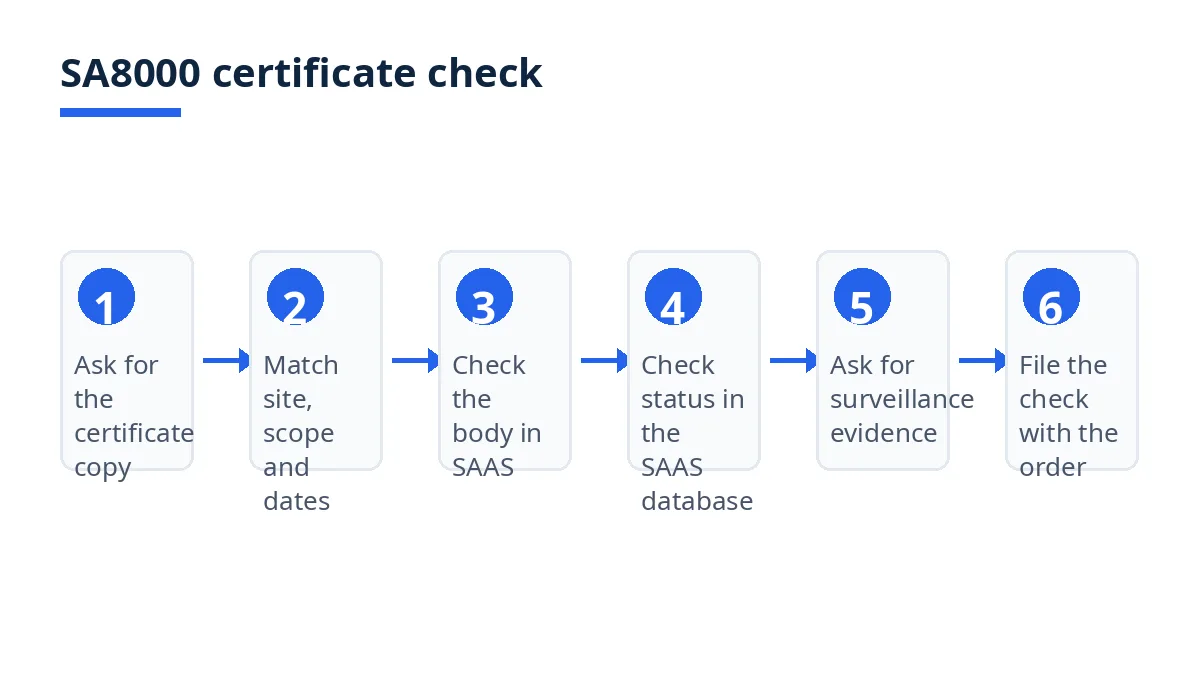
Finding a genuinely SA8000 certified factory in Bangladesh is a verification job. Work through these steps in order, and keep a copy of each check in the order file.
First, ask the factory for the certificate itself, not a logo, a brochure claim, or a screenshot. Record the facility name exactly as printed, the full site address, the standard edition named, the certification body, the certificate number, the issue date, and the expiry date. A certificate naming a head office, a trading company, or a different plant is not evidence for the plant that will make your order.
Second, check the certification body. Confirm that the body named on the certificate is currently SAAS-accredited for SA8000. DNV notes that SAAS-accredited bodies are the ones authorised to audit and issue accredited certificates.2 If the body cannot be found on the SAAS list, treat the document as unverified.
Third, check the certificate in the SAAS certificate database. TÜV SÜD points interested parties to that database to check the validity of individual certificates.5 Confirm that the facility name and site match the factory you are buying from, and that the certificate is current, not suspended or withdrawn.
Fourth, read the scope and the edition together. Scope tells you which activities and which site the certificate covers. Edition tells you which requirements were audited: the nine-element layout of the earlier edition, or the management-system and decent work structure of SA8000:2026.1 3 A process or site outside the stated scope is not covered, even if the company name matches.
Fifth, ask for surveillance evidence. A three-year certificate is maintained through surveillance audits, not granted once and left alone.3 Ask for the date and outcome of the most recent surveillance audit, and whether any nonconformities remain open. TÜV SÜD notes that a certificate is issued only when the assessment reveals no major nonconformities.5
Sixth, test the system with questions only a working system can answer. Ask who the worker representatives are, how grievances are raised without retaliation, how working hours and overtime are recorded, and what happened after the last internal audit found a problem. The standard expects worker involvement, grievance mechanisms, and corrective action as part of the management system.1 5
Seventh, handle the 2026 transition explicitly. SAI published the final SA8000:2026 standard on January 1, 2026, and from January 1, 2027, all new certifications and recertifications must be to SA8000:2026, with all organisations certified to the 2026 edition by May 31, 2029 to stay in the system.6 During 2026, 2026-edition audits became available on a staggered basis as certification bodies gained SAAS approval.6 Ask which edition the next recertification will use.
Costs, timelines and documents
No single SA8000 fee or timeline applies to every factory, and this guide states none as a programme fact. None of the opened sources used here publishes a Bangladesh fee schedule. What a buyer can do is compare quotations on the same basis and ask the certification body to price each driver separately.
Ask the body to price the certification scope, the number of sites, the size of the workforce, the audit days needed, travel and interpreter time, gap analysis and readiness work, corrective-action verification, and the surveillance cycle across the three-year validity period.3 Intertek lists gap analysis, corrective-action planning, and surveillance among its SA8000 services, which shows where time and cost accumulate outside the audit days themselves.3 DNV likewise describes a journey from obtaining the standard, through building documentation and implementing the system, to selecting a certification body and considering a pre-audit gap analysis.2
Timelines follow the same logic. The fixed points in the opened sources are the three-year certificate validity period with surveillance audits during it,3 the six-month announced-audit interval described by TÜV SÜD,5 and the 2026 transition deadlines set by SAI.6 Everything else depends on how far the facility is from the standard at the start. Ask the certification body for a dated plan, and ask the factory for its last internal audit date.
The documents a buyer should request are short and specific: the certificate copy, the SAAS database result, the scope statement, the most recent surveillance audit date and outcome, and a one-page summary of open corrective actions with closure dates. Ask the factory, separately, for working-time and payroll records for a sample period, health and safety training records, and grievance log entries with outcomes. Auditors review the same kinds of records during on-site checks.5
For a seller starting from scratch, build the management system before inviting a certification body, and run at least one full internal audit cycle first.1
Bangladesh-specific rules and tips
SA8000 sits on top of Bangladesh law, it does not replace it. SAI states that the standard respects, complements, and supports national labour laws.1 Test the certificate against the Bangladesh Labour Act, 2006, as amended, alongside the standard itself.
The Act sets the working-time frame a buyer is most likely to test. Daily hours are capped at 8 hours, extendable to 10 with overtime, weekly hours at 48, extendable to 60 with overtime, with a weekly holiday of 1 day for factories, and overtime paid at twice the basic wage plus dearness allowance.7
Three practical tips follow. First, ask for attendance, overtime, and wage records for the same sample weeks, and check that the three records agree. SA8000 auditors cross-check working-time records against other evidence on site.5 Second, ask how the factory handles leave and maternity benefit under the Act, and whether those entitlements appear in appointment letters and payroll.7 Third, treat building and fire safety as a separate check, with its own evidence, rather than assuming the SA8000 certificate covers it.
Worker interviews are central to SA8000 audits, because auditors verify documented practice against what workers describe on site.5 Arrange time to speak with workers through an interpreter the buyer trusts, not only through management.
Finally, a certificate for a sister plant is not a certificate for your plant. Match the legal entity name, site address, and scope to the entity named on the proforma invoice.
Mistakes and red flags
The most common buyer mistake is reading SA8000 as a product or shipment guarantee. TÜV SÜD is explicit that certification is not product certification and gives no direct statement on product quality.5 A certified factory can still ship late or fail a product inspection. Keep social and product checks on separate tracks.
The second mistake is accepting a logo or a claim in place of a certificate. A logo on a website or a line in a company profile is not a certificate. Ask for the certificate copy and the SAAS database result every time. Certificates expire, get suspended, and change scope at recertification.
The third mistake is checking the company instead of the site. A certificate for one plant and one scope does not cover a second plant, a subcontractor, or a new process added after the audit.
The fourth mistake is ignoring the surveillance record. Ask for the latest surveillance date and outcome, and treat an evasive answer as information. TÜV SÜD notes that certificates are issued only where no major nonconformities remain.5
The fifth mistake is treating SA8000 as interchangeable with other social programmes. A BSCI result, a SEDEX SMETA report, and a WRAP certificate are different deliverables from an SA8000 certificate, which is built around SAAS-accredited certification with a three-year term and surveillance.3
Red flags include a certificate copy omitting the body, edition, or expiry date; a body that is not SAAS-accredited; a database result that does not match the paper copy; a scope excluding your process; a factory that cannot describe its grievance process; and payroll records that disagree for the same period.
Checklist
Use this checklist before confirming an order with a factory presented as SA8000 certified.
Certificate copy received, with facility name, site address, edition, certification body, certificate number, issue date, and expiry date all legible.
Certification body confirmed as currently SAAS-accredited for SA8000.2
Certificate checked in the SAAS database, with facility, site, scope, and status matching the paper copy.5
Scope covers the product process and the production site for this order, not only a head office or a sister plant.
Edition noted: nine-element layout for earlier certificates, or management-system and decent work structure for SA8000:2026.1 3
Most recent surveillance audit date and outcome obtained, with open nonconformities and closure dates listed.3 5
2026 transition position confirmed: which edition the next recertification will use, and the applicable SAI deadline.6
Working-time, overtime, and wage records cross-checked for a sample period against the Bangladesh Labour Act, 2006 frame.7
Worker involvement and grievance process described by the factory and understood by workers on site.1
Product quality, delivery, and inspection terms agreed separately, since SA8000 gives no product quality statement.5
How Exportain helps
Exportain can help a buyer organise the checks in this guide without replacing them. A buyer can use the platform to request documents from a seller and keep the certificate copy, database result, and surveillance record in one order file.
Exportain's own supplier checks are a separate layer from SA8000 and should not be confused with it. The platform's trust centre describes supplier verification as a document review by its team, not a factory inspection and not a check against a government database.8 A platform badge and an SA8000 certificate answer different questions. For a seller, present the certificate, scope, and surveillance record clearly, with the edition and next recertification date.
FAQs
What should I know first about SA8000?
SA8000 certifies a facility's social accountability management system, not a product or a shipment. It was established by Social Accountability International in 1997, and the current version is SA8000:2026.1 Certification is issued by a SAAS-accredited body after audit, is valid for three years with surveillance,3 and can be checked in the SAAS database.5
What are the typical costs and timelines?
There is no single published fee or timeline in the opened sources for this guide. Costs move with scope, site count, workforce size, audit days, travel, and gap work, and the fixed points are the three-year validity period with surveillance,3 the six-month announced-audit interval described by TÜV SÜD,5 and the SAI 2026 transition deadlines.6
Which documents are needed?
A buyer needs the certificate copy, the SAAS database result, the scope statement, the most recent surveillance date and outcome, and open corrective actions with closure dates. A seller needs the system behind those items: policies, risk assessments, grievance processes, training records, and internal audit records.1 Auditors check those records on site.5
What are the most common mistakes?
The most common mistakes are treating the certificate as a product guarantee, accepting a logo instead of a certificate, checking the company instead of the site, ignoring the surveillance record, and treating other programmes as interchangeable with SA8000. TÜV SÜD states that certification is not product certification,5 and Intertek describes it as third-party verification of a management system.3
Next steps on Exportain
Start with seller verification to see how Exportain reviews supplier documents, then read the trust centre for what those checks do and do not cover. For certification providers, see certification services — No services published in this category yet.
Sources
- SA8000:2026 Standard. Social Accountability International (accessed )
- SA8000 Certification: Social Accountability Standard. DNV (accessed )
- SA8000 Certification: Ensuring Responsible Workplace Practices. Intertek (accessed )
- Social Accountability International SA8000 Standard. Seafish (accessed )
- SA8000® Certification Mark. TÜV SÜD (accessed )
- SA8000 Certification Program Timeline. Social Accountability International (accessed )
- Bangladesh Labour Law 2006: HR and Payroll Compliance Guide (2026). AIHR BD (accessed )
- Trust & Safety Center. Exportain (accessed )
About the author
Sourcing from Bangladesh?
Post a request for quotation and suppliers on Exportain can send you their quotes directly.
Post an RFQ


