How to Find RoHS Certified Factories in Bangladesh
How to check RoHS for products from Bangladesh: ten restricted substances, homogeneous-material limits, exemptions, and the manufacturer declaration evidence chain.
Short answer
RoHS is not a factory certification and not a product quality mark. It is an EU directive restricting hazardous substances in electrical and electronic equipment, with compliance declared by the manufacturer for a product through the CE-marking assessment. Buyers should check the declaration, material results, and product model, not a factory claim.

On this page
Key takeaways
RoHS is not a factory certification and not a product quality mark; it is an EU directive restricting substances in electrical and electronic equipment, declared by the manufacturer for a product.
Limits apply per homogeneous material, not per finished product: ten substances at 0.1%, except cadmium at 0.01%, each by weight in homogeneous materials.
Exemptions in Annexes III and IV are application-specific and time-limited, so any claimed exemption needs its entry, exact application, and current validity.
The buyer check is the scope note, material list, per-material substance results, and manufacturer declaration for the exact model, with test reports read as supplier evidence, not factory certification.
RoHS is not a factory certification, not a product quality mark, and not a status any authority grants to a factory. It is an EU directive that restricts hazardous substances in electrical and electronic equipment, and compliance is declared by the manufacturer for a product. The phrase in the title, "RoHS Certified Factories", is common search phrasing, not a real status, and no factory should be described as RoHS certified. What a buyer can check is a named model, its materials, and the declaration and evidence for that model.
Directive 2011/65/EU, the RoHS Directive, sets the framework. Electrical and electronic equipment, or EEE, means equipment dependent on electric currents or electromagnetic fields to work properly, and equipment for generating, transferring, or measuring such currents, rated up to 1,000 volts alternating current and 1,500 volts direct current.1 The Directive applies to EEE in the categories in Annex I, from household appliances and IT equipment through lighting, tools, toys, medical devices, monitoring instruments, automatic dispensers, and other EEE.1 It does not apply to the equipment in Article 2(4), including security equipment, equipment sent into space, large-scale tools and fixed installations, most means of transport, professional non-road machinery, active implantable medical devices, qualifying solar panels, and business-to-business research equipment.1 Establish whether the product is EEE in scope, and whether any exclusion applies, before any substance question is asked.
The substance rule is measured at a level smaller than the finished product. A homogeneous material is one material of uniform composition throughout, or a combination of materials that cannot be disjointed or separated into different materials by mechanical actions such as unscrewing, cutting, crushing, grinding and abrasive processes.1 EEE placed on the market, including cables and spare parts, must not contain Annex II substances, and no more than the Annex II maximum concentration value by weight in homogeneous materials is tolerated.1 A compliant housing does not offset a solder joint over its limit, and a product total averaged across materials is not the test. Each homogeneous material must pass on its own.
The current list has ten substances. The European Commission states that the Directive currently restricts lead, cadmium, mercury, hexavalent chromium, polybrominated biphenyls (PBB) and polybrominated diphenyl ethers (PBDE), bis(2-ethylhexyl) phthalate (DEHP), butyl benzyl phthalate (BBP), dibutyl phthalate (DBP) and diisobutyl phthalate (DIBP), and that all products with an electrical and electronic component, unless specifically excluded, have to comply.2 Delegated Directive (EU) 2015/863 replaced Annex II with that list, setting 0.1% for the nine substances other than cadmium and 0.01% for cadmium, each by weight in homogeneous materials.3 The phthalate restriction applied from 22 July 2019, and for medical devices and monitoring and control instruments from 22 July 2021, with the cable and spare-part and toy carve-outs stated in that directive.3
For EEE, RoHS compliance is part of the CE-marking conformity assessment. Manufacturers must draw up the required technical documentation and carry out the internal production control procedure in line with Module A of Annex II to Decision No 768/2008/EC, and where compliance has been demonstrated, draw up an EU declaration of conformity and affix the CE marking on the finished product.1 The manufacturer keeps the technical documentation and the declaration for 10 years after the EEE has been placed on the market.1 There is no separate RoHS mark in this route, and Article 7 names no required third-party certifier for RoHS. A test report is supplier evidence supporting the declaration; it is not a certification of the factory, and it does not replace the declaration for the exact model. Importers must place only compliant EEE on the Union market, so the buyer side has its own duty to check.
Why this matters for buyers and sellers
For a buyer, the main risk is paying for a company claim that cannot be traced to a product. A letter stating that a company is RoHS certified proves nothing about a particular model, because the restriction applies to substances in homogeneous materials of a named product, not to a company. A second risk is material-level error: a supplier that reports a product average, or tests only the housing, has not answered the question the Directive asks. A third risk is an unexamined exemption: Article 4(1) does not apply to the applications in Annexes III and IV, whose validity periods are up to 5 years for categories 1 to 7, 10 and 11, and up to 7 years for categories 8 and 9, decided case by case and renewable.1 An exemption valid for one application, or now expired, does not cover a different application or a later placing on the market.
For a seller, the same discipline protects the order: a manufacturer that can list its materials, name any exemption with its scope and expiry, and produce the declaration for the exact model gives a buyer a claim that can be checked before shipment.
Step-by-step: how it works
Start with the product, not a company name. Write down the exact model, function, voltage rating, and EU market, and ask the supplier to confirm the Annex I category and state in writing whether any Article 2(4) exclusion applies.
Next, ask for the material breakdown: a list of homogeneous materials the supplier can defend, such as the conductor, each insulation and jacket layer, solder, connector plating, housing plastic, and any coating treated as a separate material. For each material, ask which substances were assessed and the result against the Annex II limit. A statement covering only the finished product, or only one material, is incomplete on its face.
If an exemption is claimed, ask for its Annex III or IV entry, exact application, and current validity; a claim without entry, scope, and date cannot be checked.
Then ask for the evidence chain. The manufacturer declaration for the exact model is the central document, supported by technical documentation and supplier declarations or test reports. Check that it identifies the model, covers RoHS alongside any other applicable legislation, and matches the order and shipment documents. Read a test report the same way: material tested, substances tested, result against the limit, and date, confirming the tested item is the item being shipped. A report for a different material, model, or earlier formulation is not evidence for this order.
Work through one case before agreeing terms. Take a USB-powered LED desk lamp. Its homogeneous materials include the solder on its circuit board, the copper conductor and plastic jacket of its cable, the plating on its connector contacts, and the plastic of its housing. Suppose the housing passes for all ten substances, but the solder is over the lead limit with no Annex III or IV exemption covering that application. The lamp fails, even though most of its mass is compliant, because the limit applies per homogeneous material, not per product.1 3 The correction is a material change or a valid exemption for that exact application, documented before shipment. A matching solder result, cable jacket results, and declaration for that lamp model would give the buyer a file that matches the order.
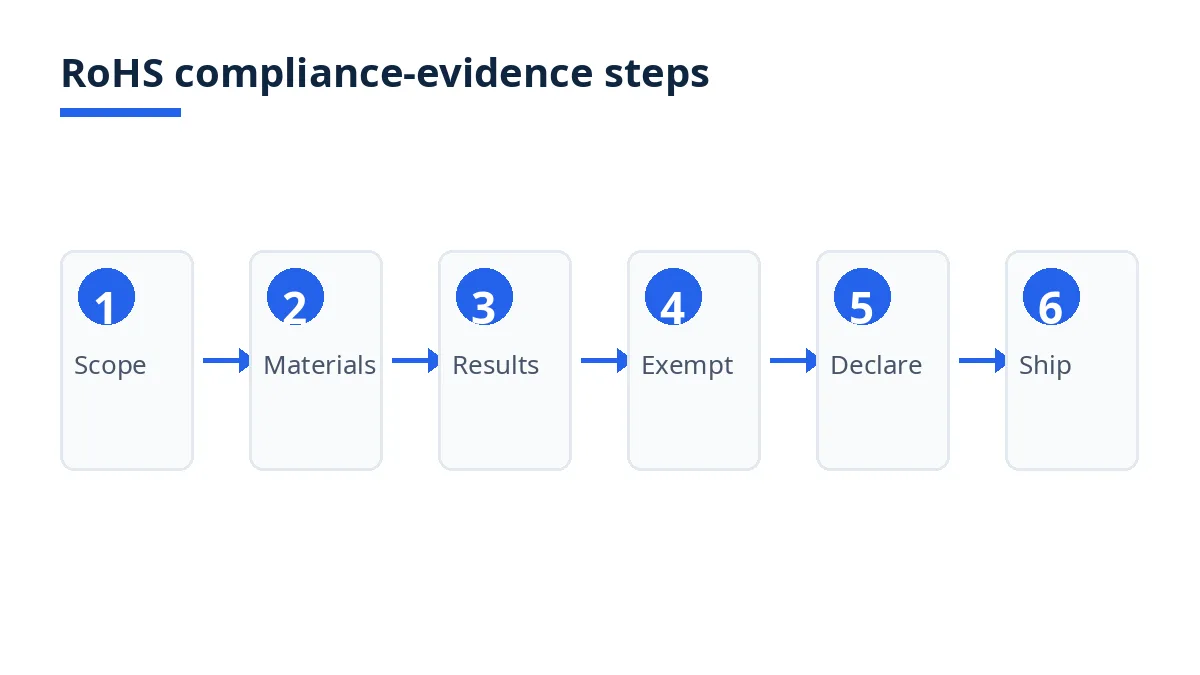
File the substance record per model: category and scope note, material list, substance results, any exemption entry with its expiry, declaration copy, and date checked. A new model, material, supplier, or Annex II or III text means a new check.
Costs, timelines and documents
There is no single public figure for RoHS compliance costs, so this guide gives cost drivers instead of numbers: the number of homogeneous materials to assess, whether supplier declarations suffice or lab testing is needed, substances tested per material, retesting after a material or supplier change, and compiling and maintaining the technical documentation. Ask for a written breakdown for the model.
Timelines follow the same logic: declaration completeness, testing-provider turnaround, repeat testing after a change, and time to draw up the declaration. A supplier should confirm in writing how long each step takes for the model. The 10-year period in Article 7 is a record-keeping duty after placing on the market, not a delivery timeline.1
Item | What to check | Why it matters |
|---|---|---|
Scope note | Annex I category, Article 2(4) position | Shows scope and exclusion position were checked |
Material list | Every homogeneous material, named separately | Limit applies per material, not per product |
Substance results | Ten substances, result against the Annex II limit, per material | An average hides a failing material |
Exemption record | Annex III or IV entry, exact application, current validity | Exemptions are specific and time-limited |
Manufacturer declaration | Exact model, RoHS covered, signer | Declaration for this model, not a company claim |
Test reports | Material tested, substances, result, date | Supplier evidence, not factory certification |
Shipment match | Declaration model matches shipped model | Another model proves nothing |
Bangladesh-specific rules and tips
There is no Bangladesh-specific RoHS rule, because RoHS is EU legislation that applies to the product placed on the EU market, not to the country of manufacture. Judge a Bangladeshi supplier on the same substance evidence as any supplier. Do not accept a claim that a Bangladeshi factory holds a RoHS certificate, or that a product is exempt because it was made in Bangladesh. None of those exclusions turns on the place of manufacture.1
The Bangladesh work is therefore about evidence handling, not a local RoHS register. There is no public directory of RoHS-compliant factories to search, and the verification route is the scope note plus the material list plus the substance results plus the declaration for the exact model. Ask for those items before the order is confirmed, with the same model name as the order. Where the buyer is the EU importer, the importer duty applies directly: only compliant EEE is placed on the Union market, so the buyer should hold the same file the manufacturer holds. Ask for material information at quotation stage, not at shipment, and keep any exemption expiry in the order file with a review date before it.
Mistakes and red flags
The most common mistake is treating a company claim as a product declaration. A statement that a factory is RoHS certified, approved, or registered does not identify a model, material, or substance result, and is unverified until the scope note, material list, substance results, and declaration for the model are produced. A paper sold as a factory RoHS certificate is not the manufacturer declaration described above, and a test report for one material is not a certificate for the company.
A second mistake is averaging: a percentage of the finished product, or a single pass mark for the whole lamp, does not answer the homogeneous-material question. Ask for the per-material result, and treat a supplier that cannot break the product into materials as not yet ready to evidence RoHS. A third mistake is an unexamined exemption: a name with no Annex entry, scope, or expiry date, or an exemption applied to a material it does not cover. Other red flags include a declaration with no model, a report with no material identified, and a supplier that will not share the declaration before ordering.
Checklist
Use this checklist before a first order and for every new model.
Product model, function, voltage rating, and EU market noted.
Annex I category confirmed; Article 2(4) position stated in writing.
Every homogeneous material listed separately, including solder, plating, coatings, and plastic layers.
Ten substance results checked per material: cadmium 0.01%, the other nine 0.1%.
Any exemption claimed: Annex III or IV entry, application, validity, expiry review date.
Manufacturer declaration received for the model, covering RoHS, signer checked.
Test reports read as supplier evidence: material, substances, result, date, matched to shipment.
Technical documentation confirmed as existing, retained 10 years after placing on the market.
Shipment documents matched to the declaration by model, not company name.
Any material, supplier, design, or legislation change flagged for a fresh check before shipment.
Any gap recorded, with a proceed-or-not decision.
How Exportain helps
Exportain's supplier checks are a document and photo review, not a RoHS conformity check, and they do not replace the scope, material, and declaration checks here. The Trust Center states that supplier verification is a document review, not a factory inspection or government-database check, and that a badge is not a guarantee of capacity, quality, or delivery.
A buyer can use Exportain to describe the model, the Annex I category, the material list, and the declaration and substance documents required, and to request the checklist documents before agreeing dates. The seller verification page describes the same document and photo review from the seller side. The certification services category currently renders "No services published in this category yet", so request the substance and declaration evidence directly from the supplier.
FAQs
What should I know first about RoHS?
Know first that RoHS is not a factory certification and not a product quality mark. It is an EU directive restricting ten hazardous substances in electrical and electronic equipment, measured per homogeneous material, with compliance declared by the manufacturer for a product through the CE-marking assessment in Article 7.1 3 No authority grants RoHS status to a factory, and a test report is supplier evidence, not a certification.
What are the typical costs and timelines?
There is no typical figure for every product. Costs depend on materials, whether supplier declarations or lab testing are needed, substances tested per material, and retesting after a change. Timelines depend on the same factors, plus testing-provider availability. Confirm the breakdown and timing for the model, and treat the 10-year retention period as record-keeping, not delivery time.1
Which documents are needed?
The core set is the scope note, the homogeneous-material list, the ten-substance results per material, any Annex III or IV exemption record with its validity, the manufacturer declaration for the exact model, and test reports identifying the material tested. Technical documentation is held by the manufacturer and kept for 10 years after placing on the market.1 Shipment documents must identify the same model as the declaration.
What are the most common mistakes?
The most common mistakes are treating a company claim as a product declaration, averaging results across the finished product instead of checking each homogeneous material, accepting an exemption with no entry, scope, or expiry, matching the company name but not the model, and treating a test report as a factory certification. The correction is the same: ask for the category, material list, per-material results, exemption record where claimed, and declaration for the exact model, and record any gap.
Next steps on Exportain
Start by describing the model, the expected Annex I category, and the documents you require, then run the checklist before agreeing shipment dates. Post a free RFQ on Exportain with the model and RoHS evidence stated. For background on platform checks, read the Trust Center and seller verification pages.
Sources
- Directive 2011/65/EU on the restriction of the use of certain hazardous substances in electrical and electronic equipment. EUR-Lex (accessed )
- RoHS Directive. European Commission (accessed )
- Commission Delegated Directive (EU) 2015/863 amending Annex II to Directive 2011/65/EU as regards the list of restricted substances. EUR-Lex (accessed )
About the author
Sourcing from Bangladesh?
Post a request for quotation and suppliers on Exportain can send you their quotes directly.
Post an RFQ