

Using Proforma Invoice Payment When Buying From Bangladesh: Bank Rules and Tips
Proforma invoice payment from Bangladesh explained: what the pre-shipment quotation document is, what it is not, how to check it, bank-detail verification, Bangladesh bank procedure, costs, timelines, red flags, and a worked correction example.
Short answer
A proforma invoice is a preliminary, non-binding quotation issued before shipment, not a payment method, a demand for payment, a tax invoice, or a bank undertaking. Use it to check goods, quantity, price, currency, delivery term, and validity against the agreed order, to apply for a letter of credit or an advance payment, and to verify bank details separately. At shipment, the commercial invoice replaces it, matching the agreed version unless a change was agreed in writing.
On this page
Key takeaways
A proforma invoice is a preliminary, non-binding quotation issued before shipment. It is not a payment method, not a demand for payment, not a tax invoice, not a bank undertaking, and not proof that goods have shipped.
Check price, quantity, currency, delivery term, validity, payment-term wording, and bank details against the agreed order before using the document for a letter of credit application, an advance payment, or an approval filing, and verify bank details through a separate channel, never from the document alone.
There is no universal proforma invoice fee or timeline to quote as fact, and no Bangladesh-specific proforma fee, timeline, or standalone proforma rule was found in the opened material for this article beyond the authorised-dealer import procedure described in the Bangladesh section.
If any check fails, do not pay against the superseded document. Ask for written reconfirmation and a reissued proforma invoice with a new reference and date, and use only the reissued version for any bank or approval step.
A proforma invoice is a preliminary, non-binding quotation document issued before shipment. It states what a seller offers, at what price, and on what proposed terms, so a buyer can arrange payment, apply for a letter of credit, or seek an import approval. It is not a payment method, not a demand for payment, not a tax invoice, not a bank undertaking, and not proof of shipment.
The United States International Trade Administration, as reported in a trade guide, describes it as a quote in invoice format that a buyer may need to apply for an import licence, open a letter of credit, or arrange financing, without being a request for payment.1 Another guide states it plainly: the document is clearly marked as not a demand for payment, and its figures are indicative until confirmed.2
Why this matters for buyers and sellers
For a buyer, it turns a price discussion into a checkable record. For a seller, it reduces later argument, because a mismatch can be spotted while it is still cheap to fix. A trade guide notes that errors carried into a letter of credit can transfer into the credit and cause delays later.3
It is not the same as the payment arrangements that may follow it:
Letter of credit (LC): a bank undertaking to honour a complying presentation of documents.
Telegraphic transfer, including an MT103 message: a bank payment instruction and its evidence, not a quotation document.
Documents against payment (D/P): a collection in which documents are released against payment.
Documents against acceptance (D/A): a collection in which documents are released against acceptance of a time draft.
Open account: shipment and invoicing first, with payment due later under agreed terms.
Cash against documents (CAD): payment in exchange for shipping documents.
Factoring: a seller selling receivables to a finance provider, rather than quoting a buyer.
Escrow: a third party holding funds until agreed release conditions are met.
Step-by-step: how it works
A seller issues it after a quotation is discussed, the buyer checks and uses it for the next formal step, and the seller later issues a commercial invoice when goods ship.
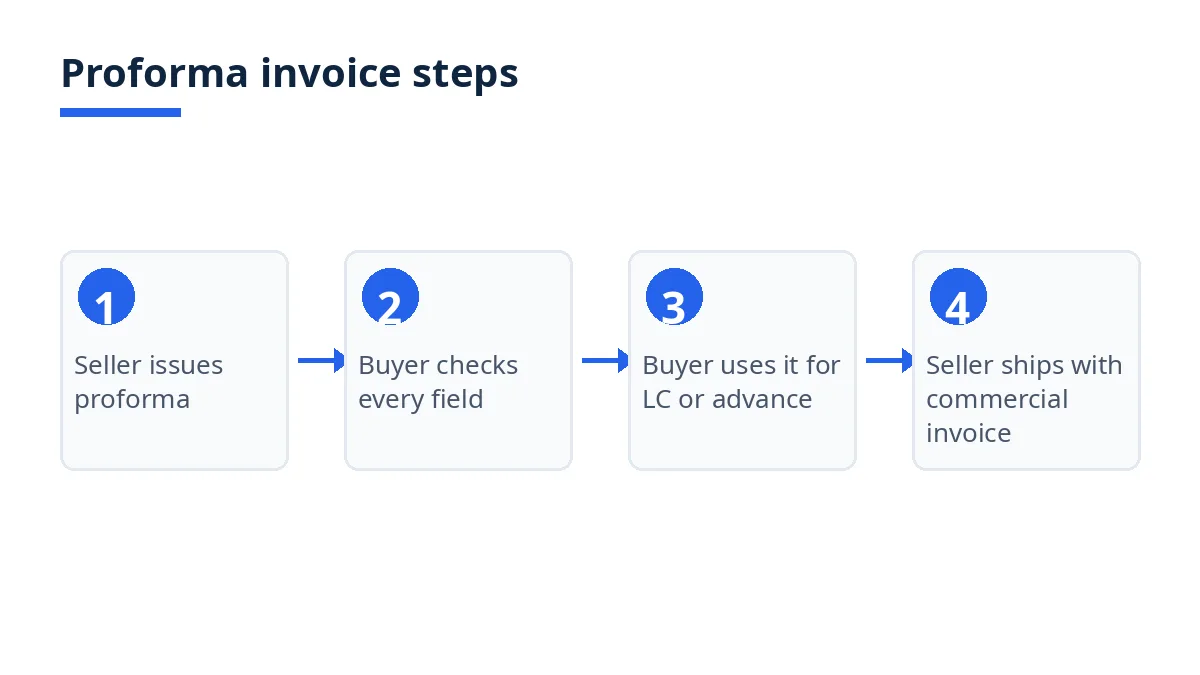
Step 1 is issue: the seller, as exporter, prepares and sends it. If such a document arrives from anyone other than the seller, ask why before relying on it.2
Step 2 is checking against the agreed order. A correction here costs an email and a reissue; after a letter of credit is opened, or an advance is paid, it can cost an amendment, a bank charge, or a delayed shipment.
Step 3 is use. The buyer may take it to a bank for a letter of credit application, use it to arrange an advance payment, file it for an import permit or approval where required, or use it for internal purchase approval. An export guide lists those uses: a letter of credit, an import permit, and foreign exchange allocation.3
Step 4 is conversion. When goods ship, the seller issues a commercial invoice. It should repeat the proforma invoice goods, prices, currency, and delivery term unless both sides have agreed a change in writing. Under a letter of credit, it must also match the credit, built from the proforma invoice, so drift becomes a discrepancy risk.2
A valid proforma invoice should contain the following fields. Query any field that is blank, vague, or inconsistent with the agreed order before use.
Field | What to check |
|---|---|
Seller details | Legal name and address matching the agreed seller |
Buyer details | Buyer legal name and address, plus consignee if different |
Goods description | Clear description and specifications identifying the product |
Quantity and unit | Quantity, unit, and packaging count |
Unit and total price | Unit price, line totals, and a grand total that adds up |
Currency | One stated currency for the whole document |
Delivery term | A named Incoterms term with a named place, such as FOB Chattogram |
Validity period | A stated expiry date for the prices and terms |
Payment term reference | The proposed arrangement, such as a sight letter of credit or a stated advance percentage |
Bank details, if any | Beneficiary, bank, account details, and SWIFT code, to be verified separately |
Shipment period | Proposed shipment window or latest shipment date, where agreed |
Reference and date | A proforma reference and issue date, distinct from a commercial invoice number |
Before paying, check four things in order: price, quantity, and currency against the agreed order; the validity expiry; the payment-term wording, so a proposed term is not read as a confirmed bank undertaking; and bank details through a separate channel, such as a previously verified contact or a bank letter, never from the document alone. A printed bank detail proves only that someone printed it there, not that the account belongs to the seller.
If any check fails, stop and ask for a written reconfirmation and a reissued proforma invoice with a new reference and date. Do not pay against the superseded document.
Costs, timelines and documents
There is no universal proforma invoice fee, timeline, or guarantee to state as fact. The document is not a priced service, so any cost comes from the payment arrangement, bank service, inspection, freight, or approval that follows it. If a fee is quoted, ask what service it buys and who charges it, and keep that answer in writing.
There is also no fixed legal validity period. One export-document guide describes 15 to 30 days as a commonly used validity span, and advises reissuing with a new number and date if the document lapses before the buyer confirms, rather than editing the old one.2 Treat that span as common practice in that guide, not as a rule for every order. The only validity period for a deal is the date printed on its proforma invoice.
The documents needed depend on the next step. For a letter of credit application, the buyer bank will normally work from the proforma invoice goods, amount, delivery term, ports, and shipment period, so those fields must be exact before filing.3 For an advance payment, the buyer needs verified bank details and a written record of what the advance covers and what happens to it if shipment does not proceed. For an import approval, the buyer needs whatever the approving authority asks for. None of these documents is proof of shipment: that comes from transport documents issued at shipment.
Bangladesh-specific rules and tips
Bangladesh-specific material on proforma invoices is narrow, and this guide states that limit plainly. No Bangladesh-specific proforma invoice fee, timeline, or standalone proforma rule was found in the opened material for this article, beyond the import-procedure role below. Buyers should confirm any Bangladesh bank requirement with the bank handling their own transaction.
The one Bangladesh-specific role that opened material describes concerns imports into Bangladesh. Reporting on a Bangladesh Bank circular, a financial newspaper recorded that, after letter of credit authorisation form registration was phased out with effect from 20 November 2022, authorised dealer banks were to obtain underlying indents, proforma invoices, and purchase or sale contracts from importers before establishment of a letter of credit or initiation of a permissible import.4 The same report recorded that import payments were not to exceed the amount of the letter of credit or other underlying arrangement.4
For a buyer purchasing from Bangladesh, rather than importing into Bangladesh, the lesson is about discipline. Three tips follow: state the port of loading, such as Chattogram, and the delivery term in full; ask for the validity date in writing on the document itself, not only in a message; and, if the deal will use a letter of credit, compare the goods description, quantity, total value, and shipment period against the draft credit before issue. Guidance about imports into Bangladesh describes the Bangladeshi importer side. It does not, by itself, set the procedure for a foreign buyer purchasing goods exported from Bangladesh, so the bank handling the buyer payment arrangement is the authority for the buyer side.
Mistakes and red flags
Paying against a proforma invoice as if it were a final invoice is the most common mistake. It carries no due date and no payment obligation on its own, so confirm the order, check the document, and confirm the payment arrangement separately before sending money. Using an expired document is the second mistake: if the date has passed, ask for a reissue. Copying a bank detail without a separate check is the third: a changed account number, a beneficiary name differing by one word from the seller legal name, or a bank detail arriving in a separate message are reasons to pause and verify through an established channel. Letting the commercial invoice drift from the proforma invoice is the fourth: a changed description, quantity, currency, or delivery term, without a written agreement, creates a mismatch a bank or customs authority may reject.
Red flags include no validity date, a total that does not add up, a goods description too vague to identify the product, a payment term promising a bank undertaking without naming the bank, pressure to pay quickly against an unverified bank detail, and a second version circulating without a new reference or date. Each is a reason to ask for a clean reissue.
A worked example shows the correction path in practice. The figures below are example figures only, created for this guide, and not a record of a real order. A buyer in Chile agrees to purchase woven jute shopping bags from a Bangladeshi seller for USD 9,650, on FOB Chattogram terms. The proforma invoice shows the bags, quantity, and total, but its validity date has already passed, and the beneficiary name differs by one word from the seller legal name. The buyer does not pay. The buyer lists both points in writing, asks for reconfirmation of the price and the correct beneficiary name, and asks for a reissued proforma invoice with a new reference, issue date, and validity date. The seller reissues it, the buyer verifies the bank details through an established contact and a bank letter, and only then files a letter of credit application based on it. The old document is kept as superseded.
Checklist
Use this checklist before a proforma invoice is used for a bank application, an advance payment, or an approval filing.
Clearly labelled as a proforma invoice, not as a commercial or tax invoice.
Seller legal name and address match the agreed seller.
Buyer legal name and address are correct, with consignee details where the consignee differs.
Goods description, specifications, quantity, and unit match the agreed order.
Unit prices, line totals, and the grand total add up, in one currency.
Delivery term is a named Incoterms term with a named place.
Validity date is stated, and the document is still within that date.
Payment term reference is a proposed arrangement, not a claimed bank promise.
Bank details, if shown, have been verified through a separate channel, with the verification recorded.
Shipment period, where agreed, is stated and workable.
The version used for any bank or approval step is the latest confirmed version.
The commercial invoice at shipment is checked against the agreed version, with any change agreed in writing first.
How Exportain helps
Exportain helps before a proforma invoice becomes a payment problem, by keeping the quotation record clear. On the buyer protection page, Exportain describes a recorded quotation trail in which the request for quotation, every quotation version, every counter-offer, and the accepted terms are stored so both parties see the same history, including unit price, minimum order quantity, lead time, delivery term, payment terms, and validity date.
The payment terms and buyer protection pages also describe funds holds. The payment terms page describes membership charges and, for goods orders, a funds hold arrangement in which a supplier may request a hold, the buyer may choose to pay it, and the hold is released after export clearance filing and buyer confirmation, with disputes frozen for a decision. The buyer protection page states that payment for goods is otherwise settled directly between buyer and supplier on the terms in the accepted quotation, unless both agree to a funds hold. Neither page describes proforma invoice processing, and neither turns a proforma invoice into a payment instruction, a bank undertaking, or a shipment guarantee.
FAQs
What should I know first about proforma invoice payment?
Know first that there is no separate payment method called proforma invoice payment. A proforma invoice is a preliminary quotation document issued before shipment, and payment, if any, follows a separate arrangement such as a letter of credit or an advance payment. It does not itself demand payment, carry a bank undertaking, or prove shipment.
What are the typical costs and timelines?
There is no universal proforma invoice cost or timeline to quote as fact. Costs belong to the payment arrangement, bank service, freight, inspection, or approval that follows the document, and timelines belong to the validity date printed on the document and to the bank or authority handling the next step. One guide describes 15 to 30 days as a commonly used validity span, but the date on the actual document is the only validity period for that deal.2
Which documents are needed?
The proforma invoice itself, a written order or accepted quotation that matches it, and whatever the next step requires: a letter of credit application built from its fields, verified bank details for an advance payment, or the approval filing required in the buyer country. At shipment, the commercial invoice for the goods actually shipped replaces it as the shipment record, and it should match the agreed version unless a change was agreed in writing.
What are the most common mistakes?
Paying against it as if it were a final invoice, using an expired document, copying bank details without a separate verification, and letting the commercial invoice drift from the agreed version. Each is avoidable by the same discipline: check the document line by line, verify bank details separately, ask for a reconfirmation and a reissue when anything fails, and never pay against a superseded version.
Next steps on Exportain
Exportain guide to letters of credit, explaining the bank undertaking that a proforma invoice often precedes: https://exportain.com/blog/lc-letter-of-credit
Exportain payment terms, describing membership charges and the funds hold arrangement: https://exportain.com/payment-terms
Exportain buyer protection page, describing the recorded quotation trail and the funds hold structure: https://exportain.com/buyer-protection
Sources
- What is a pro forma invoice?. Xero (accessed )
- Proforma Invoice Format for Export (Free PDF). Bilexor (accessed )
- The proforma invoice. ExportHelp (accessed )
- LC authorisation reformed. The Financial Express (accessed )
About the author
Sourcing from Bangladesh?
Post a request for quotation and suppliers on Exportain can send you their quotes directly.
Post an RFQ


