

Private Label Workwear and Uniforms Manufacturing in Bangladesh: A Brand Owner's Guide
No single workwear program repeats by accident: how to specify a private-label uniform range from Bangladesh so branding, durability and any protection claim survive washing and reordering.
Short answer
Private-label workwear and uniforms from Bangladesh should be bought as a program, not a single order. Fix the role map, the durability and wash standard, the emblem positions per size and the protection status of each style in writing, sample the range worn and washed, and lock who holds the patterns, artwork and approved sample for reorders.
On this page
Key takeaways
A workwear order is a program, not a single shipment: the role map, size curve and reorder pattern must be fixed before any single style is specified.
Each style must be marked ordinary uniform or protective garment first, because that decides the standard, the test evidence and the labelling it needs.
Durability must be fixed in testable numbers: fabric, reinforcement points, wash method including industrial laundering, and the wash cycles the garment must survive.
Brand identity lives in the system, not the logo alone: emblem method, size and position per size, labels and carton marking must match across sizes and reorders.
Verification on Exportain is a document review by staff, not a factory inspection, and a badge is not a guarantee of capacity, quality or delivery.
A uniform program fails in a different place from a single fashion order. The first delivery can look right while the third reorder drifts: a jacket shade shifts between dye lots, a chest emblem sits higher on the large sizes, reflective tape fades after repeated industrial washing, and one depot receives a different garment from another. This guide is for the brand owner buying workwear and uniforms as a program that must repeat, not as a one-off shipment.
That program view changes what the specification must contain. A range usually covers several roles, body shapes and workplaces, all carrying one identity, and the specification must settle how that identity survives wear, washing, repair and reordering.
One distinction shapes the whole order. Ordinary working clothes and uniforms that do not specifically protect the safety and health of the worker sit outside the European Union definition of personal protective equipment, while garments that do protect against a hazard fall inside it.1 A branded polo for office staff and a high-visibility jacket for roadside crews are not the same kind of product, even when both carry the same logo. The first is judged on appearance and durability. The second is judged on appearance, durability and a protection claim that must be evidenced. A protection claim added late can force retesting, relabelling or a new sample round.
Why this matters for buyers and sellers
For the buyer, a uniform is worn every working day, which makes small faults public at scale: a weak bar tack, a snagging zip, a collar that curls after washing or a print that cracks across the chest will be seen by every customer the wearer meets. Durability is a brand question before it is a cost question, since the garment's condition after many washes says as much about the brand as its condition on arrival.
For the seller, a uniform program differs from a seasonal fashion order. The first order carries the development cost of patterns, emblems, labels and wash standards, while later orders should repeat against those references. That repeat value only holds if the references are written down: when they live only in the factory's working notes, the buyer cannot reorder exactly, and the seller cannot defend a price change tied to a changed input. A specification both sides can test serves both.
Step-by-step: how it works
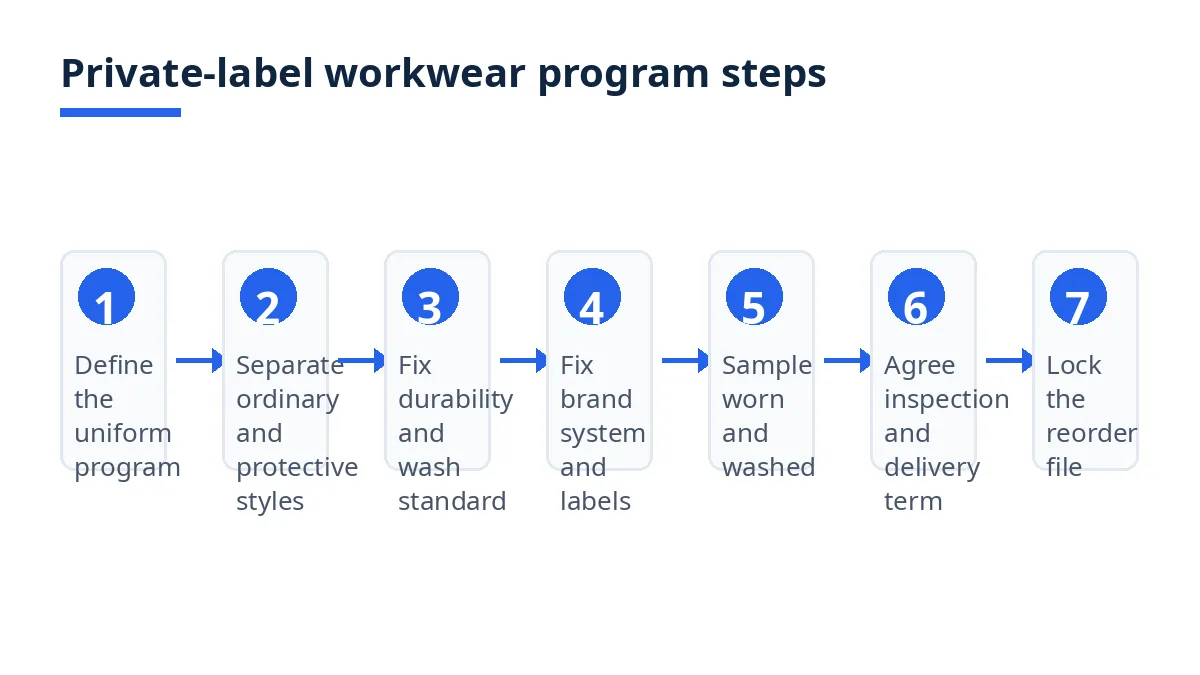
Define the program before any single style. List every role, garment, size curve and expected reorder pattern, such as seasonal top-ups or new-starter packs, so the factory can plan fabric, tape and emblem runs across styles instead of pricing each style in isolation.
Separate ordinary uniforms from protective garments. For each style, record whether it makes a protection claim and, if it does, which hazard it addresses and which standard applies. Protective clothing has general requirements covering ergonomics, innocuousness, size designation, ageing, compatibility and marking, together with the information supplied with the garment, and it must be read with the specific standard for the item in question.2
Fix the durability standard in testable numbers. State the fabric weight and weave, reinforcement points such as pocket corners, knees and stress seams, the wash method including industrial laundering where it applies, and the wash cycles the appearance, colour and tape must survive. Agree how each point will be checked on the sample.
Fix the brand system, not only the logo. Record the emblem method per placement, print or embroidery, the emblem size and position per size, the label set, and the carton marking per style and size. For high-visibility styles, check the emblem against the visibility class before sampling: the class sets minimum areas of fluorescent and retroreflective material, and branding that covers that material can reduce the certified area.3
Sample as a worn and washed set, not as a flat garment. Order samples in the actual fabric, colour, tape and emblems, across small, middle and large sizes. Wear-test the set where the job allows, wash it by the end user's method, and check fit, emblem adhesion, tape brightness and seam strength after washing. Approve or correct it in writing, with photographs of each placement.
Agree inspection and delivery terms before confirming. Write the inspection plan into the purchase order, using acceptance sampling indexed by acceptance quality limit, where AQL is the maximum average percentage of defective items considered acceptable during random sampling and sets sample sizes and acceptance or rejection thresholds.4 State one delivery term and named place for every quotation: the Incoterms 2020 rules set out 11 rules with a clear allocation of cost, risk and obligations.5
Lock the program file for reorders. Before bulk production, confirm in writing who holds the graded patterns, emblem and label artwork, tape and fabric references, wash standard and approved sample. A program whose references are held in one place can be reordered exactly.
Costs, timelines and documents
What are the typical costs and timelines?
There is no typical price or lead time for a private-label workwear program that a guide can state as fact, because each program prices its own fabric, reinforcement, tape, emblem method, size curve and delivery term. The drivers are specific to this product: a heavier twill, a lined jacket, bar-tacked stress points, retroreflective tape and an embroidered emblem each add material or handling a plain uniform does not carry, a wide size curve adds pattern and marker work, and many small reorders cost more per piece than one bulk run because each run repeats set-up.
Example figures: a buyer plans a three-style program with one jacket, one trouser and one polo, ordered first as a single bulk run and then as smaller new-starter packs. The bulk run spreads emblem set-up, pattern grading and tape sourcing across the full volume, while each top-up pack carries its own cutting, emblem and packing set-up on far fewer pieces. The example shows structure only, not a typical price, minimum or lead time. Read the MOQ definition guide for how minimums are set per style and per colour.
Timelines follow the same logic: sampling depends on fabric and tape availability and correction rounds after wash testing, bulk production on dyeing, tape delivery, emblem production and line capacity, and a protective style adds an evidence stage before bulk release that cannot be skipped. Ask for sampling, fabric and tape ready, production, inspection and shipment dates as separate lines.
Which documents are needed?
The order documents are the program brief, a tech pack per style, the brand manual covering emblems, labels and carton marking, the durability and wash standard, the inspection plan and the itemized quotation and purchase order. Where a style makes a protection claim, add its test standard, test evidence and user information, since the general protective-clothing standard requires supporting information in the technical file for each item.2
For shipment, the export declaration and its enclosed set are handled under Bangladesh customs export clearance procedures.6
Bangladesh-specific rules and tips
Bangladesh is a woven-garment source of real depth for this product. The Bangladesh Garment Manufacturers and Exporters Association represents the readymade garment industry across woven garments, knitwear and sweater sub-sectors, and around 60 per cent of its roughly 4,500 member factories are woven garment manufacturers.7 That woven base matters, because most uniform jackets, trousers and overalls are cut from woven cloth rather than knitted fabric. Ask a candidate factory which woven workwear styles it already runs, rather than accepting a general claim of garment capacity.
Classification needs attention style by style. In the Harmonized System, heading 6203 covers men's or boys' suits, ensembles, jackets, blazers, trousers, bib and brace overalls, breeches and shorts, not knitted or crocheted.8 A range mixing jackets, trousers and overalls across men's and women's styles will cross several headings, so each style needs its own heading confirmed with a customs broker before quotations are compared.
If you sell into the European Union, fibre composition on the label must follow Regulation (EU) No 1007/2011, which states that a textile product shall be labelled or marked with the name and percentage by weight of all constituent fibres in descending order. That rule sits alongside the protective-clothing marking rules for PPE styles, so a high-visibility jacket can carry two labelling regimes at once, each in the language of the destination market. Check both on the pre-production sample, not only on the artwork proof.
For protective styles sold in the European Union, the risk category decides the conformity route. Regulation (EU) 2016/425 divides PPE into three categories by risk, with Category I covering minimal risks, Category III covering risks that may cause very serious consequences such as death or irreversible damage to health, and Category II covering the rest.1 For Category II and III PPE, the model must go to a notified body for EU type-examination before serial production, and Category III also needs notified-body supervision of production.1 A factory that cannot name the category, the notified body and the evidence file for your style is not ready to quote a protective garment.
A final point is laundering. Many uniform programs are industrially laundered, a harsher regime than a domestic wash, so state it in the specification and test against it before sampling: a garment that passes a home wash test can still lose colour, tape brightness or emblem adhesion under industrial conditions.
Mistakes and red flags
What are the most common mistakes?
Branding over the visibility area. On a high-visibility style, a large chest or back emblem can cover fluorescent or retroreflective material and reduce the area the class is certified on. The three classes set minimum areas of fluorescent material at 0.14, 0.50 and 0.80 square metres and of retroreflective material at 0.10, 0.13 and 0.20 square metres for Classes 1, 2 and 3 respectively.3 Keep emblems clear of the tape bands, measure the remaining visible area on the sample, and treat any emblem crossing a band as a new certification question, not a cosmetic change.
Claiming protection the garment does not evidence. Adding words such as flame resistant or high visibility to a label, a catalogue page or an RFQ without the test evidence behind them creates a claim the buyer must then defend. If the style is protective, name the standard and hold the evidence file. If it is an ordinary uniform, sell it as one and do not borrow protective language for marketing.
Approving a sample that was never washed or worn. A flat sample proves cutting and sewing. It does not prove that the tape survives laundering, that the emblem survives pressing, that the knee panel sits correctly when the wearer bends, or that the largest size fits like the middle size. Wash and wear testing belong in the sample stage, where a correction costs a sample, not a shipment.
Approving one size and assuming the range. Emblem positions, pocket placement and tape bands shift as a pattern grades. A chest emblem approved on a medium can sit too high on a small and too low on a large, and a tape band measured on one size can fall short of the class area on another. Approve the smallest, middle and largest sizes, and record the emblem position per size.
Leaving the program file with no written holder. Patterns, emblem files, label artwork, tape references and the approved sample are the program. If no document says who holds them and what happens on a repeat or if the relationship ends, the buyer pays to rebuild them. Settle ownership and handover in writing before bulk.
Comparing quotes on different standards. A lower price on a lighter fabric, a lower visibility class, a printed emblem instead of embroidery or a different delivery term is a different offer. Compare only replies to the same program brief, on the same standards and the same Incoterm.5
Checklist
Every line should be answered in writing.
Program defined: roles, garments per role, size curve, reorder pattern.
Each style marked ordinary or protective, with hazard and standard where applicable.2 1
Durability standard fixed: fabric, reinforcement, wash method, cycle count, check method.
Brand system fixed: emblem method, size and position per size, label set, carton marking.
High-visibility styles checked: class, material areas, emblems clear of tape bands.3
Samples worn and washed, approved in writing across small, middle and large sizes.
Inspection plan and AQL values in the purchase order.4
Quotations compared on the same brief, standards and Incoterm.5
Program file holder named: patterns, artwork, references, approved sample.
Heading confirmed per style with a customs broker.8
Fibre labelling checked for the destination market.9
How Exportain helps
On Exportain, browse suppliers and post your program brief, role map and durability standard on the RFQ board so suppliers quote against the same specification. Read how supplier verification works on Exportain for what a badge records: verification is a document review by staff, not a factory inspection, and a badge is not a guarantee of capacity, quality or delivery.10
FAQs
What should I know first about workwear and uniforms?
Know whether each style is an ordinary uniform or a protective garment, because that decides the standard, the evidence and the labelling. Ordinary working clothes and uniforms that do not specifically protect the worker sit outside the EU PPE definition, while garments that protect against a hazard fall inside it and need the applicable standard and conformity route.1 Settle that style by style before sampling.
What are the typical costs and timelines?
There are no typical figures a buyer can rely on, because each program prices its own fabric, reinforcement, tape, emblem method, size curve and delivery term. Example figures: a three-style program ordered first in bulk and then as small new-starter packs spreads set-up across the bulk volume and carries set-up again on each small pack, so a top-up pack costs more per piece than the bulk run. The example shows structure only. Timelines split the same way, with a protective style adding an evidence stage before bulk release.
Which documents are needed?
The order documents are the program brief, a tech pack per style, the brand manual, the durability and wash standard, the inspection plan and the itemized quotation and purchase order. A protective style adds its test standard, test evidence and user information.2 For shipment, the export declaration and its enclosed set are handled under Bangladesh customs export clearance procedures.6
What are the most common mistakes?
The most common mistakes are branding over the visibility area so the certified class area falls short,3 claiming protection without test evidence, approving a sample that was never washed or worn, approving one size and assuming the range, leaving the program file without a named holder, and comparing quotes on different standards or delivery terms.5
Next steps on Exportain
Start the RFQ from the program brief, role map and durability standard: browse suppliers, post on the RFQ board, and before confirming read how supplier verification works on Exportain plus the MOQ definition guide.
Sources
- PPE - OSHwiki. European Agency for Safety and Health at Work (accessed )
- EN ISO 13688: 2013 - Protective Clothing – General Requirements. SATRA (accessed )
- Hi Vis EN ISO 20471 Specifications. HiVis.co.uk (accessed )
- ISO 2859-1:2026 - Sampling procedures for inspection by attributes — Part 1: Sampling schemes indexed by acceptance quality limit (AQL) for lot-by-lot inspection. ISO (accessed )
- Incoterms® 2020. International Chamber of Commerce (ICC) (accessed )
- Customs Clearance Procedures for Export. Bangladesh Customs, National Board of Revenue (accessed )
- Bangladesh Garment Manufacturers and Exporters Association (BGMEA). Devex (accessed )
- Classification Detail — HS Code 6203. United Nations Statistics Division (accessed )
- Regulation (EU) No 1007/2011 on textile fibre names and related labelling and marking of the fibre composition of textile products. European Union, (accessed )
- Trust & Safety Center. Exportain (accessed )
About the author
Sourcing from Bangladesh?
Post a request for quotation and suppliers on Exportain can send you their quotes directly.
Post an RFQ


