

Private Label Terry Bathrobes Manufacturing in Bangladesh: A Brand Owner's Guide
Private label terry bathrobes in Bangladesh from the brand-owner side: collar and fit control, shade tolerance per colourway, label law, and the approval sequence that keeps a repeat robe matching the first.
Short answer
Private label terry bathrobes from Bangladesh mean a factory makes a retail robe to a brand owner's own specification, under the brand's name. The brand owner controls the collar style, pile, size measurements, shade tolerance, artwork placement, and labelling. Fix the garment specification, approve fit and bulk samples on a body and after washing, judge shade against a sealed reference, and settle artwork ownership and the size and colour split before bulk.

On this page
Key takeaways
Private label terry bathrobes mean the brand owner controls the collar style, pile, size measurements, shade tolerance, artwork placement, and labelling, while the factory makes the garment to that specification.
A robe is judged on a body and after washing, not flat and unwashed: collar roll, belt height, pocket position, and sleeve and body lengths must be approved worn, in the middle size and then at both ends of the range.
Settle artwork and digitising ownership, brand-cost separation, repeat-shade tolerance against a sealed reference, the size and colour split per carton, and reorder and exit terms before bulk is cut.
In the EU, fibre names and percentages must be shown in descending order, and in the USA the label must show fibre content, country of origin, and the responsible business or its registered identification number.
Bathrobe classification depends on knit or woven construction, fibre, and wearer: heading 6208 covers women's or girls' bathrobes not knitted or crocheted, with 6208.91.10 for those of cotton.
Private label terry bathrobes put a retail brand's name on a garment a customer wears, washes, and judges against the last robe they bought from that brand. A Bangladeshi factory makes the robe to the brand owner's specification. This guide is for that brand owner: the person who controls the artwork, shade tolerance, labelling, and approvals, and who answers when a repeat order does not match the first. Its subject is one retail garment, sold one robe at a time, in sizes and colourways a shopper can compare.
A bathrobe is a garment, not a flat piece of towelling. A towel is judged flat: its weight, its edges, and its absorbency. A robe is judged on a body: whether the collar sits, the belt stays tied, the sleeves reach the wrist, and the length covers what the size chart promises. The factory work therefore has two halves: the terry cloth, and the garment work of cutting, sewing, and finishing a shaped article. A supplier strong on terry weaving is not automatically strong on garment fit, and a brand owner should check both halves before approving bulk.
Why this matters for buyers and sellers
For a buyer, a private label robe is a repeat-purchase product: a customer buys a second in another colour, buys one as a gift, or replaces a worn robe with the same style. Each later purchase depends on the first robe's size, shade, and hand feel holding steady. If the second robe is shorter, thinner, or a different white, the customer blames the brand, not the factory. The brand owner's job is to turn taste into a written specification a factory can repeat: collar style, pile, weight, size measurements, shade standard, and label wording, all fixed before bulk is cut.
For a seller, the same clarity protects the factory. A factory given only a photo and a target price must guess at every decision that matters, and guesses become rework and disputes about who approved what. A written specification, a signed fit sample, and a sealed shade reference give the factory a fair target and a record to point to later.
The robe has decisions flat towelling does not. A shawl collar rolls and wraps, a kimono collar lies flat and crosses, and a hood adds a separate shaped piece with its own seam and weight. Each collar changes fabric consumption, the cutting plan, and how the robe hangs. A belt needs loops at the right height and a length that wraps without pulling the front open. Pockets need a position a hand reaches without distorting the front, and sleeves need a length and cuff treatment that survive washing without twisting. None of these can be settled from a fabric swatch alone; they need a garment sample, worn and washed, before bulk.
Step-by-step: how it works
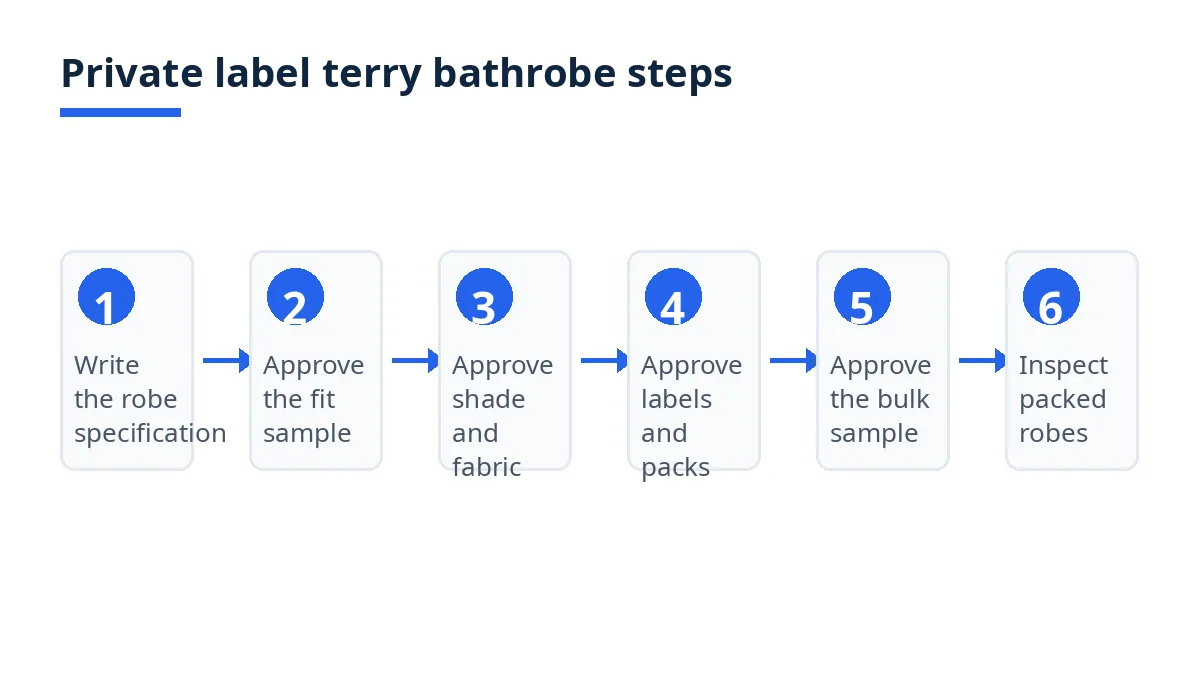
Work in this order. Each approval locks a decision the next stage depends on, and skipping a stage moves its cost into bulk.
1. Write the robe specification. Record the collar style, pile type (loop pile or sheared velour), fabric weight, size range, and measurement table for every size, plus belt length and width, pocket position and size, sleeve and overall length per size, colourways, artwork and its exact placement, and the packing method: folded in a bag, or hung on a hanger with a polybag. A specification naming only a colour and a weight is not a garment specification.
2. Approve the fit sample. Ask for the middle size first, then the smallest and largest sizes once it is right. Put the sample on a body or form, check collar roll, belt height, pocket position, and sleeve and body lengths against the measurement table, and record every deviation. A sample approved only flat hides the problems a customer finds first.
3. Approve the shade and the fabric hand. Dye a lab dip for each colourway and judge it against a sealed reference under agreed light, not showroom light alone, then approve a fabric sample at the agreed weight. Keep one sealed reference per colourway in your own file; later deliveries are judged against it, not against memory or a photograph.
4. Approve the label and pack proofs physically. Check fibre wording, care symbols, size, and origin marking on a physical label, not a screen proof, and check the retail pack: bag, hang tag, barcode position, and SKU split by size and colour. A label error found after packing means opening cartons.
5. Approve a bulk, or pre-production, sample. It must come from bulk fabric and trims, made on the bulk line, and washed under the agreed care instructions before final approval. Approve it in writing, size by size, before the factory cuts the full order. If it differs from the fit sample, stop and settle the difference.
6. Inspect during production and at packing. Check first cut pieces against the measurement table, shade across dye lots during production, and packed cartons against the size and colour split. A robe order fails most often in the split: the right total, in the wrong sizes and colours.
Costs, timelines and documents
There are no typical figures a buyer can rely on, because each factory prices your collar style, pile, weight, size range, colourways, brand work, and delivery term. The useful discipline is a cost structure: ask every quotation to separate the same lines, so quotations compare like with like. Example figures: a quotation separating fabric, cutting and sewing, dyeing, embroidery or labels, packing, inspection, and freight shows which line moved when a price changes. Those figures show structure only; they are not market rates.
Brand work should appear as its own cost line. Embroidery digitising, woven-label tooling, printed hang tags, and shade-standard work are one-off or per-colourway costs, unlike per-robe costs. Ask which repeat on a reorder, and what happens to the digitising file and label artwork if you move factories or end the range. Folding brand costs into the per-robe price hides both the reorder price and the exit cost.
Timelines follow the approval sequence. Example figures: a sequence of fit sample, shade approval, label proof, bulk sample, production, inspection, and shipping shows structure only, not a typical lead time. The stage that most often slips is approval, not production: a second lab dip, a fit correction, or a label legal check. Treat a promise that skips approval stages as a warning, not a benefit.
Delivery terms decide which costs still come after the factory price. Under Incoterms 2020, EXW (Ex Works) leaves the buyer to collect goods at the seller's premises, FOB (Free on Board) puts delivery on board at the port of loading with the buyer paying main freight, and DDP (Delivered Duty Paid) puts the seller in charge of delivery cleared for import at destination.1 Compare every quotation on the same term, stated once on every quotation and the purchase order. A cheaper factory price on a different term is not a cheaper landed cost.
The order documents are the robe specification, the approved measurement table, the sealed shade references, the approved artwork files, the itemised quotation, and the purchase order. The export set is the Bill of Export, the commercial invoice, the packing list, the EXP form, and a certificate of origin.2 Keep the specification version, the artwork version, and the shade reference with the purchase order, so a reorder a year later can be checked against the same file rather than reconstructed from emails.
Bangladesh-specific rules and tips
Confirm Bangladesh's export sequence with the supplier and freight forwarder rather than assuming it. Ask in writing about the export set named above — Bill of Export, commercial invoice, packing list, EXP form, and certificate of origin — who prepares each document, who certifies the EXP form, and which body issues the certificate of origin, so a missing document is found before the vessel sails.2
Classification needs the same care. Heading 6208 covers women's or girls' bathrobes and dressing gowns, not knitted or crocheted, and subheading 6208.91.10 covers those of cotton.3 A knitted, men's, or man-made-fibre robe falls on a different line, so confirm the full code for your exact robe — knit or woven, fibre, and wearer — with your customs broker before the invoice is raised.
Shade and size discipline matter because a robe order is usually split across colourways and dye lots. Ask how the factory judges shade — against a sealed reference, under which light, at what stage — whether each colourway is dyed as one lot or several, and how the size split is checked at packing. Those answers predict most robe-order disputes, and they cost nothing to ask before sampling.
Write measurements in centimetres and inches on the same table, state each measurement point in words (for example, body length from the highest shoulder point), and state the tolerance per measurement, not one figure for the whole garment. Keep the measurement table, shade reference, and artwork file in one order file, and send that file when you reorder.
Mistakes and red flags
The most common mistakes are garment mistakes, not fabric mistakes. Approving a robe flat, without wearing it, is the first: collar, belt height, and sleeve length cannot be judged flat, and a robe that looks right on a table can pull, gape, or ride up on a body. Approving shade from a photograph is the second, since a screen shifts colour. Approving a bulk sample that was never washed is the third: pile, belt length, and overall length all move after washing.
A further mistake is approving one size and assuming the rest. A range is graded, and a grading error shows up at the ends — the smallest and largest sizes — while the middle size looks right. Approve the middle size first, then the extremes, in every size.
Red flags are worth naming plainly. A supplier that will not separate brand costs, or say who owns the embroidery file, is keeping an exit cost hidden. One that offers to skip the bulk sample, or cut bulk while shade is unapproved, is moving risk onto you. One that quotes with no delivery term, or changes the term between quotations, makes comparison impossible. One that cannot say how shade is judged, or how the size split is checked, has not built the controls a robe order needs. Each is a reason to settle the point in writing before money moves.
A related red flag is a label promise made without a legal check. Fibre wording, care symbols, and origin marking are legal statements, not marketing copy, and the brand owner remains responsible for the label in its own markets.
Checklist
Before you confirm a private label terry bathrobe order, every line should be answered in writing.
Robe specification written: collar style, pile type, fabric weight, size range, and measurement table per size.
Belt, pockets, and sleeves fixed: belt length and width, loop position, pocket position and size, sleeve length and cuff treatment.
Colourways listed, with a sealed shade reference per colourway and the judging light agreed.
Artwork fixed: embroidery or woven-label design, exact placement, and ownership of the digitising and artwork files.
Fit sample approved on a body or form in the middle size, then in the smallest and largest sizes.
Label and pack proofs approved physically: fibre wording, care symbols, size, origin marking, bag, hang tag, and barcode position.4 5 6
Bulk sample approved from bulk fabric and trims, washed under the agreed care instructions, size by size.
Brand costs separated: one-off tooling and per-colourway costs shown apart from per-robe costs, with reorder and exit terms stated.
Size and colour split stated per carton, with a packed-goods check against that split.
Delivery term stated once, on every quotation and on the purchase order.1
Export set agreed: Bill of Export, commercial invoice, packing list, EXP form, and certificate of origin.2
Order file holds the specification version, artwork version, shade references, and inspection plan for the reorder.
How Exportain helps
On Exportain, browse suppliers and post a request for quotation (RFQ) with your robe specification summary, collar style, size range, colourways, and delivery term, so suppliers quote against the same specification and size and colour split. Ask each reply for its fit process, shade-judging method, brand-cost itemisation, and packed-goods check.
Read the badges for what they record. Exportain Verified means Exportain has checked identity, phone, email, and business registration, and Export Verified means it has checked the Export Registration Certificate (ERC).7 Factory Verified means it has reviewed photos of the manufacturer factory, while Trading Company Verified means it has reviewed photos of the trading company office or warehouse.7 Verification is a document review, not a factory inspection, so fit, shade, and label decisions stay with you.
FAQs
What should I know first about terry bathrobes?
A terry bathrobe is a garment made from looped pile cloth. The brand owner controls the collar style, pile type, weight, size measurements, shade standard, artwork placement, and labelling; the factory makes the robe to that specification. Judge it on a body and after washing, and settle the specification, shade reference, and label wording before bulk is cut.
What are the typical costs and timelines?
There are no typical figures a buyer can rely on, because each factory prices your collar style, pile, weight, size range, colourways, brand work, and delivery term for your order.1 Ask every quotation to separate fabric, cutting and sewing, dyeing, brand work, packing, inspection, and freight, and compare quotations on the same delivery term. Example figures in this guide show cost and sequence structure only; they are not market rates.
Which documents are needed?
The order documents are the robe specification, the measurement table, the sealed shade references, the approved artwork files, the itemised quotation, and the purchase order. The export set is the Bill of Export, the commercial invoice, the packing list, the EXP form, and a certificate of origin.2 The label documents are the fibre wording, the care symbols, and the origin marking for each market where the robe will be sold.4 5 6
What are the most common mistakes?
The most common mistakes are approving a robe flat without wearing it, approving shade from a photograph, approving a bulk sample that was never washed, approving one size and assuming the rest of the range, and signing without a clause on who owns the embroidery and artwork files. A further mistake is treating a badge as garment protection: verification is a document and photo review, not a factory inspection.7
Next steps on Exportain
Browse suppliers, then post your robe specification summary, size range, colourways, and delivery term on the RFQ board so suppliers state their fit process, shade-judging method, and brand-cost itemisation. Before you confirm, read how supplier verification works on Exportain and the MOQ guide for the verification and minimum-order mechanics that sit alongside this brand work.
Sources
- Incoterms® 2020. International Chamber of Commerce (ICC) (accessed )
- Customs Clearance Procedures for Export. Bangladesh Customs, National Board of Revenue (accessed )
- HS Code 62089110 - Bathrobes, dressing gowns and similar articles. Flexport (accessed )
- Regulation (EU) No 1007/2011 on textile fibre names and related labelling and marking of the fibre composition of textile products. European Union, (accessed )
- Textile, Wool, Fur, Apparel and Leather Matters. Federal Trade Commission (accessed )
- ISO 3758:2023 Textiles — Care labelling code using symbols. International Organization for Standardization (accessed )
- Supplier verification: Earn trust badges buyers can see. Exportain (accessed )
About the author
Sourcing from Bangladesh?
Post a request for quotation and suppliers on Exportain can send you their quotes directly.
Post an RFQ


