Private Label Shorts Manufacturing in Bangladesh: A Brand Owner's Guide
Private label shorts in Bangladesh, from a brand owner's view: fit blocks, wash and shade standards, label packs and packing that hold a whole shorts range together, plus the checks to agree before bulk production.
Short answer
Private label shorts from Bangladesh means a factory sews shorts to your tech pack and applies your labels, tags and packing, while you own the specification, fit block, wash standard, artwork and label content. For a range, success is consistency: one waistband standard, one label system and one shade standard across styles, agreed in writing before bulk production.
On this page
Key takeaways
Private label means a factory sews to your tech pack and applies your labels, tags and packing, while you own the specification, fit block, wash standard and label content.
For a shorts range, consistency is the product: one waistband standard, one label system and one shade standard across styles that differ in fabric, pockets and wash.
Fit must be approved on the washed pre-production sample, in your actual fabric and wash, across several sizes, not on a single unwashed size.
Label, tag and wash minimums sit apart from the garment minimum, and bulk washing starts only after written shade approval.
Exportain verification is a document and photo review, not a factory inspection, and a badge is not a guarantee.
Private label shorts manufacturing in Bangladesh means a Bangladeshi factory sews shorts to your tech pack and applies your labels, tags and packing instead of its own. You own the specification, the artwork, the fit block, the wash standard and the label content. The factory owns the production run. This guide is for a brand owner who sells a range of shorts under one name.
A shorts range tests brand control harder than a single style does. A customer who buys your chino short and your cargo short expects the same waist fit, leg length logic and label and packing standard, even though the fabrics, pockets and washes differ. The factory can sew each style well and still fail the range if the waistband, wash shade and label system drift between styles.
What should I know first about private label?
Private label is a specification contract, not a catalogue purchase. You are not buying a finished short with a logo added. You are buying fabric sourcing, cutting, sewing, washing where the style requires it, labelling and packing, all run to your documents.
What each side supplies. The factory supplies production capacity: fabric purchase, cutting, sewing lines, wash facilities or a wash partner, and packing. Ask which steps happen in its own building and which go to a subcontractor. You supply the tech pack, the size chart and fit block, artwork files, the label and tag artwork, barcode data, the wash standard and packing instructions. The woven main label, size label, care and content label, hang tag and printed carton are produced from your files, in print runs you approve. An error in your file is reproduced on every pair, so proof approval is a production step.
What makes shorts different. Shorts carry their fit in waist, rise, inseam and leg opening. A small error in rise or inseam changes how the garment sits, and a twisting waistband or unevenly recovering elastic shows at once in wear. Fix the fit block across styles, and record each deliberate difference in the tech pack.
Your label is your legal statement. If you sell into the European Union, Regulation (EU) No 1007/2011 states that a textile product shall be labelled or marked with the name and percentage by weight of all constituent fibers in descending order.1 The factory sews the label you approve, so its fiber names and percentages must match the fabric you specified and the sample you tested. Private label does not transfer that duty to the factory. For care, ISO 3758 sets out a system of graphic symbols giving the most severe treatment that does not cause irreversible damage during textile care.2
Why this matters for buyers and sellers
For the buyer, private label turns separate shorts styles into one brand range. The gain is control: one waistband standard, one label system, one packing standard and one wash language across chino, cargo, denim and jersey styles. Fabric dyed to your color, denim washed to your recipe and labels woven with your name cannot be sold to another buyer, so the factory carries your branding risk inside its minimum and price.
For the seller, a private label range is steadier than a spot order when the brand repeats the styles, because the fit block, artwork set-up, wash recipe and label runs are already paid for and approved. A new fabric lot or wash batch can still move shade and measurements.
Two controls protect both sides: an inspection plan agreed before production, and one delivery term for every quotation. ISO 2859-1 defines a system of acceptance sampling plans for inspection by attributes, indexed by acceptance quality limit (AQL) for lot-by-lot inspection.3 AQL is the maximum average percentage of defective items considered acceptable during random sampling, and it determines sample sizes and acceptance or rejection thresholds.3 The Incoterms 2020 rules set out 11 rules with a clear allocation of cost, risk and obligations.4
Step-by-step: how it works
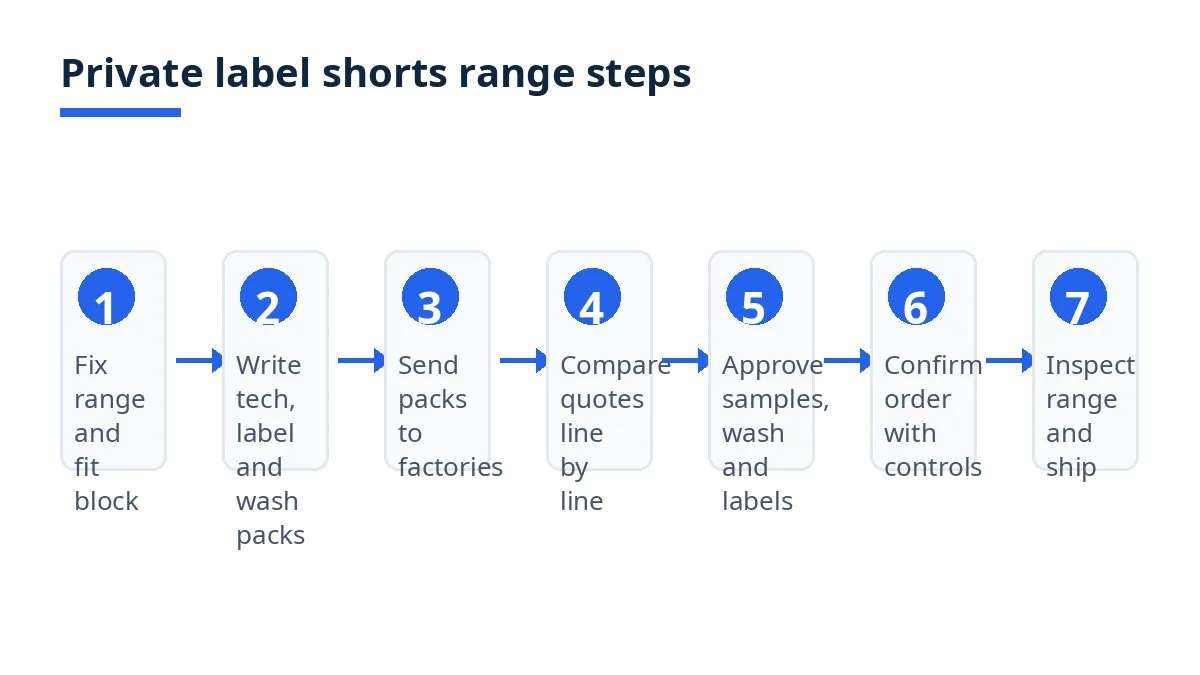
Fix the range and the fit block. List every style, the fabric for each, and the shared measurements: waist, rise, inseam and leg opening, with tolerances per size. Name the styles that differ.
Write one tech pack, one label pack and one wash standard. The tech pack covers fabric, construction, waistband, fly, pockets, drawcord, trims, size chart and packing. The label pack covers the main label, size label, care and content label, hang tag, barcode and carton marks, each as a separate file. The wash standard covers the recipe, the shade reference and the approved lab dip for each color and fabric.
Send the same packs to several factories. Give the quantity per style, per color and per size, the target markets and one delivery term. Ask for the minimum per style and per color, which steps are in-house, and where washing happens.
Compare quotations line by line. Compare fabric, construction, wash, trims, label and tag runs, finishing and packing on the same specification and the same Incoterm.4 Ask for set-up costs itemized apart from the unit price.
Approve samples, wash and labels together. Order a proto sample, then a pre-production sample in your fabric, color and wash, with your labels sewn in. Measure it before and after washing, check shade against the lab dip and across the size set, and check the label content against the fabric specification.1 Approve or list corrections.
Confirm the order with the controls written in. Put the split per style and color, the fit tolerances, the wash and shade standard, the inspection level and AQL values following ISO 2859-1,3 the packing specification and the delivery term into the purchase order. Record which set-ups and label runs you have paid for.
Inspect the range, then ship on the agreed term. Check fit across sizes, shade across styles and colors, label placement, barcode scans and carton marks against the approved sample and the purchase order. Release shipment only on the term and named place in the order.4 See the shorts quality control checklist.
Costs, timelines and documents
What are the typical costs and timelines?
There are no typical costs or timelines a guide can state as fact. Each factory prices your fabric, waistband and pocket construction, wash, trims, label and carton runs, finishing and packing, and the delivery term you choose.4 Private label adds its own lines: woven labels, printed tags, barcode stickers and printed cartons are ordered separately from the sewing run, each with its own minimum. Wash development adds its own rounds of sample washes and shade approvals.
The price drivers are fabric composition and weight, dyeing and washing, cutting and sewing, pocket and waistband construction, trims, your label and tag package, retail packing, inspection and the delivery term. Ask for the quotation split by line rather than accepting one unit price. For timelines, ask for each stage as a separate line: label and tag production, sampling, wash development and shade approval, fabric and dyeing, bulk production, inspection and shipment.
Example figures: a brand owner runs a chino, a cargo and a denim short sharing one waistband block and one label system, with two washes on the denim style. The woven label run is sized for the full range, so it clears its minimum on the combined quantity, while each wash sits on its own shade approval and minimum. The example shows structure only, not a typical minimum, price or lead time.
Which documents are needed?
Your order documents are the tech pack, the fit block, the label pack with approved proofs, the wash standard with approved lab dips, the itemized quotation and the purchase order. For export clearance in Bangladesh, goods may not be loaded unless an export declaration, the Bill of Export or Shipping Bill, is submitted to Customs and approved.5 Enclosed documents include the export contract or purchase order where there is no export letter of credit, the commercial invoice, the packing list, the EXP form certified by an authorized dealer, and a certificate of origin.5
Bangladesh-specific rules and tips
Start with the woven base. Shorts in twill, canvas and denim belong with woven factories. According to the Bangladesh Garment Manufacturers and Exporters Association (BGMEA) website as reported in December 2025, the association has around 4,500 member factories, about 60 percent of them woven garment manufacturers, and BGMEA member factories account for 100 percent of woven garment exports.6 That scale gives a brand owner several factories to quote on one range, but it does not prove that any one factory can hold your fit and wash standard.
Check the factory behind the address. Ask whether the address on the quotation is the sewing factory or a head office, and where cutting, washing and label application happen. Under BGMEA membership criteria reported in December 2025, a woven or knit garment factory must have at least 100 machines and a minimum floor space of 15,000 square feet to qualify for membership.6 Membership criteria describe the factory, not your order.
Keep one legal name, one trim plan and one size ratio across every paper. The export declaration names the exporter and the foreign buyer,5 so the name on the trade licence, quotation, proforma invoice and payment account should match. Buttons, zips, elastic and waistband tape may be bought in for your specification, and an imported trim can set both the earliest production date and a separate minimum. State the size ratio per color and per style in the purchase order and check it at inspection.
Treat wash as a controlled process, not a finish note. ISO 5077 specifies a method for determining the dimensional change of fabrics, garments or other textile articles when subjected to specified washing and drying procedures.7 Measure waist, inseam and leg opening before and after washing, and set the bulk tolerance against the washed measurements.
Mistakes and red flags
What are the most common mistakes?
Approving fit on an unwashed sample. Washing changes inseam length, waist recovery and shade. Approve fit on the washed pre-production sample, in your actual fabric and wash.
Approving one size and one style. Fit drift hides in the extremes of the size set and in the style you checked least. Measure several sizes across every style, and check shade across the size set side by side.
Letting wash drift across styles. A chino, a cargo and a denim short in the same color family are not the same shade unless you set one shade standard and approve each fabric against it. Keep one lab dip per color per fabric.
Approving the garment sample but not the labels. Buyers measure the waist and skip the sewn-in labels, then find a wrong fiber percentage at inspection. The label content is your legal statement in your market,1 so proof it like the tech pack.
Comparing quotations on different specifications. A lower price on a lighter fabric, a simpler wash, stock labels instead of your woven labels, or a different delivery term is a different offer. Compare only replies to the same packs, wash standard and Incoterm.4
Changing artwork after labels are woven. A late color or spelling change restarts the label run and can move the whole range. Freeze artwork at purchase order stage.
Checklist
Before you confirm, every line should be answered in writing.
Range listed: every style, fabric, color and wash, with deliberate fit differences named.
Fit block fixed: waist, rise, inseam and leg opening, with tolerances per size, shared across styles.
Tech pack and label pack sent; label proofs approved: main label, size label, care label, hang tag, barcode, carton marks.
Fiber names, percentages and care symbols checked against the fabric specification and approved wash.1 2
Wash standard agreed: recipe, lab dip and shade band per color per fabric; bulk wash starts only after written shade approval.
Washed measurements agreed: waist, inseam and leg opening checked before and after washing.7
Split stated per style, color and size, with one size ratio per color; minimum confirmed per style and per color, with label, tag and wash minimums apart.
In-house and subcontracted steps named, and set-up, wash development and label costs itemized apart from the unit price; paid set-ups recorded.
Pre-production sample with your labels sewn in, measured before and after washing, and approved in writing.
Inspection level and AQL values in the purchase order.3
Quotations compared on the same specification, wash standard and Incoterm.4
Export set agreed: invoice, packing list, EXP form, certificate of origin, Bill of Export.5
How Exportain helps
On Exportain, browse suppliers and post a request for quotation (RFQ) on the RFQ board with your range summary, tech pack summary, label pack summary, wash standard and delivery term, so factories quote against the same specification. State your target markets in the RFQ, because your labelling duties follow the markets you sell into.1 When you accept a quotation, Exportain creates one order and issues one proforma invoice from the accepted terms.8
Read the badges for what they record. Exportain Verified means Exportain has checked identity, phone, email and business registration, and Export Verified means it has checked the Export Registration Certificate (ERC).8 Factory Verified means it has reviewed photos of the manufacturer factory, while Trading Company Verified means it has reviewed photos of the trading company office or warehouse.8 Verification is a document review by staff, free, and never granted by membership plans.9 It is not a factory inspection,8 9 so sample, wash and inspection checks stay with you.
FAQs
What should I know first about private label?
Private label means a Bangladeshi factory sews shorts to your tech pack and applies your labels, tags and packing, while you own the specification, the fit block, the wash standard and the label content.
What are the typical costs and timelines?
There are no typical figures a buyer can rely on, because each factory sets its price, minimum and lead time for your range. Fabric, construction, wash, the split, label and tag runs, and the delivery term drive the price,4 while label production, wash approval, sampling, dyeing, bulk production and inspection drive the timeline.
Which documents are needed?
The order documents are the tech pack, the fit block, the label pack with approved proofs, the wash standard, the itemized quotation and the purchase order. The export set is the Bill of Export, commercial invoice, packing list, EXP form and certificate of origin.5
What are the most common mistakes?
The most common mistakes are approving fit on an unwashed sample, approving one size instead of the size set, letting wash shade drift across styles, approving the garment but not the labels, and comparing quotations on different specifications or terms.4
Next steps on Exportain
Browse suppliers, then post your range summary, wash standard and delivery term on the RFQ board so factories state their minimum per style and per color against one specification. Before you confirm, read how to import shorts from Bangladesh and the shorts quality control checklist.
Sources
- Regulation (EU) No 1007/2011 on textile fibre names and related labelling and marking of the fibre composition of textile products. European Union, (accessed )
- EN ISO 3758 Textile - Care Labelling Code Using Symbols. EUROLAB (accessed )
- ISO 2859-1:2026 - Sampling procedures for inspection by attributes — Part 1: Sampling schemes indexed by acceptance quality limit (AQL) for lot-by-lot inspection. ISO (accessed )
- Incoterms® 2020. International Chamber of Commerce (ICC) (accessed )
- Customs Clearance Procedures for Export. Bangladesh Customs, National Board of Revenue (accessed )
- BGMEA sets new membership criteria to ensure factory safety, operational standards. The Financial Express, (accessed )
- ISO 5077 Textiles - Determination of Dimensional Change in Washing and Drying. EUROLAB (accessed )
- Trust & Safety Center. Exportain (accessed )
- Supplier verification: Earn trust badges buyers can see. Exportain (accessed )
- supplier verification
- buyer guide
- woven garments
- Bangladesh sourcing
- bangladesh garments
- Shorts
- Private label
About the author
Sourcing from Bangladesh?
Post a request for quotation and suppliers on Exportain can send you their quotes directly.
Post an RFQ