Private Label School Uniforms Manufacturing in Bangladesh: A Brand Owner's Guide
A brand owner's guide to private label school uniforms from Bangladesh: crest and colour approval, size ladders by age and height, safety and labelling rules, and a term-time replenishment plan.
Short answer
Private label school uniforms from Bangladesh are built around a school's own identity: an approved stitched crest, numbered fabric and thread colours matched across every piece, a size ladder by age and height, and a replenishment plan for mid-year top-ups. Fix the crest, colour standards and size table in writing before bulk production, check children's safety and labelling rules for each destination, and work shipment dates backwards from the school term date.
On this page
Key takeaways
A school uniform is an identity system: the stitched crest, numbered school colours, size ladder and term-time replenishment plan must all be fixed before bulk production.
Approve the crest as a stitched sample on the actual fabric and approve colours as daylight-checked dyed swatches, held as references for every production lot.
Build the size ladder by age and height with a growth allowance, and state every order per garment, per colour and per size, never as a single total.
Agree the mid-year top-up plan, inspection level and delivery term in writing before confirming, and work shipment dates backwards from the school term date.
A school uniform order is judged differently from a fashion order. Pupils wear the same garments five days a week, parents buy them in a narrow window before term starts, and a school judges the result by whether every child in a year group looks like part of the same school. A private-label school uniform program from Bangladesh therefore turns on four things: a crest that must read clearly at a distance, a colour identity that must hold across shirts, trousers, skirts, jumpers and blazers, a size ladder spanning several years of growth, and a replenishment pattern tied to the school calendar.
Bangladesh has a large woven garment base behind this kind of program. Ready-made garment exports reached $10.578 billion in July to September of fiscal year 2026-27, up 6.10 percent year on year, and woven garments accounted for $4.614 billion of that total, up 5.11 percent.1 That capacity does not by itself solve the school-specific problems. The work is in the specification: crest file, numbered colours, size chart, and top-up plan.
Most woven school uniform pieces fall under the headings for suits, ensembles, jackets, blazers, trousers, skirts and shirts rather than under a single "school uniform" heading. Heading 6203 covers men's or boys' suits, ensembles, jackets, blazers, trousers, bib and brace overalls, breeches and shorts, and heading 6204 covers the corresponding women's or girls' garments, including dresses and skirts.2 Confirm the heading piece by piece with your customs broker, because a blazer, a skirt and a polo shirt in one set can sit under different headings.
Why this matters for buyers and sellers
For the brand owner or school supplier, the uniform is an identity system before it is a garment range. A crest embroidered slightly off centre, a jumper in a navy that does not match the blazer, or a skirt pleat that sits differently from the sample will be noticed by parents on the first day of term. A uniform set that misses its colour or crest standard cannot be sold to another school, because no other school uses that crest or that exact colour combination.
For the factory, a school program offers repeat business that fashion orders do not. Once the crest, colours and size ladder are approved, the same specification can be reordered each term, with sizes shifting as cohorts move up. The risk is shade drift between dye lots and crest variation between embroidery runs: a navy approved in one lot can read as a different navy in the next, and a crest re-run without a stitched reference can tighten, pucker or lose detail. Both sides need the same discipline: approved references kept on file, in physical form, and checked against every lot. Term timing sharpens this: with no plan for mid-year joiners, the school is left short when it most needs stock.
Step-by-step: how it works
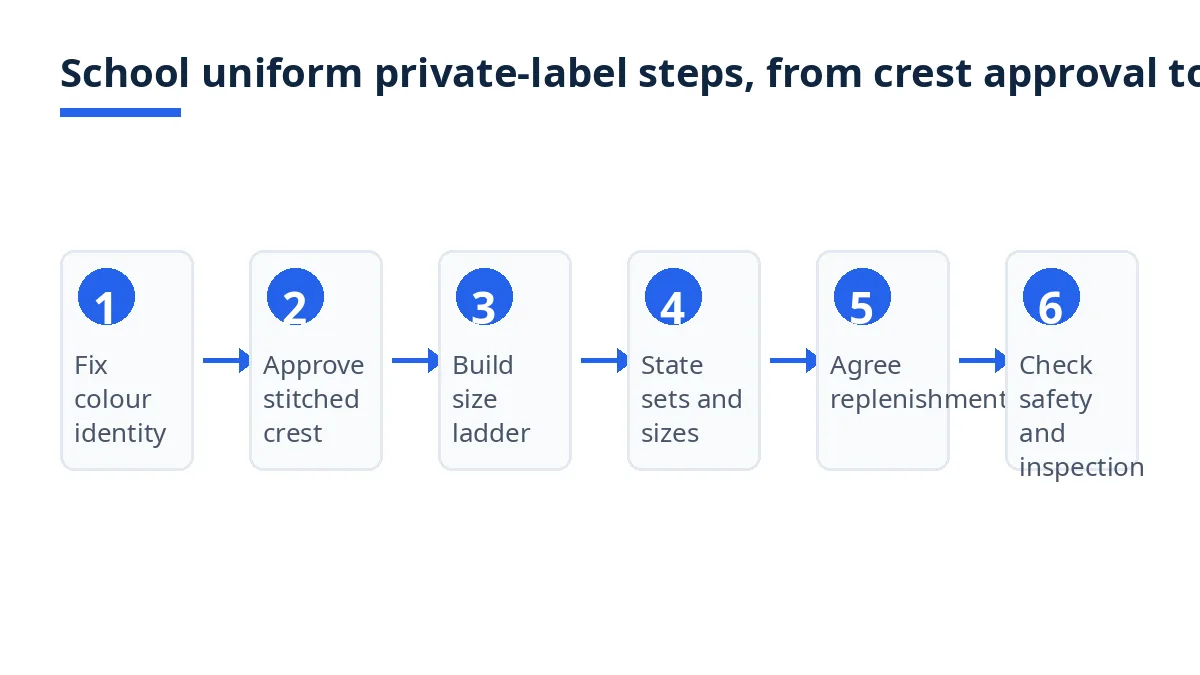
Fix the school colour identity first. Record each colour as a numbered fabric and thread standard, not as a word such as "navy". List which pieces carry which colour and where piping uses a second colour. Approve dyed swatches in daylight, and keep one swatch set with the buyer and one with the factory.
Approve the crest as a stitched sample, not on screen. Supply the crest artwork with thread colours, backing and placement per garment. Ask for a stitched crest on the actual fabric, in each size range where placement shifts, and approve it in writing with thread numbers recorded. A crest that looks clean on a monitor can lose fine lettering at chest size.
Build the size ladder by age and height, not by adult sizes. State the body measurements behind each size, the intended growth allowance, and how sizes map to year groups. Ask the factory to show the grade from smallest to largest size on one table, so a jump between adjacent sizes is visible before cutting.
State the order as sets and sizes, not as a single total. Give the quantity per garment, per colour, per size, and per school where the program covers more than one site. State how many complete sets that implies and which sizes will sell out first. A total without a size split cannot be planned, because cutting, embroidery and packing all run by size.
Agree the replenishment plan before the first bulk order. Decide which sizes and pieces will be held for mid-year top-ups, how a reorder is triggered, and whether crest set-up and dye recipes are retained for repeats. Put the repeat price basis and the top-up minimum in writing, so a small November reorder is priced on agreed terms.
Check safety, labelling and inspection on the sample, not at shipment. Confirm cord and drawstring rules for younger age groups, small-part attachment on badges and buttons, fibre content on the label, and wash-care wording per destination market. Agree the inspection plan before production, and inspect the first lot against the approved crest, swatches and size table.
Costs, timelines and documents
What are the typical costs and timelines?
There are no reliable typical figures for a school uniform program, because price moves with fabric weight and composition, pieces per set, crest stitch count, colour count, size range and delivery term. A lined blazer with a woven crest is priced on a different structure from a polo shirt with a small embroidered chest crest. Ask for the price broken down by garment, with crest set-up, embroidery per piece, fabric, trims, labels and packing as separate lines, so a change to one element can be repriced without reopening the whole quotation.
Example figures: a program of 2,400 sets split across ten sizes, with the smallest sizes taking fewer pieces and the middle sizes taking the most, will use far more embroidery machine time on the crest than the same 2,400 pieces ordered as a single garment in one size. The example shows structure only, not a typical price, minimum or lead time. Ask for the per-garment split where a factory quotes one blended set price.
Timelines follow the same logic. Sampling depends on crest digitising and dyeing, bulk production on dye-lot approval and embroidery capacity, and delivery on the term date rather than a generic lead time. Ask for separate dates for crest approval, fabric ready, bulk start, inspection and shipment, and work backwards from the date the school needs stock on shelves.
For documents, the order set is the tech pack, the crest file with thread numbers, the colour standards, the size table, the itemised quotation and the purchase order. For export clearance in Bangladesh, see the Bangladesh Customs guidance on the export declaration and its enclosed documents.3
Cost driver | Why it moves the price | State in your enquiry |
|---|---|---|
Crest embroidery | Stitch count, size, placement count | Crest file, thread numbers, placements |
Colour identity | Dye lots per colour, matching across pieces | Numbered fabric and thread standards |
Size ladder | Grading across many age bands | Measurements per size, growth allowance |
Set composition | Blazer, skirt, trouser and knit pieces differ | Quantity per garment, per size |
Labels and packing | Per-pupil sets, name labels, school packs | Label wording, pack format per pupil |
Replenishment | Small top-ups carry set-up again | Top-up minimum, repeat price basis |
Bangladesh-specific rules and tips
Treat colour matching as a lot discipline, not a one-time approval. A school colour must match across woven shirts, trousers, skirts and knitted jumpers, which may be dyed in different lots. Keep the approved swatch set as the reference for every lot, and ask for a lot swatch against it before bulk cutting. A lot that fails the match is cheaper to hold at the dye stage than to re-cut as finished garments in the wrong navy.
Write the label pack for the school, not only for customs. A school uniform label carries the fibre content, the size by age and height, and the care instructions a parent needs. In the European Union, Regulation (EU) No 1007/2011 requires textile products to be labelled or marked with their fibre composition, with labels durable, easily legible, visible and accessible and, in the case of a label, securely attached.4 Build the label file early, because a label error found after packing means opening every poly bag.
Apply children's safety rules to the design, not as an afterthought. School uniforms are children's clothing, and the safety questions are specific: cords and drawstrings, small parts that can detach, and restricted substances in dyes and prints. EN 14682, on cords and drawstrings on children's clothing, is the harmonised standard listed for children's clothing under the EU product safety framework.5 Design hoods, waist cords and toggles to that standard from the tech pack stage, and confirm which age groups each rule covers, because a cord acceptable on a senior blazer may not be acceptable on a primary school jacket.
Inspect by lot against the school references. ISO 2859-1 defines acceptance sampling plans for inspection by attributes, indexed by acceptance quality limit (AQL), for lot-by-lot inspection, and AQL is the maximum average percentage of defective items considered acceptable during random sampling.6 Agree the inspection level and AQL values for crest quality, colour match, measurements and stitching before production, and inspect each lot against the approved crest sample and colour swatches.
Compare quotations on one delivery term. The Incoterms 2020 rules comprise 11 rules with a clear allocation of cost, risk and obligations.7 State one Incoterm and named place on every quotation, because a price that includes freight and insurance cannot be compared with a price that ends at the factory gate. For a term-time program, the named place and shipment date matter as much as the unit price.
Mistakes and red flags
What are the most common mistakes?
Approving the crest on screen. A digital crest file hides stitch density, puckering and lettering loss at small sizes. Approve a stitched crest on the real fabric, in the real thread colours, at the real placement, and keep that sample as the production reference.
Using one size ratio for every year group. Intake years and senior years do not buy in the same proportions. A ratio copied from one school to another leaves the smallest and largest sizes short while middle sizes sit in stock. Build the ratio from the school's own roll by year group, and review it after the first term.
Approving colour under artificial light. Two navies that match under factory lighting can diverge in daylight, and parents see uniforms in daylight. Approve swatches in daylight, and check the first bulk lot the same way.
Forgetting the mid-year pupil. A program with no top-up plan forces the school to wait for the next bulk order when a new pupil joins or a garment is damaged. Agree the top-up minimum, the retained crest and dye records, and the reorder route before the first delivery.
Putting cords and toggles on young children's garments without a safety check. A drawstring or toggle that suits an older pupil can create a strangulation or entanglement risk for a younger one. Check the applicable children's clothing standard for each age group and garment before the tech pack is finalised.5
Reading a profile or a badge as proof of capacity. A listing shows what a supplier claims to make. It does not show whether that supplier can hold a school colour across lots, embroider a crest cleanly at chest size, or deliver ahead of term. Ask for a stitched crest sample, a dyed swatch set and a size-graded sample before confirming.
Checklist
Before you confirm, every line should be answered in writing.
Colour identity as numbered fabric and thread standards, with a daylight-approved swatch set held by both sides.
Crest approved as a stitched sample on the actual fabric, with thread numbers, backing and placement per garment.
Size ladder by age and height, with measurements, growth allowance and year-group mapping.
Order split per garment, colour and size, with complete-set quantities and first-sellout sizes identified.
Label pack approved: fibre content, size, care wording and per-pupil or school pack format.4
Children's safety check done for cords, drawstrings, small parts and restricted substances per age group.5
Inspection level and AQL values agreed, against the crest sample and colour swatches.6
Quotations compared on the same specification and the same Incoterm and named place.7
Replenishment agreed: top-up minimum, retained crest and dye records, repeat price basis, reorder route.
Shipment dates worked backwards from the school's stock-on-shelf date, with inspection before shipment.
How Exportain helps
On Exportain, browse suppliers and post the set composition, colour standards, size ladder and term date on the RFQ board, so replies quote against the same school specification rather than against a generic uniform. Ask each reply for a stitched crest sample and a dyed swatch set before you compare prices. Read how supplier verification works on Exportain for what each badge records, and the MOQ definition guide for how minimums are structured per style and colour. Verification is a document and photo review, not a factory inspection.8 9
FAQs
What should I know first about school uniforms?
Know that a school uniform is an identity system, not a single garment. The crest, the numbered colours, the size ladder and the term-time replenishment plan must all be fixed before bulk production. Most woven pieces classify under headings 6203 and 6204 by garment type and wearer, not under one uniform heading.2
What are the typical costs and timelines?
There are no typical figures to rely on, because price moves with fabric, crest stitch count, colour count, size range, set composition and delivery term, and timelines move with crest approval, dye-lot approval and the school term date. Ask for per-garment prices with set-up shown apart, and for separate dates for crest approval, fabric ready, bulk start, inspection and shipment.
Which documents are needed?
The order documents are the tech pack, the crest file with thread numbers, the colour standards, the size table, the itemised quotation and the purchase order. For export clearance, see the Bangladesh Customs guidance on the export declaration and its enclosed documents.3
What are the most common mistakes?
The most common mistakes are approving the crest on screen instead of as a stitched sample, using one size ratio for every year group, approving colour under artificial light, leaving no mid-year top-up plan, and putting cords or toggles on young children's garments without a safety check.5 Each of these is avoidable at the sample stage and expensive after bulk production.
Next steps on Exportain
Post the set composition, colour standards, size ladder and term date as an RFQ: browse suppliers, then put them on the RFQ board. Before you confirm, read how to import school uniforms from Bangladesh for the import-side steps for this product.
Sources
- Exports up over 6% to $13.1bn in Q1 of current fiscal. United News of Bangladesh (accessed )
- Bangladesh Customs Tariff, Chapter 62. Bangladesh Trade Portal (accessed )
- Customs Clearance Procedures for Export. Bangladesh Customs, National Board of Revenue (accessed )
- Regulation (EU) No 1007/2011 on textile fibre names and related labelling and marking of the fibre composition of textile products. European Union, (accessed )
- Children's Clothing Regulations and Standards in the EU. ComplianceGate, (accessed )
- ISO 2859-1:2026 - Sampling procedures for inspection by attributes — Part 1: Sampling schemes indexed by acceptance quality limit (AQL) for lot-by-lot inspection. ISO (accessed )
- Incoterms® 2020. International Chamber of Commerce (ICC) (accessed )
- Trust & Safety Center. Exportain (accessed )
- Supplier verification: Earn trust badges buyers can see. Exportain (accessed )
About the author
Sourcing from Bangladesh?
Post a request for quotation and suppliers on Exportain can send you their quotes directly.
Post an RFQ