

Private Label Medical Scrubs Manufacturing in Bangladesh: A Brand Owner's Guide
A new healthcare brand launching private-label scrubs in Bangladesh should fix three things first: the color per role, the size chart, and the wash standard the garment must survive, then test all three on samples before bulk approval.
Short answer
A new healthcare brand launching private-label medical scrubs in Bangladesh should fix three things before sampling: one color per clinical role, a measurement chart for every size, and a wash standard the garment must survive. Test all three on a pre-production sample washed under the end-user regime, approve color and fit in writing, and hold the same specification on every repeat order.
On this page
Key takeaways
A scrub line is a color and fit system: one color per clinical role, a measurement chart per size, and a wash standard the garment must survive, fixed before sampling.
Approve color from a physical swatch, then a lab-dip, then washed bulk fabric, and test the pre-production sample under the end-user wash regime before bulk approval.
Price and timeline follow the color count, embroidery set-up, label runs and dye-lot approval, not a single typical figure, so compare quotes only on the same brief and delivery term.
Write the label for the selling market: fiber composition for the EU and a care instruction the garment actually survives, checked against the market where the scrubs will be sold.
A profile or a badge is not a guarantee of color discipline, fit or delivery; hold every agreement, shade tolerance and wash standard in writing on the purchase order.
A new healthcare brand does not launch a scrub line the way it launches a fashion line. A clinic buyer does not judge the first delivery by a photograph. The buyer judges it by whether every nurse on a ward can be told apart by color at a glance, whether the same size fits the same way after months of hot washes, and whether the label still reads clearly when the carton is opened for the tenth time. Private-label medical scrubs manufacturing in Bangladesh is therefore a brand decision before it is a purchasing decision: the color system, the fit block and the wash standard fixed at the start become the brand your customers wear every shift.
That framing changes what to ask a factory. Instead of starting with a price per piece, a new brand starts with three commitments it can keep on every repeat order: a color for each role that stays recognisable after laundering, a size range that fits real clinical staff rather than a single sample model, and a fabric and construction that survives the washing regime the end user actually uses. Bangladesh offers woven-garment capacity for this work. The Bangladesh Garment Manufacturers and Exporters Association (BGMEA) represents the ready-made garment industry including woven garments, with around 4,500 member factories, about 60 percent of them woven-garment manufacturers.1 Capacity alone does not make a launch succeed. The launch succeeds when the brand owner writes those three commitments down, tests them on samples, and refuses to trade them away for a lower first quote.
Why this matters for buyers and sellers
For a new brand, scrubs are a uniform system, not a single garment. Hospitals and clinics assign colors by department or role, so a scrub top that drifts from navy to a washed-out blue after repeated laundering stops doing its job even if the stitching holds. Color discipline is a safety and identification tool on a ward, and it is also the most visible part of the brand. A brand that ships one color in its first order and a noticeably different shade in its second order has a brand problem, not just a quality complaint.
For the factory, a scrub order is attractive because it repeats. A clinic that adopts a color system reorders the same styles, colors and sizes, which lets a factory plan fabric, dye lots and label runs across repeat orders. If the first order locks in a fabric that fades, a fit block that runs small, or a label that peels, every repeat order inherits the defect and the brand owner pays to fix it through returns and replacements.
Step-by-step: how it works
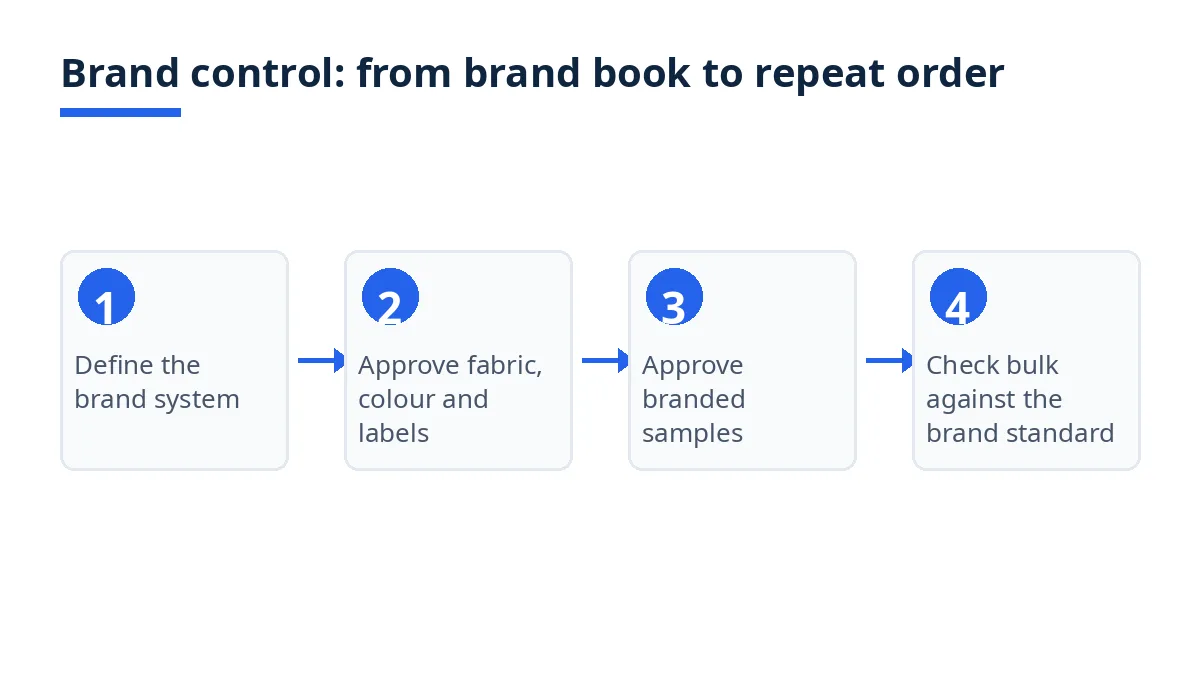
Fix the color system first. Name each role or department, assign one color to it, and record the color as a physical swatch plus a written reference, not as a screen color or a name such as "teal" alone. Ask how the factory will match that swatch on a repeat dye lot, and what tolerance it will accept before a lot is rejected.
Write the scrub specification as a clinical brief. State the top style (V-neck or round neck, pocket count and placement), the pant style (drawstring, elastic waist, jogger cuff or straight leg), the fabric composition and weight, the stretch requirement, and the size range with a measurement chart for each size. State the intended layering and movement, since scrubs are worn over other clothing through long shifts.
Decide the branding and labelling package before sampling. State where the brand mark sits (chest embroidery, printed logo, woven neck label, or a combination), the size and thread colors of the embroidery, the wording and symbols on the care label, and the carton marking. Branding decisions made after sampling cause rework, because embroidery placement changes the pattern and label wording changes the label order.
Order a proto sample, then a pre-production sample in production fabric. Measure the proto against the chart, then wash the pre-production sample under the regime the end user will use and measure it again. Approve or correct in writing, with photographs of the washed sample next to the unwashed color swatch.
Agree the inspection plan and the delivery term before confirming the order. Write the inspection level and acceptance quality limit (AQL) values into the purchase order. ISO 2859-1 defines AQL as the worst tolerable process average when a continuing series of lots is submitted for acceptance sampling.2 State one delivery term and named place for every quotation: the Incoterms 2020 rules set out 11 rules with a clear allocation of cost, risk and obligations.3
Confirm the split, not only the total. Give the quantity per style, per color and per size. A color system fails when one role color is ordered in too small a quantity to dye or cut alone, so the split per color is the number that decides whether the order can run.
Approve the bulk color and the first production pieces. Ask for a lab-dip or bulk fabric swatch approval before cutting, and check the first finished pieces against the approved sample for color, embroidery position, label content and pocket construction.
See the medical scrubs quality control checklist for pocket, seam and color points to check at inspection.
Costs, timelines and documents
What are the typical costs and timelines?
There are no typical costs or timelines a guide can state as fact, because each factory prices your fabric, color count, embroidery, label runs and delivery term separately, and each timeline depends on fabric availability, dye-lot approval, correction rounds and line capacity. The cost drivers that matter most for a scrub launch are specific to scrubs: the number of colors (each color is a dye lot), the embroidery set-up per placement, the woven-label run for your brand, and any wash testing you require before bulk approval. Fewer colors and one shared fabric across the top and the pant reduce both cost and color risk.
For timelines, treat sampling, fabric ready, bulk color approval, production and inspection as separate dated lines rather than a single delivery week. The longest single delay in a scrub launch is usually color approval: a lab-dip that does not match the swatch sends the dye lot back, and a second round costs the time of a fresh lot. Build that round into the plan instead of discovering it in the schedule.
Example figures: a new brand launches with three role colors at 400 sets per color, sharing one fabric across tops and pants, and budgets one extra week for a second lab-dip round. The same brand launching with six colors at 200 sets per color faces six dye lots and a higher chance that one color misses its lot minimum. The example shows structure only, not a typical price, quantity or lead time.
Which documents are needed?
The order documents are the clinical brief and tech pack, the itemized quotation, the color and wash approvals in writing, and the purchase order carrying the split per color and size, the inspection plan and the delivery term. For export clearance, see the Bangladesh Customs export clearance page, which sets out the Bill of Export and its enclosed documents.4
Bangladesh-specific rules and tips
Confirm association claims at the source. If a supplier claims BGMEA membership, confirm it with the association itself. BGMEA represents woven and knitwear manufacturers,1 so membership signals an active garment business, not scrub expertise, color discipline or capacity for your order. Ask specifically for scrub or uniform production experience, and for evidence of color matching across repeat orders.
Classify the garment before you quote freight. Woven scrubs sit in the "other garments" family of heading 6211. The United Nations classification lists heading 6211 as track suits, swimwear and other garments, not knitted or crocheted, with subheadings by wearer and fiber, including 6211.32 for men's or boys' garments of cotton and 6211.43 for women's or girls' garments of man-made fibers.5 Confirm the exact subheading for your fiber and wearer with your customs broker, because the subheading follows the garment, not the brand name. See the HS code for medical scrubs guide.
Write the label for the market that will sell the garment, not only the market that makes it. In the European Union, Regulation (EU) No 1007/2011 requires textile products to be labelled or marked with their fiber composition when made available on the market, with labelling that is durable, easily legible, visible and accessible.6 In the United States, the Federal Trade Commission's Care Labeling Rule requires manufacturers and importers to attach care instructions to garments, with a washing instruction or a dry-cleaning instruction.7 A scrub label therefore carries three jobs at once: your brand, the fiber composition, and a care method the garment actually survives. Check all three against the market where the scrubs will be sold, and put the care method through the wash test before approving it.
Choose the fabric for the laundry, not the showroom. Polyester-cotton blends tend to hold color and shape better than pure cotton over repeated high-temperature cycles, while pure cotton is softer at first but fades and shrinks faster under clinical washing conditions.8 State the wash regime in the brief (home laundry or industrial laundry, temperature, and whether disinfection steps apply), and require the pre-production sample to be tested under that regime, measured before and after, before bulk approval.
Keep one legal name across every paper. The export declaration names the exporter and the foreign buyer,4 so the name on the trade licence, quotation, proforma invoice and payment account should match, and the brand name on the label should not be confused with the legal exporter name on the shipping papers.
Mistakes and red flags
What are the most common mistakes?
Approving a color from a screen. A color chosen on a monitor shifts under factory lighting, dye chemistry and laundering. Approve from a physical swatch, then from a lab-dip, then from washed bulk fabric. Any step skipped is a shade dispute waiting for the second order.
Approving a fit on one body. A scrub size chart approved on a single sample wearer fails across a real clinical workforce. Fit-test the range on several body shapes, in the layering the wearer will use, and through the movements of a shift: bending, reaching overhead and sitting.
Writing a care label the garment cannot survive. A label that promises a hot wash the fabric cannot hold, or an ironing instruction for a fabric that scorches, turns a labelling error into a product failure. Test the labelled care method on the pre-production sample and record the result.
Treating a performance claim as the fabric itself. A claim about a finish is only as good as its test report and its wash durability. Ask for the test method, the property tested, and the result after washing, not only on new fabric. A claim with no report is a marketing line, not a specification.
Comparing quotes on different color counts or wash standards. A lower price on fewer colors, an unwashed sample approval, or a different delivery term is a different offer. Compare only replies to the same brief, with the same colors, the same wash standard and the same Incoterm.3
Accepting a color or fit exception verbally. Record any agreed shade tolerance, size-chart change or wash standard on the quotation and purchase order, with the color and size it applies to. A verbal exception is forgotten by the second order.
Reading a profile or a badge as a guarantee. A profile is a starting point for enquiries. It does not test whether a factory can hold your color across dye lots, and a badge is not a guarantee of capacity, quality or delivery.
Checklist
Before you confirm, every line should be answered in writing.
Color system fixed: one color per role, physical swatch reference recorded.
Scrub brief written: top and pant styles, pockets, fabric, weight, stretch, size chart.
Branding and labelling package decided: mark placement, label wording, care method, carton marking.
Proto sample measured; pre-production sample washed under the end-user regime and re-measured.
Wash standard agreed: regime, temperature, post-wash measurement and color tolerance.
Split stated per style, per color and per size, with one size ratio per color.
Inspection level and AQL values in the purchase order.2
Quotations compared on the same brief, colors, wash standard and Incoterm.3
HS subheading confirmed for fiber and wearer with the customs broker.5
Label checked for the selling market: fiber composition and care instruction.6 7
Export papers consistent: one legal name on licence, quotation, invoice and payment account.4
How Exportain helps
On Exportain, browse suppliers and post your scrub brief, color system and wash standard on the RFQ board so suppliers quote against the same specification. Ask each reply how it will match your colors on a repeat dye lot and what wash testing it will run before bulk approval. Read how supplier verification works on Exportain to understand what a badge records and what it does not, and read the MOQ guide before fixing your split per color.
FAQs
What should I know first about medical scrubs?
Know that a scrub line is a color and fit system, not a single garment. Fix the color per role, the measurement chart per size and the wash regime before sampling, because those three decisions decide whether the second order matches the first. Woven scrubs fall in the "other garments" family of heading 6211, with subheadings by wearer and fiber.5
What are the typical costs and timelines?
There are no typical figures a buyer can rely on, because each factory prices your fabric, color count, embroidery and label runs separately, and timelines depend on dye-lot approval and correction rounds. Color approval is usually the longest single stage, so plan for a second lab-dip round rather than treating the first dip as final.
Which documents are needed?
The order documents are the clinical brief and tech pack, the itemized quotation, the written color and wash approvals, and the purchase order with the split per color and size, the inspection plan and the delivery term. The export set follows the Bangladesh Customs export clearance requirements.4
What are the most common mistakes?
The most common mistakes are approving a color from a screen, fitting a size range on one body, writing a care label the garment cannot survive, accepting a performance claim without a wash-durability test report, and comparing quotes on different color counts or delivery terms.3 Each mistake is cheap to prevent at sample stage and expensive to fix after packing.
Next steps on Exportain
Browse suppliers, then post your scrub brief, color system and wash standard on the RFQ board so suppliers state how they will hold your colors on repeat orders. Before you confirm, read how to import medical scrubs from Bangladesh and the medical scrubs quality control checklist.
Sources
- Bangladesh Garment Manufacturers and Exporters Association (BGMEA). Devex (accessed )
- ISO 2859-1:2026 - Sampling procedures for inspection by attributes — Part 1: Sampling schemes indexed by acceptance quality limit (AQL) for lot-by-lot inspection. ISO (accessed )
- Incoterms® 2020. International Chamber of Commerce (ICC) (accessed )
- Customs Clearance Procedures for Export. Bangladesh Customs, National Board of Revenue (accessed )
- Classification Detail — HS Code 6211. United Nations Statistics Division (accessed )
- Regulation (EU) No 1007/2011 on textile fibre names and related labelling and marking of the fibre composition of textile products. European Union, (accessed )
- What kind of care instruction is required on apparel labels?. American Apparel and Footwear Association (accessed )
- How to Choose Scrubs for Your Medical Team. The Laundry Brothers (accessed )
About the author
Sourcing from Bangladesh?
Post a request for quotation and suppliers on Exportain can send you their quotes directly.
Post an RFQ


