Private Label Leggings Manufacturing in Bangladesh: A Brand Owner's Guide
Private-label leggings from Bangladesh, from the brand owner's side: what you own, what the factory owns, and how label wording, artwork files and repeat rights are agreed before production.
Short answer
Private-label leggings from Bangladesh are made to the brand owner's specification, label and packaging. Before ordering, agree in writing who owns the pattern, grading, artwork and label files, settle the label wording for each market, and require a file handover at shipment, so repeats and a factory move stay possible.
On this page
Key takeaways
Private-label leggings are a brand-asset order, not only a garment order: the pattern, grading, artwork and label files you agree in writing decide whether repeats and a factory move stay possible.
Under OEM you supply the design and should record ownership; under ODM the factory supplies the pattern, so reuse rights and exclusivity must be stated, with scope and duration.
Label wording is settled at tech-pack stage for each market, including EU fibre names and percentages in descending order, so a correction does not become a relabelling run.
Brand-asset set-up lines are quoted apart from the unit price and recorded for repeats, so artwork and plates already paid for are not charged again.
Exportain verification is a document and photo review, not a factory inspection, so label approval, file handover and inspection stay with the brand owner.
A private-label order ends with two things in your hands: a shipment of leggings, and a set of brand assets that should still belong to you. The shipment is easy to check at the port. The assets are harder to check, because they are files, plates, patterns and label approvals that live with the factory unless you claim them in writing. This guide is written for the brand owner. It covers what you own, what the factory owns, and what must be written down before production starts so the second order, and a move to a different factory, stay possible.
A private label means the garment carries your name, your labels and your packaging, made to your specification. That is different from buying a factory range and adding a hang tag. The brand decisions sit with you: fit, fabric blend, waistband construction, artwork, label wording and carton marking. The factory executes those decisions. When the arrangement is not written down, the factory can reasonably treat a pattern it graded, a print file it prepared or a label plate it paid for as its own working material.
What should I know first about private label?
Start with the two supply models. In an original equipment manufacturer (OEM) arrangement, the factory produces to your tech pack, and you supply the design decisions. In an original design manufacturer (ODM) arrangement, the factory offers its own patterns and styles for you to label. Under OEM, the pattern, grading and artwork normally originate with you, so your order terms should say so. Under ODM, the pattern originates with the factory, so you need a written statement of what you may reuse, whether the style is exclusive to you, and what happens to it if you stop ordering. Do not assume an ODM style is exclusive because it carries your label. Exclusivity is a term to agree, with a scope and a duration, not a property of a label.
Why this matters for buyers and sellers
For the brand owner, the risk is lock-in. If the factory holds the only graded pattern, the only print files and the only approved label artwork, a repeat order can only go back to that factory on its terms, and a dispute over a defect leaves you without the material to prove what was approved. For the factory, the mirror risk is a brand that changes artwork late or approves labels verbally. A written brand pack protects both sides by fixing who supplies what, who approves what and who keeps what at the end of the order.
The brand pack travels with the order. It has four parts: the garment tech pack, the label pack, the artwork and file register, and the ownership and reuse terms. The tech pack states fabric blend, construction, weight, rise, length, inseam, waistband construction, seam type, gusset, size chart and packing. The label pack states every label, tag and carton marking word for word, with placement and size. The file register lists every file by name, version and owner, and the ownership terms state, for each item, whether the brand, the factory or both may use it after the order. Put all four parts on the purchase order.
Step-by-step: how it works
Work through the steps in order. The order below follows the brand assets, not the factory schedule, so a step is complete only when its file or approval exists.
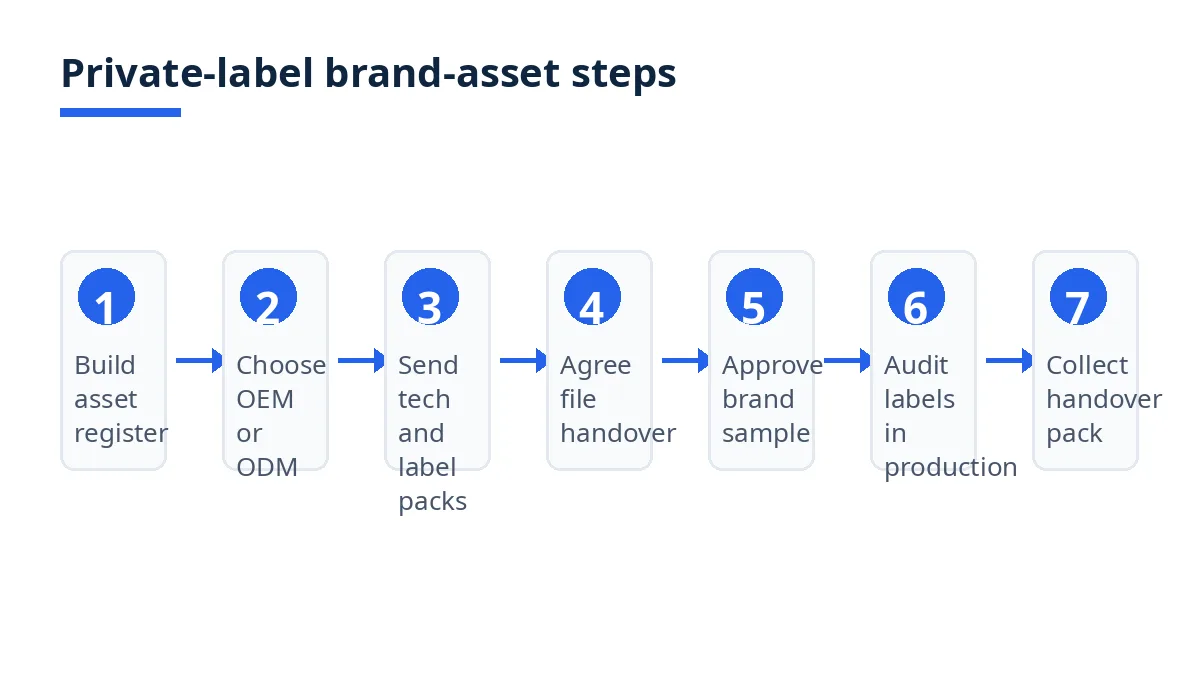
Build the brand asset register before you quote. List your trademark, logo files, label wordings, carton markings and existing pattern or grading files, each with a version number.
Choose OEM or ODM in writing, style by style. State whether the factory works to your tech pack or offers its own pattern, and what exclusivity applies, including whether it may offer the same style to another buyer without your label.
Send one tech pack and one label pack to every candidate. The label pack carries fibre wording, care wording, size markings, country-of-origin wording and the placement of each label. Ask each candidate to confirm it line by line, not only the garment.
Agree file custody and handover before sampling. State who holds the master pattern, grading, artwork and label files during production, in what format they return to you at shipment, and who pays for file preparation.
Approve brand elements on the sample, in writing. Check the woven label, size label, hang tag, waistband branding, print placement and carton marking on the pre-production sample, not only fit and fabric. Photograph the approved labels.
Audit labels during production, not only at shipment. Agree a label check early, when a wrong fibre wording or misspelled brand name can still be corrected. ISO 2859-1 defines sampling schemes indexed by acceptance quality limit (AQL) for lot-by-lot inspection,1 and AQL is the maximum average percentage of defective items considered acceptable during random sampling. Treat label defects as a defect class with its own AQL, so a label error is a counted defect rather than a matter of opinion.
Collect the handover pack at shipment. Receive the final pattern, grading, artwork and label files, the approved sample photographs and a statement of leftover branded stock, and confirm in writing whether that stock is destroyed, held for your repeat, or returned to you.
Costs, timelines and documents
Brand-asset costs sit apart from the garment unit price, and should be quoted apart from it. Ask for pattern and grading work, artwork preparation and print set-up, label and tag runs, carton and packing plates, and sample charges tied to brand elements as separate lines. Inside a single unit price, you cannot tell what you have paid for, what you own, or what a repeat order should cost without them.
What are the typical costs and timelines?
There are no typical private-label costs or timelines a guide can state as fact, because each factory prices your pattern work, artwork, label runs and packing for your specification, and the delivery term changes the comparison. The Incoterms 2020 rules set out 11 rules with a clear allocation of cost, risk and obligations,2 so compare quotations only on the same term and named place. For timelines, ask for brand-asset dates as separate lines, not a single delivery week. A label delay discovered at packing costs a second handling pass for relabelling.
Example figures: a brand pays brand-asset set-up lines of 120 dollars for artwork preparation, 80 dollars for a label plate and 50 dollars for a carton plate. The example figures add to 250 dollars (120 + 80 + 50 = 250). Spread over an order of 5,000 pieces, the example figures give 0.05 dollars per piece (250 divided by 5,000 = 0.05). These are example figures only, not a market price, a typical price, or a price any supplier will offer. The point is the separation: on a repeat order, set-up lines already paid for should not be charged again unless the artwork or the plate has changed.
Which documents are needed?
The brand documents are the asset register, the tech pack, the label pack, the artwork and file register, the ownership and reuse terms, the written sample approval with label photographs, and the handover pack. The shipment documents are the commercial invoice, the packing list and the certificate of origin.
Before anything is loaded, confirm the export set is complete and consistent. The brand owner name on the purchase order must match the buyer name on the export declaration, and loading cannot proceed until Customs has approved the Bill of Export (Shipping Bill).3 The set that accompanies the declaration runs from the commercial invoice and packing list through the authorised-dealer-certified EXP form to the certificate of origin from the Export Promotion Bureau (EPB) or a Chamber of Commerce and Industry, with the export contract or purchase order enclosed where no letter of credit is in place.3
Bangladesh-specific rules and tips
Confirm association claims at the source, and check ODM claims separately. The Bangladesh Knitwear Manufacturers and Exporters Association (BKMEA), established in 1996, is the apex trade body for the knitwear sector and represents approximately 2,540 knitwear member factories.4 Membership signals an active knitwear business, not ownership of a style. If a supplier offers an ODM style as its own, ask for the pattern origin in writing.
Settle the fibre split before you lock the label. A legging worn as trousers falls under the women's and girls' knitted-or-crocheted garments heading, 6104, whose trouser lines divide by fibre — cotton under 610462, synthetic fibres under 610463.5 That split, not the style name, is what the label and the declaration must reflect, so confirm it against the actual fabric composition before the label pack is signed off.
Settle label text at tech-pack stage for each market. If you sell into the European Union, Regulation (EU) No 1007/2011 states that a textile product shall be labelled or marked with the name and percentage by weight of all constituent fibres in descending order.6 A fibre wording agreed at tech-pack stage costs nothing extra to print; one corrected after production costs a relabelling run and a second inspection pass. Apply the same discipline to care wording, size markings and origin wording, and keep one approved label pack per market.
A name mismatch is a payment risk, not a clerical detail. The declaration carries the exporter and the foreign buyer,3 and when the brand owner name differs across the trade licence, quotation, proforma invoice, label pack and payment account, banks and customs both have a reason to pause the file. Align every paper on one legal name before the first shipment is booked.
Mistakes and red flags
What are the most common mistakes?
Assuming the pattern belongs to you because you paid for the garments. Payment for garments is not payment for pattern ownership. If the purchase order does not state who owns the pattern and grading files, the factory can treat them as its working material.
Accepting an ODM style without an exclusivity term. A style offered to you under your label may also be offered to another buyer under a different label. If exclusivity matters, state its scope and duration in writing, or accept that the style is shared.
Approving labels verbally or after production. A verbal label approval leaves no record to inspect bulk against, and an approval given after production leaves no time to correct a fibre wording or spelling error without relabelling.
Leaving artwork and label files with the factory at shipment. Without a handover clause, the master files stay where they were made, the repeat order depends on the same factory, and a move to a new factory starts with regrading and re-artwork.
Leaving leftover branded stock unaccounted for. Woven labels, hang tags and printed cartons carrying your brand have value only to you, and risk only for you, if they leave the factory uncontrolled. State whether leftover branded material is destroyed, held for your repeat, or returned to you, with a count.
Checklist
Before you confirm, every line should be answered in writing.
Brand asset register built, each item versioned.
OEM or ODM stated style by style, with exclusivity scope and duration where claimed.
Tech pack and label pack sent as one pack, with fibre wording per market.6
File custody and handover agreed: master files, format, handover at shipment, cost.
Labels, tags, waistband branding and carton marking approved on the sample, with photographs attached.
Label audit agreed early in production, with label defects as a counted defect class.1
Brand-asset set-up lines itemized apart from the unit price; paid set-ups recorded for repeats.
Leftover branded stock term agreed: destroy, hold for repeat, or return, with a count.
Quotations compared on the same specification and Incoterm.2
Export set agreed, with matching names.3
Handover pack due at shipment: final pattern, grading, artwork and label files, sample photographs.
How Exportain helps
Put the brand terms in front of suppliers from the first enquiry: open the supplier directory, then raise an RFQ on the RFQ board that states, per style, whether the route is OEM or ODM, attaches the label pack, and names the file-handover requirement and delivery term. Replies should then confirm the label pack line by line and declare their file-handover position, and the accepted quotation becomes a single order with a single proforma invoice.7
Treat profile badges as a record of checks already done, not as a quality verdict: the platform's own pages explain what each badge records, and label approval, file handover and inspection remain the buyer's responsibility.7 8
FAQs
What should I know first about private label?
Know what you own before you ask for a price. In an OEM arrangement you supply the design decisions and should record pattern, grading and artwork ownership in the order terms. In an ODM arrangement the factory supplies the pattern, so you need a written statement of reuse rights and exclusivity. A trademark is a sign capable of distinguishing the goods or services of one enterprise from those of other enterprises,9 and the label is that sign in production, so control the label files, plates and approval record as carefully as the garment.
What are the typical costs and timelines?
There are no typical figures a buyer can rely on, because each factory sets its price and lead time for your specification. Pattern and grading work, artwork preparation, label and carton runs and the delivery term drive the brand-asset cost,2 and label artwork approval, label production, sampling, bulk production and the label audit drive the timeline. Ask for set-up lines apart from the unit price, so a repeat order does not pay twice for the same set-up.
Which documents are needed?
Close the job with two bundles, not one. The brand bundle holds the asset register, tech pack, label pack, artwork and file register, the ownership and reuse terms, the written sample approval with label photographs, and the handover pack. The export bundle holds the Bill of Export, commercial invoice, packing list, authorised-dealer-certified EXP form, and the EPB or Chamber certificate of origin.3
What are the most common mistakes?
The most common mistakes are assuming pattern ownership from payment for garments, accepting an ODM style without an exclusivity term, approving labels verbally or after production, leaving artwork and label files with the factory at shipment, and leaving leftover branded stock unaccounted for. A badge is not a guarantee of capacity, quality, delivery or exclusivity.7
Next steps on Exportain
Start from the shortlist: open suppliers, raise your RFQ on the RFQ board with the brand pack summary, label pack and file-handover requirement attached, and ask each quoter to confirm the brand terms in writing. For the surrounding numbers, read the leggings manufacturers in Bangladesh guide, the wholesale leggings in Bangladesh guide and the leggings MOQ guide before you confirm.
Sources
- ISO 2859-1:2026 - Sampling procedures for inspection by attributes — Part 1: Sampling schemes indexed by acceptance quality limit (AQL) for lot-by-lot inspection. ISO (accessed )
- Incoterms® 2020. International Chamber of Commerce (ICC) (accessed )
- Customs Clearance Procedures for Export. Bangladesh Customs, National Board of Revenue (accessed )
- BKMEA at a Glance. BKMEA (accessed )
- Classification Detail — HS Code 6104. United Nations Statistics Division (accessed )
- Regulation (EU) No 1007/2011 on textile fibre names and related labelling and marking of the fibre composition of textile products. European Union, (accessed )
- Trust & Safety Center. Exportain (accessed )
- Supplier verification: Earn trust badges buyers can see. Exportain (accessed )
- Trademarks. World Intellectual Property Organization (accessed )
About the author
Sourcing from Bangladesh?
Post a request for quotation and suppliers on Exportain can send you their quotes directly.
Post an RFQ