

Private Label Knit Dresses Manufacturing in Bangladesh: A Brand Owner's Guide
No single dress MOQ or price applies: what sets the minimum, how to specify a silhouette and size curve, and how to keep the blocks and artwork yours.
Short answer
Private label knit dresses from Bangladesh are made to your silhouette, fabric, print and label specification, and the brand assets to secure in writing are the silhouette blocks and grading, the print and embellishment artwork in its placed form, and the label and care pack. No single MOQ or price applies: each factory sets its minimum and price per style, colour and size curve, so compare quotations only on the same specification and delivery term.
On this page
Key takeaways
A knit dress order stands or falls on silhouette ownership: bodice fit, waist placement, skirt shape and drape intent must be specified in writing, with grading for bodice, waist and skirt separately, or the shape will not survive the size range.
Print and embellishment must be approved in placed form on a sewn sample, panel by panel, because a motif that looks even flat can widen, stretch or split across a flared skirt or a waist seam.
Label and care wording must reflect the finished, embellished dress and the fibre split under HS heading 6104, with one approved pack per market, settled before bulk cutting.
Set-up lines for blocks, artwork, embellishment and labels should be quoted apart from the unit price, and ownership of blocks, grading and placed artwork files should be stated on the purchase order.
A knit dress is bought for how it sits on the body, not for how it looks flat on a table. That fact shapes every decision in a private-label dress order from Bangladesh. Fabric, cut and print can each be right on their own and still produce a dress that pulls at the waist, flares in the wrong place, or carries a print that breaks across a seam. This guide follows silhouette, drape, print and embellishment placement, label pack, and size curve.
The Bangladesh Knitwear Manufacturers and Exporters Association (BKMEA), established in 1996, is the apex trade body for the knitwear sector and represents approximately 2,540 knitwear member factories.1 Knitwear exports reached $5,963.76 million in July to September 2026, up 6.88 percent year on year, within ready-made garment exports of $10,578.56 million, according to Export Promotion Bureau (EPB) data.2 That breadth does not mean two factories hold the same silhouette through a size range.
What should I know first about private label?
Private label means the dress carries your brand: your silhouette, fabric and colour choices, print or embellishment artwork, labels and packing, made to your specification. What you must settle before quoting is which parts of the dress are yours to keep. A silhouette block graded for your fit, a print file placed for your panels, and a size curve built for your customer are brand assets. If the purchase order does not say who owns them, a repeat order or a move to another factory starts from scratch.
In the Harmonized System, heading 6104 covers suits, ensembles, jackets, dresses, skirts, divided skirts, trousers, bib and brace overalls, breeches and shorts (not swimwear), women's or girls', knitted or crocheted, and its dress lines divide by fibre, including cotton under 610442 and synthetic fibres under 610443.3 The fibre split matters twice: it sets the classification line, and it sets the fibre wording on the label. If you sell into the European Union, Regulation (EU) No 1007/2011 states that a textile product shall be labelled or marked with the name and percentage by weight of all constituent fibres in descending order.4
Why this matters for buyers and sellers
For the buyer, the risk is a dress that fits the sample size and fails the range. A bodice graded by enlarging every measurement grows the waist faster than the shoulder, and a skirt with the same flare angle at every size hangs differently on a larger frame. A knit that falls cleanly in a straight skirt can bunch under the arm or swing unevenly in a flared hem, and neither fault shows on a flat measurement sheet.
For the seller, the risk is a specification that changes after cutting. Moving a waist seam, re-scaling a print, or re-grading a bodice after markers are laid means new pattern work, new screens, and fabric already cut to the old shape. Freeze silhouette decisions early, and print decisions panel by panel.
Settle three ownership questions in writing, on the purchase order, before sampling starts: silhouette block and grading, placed artwork, and label and care pack wordings.
Step-by-step: how it works
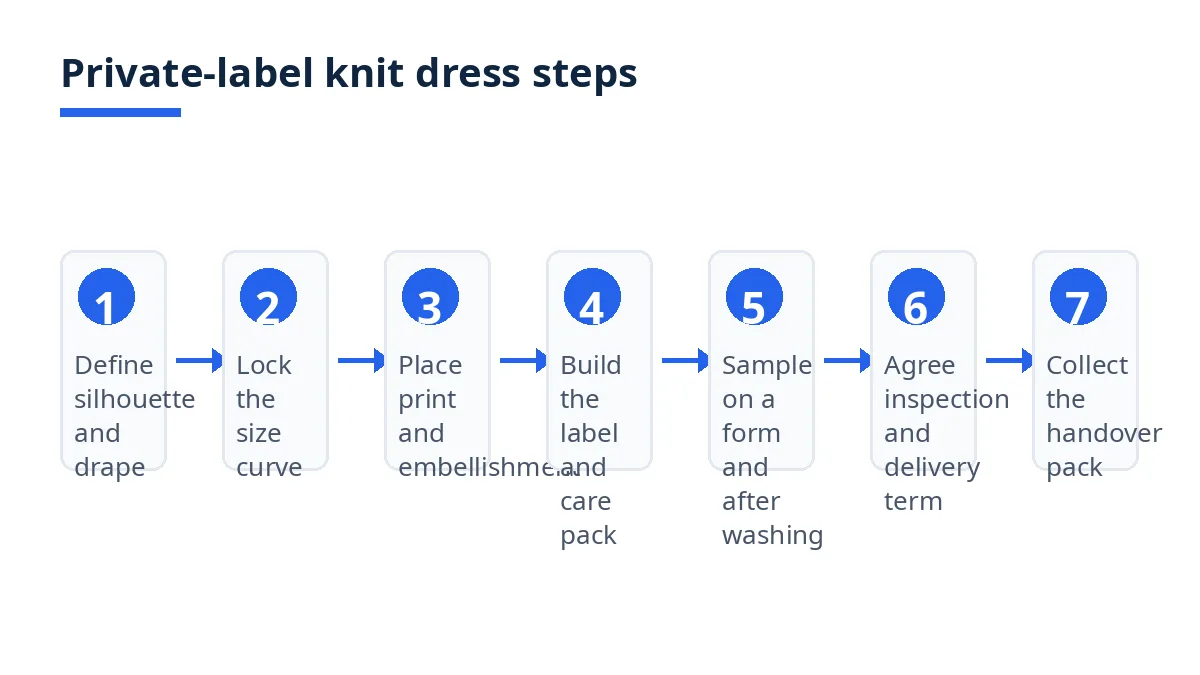
Define the silhouette and the drape intent. State bodice fit (fitted, semi-fitted, or relaxed), waist placement (natural, raised, or dropped), skirt shape (straight, A-line, or flared), sleeve shape, and hem length per size. Add where fabric should fall close, where it should swing free, and how the hem should move, plus the fabric construction, weight, and stretch direction behind that drape.
Lock the size curve before you price the range. Give the full size range, body measurements per size, and grade increments for bodice, waist, and skirt separately: a fitted bodice and a flared skirt do not grade by the same increments. State quantities per size and colour, since the curve decides fabric use and cutting waste.
Place print and embellishment on the panels, not on the flat artwork. State motif, scale, and placement per panel (bodice front, bodice back, skirt panels, sleeves), and behaviour at seams and at the flare. A repeat even on a straight panel widens as a flared skirt widens, and a motif across a waist seam splits at the join. Approve placement on a sewn sample, photographed per panel.
Build the label and care pack for dresses, per market. Write fibre wording, care instructions, size markings, and origin wording word for word, with placement and size for each label. Care wording must reflect the embellishment, not only the base fabric, since beading, sequins, or applied trim can change what washing the dress tolerates.
Sample on a form, in movement, and after washing. Order a proto sample, then a pre-production sample in the actual fabric, colour, print or embellishment, and labels. Fit it on a form across the size range, check the hem line in movement, measure it, wash it to the care label, and measure it again. Check print placement and embellishment attachment after washing, and approve or list corrections in writing, with front, back, and side photos.
Agree inspection and delivery term before you confirm. Write the inspection level and acceptance quality limit (AQL) values into the purchase order. ISO 2859-1 defines a system of acceptance sampling plans for inspection by attributes, indexed by AQL for lot-by-lot inspection,5 and AQL is the maximum average percentage of defective items considered acceptable during random sampling.5 Treat drape faults, print misplacement, and loose embellishment as counted defect classes. State one Incoterm and named place per quotation: the Incoterms 2020 rules set out 11 rules with a clear allocation of cost, risk, and obligations.6
Collect the handover pack at shipment. Receive the final silhouette blocks, grading tables per section, placed print and embellishment files, label artwork, approved sample photographs, and a statement of leftover branded labels and dress boxes, with disposal, holding, or return agreed in writing. Confirm who may reuse each item on a repeat order.
Costs, timelines and documents
Ask for silhouette block and grading work, print artwork and screen set-up, embellishment set-up, label and tag runs, and carton plates as separate lines from the unit price. Inside a single unit price, you cannot tell what you have paid for, what you own, or what a repeat order should cost.
What are the typical costs and timelines?
There are no typical private-label dress costs or timelines a guide can state as fact, because each factory prices your silhouette work, print and embellishment set-up, label runs, size curve, and delivery term for your specification. Compare quotations only on the same specification and Incoterm and named place, since the Incoterms 2020 rules allocate cost, risk, and obligations for each rule.6
For timelines, ask for block and grading, fabric ready, sampling, print approval, production, and inspection dates as separate lines, not a single delivery week. Print approval is the stage most often squeezed, and a motif approved flat but not on a sewn dress costs a second sampling round.
Example figures: set-up lines of 150 dollars for silhouette block work, 110 dollars for print artwork preparation, and 60 dollars for a label plate add to 320 dollars (150 + 110 + 60 = 320). Over 4,000 dresses that is 0.08 dollars per dress (320 divided by 4,000 = 0.08). These are example figures only, not a market price or a price any supplier will offer. On a repeat order, set-up lines already paid for should not be charged again unless the silhouette, artwork, or plate has changed.
Example figures for a size curve: five sizes in the ratio 1-2-3-2-1 total 9 parts. An order of 1,800 dresses gives 200 dresses per part (1,800 divided by 9 = 200), so the sizes run 200, 400, 600, 400, and 200. State the curve and split per size and colour on the quotation and purchase order.
Which documents are needed?
The order documents are the silhouette specification with drape intent, the size curve and grading tables, the placed artwork files, the label and care pack, the itemized quotation, and the purchase order, with the split per size and colour on both. Goods may not be loaded unless an export declaration, the Bill of Export or Shipping Bill, is submitted to Customs and approved.7 Enclosed documents include the export contract or purchase order where there is no export letter of credit, the commercial invoice, the packing list, the EXP form certified by an authorized dealer, and a certificate of origin issued by the EPB or a Chamber of Commerce and Industry.7
Bangladesh-specific rules and tips
Check membership claims with the association, and judge dress capability separately. BKMEA membership, if claimed, is verifiable with BKMEA itself.1 A confirmed membership tells you the firm is an active knitwear business; it tells you nothing about silhouette or print-placement capability or capacity for your size curve. Ask separately which silhouettes the factory cuts in-house, how it places prints across flared panels, and which embellishment work it does in-house.
Settle the fibre split before you lock the label pack. The dress lines under heading 6104 divide by fibre, including cotton and synthetic fibres,3 and the label must reflect the actual fabric composition. A wording agreed at tech-pack stage costs nothing extra to print; one corrected after production costs a relabelling run. In the European Union, fibre names and percentages follow Regulation (EU) No 1007/2011, which requires the name and percentage by weight of all constituent fibres in descending order.4
Keep one legal name across every paper. The export declaration names the exporter and the foreign buyer,7 so the name on the trade licence, quotation, proforma invoice, label pack, and payment account should match. A mismatch gives banks and customs a reason to pause the file, and a paused file at loading stage costs more than a corrected name at order stage.
Mistakes and red flags
What are the most common mistakes?
Approving a print on a flat proof. A motif approved flat can stretch, widen, or split once sewn across a bodice and a flared skirt. Approve placement on a sewn sample, photographed per panel.
Grading the bodice and the skirt by one table. A single increment table distorts one section or the other. Grade bodice, waist, and skirt separately, and check the hem line on a form at the smallest and largest sizes.
Writing care wording for the base fabric only. An embellished dress is washed as a whole. If the care label promises a wash the beading or trim cannot withstand, the first wash breaks the promise. Wash the embellished sample to the care label before approval.
Comparing dress quotations on different silhouettes or terms. A lower price on a straight skirt, a flat print approval, stock labels, or a different delivery term is a different offer. Compare only replies to the same silhouette, the same placed artwork, and the same Incoterm.6
Accepting ownership verbally. Payment for dresses is not payment for blocks, grading tables, or placed artwork files. If the purchase order does not state who owns each item, the factory can treat them as its working material.
A profile opens an enquiry; it proves nothing about dresses. Nothing on a profile shows whether a factory holds your silhouette through a size range, and a badge guarantees neither capacity, quality nor delivery.8
Checklist
Silhouette defined: bodice fit, waist placement, skirt shape, sleeve shape, hem length per size.
Drape intent recorded: where fabric falls close, where it swings, how the hem moves.
Size curve locked: separate grade increments for bodice, waist, and skirt, with quantities per size and colour.
Print and embellishment placed per panel and at seams, approved on a sewn sample with photographs.
Label and care pack written word for word per market, reflecting embellishment wash tolerance.
Pre-production sample fitted on a form, checked in movement, washed to the care label, approved in writing.
Inspection level and AQL values in the purchase order, with drape, print, and embellishment defect classes.5
Quotations compared on the same silhouette, artwork, and Incoterm.6
Ownership stated per item: blocks, grading, placed artwork, label files.
Export set agreed: invoice, packing list, EXP form, certificate of origin, Bill of Export.7
Handover pack due at shipment: blocks, grading, artwork, label files, sample photographs.
How Exportain helps
On Exportain, browse suppliers and post a request for quotation (RFQ) on the RFQ board with your silhouette summary, size curve, placed artwork note, and delivery term, so suppliers quote against the same dress specification. Ask each reply for its grading approach and print placement method. When you accept a quotation, Exportain creates one order and issues one proforma invoice from the accepted terms.8
Read the badges for what they record: verification is a document and photo review by staff, not a factory inspection, and a badge is not a guarantee of capacity, quality, or delivery.8 9 See how supplier verification works on Exportain before treating any badge as evidence of dress capability. For MOQ structure, see the MOQ definition guide, and ask each supplier for its minimum per style, per colour, and per size curve in writing.
FAQs
What should I know first about private label?
Private label means the dress carries your brand and specification, and the three ownership questions to settle first are the silhouette block and grading, the placed artwork, and the label and care pack. Knit dresses sit under HS heading 6104, whose dress lines divide by fibre,3 so the fibre split confirmed for classification is also the fibre wording the label must carry.4
What are the typical costs and timelines?
There are no typical figures a buyer can rely on, because each factory sets price and lead time for your silhouette, fabric, print and embellishment set-up, size curve, label runs, and delivery term. Set-up lines should be quoted apart from the unit price, and timelines as separate lines, compared only on the same Incoterm.6
Which documents are needed?
Keep the commercial papers and the shipment papers apart. The commercial set — silhouette specification with drape intent, size curve and grading tables, placed artwork files, label and care pack, itemized quotation, purchase order — proves what was agreed. The shipment set proves the goods left: Bill of Export, commercial invoice, packing list, EXP form certified by an authorized dealer, and certificate of origin.7
What are the most common mistakes?
The most common mistakes are approving a print on a flat proof, grading bodice and skirt by one table, writing care wording for the base fabric only, comparing quotations on different silhouettes or terms,6 and accepting ownership of blocks and artwork verbally. Each is fixed at specification stage, and expensive after cutting.
Next steps on Exportain
Browse suppliers, then post your silhouette summary, size curve, and delivery term on the RFQ board so suppliers state their grading and print placement approach. Before you confirm, read how supplier verification works on Exportain.
Sources
- BKMEA at a Glance. BKMEA (accessed )
- RMG exports rise 6.10pc to US$10.58b in July-Sept of FY27. The Financial Express, (accessed )
- Classification Detail — HS Code 6104. United Nations Statistics Division (accessed )
- Regulation (EU) No 1007/2011 on textile fibre names and related labelling and marking of the fibre composition of textile products. European Union, (accessed )
- ISO 2859-1:2026 - Sampling procedures for inspection by attributes — Part 1: Sampling schemes indexed by acceptance quality limit (AQL) for lot-by-lot inspection. ISO (accessed )
- Incoterms® 2020. International Chamber of Commerce (ICC) (accessed )
- Customs Clearance Procedures for Export. Bangladesh Customs, National Board of Revenue (accessed )
- Trust & Safety Center. Exportain (accessed )
- Supplier verification: Earn trust badges buyers can see. Exportain (accessed )
About the author
Sourcing from Bangladesh?
Post a request for quotation and suppliers on Exportain can send you their quotes directly.
Post an RFQ


