Private Label Formal Suits Manufacturing in Bangladesh: A Brand Owner's Guide
Private-label formal suits are judged as a matched set. Fix the canvas, lapel and shoulder shape, set fit, cloth lot, brand trims and pressed finish in writing before bulk production, and approve a pressed set sample.
Short answer
Private-label formal suits from Bangladesh are ordered as a matched set, not as two separate garments. Fix the canvas method, lapel and shoulder shape, jacket and trouser fit charts, cloth lot rule, brand trims and lining, and pressed finish in writing before bulk production, then approve a pressed set sample and agree inspection and one delivery term.
On this page
Key takeaways
A private-label suit is judged as a matched set: the jacket and trouser must share cloth lot, shade, fit standard and pressed finish, or the set fails as a whole.
The canvas method, lapel width and gorge height, shoulder line and padding, and button stance are brand decisions to name in the tech pack, not details to leave to a sample photograph.
Approve the jacket and trouser fit charts together, with tolerances and trouser break, and approve a pressed full-suit sample showing lapel roll, collar sit, crease and break.
Buttons, lining print, undercollar wording and labels form the brand trim set; any lining substitution needs a fresh sample and a written approval.
Exportain verification is a document and photo review, not a factory inspection, and a badge is not a guarantee of suit capability, quality or delivery.
A formal suit is sold as a set, and a private-label suit is judged as a set. A jacket that holds its shape means little if the trouser in the same suit fades to a different shade, sits at a different waist height, or arrives with a lining print that does not match the jacket. A brand owner ordering suits from Bangladesh therefore has to fix the suit as one system: the cloth, the canvas inside the jacket, the lapel and shoulder shape, the fit of both pieces, the brand trims, and the pressed finish.
A private label means the suit carries your brand name, labels and packaging, made to your specification. For suits, the brand decisions include the jacket construction, lapel width and roll, shoulder line, button stance, trouser cut and break, lining, undercollar wording, and the way the set is pressed and packed.
In classification terms, heading 6203 covers men's or boys' suits, ensembles, jackets, blazers, trousers, bib and brace overalls, breeches and shorts, other than swimwear, not knitted or crocheted.1 A two-piece suit, a jacket sold with its matching trouser, and a separate jacket or trouser therefore sit in the same heading family, but they are not the same order. State on the enquiry whether you are ordering a matched set, a jacket only, or a trouser only, and whether the jacket and trouser must come from the same cloth lot.
What should I know first about private label?
Start with the canvas, because it decides how the jacket behaves after it is worn and pressed. A fused jacket uses an adhesive interlining bonded to the front panels. A half-canvas jacket uses a canvas through the chest and lapel area, with the lower front fused or free. A full-canvas jacket uses a canvas through the full front. Each method changes the drape, the way the lapel rolls, the pressing routine, and the cost of materials and handwork. Do not leave the canvas method to a sample photograph. Name it in the tech pack, and require the bulk jacket to use the same method as the approved sample.
Next, fix the suit fit standard as a set standard, not as two separate garment standards. A jacket measurement chart and a trouser measurement chart approved on different dates can drift apart. Approve them together, on the same fit model or dress form, in the same cloth, with the jacket buttoned and the trouser worn at the waist height your customer expects. Record the jacket length, chest, shoulder, sleeve length, trouser waist, seat, thigh, knee, hem width and trouser break in one document, with tolerances for each point, and require the factory to measure the pre-production sample against that same document.
Why this matters for buyers and sellers
For the buyer, the suit risk is mismatch. Cloth shade can vary between lots, lining can be substituted when a lot runs short, and a lapel that rolled cleanly on a sample can flatten when the pressing routine changes in bulk. Each fault is small on its own, but together they break the impression of a single suit. A customer who tries a jacket and trouser that do not look related will return the set, not one piece.
For the seller, the suit risk is rework that cannot be undone cheaply. Once a jacket front is fused, a lapel is pressed, or a trouser is hemmed to the wrong break, the correction often means remaking the piece. Clear canvas, fit and finish standards remove the need to guess what the brand expects.
Labelling is part of the brand standard, not an afterthought. For a textile product sold into the European Union, Regulation (EU) No 1007/2011 states that a textile product shall be labelled or marked with the name and percentage by weight of all constituent fibres in descending order.2 A suit label pack therefore has to state the shell cloth, the lining and any other textile component correctly, in the wording your market requires. Give the factory the exact label wording, fibre composition, care wording, size marking and country-of-origin wording, and require a photograph of every label in place before bulk production.
Suit element | Brand decision to fix in writing | Why it matters for the set |
|---|---|---|
Canvas | Fused, half-canvas or full-canvas, with weight | Sets drape, lapel roll and pressing routine |
Lapel and shoulder | Lapel width, gorge height, shoulder line and padding | Gives the jacket its recognisable silhouette |
Fit standard | Jacket and trouser charts approved together, with tolerances | Keeps both pieces in proportion across sizes |
Cloth lot | Same lot for jacket and trouser in a set | Prevents shade difference inside one suit |
Brand trims | Buttons, lining print, undercollar, labels | Carries the brand where the customer looks |
Pressed finish | Pressing standard and sample for jacket and trouser | Decides how the set looks on first opening |
Example figures: a brand orders 600 suits split across three cloth colours at 200 suits per colour. If the jacket cloth and the trouser cloth are drawn from different lots, one colour can still show a visible shade gap inside the set even though the total quantity looks large. The example shows structure only, not a typical MOQ, price or lead time.
Step-by-step: how it works
Follow the steps in suit order, working from the inside of the jacket outward, so that each approval locks the next decision in place.
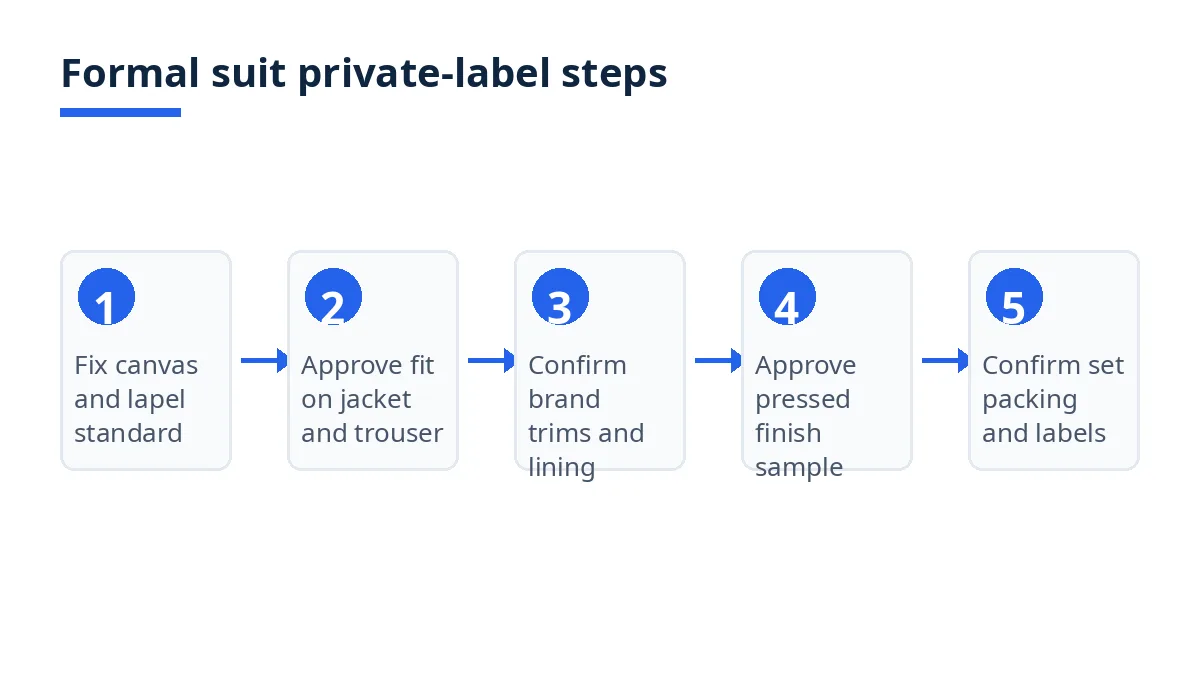
Fix the canvas and lapel standard first. State the canvas method, the lapel width and gorge height, the shoulder line and padding, and the button stance. Ask the factory to make a jacket shell sample in your cloth showing the lapel roll and shoulder before lining or trim is added.
Approve fit on the jacket and trouser together. Send one size chart for the set, with the jacket and trouser points, tolerances and trouser break. Fit the sample as a set, note corrections on both pieces in one document, and do not approve the jacket while the trouser is still unmeasured.
Confirm brand trims and lining as a set. List the buttons, buttonhole finish, sleeve button count, lining cloth and print, undercollar wording, woven labels, size labels, hang tags and spare button provision. Confirm that the lining lot covers the full order.
Approve a pressed finish sample. Ask for one full suit pressed to your standard, photographed front and back, with the lapel roll, collar sit, trouser crease and hem break visible. Write the pressing points into the purchase order.
Agree inspection and one delivery term before you confirm. Write the inspection level and acceptance quality limit values into the purchase order, following ISO 2859-1, which defines a system of sampling plans for inspection by attributes.3 State one Incoterm and named place for every quotation. The Incoterms 2020 rules set out 11 rules with a clear allocation of cost, risk and obligations,4 so compare quotations only on the same term.
Confirm set packing before bulk cutting ends. State how the jacket and trouser are folded or hung, how they are paired in the carton, what carton marking identifies the suit, and how a split pair is prevented. A suit packed as two unrelated garments is easy to split in a warehouse.
Costs, timelines and documents
What are the typical costs and timelines?
There are no typical costs or timelines a guide can state as fact, because each factory prices your cloth, canvas method, lapel and shoulder work, lining, buttons, labels, pressing and packing, and the delivery term you choose.4 A full-canvas jacket, a printed lining and hung packing each add cost that a fused jacket with a plain lining does not carry, so compare quotations only on the same canvas, trim and packing specification.
For timelines, cloth availability usually sets the start. Imported suiting cloth, a printed lining and a custom button each have their own lead time, and bulk production cannot start until the longest is in hand. Ask for cloth ready, sample approval, bulk production, pressing, inspection and shipment dates as separate lines, not a single delivery week.
Which documents are needed?
The order documents are the tech pack, the set size chart, the label pack, the itemized quotation and the purchase order, with the canvas method, the cloth lot rule for matched sets, the trim list and the pressed finish standard on each. For export clearance, confirm the current Bill of Export procedure with your supplier or agent, following the Bangladesh Customs guidance for export clearance.5
Bangladesh-specific rules and tips
Ask which suiting inputs are imported for your order. Suiting cloth, canvas, lining and buttons are often bought in for a specific brand specification, and an imported cloth or button can set both the minimum quantity and the earliest production date. Ask the factory to name the cloth lot size and reorder position for your colour before you confirm, so a repeat suit can be cut from a matching lot.
One legal name on every paper. Check the trade licence, quotation, proforma invoice and payment account against each other before the purchase order: the export declaration itself names the exporter and the foreign buyer,5 so any name that drifts between documents can hold clearance up once the file is compared.
Check the set, not only the sample room. Ask to see a finished suit from a current bulk run, pressed and packed as it will ship. Check the lapel roll, trouser crease and break, lining print alignment, and whether jacket and trouser in one carton share the same shade.
Plan for shade control across sizes and repeats. A range cut across several weeks can drift in shade if a second lot is introduced without a check. Require shade approval for each new lot, with jacket and trouser cut from the approved lot together.
Mistakes and red flags
What are the most common mistakes?
Approving the jacket and ignoring the trouser. A jacket approval without a trouser approval leaves half the suit untested, so approve the set together.
Leaving the canvas method unnamed. A quotation that says only "suit jacket" can be priced on a fused front while the sample used a canvas chest, and the lapel and drape will differ.
Accepting a lining substitution without a new approval. Any lining substitution needs a fresh sample and a written approval, not a verbal note.
Comparing prices on different canvas, trim and packing specifications. Compare only replies to the same tech pack on the same Incoterm.4
Treating a profile or a badge as a guarantee of suit capability. A profile does not prove that a factory can hold a lapel roll, a shoulder line and a set shade across a bulk run, and a badge is not a guarantee of capacity, quality or delivery.6
Skipping the pressed-finish check to save time. Under ISO 2859-1, sampling measures a lot against an agreed acceptance quality limit,3 and that measurement should cover the pressed finish, lapel, collar sit and trouser crease — the details a buyer notices first.
Checklist
Before you confirm, every line should be answered in writing.
Canvas method named: fused, half-canvas or full-canvas, with weight.
Lapel width, gorge height, shoulder line, padding and button stance fixed.
Jacket and trouser size charts approved together, with tolerances and trouser break.
Cloth lot rule stated: jacket and trouser in a set from the same lot.
Buttons, buttonholes, lining print, undercollar wording and labels confirmed as a set.
Pressed finish sample approved, with lapel roll, collar sit, crease and break visible.
Shade approval required for each new cloth lot, recorded against the shipment.
Inspection level and acceptance quality limit values in the purchase order.3
Quotations compared on the same canvas, trim, packing specification and Incoterm.4
Set packing confirmed: pairing, carton marking and split-pair prevention.
How Exportain helps
On Exportain, browse suppliers and post a request for quotation on the RFQ board with your canvas method, set size chart, trim list and pressed finish standard, so suppliers quote against the same suit specification. Read the badges for what they record on the supplier verification page: verification is a document and photo review, not a factory inspection, so sample approval and inspection stay with you.6 7
FAQs
What should I know first about private label?
A private label means the suit carries your brand, made to your specification. The decisions that matter most are the canvas method, lapel and shoulder shape, set fit standard, cloth lot rule, brand trims and lining, and pressed finish. Fix each in writing before bulk production.
What are the typical costs and timelines?
No buyer can rely on typical figures here, because each factory prices and schedules your cloth, canvas method, lining, buttons, labels, pressing, packing and delivery term separately.4 Ask for each stage as its own date.
Which documents are needed?
The order documents are the tech pack, the set size chart, the label pack, the itemized quotation and the purchase order, with the canvas method, cloth lot rule, trim list and pressed finish standard on each. For export clearance, confirm the current Bill of Export procedure with your supplier or agent, following the Bangladesh Customs guidance.5
What are the most common mistakes?
The most common mistakes are approving the jacket without the trouser, leaving the canvas method unnamed, accepting a lining substitution without a new approval, comparing prices on different specifications or terms,4 and reading a badge as a guarantee.6
Next steps on Exportain
After browsing suppliers, raise your canvas method, set size chart and trim list on the RFQ board, so replies state their suit specification directly. Before confirming, read how supplier verification works on Exportain and the MOQ guide.
Sources
- Classification Detail — HS Code 620312. United Nations Statistics Division (accessed )
- Regulation (EU) No 1007/2011 on textile fibre names and related labelling and marking of the fibre composition of textile products. European Union, (accessed )
- SIST ISO 2859-1:2003 - Sampling procedures for inspection by attributes, Part 1: Sampling schemes indexed by acceptance quality limit (AQL). International Organization for Standardization, (accessed )
- Incoterms® 2020. International Chamber of Commerce (ICC) (accessed )
- Customs Clearance Procedures for Export. Bangladesh Customs, National Board of Revenue (accessed )
- Supplier verification: Earn trust badges buyers can see. Exportain (accessed )
- Trust & Safety Center. Exportain (accessed )
About the author
Sourcing from Bangladesh?
Post a request for quotation and suppliers on Exportain can send you their quotes directly.
Post an RFQ