Private Label Duvet Covers Manufacturing in Bangladesh: A Brand Owner's Guide
Private label duvet covers from Bangladesh: how a brand owner controls labels, shade, closures, packing and wash consistency across a whole duvet range, from brand book to repeat order.
Short answer
Private label duvet covers from Bangladesh put your brand on the cover: your label wording, shade standard, closure and corner-tie specification, packing system and care promise. This guide shows a brand owner how to write those decisions into a brand book, approve them across a range sample, and hold them lot by lot and repeat by repeat.
On this page
Key takeaways
Private label means you own the brand decisions: label set, shade standard, closure and tie specification, packing system and care promise.
In the EU, fiber names and percentages must appear in descending order by weight, and in the US the label must show fiber content, identity and origin.
Approve a range sample across closure types, color families and matching pillowcases, washed by the care label, before bulk production.
Judge shade, labels and packing lot by lot against a sealed reference set, not against the last shipment alone.
Exportain verification is a document and photo review, not a factory inspection, and a badge is not a guarantee.
Private label changes what a duvet cover order is. You are not only buying covers in a size and color. You are putting your brand name, label wording, packaging and care instructions on a product that customers will judge as yours, wash after wash. This guide is for a brand owner who wants that range to look, feel and wash the same way across every design, size and repeat order from Bangladesh.
A private label order therefore needs a different control point from a plain wholesale order. The factory makes the cover, but you own the brand decisions: the label set, the shade standard, the closure and corner-tie specification, the packing system and the wash behavior the care label promises. Written down once, approved on samples and checked the same way on every lot, those decisions hold the range together.
Why this matters for buyers and sellers
For the buyer, private label is a brand risk as much as a product order. A customer who buys two covers from the same range expects the same shade, the same closure action and the same fit over the insert. A cover that shrinks differently from its matching pillowcases reads as a different brand, even when each piece passes on its own.
For the seller, private label work is repeatable only when the brand rules are fixed. A mill that knows your label artwork, shade standard, closure type and packing layout can plan dye lots, label print runs and carton layouts around them. A late change to artwork or shade can force a reprint, a repack or a delay that neither side wanted.
Label law is part of that brand control, not an extra at the end. In the European Union, a textile product shall be labeled or marked with the name and percentage by weight of all constituent fibers in descending order.1 In the United States, every covered textile product must carry a label showing fiber content, manufacturer or dealer identity and country of origin, with fiber content listed by generic name in order from highest to lowest percentage and identity shown by full business name or by a Registered Identification Number (RN) issued by the Federal Trade Commission.2 A brand owner who controls the label artwork controls the legal statement on the product, and must check that it matches the fabric actually bought.
Care labelling carries the same weight. ISO 3758:2023 establishes a system of graphic symbols for marking textile articles with information on the most severe treatments that do not cause irreversible damage during textile care, in the order washing, bleaching, drying, ironing and professional textile care.3 Your care label is a promise about washing that the range must keep after repeated washing, not only on the first sample.
Step-by-step: how it works
The steps below keep brand control with you while the factory keeps production control. Work through them in order, and keep every approval in writing.
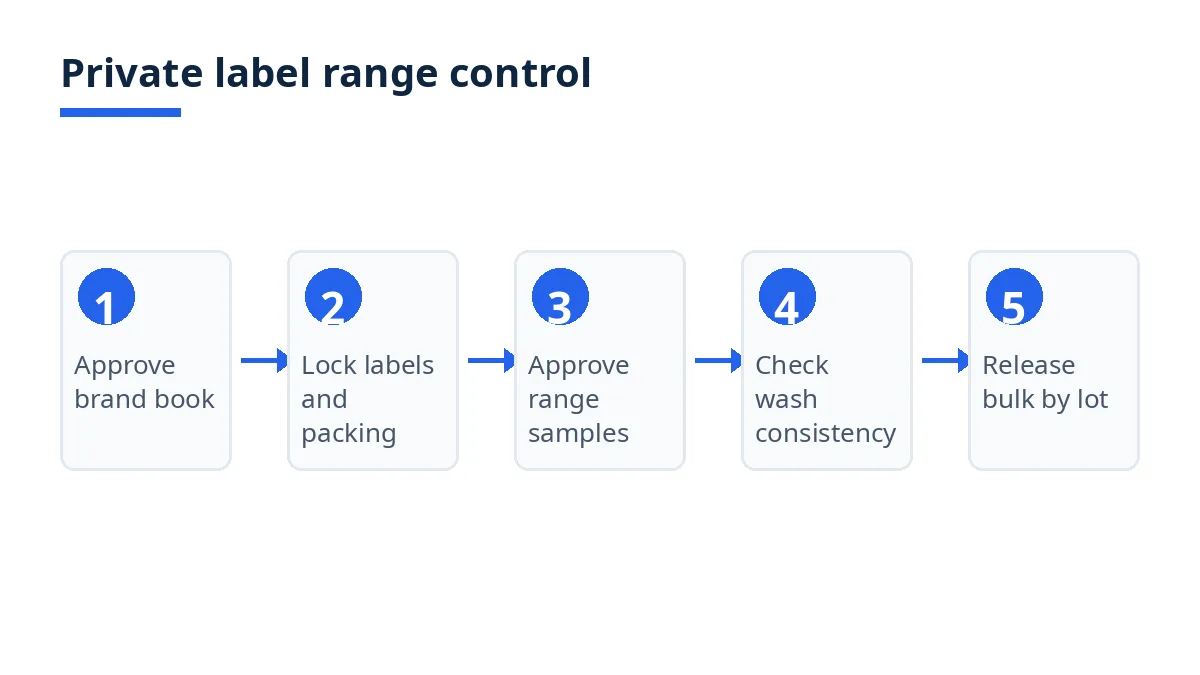
Write the brand book before you ask for a price. Record your brand name and logo use, the label set, shade standard, fabric composition, closure type and position, corner-tie specification, size range, packing layout and barcode system. Send the same brand book to every candidate supplier.
Fix the label set as one artwork package. Include the main label, the fiber and care label, the size label, any hang tag and the carton marking. Confirm fiber wording, care symbols, size wording and origin wording for each market separately.
Approve a range sample, not a single cover. Ask for at least one cover in each closure type, one in each color family and one matching pillowcase where the cover is sold as a set. Fit each sample over its named insert, work the closure, tie the insert in at the corners and wash it by the care label before you approve.
Lock the shade and wash standard in writing. Name the approved shade standard for each color, the light under which shade is judged and the wash procedure the range must survive.
Agree the lot and repeat rules before bulk starts. State how shade, labels and packing are checked lot by lot, how a new dye lot is approved against the standard, and what happens to a lot that does not match.
Check the range as a range at final inspection. Sample across designs, sizes and colors, and check shade across a complete set, closure action on every sampled cover and label wording on every sampled carton.
Keep a sealed reference set. Retain one approved sample of each design, with its label set and packing, as the reference for the next order.
Costs, timelines and documents
What are the typical costs and timelines?
There are no typical private label costs or timelines that a guide can state as fact, because each range prices its own fabric, label print runs, closure and tie specification, packing system and delivery term. Artwork approval, label print runs, hang tags, carton printing and barcode work are fixed for the range, while fabric and sewing move with quantity and design count. Ask for those fixed brand costs as separate lines.
For timelines, separate the brand timeline from the production timeline. Artwork, shade and range-sample approval sit before bulk production, and each correction round adds time. Ask for sampling, artwork ready, shade approval, bulk production and inspection dates as separate lines.
Example figures: a brand range of four designs in two color families carries one label artwork package, four shade standards and one packing layout. The example shows structure only, not a typical price, minimum or lead time. The fixed artwork and label lines are shared across the four designs, while fabric, sewing and packing move with each design.
Which documents are needed?
The brand documents are the brand book, the approved label artwork package, the shade standard, the size chart, the packing specification and the purchase order that names all of them. The order documents are the itemized quotation and the purchase order, with the closure, tie, label and packing specification on both.
For export clearance in Bangladesh, goods shall not be loaded or stuffed for export unless an export declaration, known as the Bill of Export or Shipping Bill, is submitted to Customs and approved.4 Documents enclosed with the Bill of Export include the export letter of credit or, where there is none, the export contract or purchase order, the commercial invoice, the packing list, the EXP form certified by authorized dealers and a certificate of origin issued by the Export Promotion Bureau (EPB) or a Chamber of Commerce and Industry.4
Classification sits behind the documents. Heading 6302 covers bed linen, table linen, toilet linen and kitchen linen, with bed linen split by knitted or crocheted construction, printed or unprinted state and fiber.5 Confirm the full national code for each design before you price or ship.
The delivery term belongs in the same document set. The Incoterms 2020 rules provide 11 rules with a clear allocation of cost, risk and obligations.6 State one Incoterm and named place for every quotation.
Brand cost or control | Why it is separate | Record it as |
|---|---|---|
Label artwork package | Fixed for the range, reused on repeats | Artwork version and approval date |
Shade standard per color | Judged lot by lot against one standard | Standard reference and light condition |
Closure and tie specification | Decides fit and wash behavior | Type, position, length and stitching |
Packing and carton system | Carries brand, barcode and size marking | Layout, carton count and marking |
Wash and care promise | Must hold across the whole range | Care symbols and wash procedure |
Bangladesh-specific rules and tips
Keep one brand name and one legal name across every paper. The export declaration specifies the name of the exporter and the name of the foreign buyer or importer.4 The name on the trade licence, quotation, proforma invoice and payment account should match the name on the label identity line for your market.
Approve shade by standard, not by screen or memory. Keep a physical shade standard for each color, judge sampled covers and pillowcases under the same light, and approve a new dye lot against that standard before it is cut.
Test wash durability across the range, not on one design. ISO 5077 specifies a method for determining the dimensional change of fabrics, garments or other textile articles when subjected to a specified combination of washing and drying procedures, with specimens conditioned and measured before treatment and again after drying.7 Apply the same wash procedure to each color family and closure type in the range.
Treat substance claims as a whole-product claim. Under OEKO-TEX STANDARD 100, the certificate and label are only awarded if all components of an item meet the required criteria without exception, including outer fabric, sewing threads, lining, dyes, finishes and prints and non-textile accessories such as buttons, rivets or zips.8 If your brand will carry such a claim, check the scope and components covered for the finished cover, not only for the fabric.
Agree inspection before production, not at the port. ISO 2859-1 defines a system of acceptance sampling plans for inspection by attributes, and acceptance quality limit (AQL) is the maximum average percentage of defective items considered acceptable during random sampling, used to determine sample sizes and acceptance or rejection thresholds.9 Write the inspection level and AQL values into the purchase order, and sample across the range.
Mistakes and red flags
What are the most common mistakes?
Approving one cover and assuming the range. A single approved sample does not approve a shade family, a second closure type or a matching pillowcase.
Letting the factory choose the label wording. A supplier may use a fiber name, care symbol or origin phrase that suits its own market. Check every word against your market rules before bulk label printing begins.1 2
Changing artwork after bulk labels are printed. A late change can force a reprint of the whole label run and a repack of finished covers. Freeze artwork at the range-sample stage.
Judging shade design by design. Shade must be judged across a complete set and across the range, not design by design.
Treating a repeat order as a copy of the last shipment. Judge every repeat against the sealed reference set and the original shade standard.
Reading a badge as a brand guarantee. A profile badge records a document and photo review. It does not test whether a supplier can hold your shade, closure and wash standard across a range.10
Checklist
Before you confirm a private label range, every line should be answered in writing.
Brand book sent: brand name, logo use, label set, shade standards, closure and tie specification, sizes, packing and barcode system.
Label artwork package approved per market: fiber wording, care symbols, size wording and origin wording.1 2 3
Range samples approved: each closure type, each color family and each matching pillowcase, washed by the care label.
Shade standard and judging light recorded per color, with new dye lot approval against the standard.
Wash procedure and dimensional change method agreed for each color family and closure type.7
Inspection level and AQL values in the purchase order, sampled across the range.9
Substance or certification claims checked for the finished cover, including threads, trims and closures, where a claim will be used.8
Packing layout, carton marking and barcode system approved, with carton counts per design.
Export set agreed: Bill of Export, commercial invoice, packing list, EXP form and certificate of origin.4
Delivery term stated as one Incoterm and named place for every quotation.6
Sealed reference set retained: one approved sample of each design with its label set and packing.
How Exportain helps
On Exportain, browse suppliers and post your brand book summary, range structure and delivery term on the RFQ board, so suppliers quote against the same brand specification. Ask each reply how it will hold shade, closure and wash consistency across the range.
Read the badges for what they record. Exportain Verified means Exportain has checked identity, phone, email and business registration, and Export Verified means it has checked the Export Registration Certificate (ERC).10 Factory Verified means it has reviewed photos of the manufacturer factory, while Trading Company Verified means it has reviewed photos of the trading company office or warehouse.10 Verification is a document and photo review by staff, free, and never granted by membership plans.10 11 It is not a factory inspection,10 11 so range-sample approval and inspection stay with you. See the how to import duvet covers from Bangladesh guide and the duvet covers quality control checklist for the import and inspection points beside this brand guide.
FAQs
What should I know first about private label?
Private label means you own the brand decisions on the product: the label set, the shade standard, the closure and tie specification, the packing system and the care promise. Start with that book, approve a range sample across designs and colors, and keep a sealed reference set for repeats.
What are the typical costs and timelines?
There are no typical private label costs or timelines a guide can state as fact. Artwork, label print runs, hang tags, carton printing and barcode work are fixed for the range, while fabric, sewing and packing move with design count and quantity. Artwork, shade and range-sample approval come before bulk production, and each correction round adds time.
Which documents are needed?
The brand documents are the brand book, the approved label artwork package, the shade standard, the size chart, the packing specification and the purchase order naming all of them. The export set enclosed with the Bill of Export includes the export contract or purchase order where there is no export letter of credit, the commercial invoice, the packing list, the EXP form certified by authorized dealers and a certificate of origin issued by the EPB or a Chamber of Commerce and Industry.4
What are the most common mistakes?
The most common mistakes are approving one cover instead of the range, letting the factory choose label wording, changing artwork after bulk labels are printed, judging shade design by design, treating a repeat as a copy of the last shipment and reading a badge as a guarantee. Each is prevented by a written brand book, a range sample and a sealed reference set.
Next steps on Exportain
Browse suppliers, then post your brand book summary and range structure on the RFQ board so suppliers quote on the same brand specification. Before you confirm, read the how to import duvet covers from Bangladesh guide and check the Trust and Safety Center for what each badge records.
Sources
- Regulation (EU) No 1007/2011 on textile fibre names and related labelling and marking of the fibre composition of textile products. European Union, (accessed )
- Textile Fiber Products Identification Act: Labeling Rules. LegalClarity (accessed )
- ISO 3758:2023 Textiles — Care labelling code using symbols. International Organization for Standardization (accessed )
- Customs Clearance Procedures for Export. Bangladesh Customs, National Board of Revenue (accessed )
- HS 2017 - Code 6302: Bed linen, table linen, toilet linen and kitchen linen. United Nations Statistics Division (accessed )
- Incoterms® 2020. International Chamber of Commerce (ICC) (accessed )
- ISO 5077:2007 — Textiles — Determination of dimensional change in washing and drying. International Organization for Standardization (ISO), (accessed )
- OEKO-TEX STANDARD 100 for textiles tested for harmful substances. Hohenstein (accessed )
- ISO 2859-1:2026 - Sampling procedures for inspection by attributes — Part 1: Sampling schemes indexed by acceptance quality limit (AQL) for lot-by-lot inspection. ISO (accessed )
- Trust & Safety Center. Exportain (accessed )
- Supplier verification: Earn trust badges buyers can see. Exportain (accessed )
- supplier verification
- buyer guide
- Bangladesh sourcing
- home textiles
- Duvet covers
- Private label
- Brand packaging
About the author
Sourcing from Bangladesh?
Post a request for quotation and suppliers on Exportain can send you their quotes directly.
Post an RFQ