

Private Label Denim Jackets Manufacturing in Bangladesh: A Brand Owner's Guide
Private label denim jackets from Bangladesh: set the wash standard, approve hardware as one branded set, and specify the lining before you ask for a price, so suppliers quote the same jacket.
Short answer
A private label denim jacket order from Bangladesh starts with three brand decisions: the wash standard set by a reference garment, the hardware approved as one branded set mounted on denim, and the lining specified by coverage, fabric and print. Settle those in the tech pack before asking for a price, because they drive the quotation, the sample rounds and the quality checks.
On this page
Key takeaways
A private label denim jacket is defined by its wash, its hardware and its lining as much as by its silhouette, so all three belong in the tech pack before any price is requested.
Approve wash shade on a washed jacket in the actual denim against a signed reference garment, and approve buttons, rivets, zip pullers and snaps as one hardware card mounted on denim.
Specify the lining by coverage, fabric and print, and confirm the neck label, size label, care label, back patch and hangtag in their jacket positions.
There is no typical price or lead time for a private label denim jacket: each factory prices the denim, wash method, branded hardware, lining and label set for the buyer's specification.
Verification on Exportain is a document and photo review, not a factory inspection, and sample approval and inspection stay with the buyer.
A private label denim jacket is not a generic woven order with a logo added at the end. The jacket itself carries the brand: the metal buttons and rivets, the wash shade, the lining print, the leather patch and the neck label all have to match the standard a buyer sets before cutting starts. Bangladesh is a practical place to source that jacket, because denim is an established part of its woven garment trade. Bangladesh remained the largest denim supplier to the European Union in the first eight months of 2026, with January to August shipments of 869.13 million euros and an August share of about 31.2 percent of EU denim imports.1 Woven garments, the category a denim jacket sits in, reached 4,614.80 million dollars of Bangladeshi ready-made garment exports in July to September 2026, up 5.11 percent year on year.2
That scale does not remove the brand work. A denim jacket order fails most often on a wash that drifts between batches, hardware that arrives in the wrong finish, or a lining that was never specified as a brand surface. This guide walks through the jacket-specific decisions a brand owner should settle before placing the order, so the factory quotes against the same jacket, not a rough idea of one.
Why this matters for buyers and sellers
For the buyer, a denim jacket is a signature piece. Customers judge it by hand feel, wash shade, hardware weight and fit across the shoulders and body, and those qualities are hard to fix after bulk cutting. Settling the wash reference, the hardware set and the lining treatment in the tech pack protects the retail price, because a jacket that arrives in the wrong shade or with mixed hardware cannot be sold as the planned style.
For the seller, the jacket order is a wash and trim commitment as much as a sewing commitment. Denim fabric, wash chemicals and laundry capacity have to be booked for the shade, and buttons, rivets, zips and labels are made or bought for the brand. A clear brand standard lets the factory reserve the right wash line and hardware lot, while a vague brief forces rework that eats the margin on both sides.
The trade association picture supports starting the search in the woven sector. The Bangladesh Garment Manufacturers and Exporters Association represents the woven, knitwear and sweater sub-sectors, and around 60 percent of its member factories are woven garment manufacturers, with member factories accounting for 100 percent of the country's woven garment exports.3 Membership on its own proves nothing about one factory's jacket capability, so the buyer still checks wash, hardware and lining competence directly.
Step-by-step: how it works
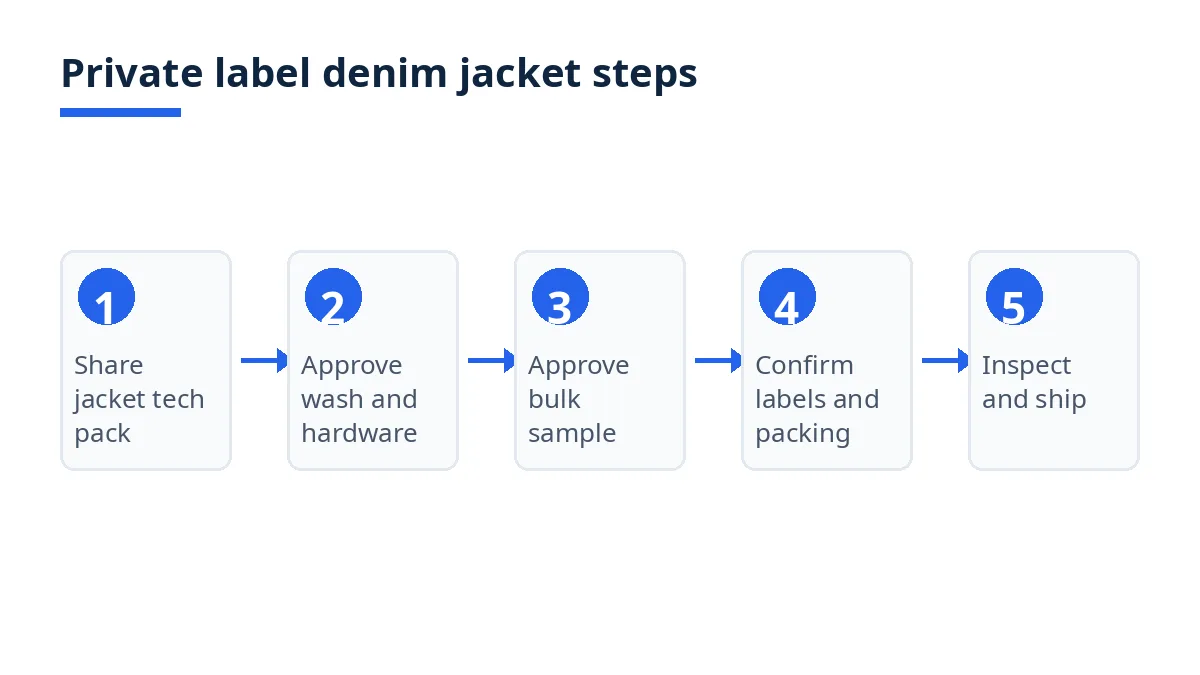
Write the jacket tech pack first. State the silhouette (trucker, oversized, cropped or long), body and sleeve measurements, shoulder and collar construction, pocket layout, button stance, fabric weight and stretch, wash name and shade, hardware set, lining and pocketing, label set and packing. A jacket tech pack without a wash reference and a hardware list is incomplete.
Set the wash brand standard. Agree one physical wash reference garment, a shade tolerance described in words both sides sign, and the wash method (stone, enzyme, bleach or a combination) with any distressing or whisker placement marked on a photo. Approve the wash on the actual denim, not on a swatch alone, because denim shade shifts with the fabric lot.
Approve hardware as a branded set. Send the button, rivet, zip puller and snap specifications together: base metal, finish, size, engraving or debossing of the brand name, and the backing and shank type. Order a hardware card showing every piece mounted on denim, and keep one signed card as the bulk reference.
Treat the lining as brand identity. Decide whether the jacket is unlined, half-lined or fully lined, and specify the lining fabric, its print or colour, and any brand print on the pocketing. A printed lining or a branded inner pocket is part of the jacket's identity, and it needs its own artwork file and colour approval, separate from the outer label.
Approve labels in their jacket positions. Confirm the neck label, the size label, the care label, the leather or faux-leather back patch and the hangtag, each with its position, size, attachment method and artwork. A patch that is stitched in the wrong place or a neck label sewn at the wrong angle reads as a defect even when the jacket is well made.
Run a proto, then a wash-approved bulk sample. Check the proto for fit and construction, then check the bulk sample after washing for shade against the reference garment, hardware finish after washing, lining behaviour and label positions. Approve or list corrections in writing, and record which sample version the bulk must match.
Confirm packing by jacket, not by carton only. State whether jackets are folded, hung or bagged, how hardware is protected against scratching in transit, and what goes on the carton mark.
Costs, timelines and documents
What are the typical costs and timelines?
There is no typical price or lead time a guide can state for a private label denim jacket, because each factory prices the denim weight, the wash method, the hardware set, the lining, the label set and the delivery term for the buyer's specification. Wash intensity moves the price because a heavier stone or bleach wash uses more laundry time and carries more shade risk, and branded hardware moves it because engraved buttons and rivets are made for the brand rather than bought as stock. Lining adds a second fabric and a second set of operations, so a fully lined jacket prices differently from an unlined trucker in the same denim.
Timelines follow the same logic. Sampling depends on denim availability, wash approval rounds and hardware production, while bulk production depends on laundry capacity and the shade approval at the start of the run. Ask for sampling, wash approval, hardware ready, bulk production and inspection dates as separate lines, not a single delivery week, and compare quotations only on the same delivery term. The Incoterms 2020 rules set out 11 rules with a clear allocation of cost, risk and obligations.4 Read the MOQ definition guide before accepting a minimum tied to a wash lot or a hardware run.
Example figures: a buyer orders 800 jackets in one wash and two sizes, with engraved buttons and a printed lining. The wash lot covers the full quantity, the hardware run is made once for the order, and the lining print run is sized for the same quantity. Splitting the same 800 jackets across four washes would create four wash approvals and four shade risks at the same total, which is why the wash split, not only the total, decides the cost. The example shows structure only, not a typical price, minimum or lead time.
Which documents are needed?
The buyer-side set is the jacket tech pack, the wash reference record, the hardware card, the lining and label artwork files, the itemized quotation and the purchase order, with the wash standard, hardware set and lining specification written into the purchase order. For export clearance, the supplier files the export declaration set described by Bangladesh Customs.5
Jacket decision | What to write down | Why it moves cost or risk |
|---|---|---|
Wash shade | Reference garment, method, tolerance | Shade drift across batches |
Hardware set | Metal, finish, engraving, size | Brand-only production run |
Lining | Fabric, print, coverage | Second fabric and operations |
Label set | Position, size, attachment | Wrong placement reads as defect |
Packing | Fold or hang, hardware protection | Scratching inside the carton |
Bangladesh-specific rules and tips
Confirm the classification for the jacket. A men's or boys' cotton jacket that is not knitted or crocheted sits under HS subheading 620332, described as jackets and blazers, men's or boys', of cotton, not knitted or crocheted.6 Confirm the heading for the buyer's market and gender split with the supplier and the freight forwarder, because a jacket and a jean do not share a heading even when they share a denim fabric.
Put fibre content on the label for the destination market. If the jacket sells into the European Union, Regulation (EU) No 1007/2011 requires textile products to be labelled or marked with the name and percentage by weight of all constituent fibres in descending order. The regulation is the labelling source to check against the jacket's actual fibre mix, including any stretch fibre in the denim and any different fibre in the lining.7
Ask where the wash happens and who approves shade. Some factories wash in-house and some send jackets to a separate laundry, and the shade approver may sit in either place. Record who signs the wash reference, how shade is checked at the start of bulk, and what happens to jackets that fall outside the agreed tolerance.
Check hardware supply early. Engraved buttons and rivets, branded zip pullers and leather patches are often made to order, so their production time can set the earliest bulk start date. Ask whether each hardware piece is stock, made to order or imported for the order, and get the hardware ready date in writing before confirming the bulk date.
One legal name on every paper. Before the purchase order, line up the trade licence, quotation, proforma invoice and payment account and confirm they all carry the same name — the export declaration itself names the exporter and the foreign buyer,5 so any drift between documents stalls the file at the point where fixing it costs most.
Mistakes and red flags
What are the most common mistakes?
Approving a wash from a swatch. A small denim swatch cannot show how a full jacket washes, how seams pucker or how hardware reacts to the wash bath. Approve shade on a washed jacket in the actual denim and size range.
Ordering hardware pieces separately. Buttons in one finish, rivets in another and a zip puller in a third turn a branded jacket into a mixed-trim jacket. Approve the full hardware set mounted on denim as one card, and check the card again after washing.
Leaving the lining unspecified. An unlined jacket, a half-lined jacket and a fully lined jacket are three different products with different costs and different quality checks. If the tech pack does not state the lining, the factory will choose, and the choice may not match the brand.
Treating a patch or neck label as an afterthought. The back patch and the neck label are the most visible brand marks on a denim jacket. Artwork approved late, in the wrong size or with the wrong attachment method holds up bulk even when sewing is ready.
Accepting a wash tolerance verbally. Shade judgement is subjective, so a verbal tolerance means nothing when a batch arrives darker than the reference. Write the tolerance, the reference garment and the rejection rule into the purchase order.
Reading a profile or a badge as jacket capability. A profile shows a supplier's listings, not whether its laundry can hold a shade across a bulk run or its hardware supplier can engrave to the brand standard. Ask for a washed jacket sample in the buyer's denim weight before confirming.
Checklist
Before confirming, every line should be answered in writing.
Jacket tech pack sent: silhouette, measurements, collar, pockets, button stance, fabric weight and stretch.
Wash standard set: reference garment, method, shade tolerance and named shade approver.
Hardware set approved as one card: buttons, rivets, zip puller, snaps, finish and engraving.
Lining specified: coverage, fabric, print or colour, pocketing brand print.
Label set confirmed in position: neck, size, care, back patch and hangtag.
Proto approved for fit and construction; bulk sample approved after washing.
Packing agreed: fold or hang, hardware protection, carton mark.
Quotations compared on the same jacket specification and delivery term.4
Purchase order carries the wash standard, hardware set and lining specification.
Export declaration set confirmed with the supplier.5
How Exportain helps
On Exportain, browse suppliers and post a request for quotation on the RFQ board with the jacket tech pack summary, the wash standard, the hardware set and the lining specification, so suppliers quote against the same jacket. Ask each reply for its wash approval process, its hardware lead time and whether washing is in-house or sent out. Read the supplier page for what its badges record, and keep sample approval and inspection with the buyer: verification on Exportain is a document and photo review, not a factory inspection.8 See how supplier verification works on Exportain for what each check covers; verification is free and each check is reviewed by staff.9
FAQs
What should I know first about denim jackets?
A private label denim jacket is defined by its wash, its hardware and its lining as much as by its silhouette. Set the wash reference garment, approve the full hardware set mounted on denim, and specify the lining coverage and print before asking for a price, because those three decisions drive the quotation, the sample rounds and the quality checks. A men's or boys' cotton jacket that is not knitted or crocheted sits under HS subheading 620332.6
What are the typical costs and timelines?
There are no typical figures a buyer can rely on, because each factory prices the denim, the wash method, the branded hardware, the lining and the label set for the buyer's specification, and each sets its timeline around wash approval, hardware production and laundry capacity. Compare quotations only on the same jacket specification and the same delivery term, with the Incoterms 2020 rules allocating cost, risk and obligations for the term chosen.4
Which documents are needed?
The buyer documents are the jacket tech pack, the wash reference record, the hardware card, the lining and label artwork files, the itemized quotation and the purchase order carrying the wash standard, hardware set and lining specification. The supplier handles the export declaration set described by Bangladesh Customs.5
What are the most common mistakes?
The most common mistakes are approving a wash from a swatch instead of a washed jacket, ordering hardware pieces separately instead of as one set, leaving the lining unspecified, approving patch and neck label artwork late, and accepting a wash tolerance verbally. Each one is avoidable by writing the jacket standard into the purchase order before bulk starts.
Next steps on Exportain
Raise the jacket tech pack summary, wash standard, hardware set and lining specification as an RFQ after browsing suppliers, so each supplier prices one identical jacket. Study the verification guide and the MOQ guide before confirming.
Sources
- Denim exports to EU rise 12.71pc in August. The Financial Express, (accessed )
- RMG exports rise 6.10pc to US$10.58b in July-Sept of FY27. The Financial Express, (accessed )
- Bangladesh Garment Manufacturers and Exporters Association (BGMEA). Devex (accessed )
- Incoterms® 2020. International Chamber of Commerce (ICC) (accessed )
- Customs Clearance Procedures for Export. Bangladesh Customs, National Board of Revenue (accessed )
- Classification Detail — HS Code 620332. United Nations Statistics Division (accessed )
- Regulation (EU) No 1007/2011 on textile fibre names and related labelling and marking of the fibre composition of textile products. European Union, (accessed )
- Trust & Safety Center. Exportain (accessed )
- Supplier verification: Earn trust badges buyers can see. Exportain (accessed )
About the author
Sourcing from Bangladesh?
Post a request for quotation and suppliers on Exportain can send you their quotes directly.
Post an RFQ


