

Private Label Cushion Covers Manufacturing in Bangladesh: A Brand Owner's Guide
Private label cushion covers in Bangladesh from the brand-owner side: keeping a whole collection matching — colour story across techniques, closures and trims, cover-only versus filled lines, and the dressed-set approval to lock before bulk.
Short answer
Private label cushion covers from Bangladesh means a factory makes covers to your brand's own collection standard, under your name. You control the collection board, the colour story across print, embroidery and dye, the closure and trim standard, the cover-only or filled decision, and the label and pack approvals. Approve a dressed set, washed and made up again, and judge shade as a set before bulk.
On this page
Key takeaways
A private label cushion cover brand is judged as a collection: pairs, sets and shelf rows must match in shade, closure, trim and pack, not just as single covers.
Lock one sealed shade reference per colour and judge the printed, embroidered and dyed versions together, so one colour story holds across every technique in the range.
Keep covers only and covers with inserts as separate order lines, with separate codes, labels and packs, and fix the closure, trim and insert size standard for the whole collection.
Approve a dressed set, washed under the agreed care instructions and made up again, rather than a single flat sample, before bulk production starts.
In the EU, a distributor placing a product under his own name or trademark is considered a manufacturer for labelling purposes, and in the USA the label must list fibre content, origin and the responsible business.
A private label cushion cover order puts your brand name on covers a Bangladeshi factory makes to your specification. The factory supplies the fabric, the making and the packing. You supply the designs, the colour story, the artwork, the label wording and the standard every cover in the collection must meet. If any of those decisions is left open, the problem reaches your customer carrying your name.
A cushion cover brand is judged differently from a single-item brand, because customers buy pairs for a sofa, sets for a bed, or rows on a retail shelf, and judge them together. The work of private label for cushion covers is therefore collection work: keeping several designs, shapes and sizes reading as one brand, in one colour story, through every repeat order. One shade gap, one different zip, or one mismatched piping breaks the set, even when each cover alone is well made.
Why this matters for buyers and sellers
For the buyer, the risk of a private label cushion cover order sits in the set, not in one piece. A wholesale buyer who receives a cover with a small fault loses that cover. A brand owner who ships a set in which the designs do not match loses the set as a selling unit: the pair cannot be sold as a pair, the shelf row does not read as a collection, and a customer who notices the mismatch doubts the rest of the range.
For the seller, a private label collection order carries a different kind of commitment from an unbranded order. Fabric is dyed or printed to your colourway, labels and packs carry your name, and a design made for your collection has no second buyer if you walk away. That is why a factory prices set-up, shade work and branded materials into the order, and why it will ask for written approvals before it commits a dye lot or prints a label run.
What you control as the brand owner is the collection board, the colour story across every technique in the range, the closure and trim standard across shapes and sizes, the cover-only or filled decision, the label and pack artwork, the shade tolerance, and the approval gates. The factory controls how it makes each cover to that standard.
Step-by-step: how it works
Work in this order. Each approval locks a decision the next stage depends on, and bulk production should not start while a collection approval is still open.
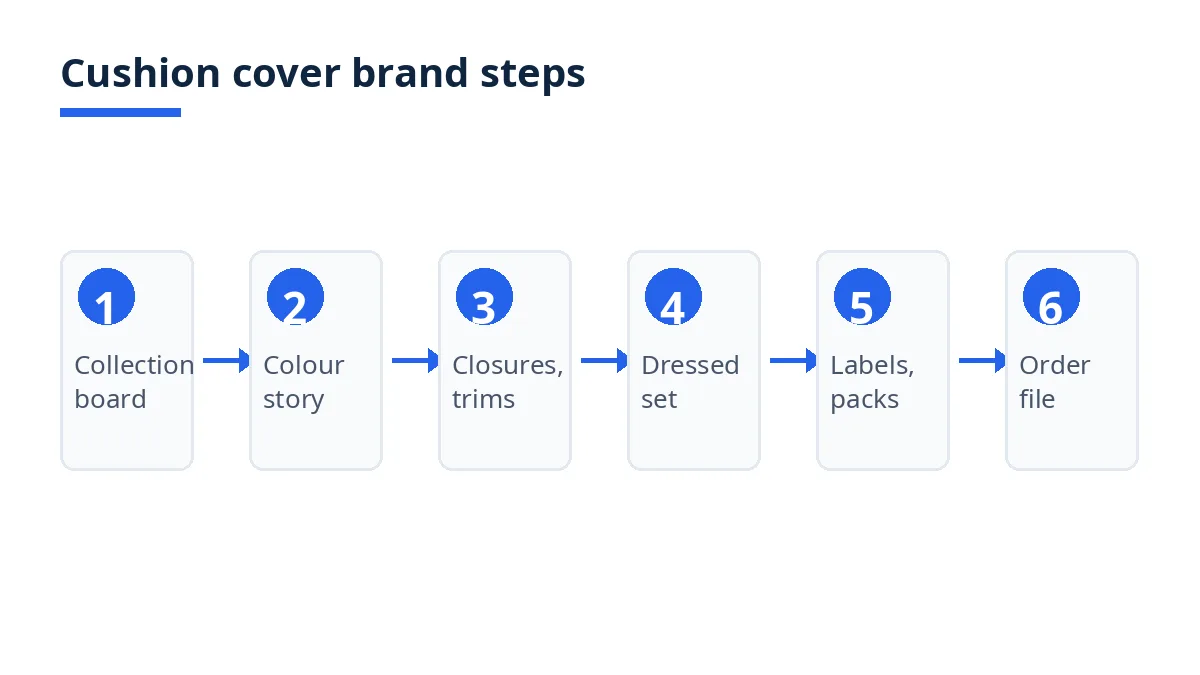
Build the collection board first. Put every design, shape, size, fabric and colourway on one board before any sample is cut. Mark which designs are sold as pairs or sets, which shapes share a colour, and which pieces must sit next to each other on a shelf or a sofa.
Lock the colour story across techniques. A colour story that spans a printed design, an embroidered design and a plain dyed cover cannot be judged from one swatch. Agree one sealed shade reference per colour, state how shade is judged and under what light, and require the printed, embroidered and dyed versions of the same colour to be judged together, against the same reference.
Fix closures, trims and the insert policy. Decide the closure type, zip or envelope style, piping, tassel or trim finish, and seam finish for the whole collection, and state where each design may differ on purpose. Decide separately whether you sell covers only or covers with inserts, and keep the two as separate order lines: a cover sold with its insert already fitted is a different article from a cover alone, and the two need separate codes, labels and packs.
Approve a dressed set, not a flat sample. Ask for the full set made up as the customer will see it: pairs together, sets together, on cushions of the agreed insert size, in the agreed pack. Judge shade, piping, closure function and trim finish on the dressed set, then judge the same set again after the covers have been washed under the agreed care instructions.
Approve labels and packs as physical proofs. Check fibre wording, care symbols, size marking, set contents and origin marking on the physical label and pack, for every design and every market.
Confirm the order file before bulk. The purchase order should carry the collection board version, the artwork version, the shade references, the closure and trim standard, the insert policy, the inspection plan and one delivery term. The Incoterms 2020 rules set out 11 rules with a clear allocation of cost, risk and obligations.1
Costs, timelines and documents
What sets the cost and the timeline
There is no typical private label cushion cover cost, because the cost follows your collection, not a generic cover. Product costs cover fabric, dyeing or printing, embroidery where used, cutting and sewing, closures and trims, and packing. Brand costs sit apart: artwork, shade standard work, label plates or printing, and branded packs. Collection-approval costs sit apart again: the dressed-set samples, the wash test of the dressed set, and the shade work across techniques.
Timelines run in stages, not as a single delivery week. Ask for separate dates for the collection board, artwork and label approval, the dressed-set sample, the wash test, bulk production, packed-goods checking and shipment.
Example figures: a first collection of four designs, each in two colourways, with a pair pack for two of the designs and a single pack for the other two, shows the structure a quotation should follow: product, brand and collection-approval lines, a per-design and per-colourway split, and a shipment split by set. These example figures show structure only, not a typical price, quantity or lead time.
Which documents sit in the order file
The order documents are the collection board, the approved artwork files, the shade references, the closure and trim standard, the insert policy, the label and pack proofs, the tolerance record, the itemised quotation and the purchase order, with the collection board version and the set split on both. The export set is separate: goods may not be loaded for export unless an export declaration, the Bill of Export or Shipping Bill, is submitted to Customs and approved, and the enclosed documents include the export contract or purchase order where there is no export letter of credit, the commercial invoice, the packing list, the EXP form certified by an authorized dealer, and a certificate of origin issued by the EPB or a Chamber of Commerce and Industry.2
Bangladesh-specific rules and tips
Code each line, not the collection. Heading 6304 covers furnishing articles excluding those of heading 9404, and its subheadings split by construction and material: knitted or crocheted articles, cotton articles not knitted or crocheted, synthetic-fibre articles not knitted or crocheted, and articles of other textile materials.3 A printed cotton cover, an embroidered synthetic cover and a knitted cover in one collection can therefore sit on different lines, and a cover sold with its insert fitted sits differently again from a cover sold alone. Keep the code per line in the order file, and confirm each line with your customs broker, because duty and import paperwork follow the line, not the collection name.
Settle labelling law for each market before artwork. In the EU, Regulation (EU) No 1007/2011 states that a textile product shall be labelled or marked with the name and percentage by weight of all constituent fibres in descending order, and that a distributor shall be considered a manufacturer for its purposes where he places a product on the market under his name or trademark.4 In the USA, federal law requires that most textile and wool products have a label that lists the fibre content, the country of origin, and the identity of the manufacturer or another business responsible for marketing or handling the product, and under the Care Labeling Rule, manufacturers and importers must provide cleaning instructions.5 Decide before sampling whether the label carries your company name or another responsible business identity, and match that decision to the name on your import documents.
Agree the care wording from the fabric, not from the catalogue. ISO 3758 provides a care labelling code using symbols, covering washing, bleaching, drying, ironing and pressing, and professional textile care.6 Base the care symbols on the washed dressed set, and keep one care standard per fabric across every design that uses it.
Judge shade as a set, in one place. Judge shade centrally, against one sealed reference per colour, with the printed, embroidered and dyed versions of that colour side by side, and record the light used and the reference version so a repeat order is judged against the same record.
Mistakes and red flags
Which mistakes repeat most often
Approving a flat sample and calling the collection approved. A flat cover proves one design only; it does not prove a pair matches, a set reads as a collection, or a zip works when the cover is filled.
Letting each design approve its own shade. Shade is approved once, per colour, across every technique that uses it, or the collection ends up with several versions of one colour.
Changing the colour story after tools are made. A colour change after embroidery files, print screens or label plates are made needs a new proof, a new price line and a new approval date.
Mixing cover-only and filled lines in one order line. One order line covering both produces one of them wrong, because the two need different codes, labels and packs.
Signing without a spare-label and exclusivity clause. State who owns the artwork, embroidery files, print screens and label artwork, whether the factory may sell your design or colourway to another buyer, and what happens to spare labels, branded packs and finished branded stock if the relationship ends.
Treating a profile or a badge as collection protection. A profile is a starting point for enquiries. Exportain verification is a document and photo review, not a factory inspection, and a badge is not a guarantee of capacity, quality or delivery.7
Red flags in a supplier reply. A reply that will not name the shade tolerance, confirm file ownership, itemise brand costs separately, accept a dressed-set approval, or explain how a repeat collection will match the first is a reply to pause on.
Checklist
Before you confirm a private label cushion cover collection, every line should be answered in writing.
Collection board recorded: every design, shape, size, fabric and colourway, with pairs and sets marked.
Colour story locked: one sealed shade reference per colour, judged across print, embroidery and dye together.
Closure and trim standard fixed: closure type, piping, trim and seam finish, with deliberate differences stated.
Insert policy decided: covers only or covers with inserts, as separate order lines with an insert size rule.
Dressed set approved: pairs and sets made up, washed under the agreed care instructions, and made up again.6
Label and pack proofs approved physically: fibre wording, care symbols, size, set contents and origin marking.4 5
Contract clauses settled: artwork and tool ownership, branded-design exclusivity, change control, spare-label handling, repeat terms and exit.
Order file holds collection board version, artwork version, shade references, tolerance record, set split and inspection plan.
Delivery term stated once, on every quotation, compared on the same term.1
Export set agreed: invoice, packing list, EXP form, certificate of origin, Bill of Export.2
Repeat rule agreed: which files, references and tolerances a repeat order reuses unchanged.
How Exportain helps
On Exportain, browse suppliers and post a request for quotation (RFQ) on the RFQ board with your collection board summary, colour story, closure and trim standard, insert policy and delivery term, so suppliers quote against the same collection and the same set split. When you accept a quotation, Exportain creates one order and issues one proforma invoice from the accepted terms.7
Exportain Verified means Exportain has checked identity, phone, email and business registration, and Export Verified means it has checked the Export Registration Certificate (ERC).7 Factory Verified means it has reviewed photos of the manufacturer factory, while Trading Company Verified means it has reviewed photos of the trading company office or warehouse.7 Verification is a document review by staff, free, and never granted by membership plans.8
FAQs
What should I know first about cushion covers?
A cushion cover brand is judged as a collection, not as single covers. A finished cover sits inside heading 6304, which covers furnishing articles excluding those of heading 9404.3
What are the typical costs and timelines?
There are no typical figures a buyer can rely on, because each factory prices your collection, colour story, brand work, dressed-set approval and delivery term for your order.1
Which documents are needed?
The order documents are the collection board, approved artwork files, shade references, closure and trim standard, insert policy, label and pack proofs, tolerance record, itemised quotation and purchase order. The export set is the Bill of Export, commercial invoice, packing list, EXP form certified by an authorized dealer, and a certificate of origin issued by the EPB or a Chamber of Commerce and Industry.2
What are the most common mistakes?
The most common mistakes are approving a flat sample instead of a dressed set, letting each design approve its own shade, changing the colour story after tools are made, mixing cover-only and filled lines in one order line, and signing without a spare-label and exclusivity clause.
Next steps on Exportain
Browse suppliers, then post your collection board summary, colour story and delivery term on the RFQ board so suppliers state their shade tolerance, file-ownership position and repeat-collection terms. Before you confirm, read how supplier verification works on Exportain and the MOQ guide for the badge meanings and the minimum-order mechanics that sit alongside this collection work.
Sources
- Incoterms® 2020. International Chamber of Commerce (ICC) (accessed )
- Customs Clearance Procedures for Export. Bangladesh Customs, National Board of Revenue (accessed )
- Classification Detail — HS Code 6304. United Nations Statistics Division (accessed )
- Regulation (EU) No 1007/2011 on textile fibre names and related labelling and marking of the fibre composition of textile products. European Union, (accessed )
- Textile, Wool, Fur, Apparel and Leather Matters. Federal Trade Commission (accessed )
- ISO 3758:2023 Textiles — Care labelling code using symbols. International Organization for Standardization (accessed )
- Trust & Safety Center. Exportain (accessed )
- Supplier verification: Earn trust badges buyers can see. Exportain (accessed )
About the author
Sourcing from Bangladesh?
Post a request for quotation and suppliers on Exportain can send you their quotes directly.
Post an RFQ


